Custom software development is one of the most significant technology investments a business can make. This guide gives you real numbers, honest context, and a clear framework for budgeting your next project.
The number one question every business asks before starting a software project is simple: how much is this going to cost? The honest answer is that it depends on a range of factors — but that answer is rarely helpful when you are trying to get board approval or decide between building custom and buying off-the-shelf.
This guide breaks down the real cost of custom software development in 2026. We cover pricing by project type, the factors that drive costs up or down, how to evaluate quotes from development agencies, and what you can do to get more value for your budget.
Whether you are planning a web application, an enterprise platform, an MVP for a startup, or a complex integration system, this breakdown applies.
Why Custom Software Costs Vary So Widely
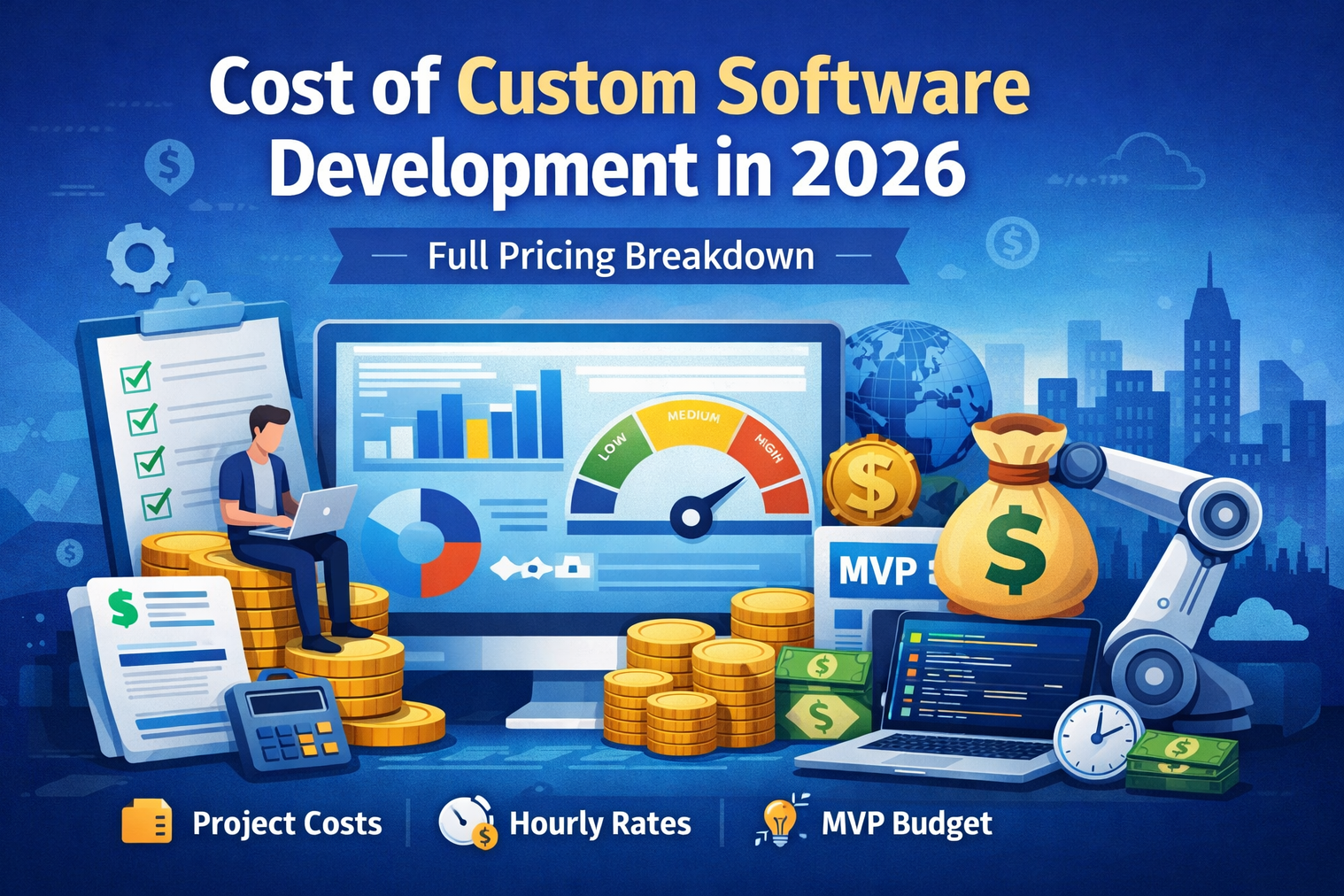
Custom software development pricing ranges from as low as $5,000 for a basic MVP to over $500,000 for an enterprise-grade platform. That enormous range is not a sign that the industry lacks transparency — it reflects genuine variation in what is being built.
The three biggest drivers of cost are:
- Scope and complexity: A five-page website with a contact form is fundamentally different from a multi-tenant SaaS platform with role-based access control, real-time data processing, and third-party API integrations.
- Team size and structure: A single freelance developer costs less per hour than a full agency team, but also delivers less capacity, less specialisation, and usually less reliability.
- Location of the development team: Hourly rates vary dramatically by geography. A senior developer in the United States or Western Europe charges $100–200 per hour. The same expertise in Eastern Europe costs $40–80 per hour, and in South Asia $20–50 per hour.
Understanding these drivers lets you make intelligent trade-offs rather than simply chasing the lowest quote.
Custom Software Development Cost by Project Type
Here is a breakdown of typical budget ranges for common project types in 2026. These are real-world ranges based on market rates, not theoretical estimates.
Simple Web Application or Internal Tool: $15,000 – $50,000
This range covers straightforward web applications — internal dashboards, workflow management tools, simple customer portals, and lightweight CRMs. The scope typically involves a single user role, limited integrations, and a relatively small data model.
Timeline: 2–4 months with a small team of 2–3 developers.
Mid-Complexity SaaS Product or Business Platform: $50,000 – $150,000
At this level you are building something with meaningful complexity — multiple user roles, a payment integration, a subscription model, third-party API connections, and a custom data model. This is where most startups building their first real product land, and also where many mid-market companies sit when digitising a core business process.
Timeline: 4–8 months with a team of 3–5 people including a project manager, 2–3 developers, and a QA engineer.
Enterprise Platform or Complex Custom Solution: $150,000 – $500,000+
Enterprise software development at this level involves high availability requirements, complex integrations with legacy systems, advanced security and compliance needs, and large teams. ERP systems, healthcare platforms requiring HIPAA compliance, financial systems with regulatory requirements, and large multi-tenant SaaS applications all fall into this bracket.
Timeline: 8–18+ months. Team size can range from 6 to 20+ people.
MVP for Startup: $20,000 – $80,000
A minimum viable product is intentionally scoped to test core assumptions with minimum investment. The goal is not a polished product — it is a functional system that demonstrates your core value proposition to early users or investors. A well-scoped MVP can be delivered in 6–12 weeks.
The most common mistake startups make is building an MVP that is too large. The discipline of cutting scope ruthlessly before development starts is where the real cost savings come from.
The Hourly Rate Question: Offshore, Nearshore, or Local?
Location is the single biggest lever you can pull on software development costs. Here is what you should expect in 2026:
United States / Canada / Western Europe
- Junior developer: $70–110 per hour
- Mid-level developer: $100–160 per hour
- Senior developer: $130–200+ per hour
Eastern Europe (Poland, Romania, Ukraine, Czech Republic)
- Junior developer: $30–50 per hour
- Mid-level developer: $45–75 per hour
- Senior developer: $65–90 per hour
South Asia (India, Pakistan, Bangladesh)
- Junior developer: $15–30 per hour
- Mid-level developer: $25–50 per hour
- Senior developer: $40–70 per hour
The key point is not which tier is cheapest — it is which tier delivers the best total cost of ownership. A cheaper developer who misunderstands requirements, delivers buggy code, or needs constant supervision often ends up costing more than a more expensive developer who moves fast and gets things right.
The real cost of software development is not the hourly rate — it is the hourly rate multiplied by the number of hours needed, plus the cost of fixing mistakes made along the way.
Fixed Price vs Time and Material: Which Contract Model Is Right?
One of the most consequential decisions you make before a project starts is the contract model. The two main options are fixed price and time-and-material, and each has significant implications for your budget predictability and the project outcome.
Fixed Price Contracts
In a fixed price engagement, you agree on a defined scope upfront and the development partner commits to delivering it for a set budget. The advantage is cost certainty. The disadvantage is that fixed price contracts require very detailed specifications before work starts — and any change to scope usually triggers expensive change requests.
Fixed price works well for: clearly defined projects with stable requirements, maintenance work, and MVPs with tight scope.
Time and Material Contracts
Time and material contracts charge you for the actual hours worked at an agreed rate. This offers maximum flexibility — you can change direction, add features, or cut scope at any point. The trade-off is that the final cost is not known upfront.
Time and material works well for: complex projects with evolving requirements, long-term development partnerships, and product development where user feedback will shape the roadmap.
For most product companies building something new, time and material with a monthly or quarterly budget cap is the most practical approach. It combines flexibility with enough financial predictability to plan ahead.
What Is Included in a Software Development Quote?
When you receive a quote from a development agency, it should include more than just coding hours. A comprehensive software development quote covers:
- Discovery and scoping: The process of turning your idea into a detailed technical specification. Usually 1–3 weeks. Some agencies charge for this; others include it in the project fee.
- UI/UX design: Wireframing, prototyping, and visual design. Often underestimated — a complex application might need 200–400 hours of design work.
- Frontend development: Building the user-facing interface.
- Backend development: Building the server, database, and business logic layer.
- Testing and QA: Manual testing, automated test writing, and bug fixing.
- DevOps and deployment: Setting up hosting infrastructure, CI/CD pipelines, and monitoring.
- Project management: Coordination, sprint planning, client communication.
- Post-launch support: Typically 30–90 days of bug fixes after launch.
If a quote only covers development hours and omits design, QA, and infrastructure, the real cost will be significantly higher than advertised. Always ask for a fully loaded estimate.
How to Get More Value From Your Software Development Budget
Budget is fixed. Scope is negotiable. Here are the most effective strategies for maximising the value you get from a fixed software development budget:
- Invest heavily in discovery: Every hour spent clarifying requirements before development starts saves three to five hours of rework. A tight specification reduces cost more than any other single factor.
- Build the MVP, not the vision: Every product feature you remove from scope reduces cost linearly. Build only what is needed to test your core hypothesis. Add features in subsequent sprints based on real user data.
- Use proven technology stacks: Custom frameworks and exotic technology choices increase cost and reduce the pool of available developers. Stick to well-supported stacks — React, Node.js, Python, PostgreSQL — unless there is a compelling reason not to.
- Choose reuse over reinvention: Use battle-tested open-source libraries, third-party services (Stripe for payments, Auth0 for authentication, Twilio for messaging), and cloud-native services wherever possible. Building these from scratch is expensive and unnecessary.
- Plan for ongoing costs: The initial build is not the total cost of ownership. Budget for hosting, monitoring tools, ongoing maintenance, and feature development after launch. A realistic year-one total cost includes 20–30% of the initial build cost for ongoing operations.
At AventisHub, we specialise in scoping projects that deliver real business value within realistic budgets. Our team can provide a no-obligation estimate for your project. Visit aventishub.com or email operations@aventishub.com to get started.