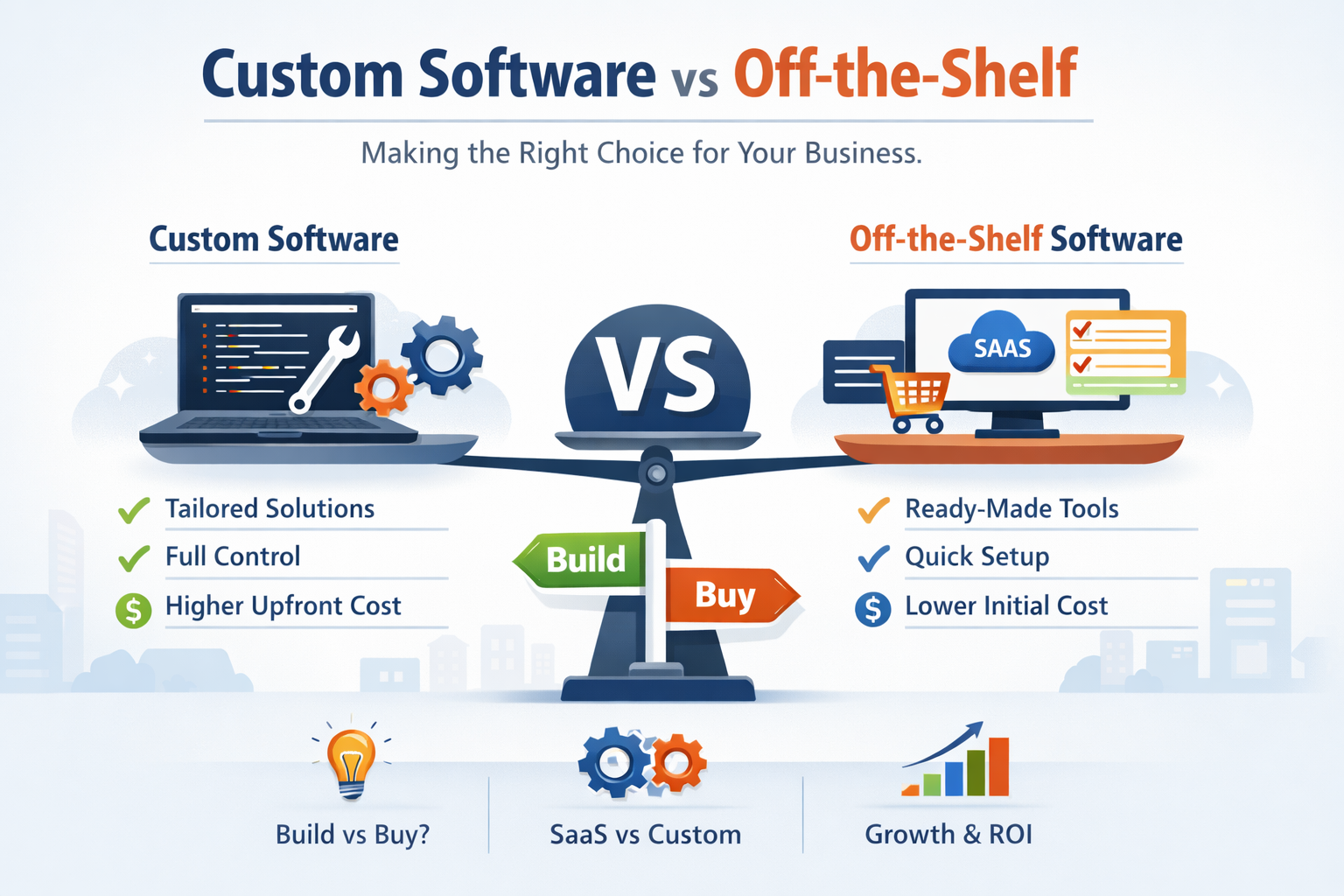
This is one of the most consequential technology decisions a growing business makes. Get it wrong and you spend years fighting your tools. Get it right and your software becomes a competitive advantage.
Every business reaches a point where spreadsheets and generic SaaS tools are no longer enough. The question becomes: do we adapt our processes to fit existing software, or do we build software that fits our processes?
Both paths are legitimate. Both have succeeded for businesses of every size and type. But the right answer depends on factors that are specific to your business — your processes, your growth trajectory, your competitive position, and your budget.
This guide gives you a clear framework for thinking through the custom software vs off-the-shelf decision. We will look at the real trade-offs, the scenarios where each approach wins, the costs involved, and the questions you should answer before committing to either path.
Understanding the Two Options
Off-the-Shelf Software
Off-the-shelf software — also called commercial off-the-shelf (COTS) or packaged software — is built for a broad market. Salesforce serves thousands of sales teams. QuickBooks serves hundreds of thousands of businesses. Shopify powers millions of online stores. These products are designed to handle common use cases well, and they rely on network effects and large user bases to fund continuous improvement.
The appeal is obvious: fast deployment, lower upfront cost, no development risk, and the backing of a well-resourced company that will maintain and improve the product over time.
Custom Software
Custom software is built specifically for your business — your workflows, your data model, your user roles, your integration requirements. It does exactly what you need it to do, because it was designed around your specific processes rather than the average of thousands of customers’ processes.
Custom software development takes longer and costs more upfront than buying an existing product. But it can deliver capabilities that no off-the-shelf product offers, integrate seamlessly with your existing systems, and become a genuine competitive advantage that competitors cannot easily replicate.
The Real Trade-offs
The custom vs off-the-shelf debate is often framed as cost vs capability. That is a simplification. The real trade-offs are more nuanced:
Time to Deployment
Off-the-shelf software wins decisively on speed. Many SaaS products can be operational within hours of signing up. Custom software development takes months — typically 3–9 months for a mid-complexity system. If speed of deployment is your primary concern, off-the-shelf is the right choice.
However, consider that ‘deployed’ and ‘fully operational’ are different things. Many businesses spend 6–18 months configuring, customising, and integrating off-the-shelf products before they are genuinely serving the original use case. This hidden implementation timeline often closes the gap with custom development more than expected.
Total Cost of Ownership
Off-the-shelf software has lower upfront cost but ongoing subscription fees that compound over time. A $500 per month SaaS product costs $6,000 per year — and $60,000 over ten years, not accounting for price increases. Many enterprise SaaS products charge $50,000 to $500,000 per year once you hit certain user or feature tiers.
Custom software has higher upfront cost — typically $50,000 to $500,000 depending on complexity — but much lower ongoing cost. Once built, the primary ongoing expenses are hosting, maintenance, and updates. For systems with a long lifespan, the total cost of ownership of custom software often ends up lower than the cumulative subscription costs of commercial alternatives.
The total cost of ownership calculation over 5–10 years frequently favours custom software for businesses with complex needs. Do the maths for your specific situation before assuming off-the-shelf is cheaper.
Fit to Your Business Processes
This is where custom software wins most decisively. Off-the-shelf products are designed around the average use case. If your processes are standard, this is fine. If your processes are distinctive — because they represent your competitive advantage, or because your industry has unusual requirements — forcing them into generic software creates real operational pain.
Every workaround, every manual data export, every ‘almost but not quite’ compromise with a packaged product has a cost. That cost is often diffuse and invisible on any given day, but it accumulates into lost productivity, frustrated employees, and eventually customers who notice that your operations are slower or less precise than they should be.
Scalability and Long-term Flexibility
Off-the-shelf products are designed to scale, but they scale along dimensions the vendor has anticipated. If your growth trajectory diverges from the typical customer — unusual transaction volumes, non-standard data structures, unique workflow requirements — you may find the product becoming a ceiling rather than a foundation.
Custom software scales exactly as your business scales, because you control the architecture. If you need to add 50 new user types, build a mobile app for field workers, or integrate with a new piece of machinery, you can do that. You are not waiting for a vendor roadmap.
When Off-the-Shelf Software Is the Right Answer
There are situations where buying an existing product is clearly the right decision. Choosing off-the-shelf makes sense when:
- Your needs match a well-served market: Accounting, CRM for a standard sales process, project management, HR management, email marketing — these categories have excellent products that serve most businesses well. Building custom alternatives is almost never justified.
- Speed is your primary constraint: If you need a solution operational in weeks, not months, off-the-shelf wins on timeline. This is particularly true for early-stage startups that need basic infrastructure to operate while they focus on their core product.
- Your process is still evolving: If you do not yet understand what your optimal process looks like, building custom software to support it is premature. Use off-the-shelf tools to operate while you develop clarity, then build custom software around the process once it is proven.
- The capability gap is small: If off-the-shelf software meets 90% of your needs and the remaining 10% can be handled with a simple integration or workaround, the investment in custom development may not be justified.
When Custom Software Is the Right Answer
Custom software development is the right choice in specific circumstances where its unique advantages create real business value:
Your Process Is Your Competitive Advantage
If the way you operate is genuinely different from competitors — if your process is the reason customers choose you over alternatives — then that process needs software that reflects its specifics, not software designed around the average competitor.
A logistics company that has developed a proprietary routing algorithm cannot express that algorithm in standard fleet management software. A financial services firm with a unique risk assessment model cannot run that model in off-the-shelf compliance software. In these cases, the software is not supporting the business — it is the business. Custom development is the only option.
Integration Complexity Makes Off-the-Shelf Impractical
Many businesses reach a point where they are running 10, 15, or 20 different SaaS tools, with data fragmented across all of them. Integrations between tools are brittle, require constant maintenance, and never quite work the way you need them to.
When integration complexity crosses a threshold, a unified custom platform that replaces multiple point solutions often delivers better outcomes than continuing to add tools and integrations. The custom system becomes the single source of truth for your operations.
Regulatory or Security Requirements Cannot Be Met by Generic Products
Some industries have requirements that generic software vendors cannot or will not meet. Custom healthcare software can be built to your specific HIPAA compliance architecture. Custom financial software can implement your specific regulatory controls. Custom software for a government contractor can meet data residency and security classification requirements that no public cloud SaaS product can satisfy.
You Are Building a Software Product, Not Supporting Internal Operations
If your business model involves delivering software to customers — if the software is the product you sell — then by definition it must be custom. No off-the-shelf product can be your product. This applies to SaaS companies, platform businesses, and any organisation where the software is the core value proposition.
A Decision Framework: Five Questions to Answer
Rather than making this decision based on gut instinct, use these five questions to structure your thinking:
- Does an off-the-shelf product genuinely serve your use case? Not approximately, not with workarounds — but genuinely. If the answer is yes, use it.
- What is the 5-year total cost of each option? Include subscription fees with realistic price increase assumptions, implementation and customisation costs, maintenance costs, and the opportunity cost of a poor-fit tool.
- How distinctive is your process? The more your process differentiates your business, the stronger the case for custom software that mirrors it precisely.
- How fast is your business changing? Rapidly evolving businesses often struggle with custom software because it takes time to build changes. Stable, well-understood processes are a better fit for custom development.
- Do you have the capability to manage a software development project? Custom software requires ongoing engagement with a development partner, clear communication of requirements, and the ability to make product decisions. If you lack these capabilities today, develop them before committing to custom development.
Most businesses find that the answer is not binary. A common practical approach: use best-in-class off-the-shelf tools for standard business functions (email, accounting, HR), and invest in custom software for the specific capabilities that are central to your competitive position.
The best software strategy is not all custom or all off-the-shelf. It is choosing the right tool for each function, and investing in custom development exactly where it creates differentiated value.
How to Choose a Custom Software Development Partner
If you decide that custom software is the right path, choosing the right development partner is as important as making the decision itself. Here is what to look for:
- A discovery process that starts with business problems, not technology solutions: The first conversation with a good development partner should be about your business, your users, and your goals — not about which framework or cloud provider they prefer.
- Experience with similar projects: Have they built systems of similar complexity in your industry? Can they show you examples? What happened when those projects ran into problems?
- Transparent project management: How do they communicate progress? How do you see work in progress? What happens when scope changes? Clear answers to these questions predict a smooth project.
- Realistic timelines and budgets: Be sceptical of unrealistically low estimates. Experienced developers know that complex systems take time to build well. A suspiciously low quote usually means scope has been misunderstood or corners will be cut.
- Post-launch support: Building the software is not the end of the engagement. Who handles bugs after launch? Who implements updates? What does the ongoing relationship look like?
The best development partnerships are long-term relationships built on trust and clear communication, not one-time transactions. Choose a partner you can work with for years, not just for the initial build.
AventisHub has helped businesses across multiple industries make this exact decision — and build the custom software that drives their competitive advantage. Talk to our team at aventishub.com to explore your options.