
The software industry is being reshaped faster than at any point in its history. Artificial intelligence is no longer a feature — it is the foundation. Here is what is driving that shift in 2026. If you asked a software engineer in 2022 whether they would be using AI to write, review, and deploy code within three years, most would have called it optimistic. Today, it is standard practice. The pace of change in AI tools for software development has outstripped nearly every forecast, and 2026 is proving to be the year where experimentation becomes institutional adoption. Whether you run a startup, lead a product team, or manage an enterprise IT budget, understanding the real AI trends shaping software development in 2026 is not optional. It directly affects how quickly you can ship, how much it costs to build, and whether your competitors are moving faster than you. This post breaks down the seven most important AI trends in software development right now, what they mean for your business, and where to focus your attention. 1. Agentic AI: Software That Builds and Deploys Itself The biggest shift happening in 2026 is the move from AI assistants to AI agents. An AI assistant responds to a single prompt. An AI agent pursues a multi-step goal — independently browsing the web, writing code, running tests, and deploying changes — without needing to be prompted at every step. In software development, this means AI agent development services are replacing entire workflow categories. Agents are being used to handle code refactoring, dependency updates, bug triage, and even sprint planning. Tools like Devin, GitHub Copilot Workspace, and custom-built agents powered by Claude and GPT-4 are already running inside engineering pipelines at mid-size and enterprise companies. What this means for your business: if your team is still treating AI as a code completion tool, you are behind. The companies gaining ground are deploying agents that handle entire subtasks autonomously, freeing engineers to focus on architecture and business logic. Key action: Evaluate where autonomous AI agents could handle repeatable engineering tasks in your current workflow — dependency management, test writing, and documentation are the fastest wins. 2. Generative AI Moves from Prototypes to Production In 2024 and early 2025, most businesses experimented with generative AI through pilots and proofs of concept. In 2026, that experimentation phase is ending. Generative AI development services are now focused on production-grade systems — reliable, monitored, and integrated deeply into business processes. The most common production use cases include AI-powered customer service chatbots, intelligent document processing, automated code generation pipelines, and personalised user experiences. Critically, these are no longer built on raw API calls to a single LLM. They are sophisticated architectures involving retrieval-augmented generation (RAG), fine-tuned models, vector databases, and multi-agent orchestration. The companies that made the jump from pilot to production share a few characteristics: they invested in proper data infrastructure, they built evaluation frameworks to measure AI output quality, and they treated AI as a software engineering problem — not a data science experiment. The practical outcome is that generative AI development services are no longer a niche offering. Every software company needs a clear answer to the question: how does our product use AI, and how does that create value for the customer? 3. LLM Integration Becomes a Core Engineering Skill Large language model integration is now a standard part of the software engineering toolkit. LLM integration services that were specialist offerings two years ago are now baseline expectations. Engineers who cannot integrate OpenAI, Anthropic Claude, or Google Gemini APIs into a product are increasingly considered behind the curve. More importantly, the integration patterns are maturing. Rather than direct API calls, modern LLM integration involves prompt management layers, semantic caching, model routing (directing different queries to different models based on cost and capability), and robust evaluation pipelines to catch regressions when models update. Businesses that build on top of foundation models rather than building their own are winning on speed. The key differentiator is not which LLM you use — it is how well you engineer the layer between the model and your user. The Rise of Multi-Model Architectures One of the more sophisticated trends in 2026 is multi-model orchestration. Rather than relying on a single LLM, production systems increasingly route tasks to the most appropriate model. A reasoning-heavy task might go to Claude 3.7 Opus, a high-volume summarisation task to a faster, cheaper model, and an image-based task to a vision model. This reduces cost while improving quality. 4. AI-Powered Testing and Quality Assurance Testing has historically been one of the most time-consuming parts of software development. In 2026, AI is dramatically accelerating it. AI-driven software testing tools can now generate test cases automatically from requirements documents, identify untested code paths, and even predict which areas of a codebase are most likely to contain bugs based on historical data. Companies using AI-powered QA testing services are reporting meaningful reductions in the time spent writing and maintaining tests. More importantly, AI-generated tests often catch edge cases that human engineers miss — particularly around data validation, error handling, and concurrency. The shift toward shift-left testing (finding bugs earlier in the development cycle) is being accelerated by AI. When a developer can ask an AI agent to generate a full test suite for a new function before it is even merged, the quality bar at the pull request stage rises significantly. 5. Platform Engineering Powered by AI Platform engineering — the practice of building internal developer platforms that abstract away infrastructure complexity — is being transformed by AI. In 2026, platform engineering services increasingly include AI-powered developer portals that can provision infrastructure, generate boilerplate, suggest architecture patterns, and auto-remediate failing deployments. This is accelerating the ‘golden path’ concept in DevOps: a pre-approved, opinionated set of tools and workflows that lets engineers ship code quickly without worrying about the underlying plumbing. AI makes that path smarter, adapting recommendations based on the specific codebase and team patterns. The practical impact: companies
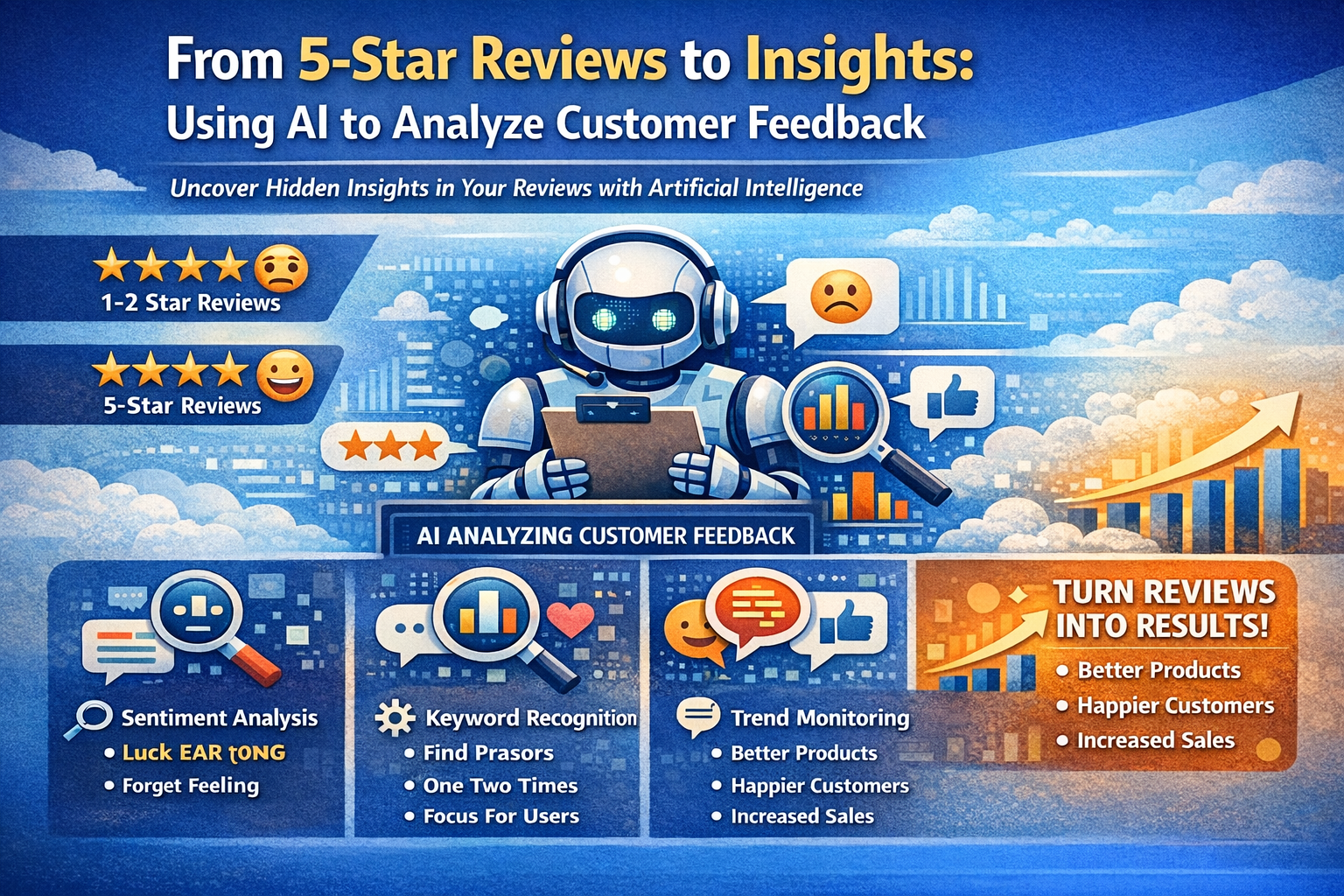
From 5-Star Reviews to Insights: Using AI to Analyze Customer Feedback
Overview Every company loves 5-star reviews. ⭐⭐⭐⭐⭐ They make your brand look strong and trusted. But what about 1-star, 2-star, and 3-star reviews? Inside those reviews are powerful lessons. Customers tell you what they like, what they dislike, and what they wish was better. The problem is simple: When you have hundreds or thousands of reviews, reading each one takes too much time. This is where Artificial Intelligence (AI) helps. AI can read, sort, and understand customer feedback very fast. It turns long lists of comments into clear and useful insights. In this blog, you will learn how AI helps businesses understand customer feedback—and how custom software solutions make this process even more powerful. Why Customer Feedback Is Important Customer feedback is like a report card for your business. It tells you: If you ignore feedback, you miss chances to grow. When you study feedback the right way, you can: Listening to customers is not optional. It is necessary for success. The Problem with Manual Review Analysis Many companies still read reviews by hand. This creates problems: Imagine reading 10,000 reviews. It could take weeks. Even then, you might miss hidden trends. Businesses need a faster and smarter solution. How AI Analyzes Customer Feedback AI works like a super-fast reader. It can scan thousands of reviews in minutes. Here’s what it can do: 1. Sentiment Analysis AI understands emotions in text. It shows whether feedback is: This helps you quickly see how customers feel about your product or service. 2. Keyword Recognition AI finds common words and phrases. For example: You can clearly see repeated problems and strong points. 3. Trend Monitoring AI tracks feedback over time. You can see: This helps leaders make better decisions. 4. Intelligent Classification AI groups feedback into categories like: This makes reports simple and easy to understand. Real Business Benefits of AI Feedback Analysis When companies use AI to study reviews, they see real results. Faster Decisions Managers do not wait weeks for reports. Insights are ready in minutes. Better Products If many users complain about one feature, you can fix it quickly. Improved Customer Experience When customers feel heard, they stay loyal. Higher Revenue Happy customers buy more. They also leave better reviews. Why Custom Software Solutions Matter Every organization is different. A small startup does not need the same system as a large enterprise. That is why custom software development is important. Custom AI feedback tools can: Instead of using a basic tool, you get a system built just for your business goals. From Reviews to Real Action Let’s look at a simple example. A company sells an online service. AI studies 5,000 reviews and finds: Now the company knows exactly what to fix. They improve delivery speed and simplify checkout. After a few months, ratings increase and customer satisfaction grow This is how businesses move from reviews to real improvement. The Future of AI in Customer Feedback AI will become even smarter. In the future, it will: Companies that use AI today will lead tomorrow. Ready to Turn Reviews into Business Growth? Your customer reviews are full of valuable information. But without the right tools, you cannot unlock their true power. 👉 Want to turn feedback into smart decisions? Let our team build a custom AI-powered solution for your organization. 👉 Looking to improve products and boost customer satisfaction? Partner with us for tailored software development that fits your needs. 👉 Contact us today and start transforming reviews into real results. Conclusion 5-star reviews are wonderful. But real growth comes from understanding all feedback. AI helps businesses move beyond ratings and discover deep insights. When combined with custom software solutions, AI becomes a powerful tool for smarter decisions, better products, and long-term success. Your customers are already sharing their thoughts. Now is the time to listen, learn, and grow.