Introduction: The Technology Everyone Is Talking About
Generative AI is no longer a futuristic concept reserved for research labs — it is actively reshaping how businesses operate, compete, and grow. From automating customer support to generating marketing copy in seconds, generative AI development services are opening doors that previously required armies of specialists.
But what exactly is generative AI? And more importantly, what does it mean for your business? This guide cuts through the jargon to give you a plain-English explanation, backed by real-world use cases that show exactly how companies are putting this technology to work.
What Is Generative AI?
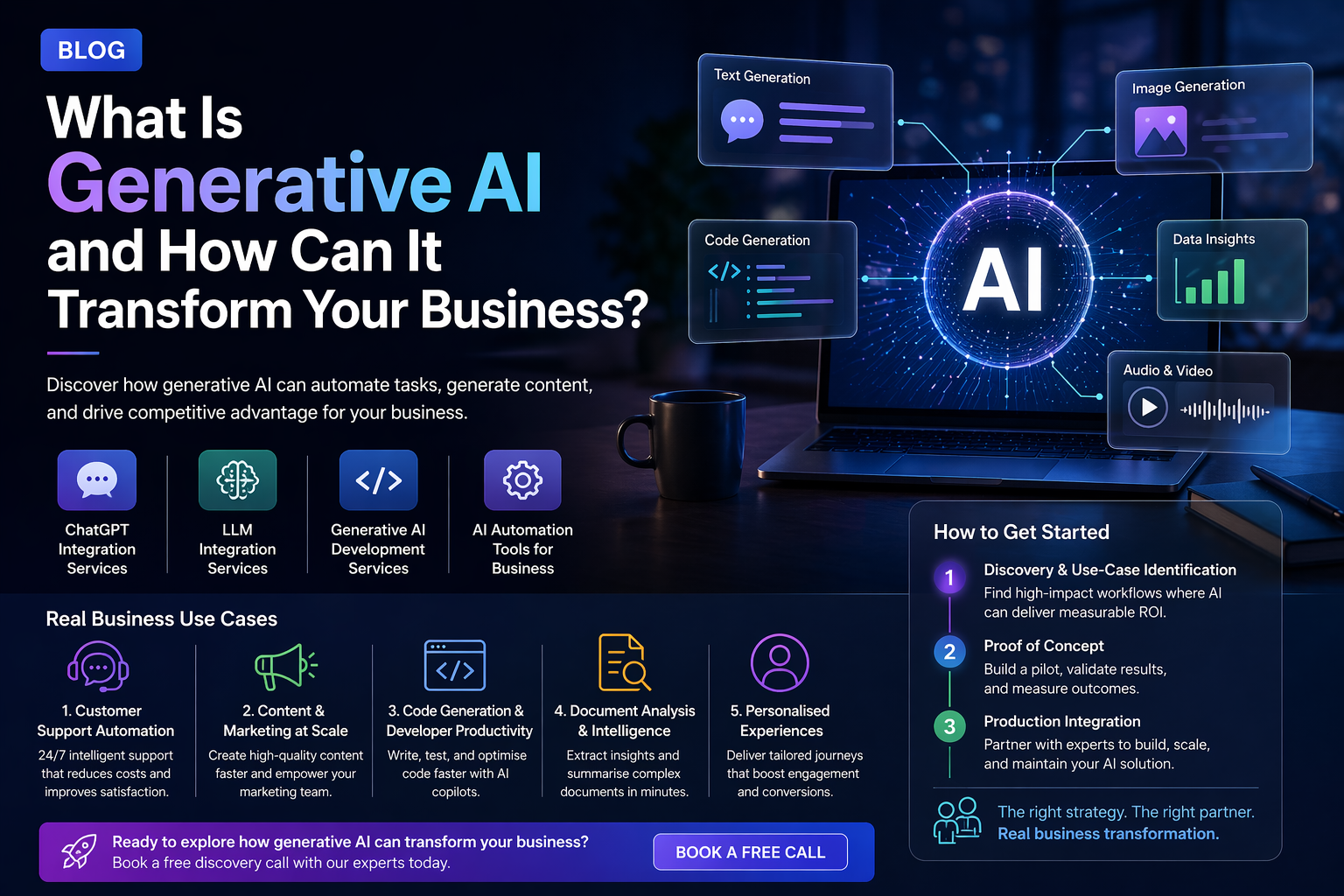
Generative AI refers to a category of artificial intelligence models that can create new content — text, images, audio, video, code, and more — based on patterns learned from vast amounts of training data. Unlike traditional AI, which is built to classify or predict, generative AI produces original outputs.
At the heart of most modern generative AI systems are Large Language Models (LLMs) — neural networks trained on billions of text examples. When you type a prompt into a tool like ChatGPT, the model predicts and generates a coherent, contextually relevant response.
Key technologies powering the generative AI revolution include:
- Large Language Models (LLMs) such as GPT-4, Claude, and Gemini
- Diffusion models for image generation (Midjourney, DALL·E, Stable Diffusion)
- Multimodal models that process and generate text, images, and audio simultaneously
- Retrieval-Augmented Generation (RAG) for grounding AI in your company’s own data
How Is Generative AI Different from Traditional AI?
Traditional AI systems are typically trained for one narrow task — spam detection, image classification, or product recommendations. They cannot go outside their training scope. Generative AI, by contrast, is flexible: the same base model can write code, summarize a legal document, or draft a sales email — all depending on the prompt you provide.
This flexibility is what makes generative AI development services so powerful for businesses. Rather than building a bespoke model for every task, you can integrate a single AI foundation and customise it for dozens of workflows.
Real Business Use Cases for Generative AI
1. Customer Support Automation
Companies are deploying ChatGPT integration services to build intelligent support agents that handle tier-1 queries 24/7. These agents understand context, maintain conversation history, and escalate complex cases to human agents — dramatically reducing support costs while improving response times.
2. Content and Marketing at Scale
Marketing teams are using AI automation tools for business to generate first drafts of blog posts, product descriptions, social media copy, and email campaigns. A workflow that once took days now takes hours, freeing creative teams to focus on strategy and refinement.
3. Code Generation and Developer Productivity
Engineering teams are integrating LLMs directly into their development environments. AI copilots can write boilerplate code, generate unit tests, explain legacy codebases, and suggest bug fixes — resulting in measured productivity gains of 30–50% on repetitive tasks.
4. Document Analysis and Intelligence
Law firms, financial services companies, and healthcare providers are using generative AI to extract insights from dense documents. Contracts, regulatory filings, clinical notes — AI can read, summarise, and flag key clauses in minutes rather than hours.
5. Personalised Product Experiences
E-commerce and SaaS companies are building personalisation engines powered by generative AI. Dynamic product recommendations, personalised onboarding flows, and tailored email sequences are all now achievable with LLM integration services.
The Business Case: Why Act Now?
The competitive advantage of early AI adoption is significant and measurable. McKinsey estimates that generative AI could add between $2.6 trillion and $4.4 trillion annually to the global economy. Businesses that integrate AI into their operations now will build compounding advantages in speed, cost efficiency, and customer experience.
For businesses that delay, the risk is not just missing efficiency gains — it is falling behind competitors who are already deploying AI at scale.
How to Get Started with Generative AI for Your Business
The most effective path to generative AI adoption follows three stages:
- Discovery and use-case identification: Map your highest-impact workflows where AI can deliver measurable ROI
- Proof of concept: Build a small-scale pilot using a relevant LLM or AI platform, validate results, and measure outcomes
- Production integration: Partner with a generative AI development services provider to build, scale, and maintain your AI solution
A critical decision at this stage is whether to use an off-the-shelf model, fine-tune an existing one, or implement RAG to ground responses in your proprietary data. Each approach has distinct cost and performance trade-offs — a topic we cover in depth in our guide on RAG vs Fine-Tuning.
Common Questions About Generative AI for Business
Is my data safe with generative AI?
When deployed correctly — using private model instances, enterprise APIs, or on-premise solutions — your data does not train public models. Security and data governance are critical considerations in any AI implementation, and reputable AI development partners will prioritise these from day one.
How much does generative AI implementation cost?
Costs vary widely depending on your use case, the model you select, and whether you require custom development. A simple ChatGPT integration can be operational within days at minimal cost, while a fully custom AI platform may require weeks of development. We recommend starting with a scoped discovery phase to define requirements and estimate accurately.
Do we need an AI team in-house?
Not necessarily. Many businesses partner with AI development companies to access the expertise they need without building an in-house team from scratch. A hybrid approach — internal product ownership combined with external AI engineering — is often the most cost-effective starting point.
💡 Ready to explore how generative AI could transform your business? Our team specialises in generative AI development services tailored to your industry. Book a free discovery call today.
Conclusion
Generative AI is not a technology trend to monitor from the sidelines — it is a fundamental shift in how work gets done. Whether your goal is to reduce operational costs, accelerate product development, or deliver better customer experiences, generative AI offers a viable and increasingly accessible path forward.
The businesses winning with AI today are not necessarily the largest or most technical — they are the ones who started with a clear use case, validated quickly, and scaled with the right partners.