
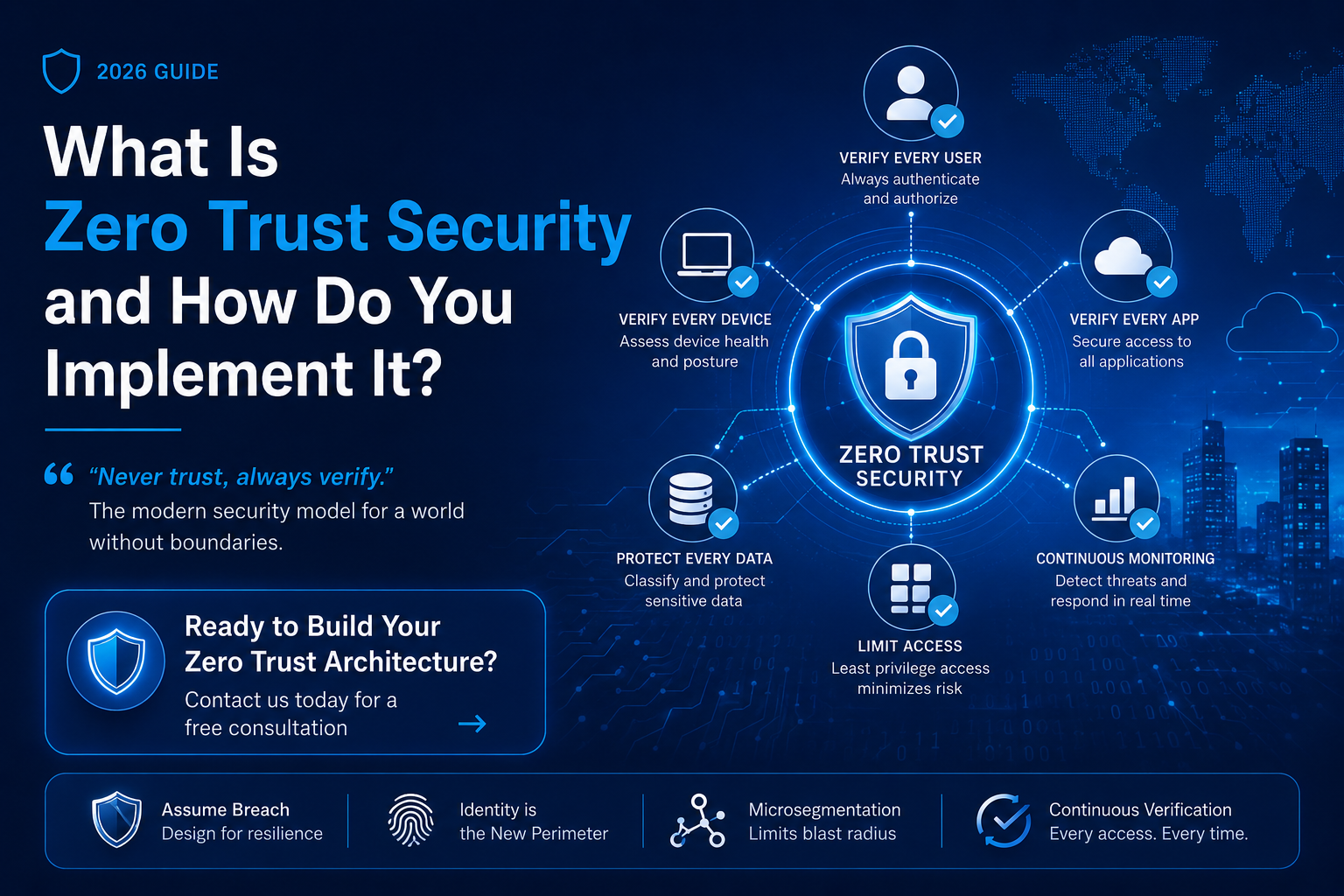
| “Never trust, always verify.” This is the founding principle of zero trust security — and it may be the most important architectural shift in enterprise cybersecurity of the past decade. |
For decades, corporate networks operated on a castle-and-moat model: build a strong perimeter, and everything inside is trusted. That model worked when employees sat in one office and applications ran on local servers. Today, with remote workers, SaaS applications, cloud infrastructure, and contractor access scattered across dozens of environments, the perimeter is effectively gone. Zero trust security was built for this reality.
What Is Zero Trust Security?
Zero trust security is an architectural model that treats every access request — regardless of where it originates — as potentially hostile. No user, device, or system receives automatic trust based on network location. Every access request must be continuously authenticated, authorized, and validated before access is granted.
The concept was formally articulated by Forrester Research analyst John Kindervag in 2010, and has since been endorsed by CISA’s Zero Trust Maturity Model, NIST SP 800-207, and the US Executive Order on Improving the Nation’s Cybersecurity (2021).
The Core Principles of Zero Trust
| Principle | Description |
| Never Trust Implicitly | No user or device is trusted by default — inside or outside the network. Every request must be verified. |
| Always Verify Explicitly | Authentication and authorization use all available data points: identity, location, device health, service, workload, and data classification. |
| Least Privilege Access | Users, systems, and applications receive only the minimum permissions needed for the task at hand — nothing more. |
| Assume Breach | Design and operate under the assumption that attackers may already be inside. Minimize blast radius through segmentation and monitoring. |
Zero Trust vs Traditional Perimeter Security
| Traditional Perimeter Security | Zero Trust Security |
| Trust anything inside the network | Verify every request regardless of origin |
| Binary access: inside = trusted, outside = blocked | Contextual, continuous, risk-based access decisions |
| Broad network access once authenticated | Granular, least-privilege access per resource |
| Static security policies | Dynamic policies that adapt to device/user context |
| Perimeter firewall as primary control | Identity is the new perimeter |
| Limited lateral movement detection | Microsegmentation limits blast radius |
How to Implement Zero Trust Security: A Step-by-Step Roadmap
Implementing zero trust security is a journey that organizations pursue incrementally. Professional cybersecurity consulting services are valuable because zero trust touches every layer of your environment. Here is a practical roadmap:
1. Define Your Protect Surface — Identify crown-jewel data, critical applications, essential services, and key infrastructure. Unlike the attack surface (which is infinite), the protect surface is finite and manageable.
2. Map Transaction Flows — Understand how data moves across your environment: how users, applications, and systems interact with protected resources.
3. Architect Your Zero Trust Environment — Deploy a next-generation firewall or ZTNA solution around the protect surface, enforce micro-segmentation, and route all traffic through policy enforcement points.
4. Strengthen Identity and Access Management — Implement strong MFA, deploy identity and access management services (IAM) including PAM, and establish continuous identity verification.
5. Create Zero Trust Policies — Define granular access policies based on user identity, device posture, location, time of day, and resource sensitivity.
6. Monitor, Log, and Continuously Improve — Deploy a SIEM and behavioral analytics to detect anomalies. Log all traffic crossing policy enforcement points and continuously refine policies.
Zero Trust and DevSecOps
Modern software delivery pipelines are themselves an attack vector. DevSecOps — the integration of security into every stage of the development lifecycle — is the application of zero trust principles to your software supply chain. In practice: enforce strong authentication within your CI/CD pipeline, scan infrastructure-as-code before deployment, sign artifacts throughout the build process, and integrate automated security testing at every pipeline stage.
Frequently Asked Questions
Is zero trust security a product you can buy?
No. Zero trust is an architectural philosophy and strategy, not a single product. Many vendors sell products that support zero trust implementation — ZTNA solutions, identity platforms, microsegmentation tools — but none of them alone constitutes zero trust. Achieving zero trust requires strategic planning, cybersecurity consulting services, and a phased implementation across identity, devices, networks, applications, and data.
How long does it take to implement zero trust?
A full zero trust transformation typically unfolds over 2-4 years for enterprise organizations. However, high-impact quick wins — enforcing MFA, deploying identity and access management services, and segmenting your highest-risk systems — can be achieved within weeks or months and deliver substantial risk reduction immediately.
What is the relationship between zero trust and cloud security?
Zero trust is particularly well-suited to cloud environments, where the traditional network perimeter does not exist. Cloud-native implementations use identity as the primary security control, replace legacy VPNs with ZTNA, and enforce policy at the application and data layer rather than the network layer.
| 📣 Ready to Build Your Zero Trust Architecture?Our cybersecurity consulting services help organizations design and implement zero trust security frameworks tailored to their environment, risk profile, and compliance requirements — no generic templates.→ Contact us today for a free consultation |