
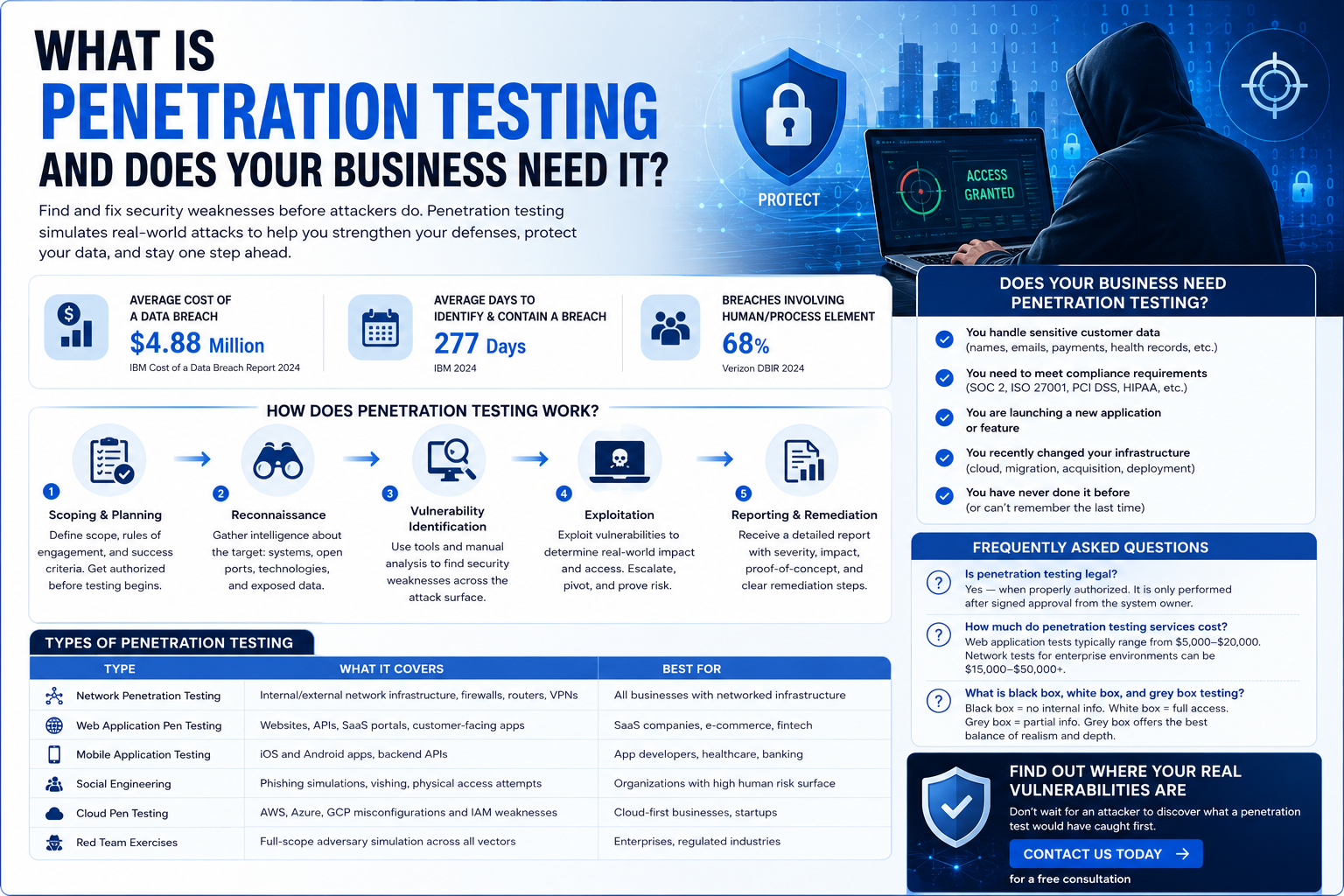
Every day, thousands of businesses quietly lose sensitive data — not because they lacked antivirus software or firewalls, but because nobody ever tested whether those defenses actually worked under real-world attack conditions. That is precisely the problem penetration testing solves. If you have never heard the term before, or you are wondering whether your company truly needs it, this guide breaks everything down in plain language.
| Statistic | Figure | Source |
| Average cost of a data breach | $4.88 Million | IBM Cost of a Data Breach Report 2024 |
| Average days to identify & contain a breach | 277 Days | IBM 2024 |
| Breaches involving human/process element | 68% | Verizon DBIR 2024 |
What Is Penetration Testing?
Penetration testing — commonly shortened to pen testing — is a structured, authorized simulation of a cyberattack against your own systems, networks, or applications. A team of security professionals (called ethical hackers) attempts to exploit real vulnerabilities in your environment, exactly the way a malicious attacker would, but with your full permission and a controlled scope.
The goal is not to cause damage. The goal is to find every crack in your defenses before a criminal does, so you can close those gaps before they become headlines. Think of it as a fire drill — except instead of evacuating a building, you are discovering that three of your fire exits were secretly locked from the outside.
| Key distinction: Penetration testing is not the same as a vulnerability scan. A vulnerability scan is automated software that flags known weaknesses. Penetration testing involves human experts who chain multiple weaknesses together, pivot across systems, and prove exploitability — the way actual threat actors operate. |
How Does Penetration Testing Work?
Professional penetration testing services follow a repeatable, standards-based methodology. Most engagements follow these five core phases:
1. Scoping & Planning — The client and testing team define what systems are in scope, rules of engagement, and success criteria. Legal authorization documents are signed before any testing begins.
2. Reconnaissance — Testers gather intelligence about the target: open ports, software versions, employee email formats, and exposed credentials in public data leaks.
3. Vulnerability Identification — Using both automated tools and manual analysis, the team identifies security weaknesses across the attack surface.
4. Exploitation — Identified vulnerabilities are actively exploited to determine real-world impact. Can a tester escalate privileges? Access sensitive databases? Move laterally to other systems?
5. Reporting & Remediation Guidance — Every finding is documented with severity ratings, proof-of-concept evidence, business impact analysis, and actionable remediation steps.
Types of Penetration Testing
| Type | What It Covers | Best For |
| Network Penetration Testing | Internal/external network infrastructure, firewalls, routers, VPNs | All businesses with networked infrastructure |
| Web Application Pen Testing | Websites, APIs, SaaS portals, customer-facing apps | SaaS companies, e-commerce, fintech |
| Mobile Application Testing | iOS and Android apps, backend APIs | App developers, healthcare, banking |
| Social Engineering | Phishing simulations, vishing, physical access attempts | Organizations with high human risk surface |
| Cloud Pen Testing | AWS, Azure, GCP misconfigurations and IAM weaknesses | Cloud-first businesses, startups |
| Red Team Exercises | Full-scope adversary simulation across all vectors | Enterprises, regulated industries |
Penetration Testing vs Vulnerability Assessment
A vulnerability assessment uses automated scanners to identify and list known weaknesses. It is broad, fast, and relatively low-cost. It tells you what might be exploitable. Penetration testing goes further — a skilled human tester chains vulnerabilities together, demonstrates real exploit paths, and proves what an attacker could actually do. It tells you what is exploitable and what the real business impact would be.
Both have value. The most mature security programs use VAPT services — combining vulnerability assessments for continuous monitoring with penetration testing for deep, periodic validation.
Does Your Business Actually Need Penetration Testing?
The honest answer: most businesses with any kind of digital presence, customer data, or regulated information should be conducting penetration testing at least annually. Here are the clearest signals that you need it now:
- • You handle sensitive customer data — names, emails, payment information, health records, or credentials.
- • You are preparing for compliance certification — SOC 2, ISO 27001, PCI DSS, and HIPAA all require or strongly recommend regular penetration testing.
- • You are launching a new application and want to catch critical flaws before real users encounter them.
- • You recently changed your infrastructure — cloud migrations, acquisitions, or major software deployments each introduce new attack surface.
- • You have never done it before — if you cannot remember the last time a qualified third party tried to break into your systems, that alone is sufficient reason.
How Often Should You Run Penetration Tests?
Industry guidance from NIST SP 800-115 recommends conducting penetration testing at minimum once per year. Higher-risk environments — fintech, healthcare, SaaS platforms with enterprise customers — typically benefit from semi-annual or quarterly testing cycles.
Frequently Asked Questions
Is penetration testing legal?
Yes — when properly authorized. Penetration testing is only performed after signed authorization from the system owner. Unauthorized testing is illegal under computer fraud laws in most jurisdictions.
How much do penetration testing services cost?
Web application tests typically range from $5,000–$20,000. Network penetration tests for enterprise environments can run $15,000–$50,000+. Compare that to the average $4.88M cost of a breach.
What is the difference between black box, white box, and grey box testing?
Black box testing gives the tester no internal information. White box provides full source code and architecture access. Grey box is a hybrid with limited internal context — most modern engagements use grey box for the best balance of realism and depth.
| 📣 Find Out Where Your Real Vulnerabilities AreDon’t wait for an attacker to discover what a penetration test would have caught first. Book a scoped consultation with our certified ethical hacking team and get a clear picture of your actual risk exposure — before it costs you.→ Contact us today for a free consultation |