
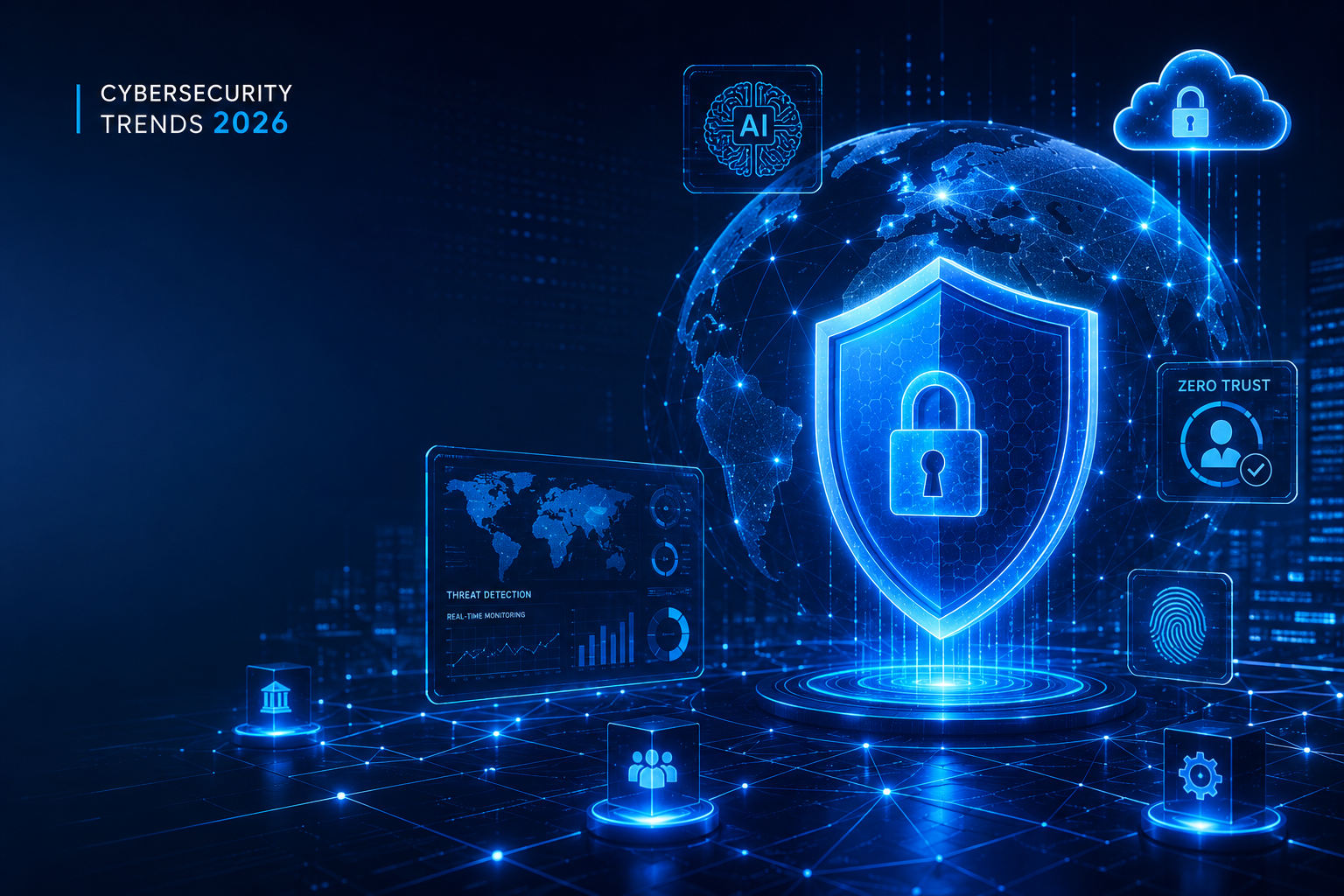
The cybersecurity landscape does not pause for planning cycles. The threat environment evolving in 2026 is more sophisticated, more automated, and more accessible to a wider range of adversaries than anything organizations faced even three years ago. Staying ahead requires more than reactive patching — it demands visibility into where threats are heading and a security strategy built to adapt. This guide covers the most consequential cybersecurity trends in 2026 and the specific actions your organization should be taking in response.
1. AI-Powered Attacks Are No Longer Emerging — They Are Here
The most significant shift in the 2026 threat landscape is the mainstreaming of AI-powered attacks. Threat actors — from nation-state groups to organized cybercrime syndicates — are now using generative AI tools to write more convincing phishing emails, automate vulnerability discovery, generate functional malware variants, and conduct reconnaissance at machine speed.
The practical implication for defenders: social engineering attacks that once required skilled human operators can now be run at enormous scale by low-skill actors. A phishing email written by a generative AI model is grammatically perfect, contextually aware, and personalized to the target. Traditional email security filters trained on poorly written lure content are increasingly ineffective against these attacks.
Defending against AI-powered attacks requires AI-powered defenses — specifically, AI cybersecurity solutions that use behavioral analysis and anomaly detection rather than signature-based pattern matching. Organizations relying solely on legacy security tools are at a structural disadvantage in 2026.
2. Ransomware Continues to Evolve: Double and Triple Extortion
Ransomware is not new, but its model continues to evolve in ways that make every incident more costly and complex. According to Coveware’s Quarterly Ransomware Report, double extortion attacks — where attackers both encrypt data and threaten to publish it — are now standard practice. Triple extortion adds a third vector: direct contact with customers, partners, or regulators to increase pressure.
In 2026, ransomware-as-a-service (RaaS) platforms continue to lower the barrier to entry for cybercriminals, enabling technically unsophisticated actors to deploy sophisticated ransomware strains. The healthcare, manufacturing, and education sectors remain the highest-volume targets due to operational disruption pressure and often-underfunded security programs.
- • Average ransomware payment in 2024: $2.73 million (Sophos State of Ransomware 2024)
- • Only 57% of encrypted data was fully recovered even when ransom was paid
- • Mean time to recover from a ransomware attack: 21 days
- • Organizations with tested incident response plans recovered 35% faster
3. The Attack Surface Expansion: Cloud, IoT, and Supply Chain
One of the defining cybersecurity trends of 2026 is continued attack surface expansion. Three vectors are driving this: cloud misconfigurations, IoT proliferation, and software supply chain vulnerabilities. The Cloud Security Alliance reports that misconfigured cloud storage and IAM policies remain the leading cause of cloud-related breaches — not sophisticated intrusion techniques.
The software supply chain attack vector — illustrated dramatically by incidents like SolarWinds, Codecov, and the XZ Utils backdoor — has fundamentally changed how organizations need to think about third-party risk. In 2026, every open-source dependency, every SaaS integration, and every vendor with network access is a potential entry point.
Mitigating supply chain risk requires a Software Bill of Materials (SBOM), continuous application security testing across the development pipeline, and vendor security assessments that go beyond checkbox questionnaires.
4. Zero Trust Becomes a Baseline Expectation, Not a Differentiator
A few years ago, zero trust security was a competitive differentiator — something progressive organizations adopted early. In 2026, it is rapidly becoming a baseline customer and regulatory expectation. The US CISA Zero Trust Maturity Model and the EU’s NIS2 Directive both push organizations toward zero trust principles as a foundation of responsible security architecture.
For businesses that have not yet begun their zero trust journey, zero trust security services are now widely available and increasingly cost-accessible. The core question for most organizations has shifted from ‘Should we adopt zero trust?’ to ‘How quickly can we implement it?’ The organizations most exposed in 2026 are those still operating on implicit-trust perimeter models.
5. Regulatory Pressure Intensifies Globally
The regulatory landscape for cybersecurity in 2026 is more demanding than ever. NIS2 Directive enforcement is in full effect across the EU, expanding mandatory security requirements to a significantly broader set of industries than the original NIS Directive. The SEC’s cybersecurity disclosure rules require US public companies to report material cybersecurity incidents within four business days. Australia’s updated Privacy Act introduces stricter breach notification timelines.
For compliance-conscious organizations, 2026 is a year to conduct a formal gap assessment against applicable frameworks — GDPR, NIS2, DORA (for financial services), HIPAA, and SOC 2 or ISO 27001 depending on your market. The cost of proactive compliance is a fraction of the cost of regulatory response after an incident.
[Internal Link -> SOC 2 vs ISO 27001: Which Framework Does Your Business Need? | /blog/soc2-vs-iso27001]
6. The Cybersecurity Skills Gap Drives MSSP and vCISO Adoption
The global cybersecurity workforce gap stands at approximately 4 million unfilled positions according to ISC2’s Cybersecurity Workforce Study. In 2026, demand for qualified security professionals continues to outpace supply significantly, particularly for senior roles like CISO, security architect, and incident response lead.
This gap is accelerating adoption of two models: managed security services (MSSPs) that provide 24/7 monitoring and response capability without full in-house headcount, and virtual CISO services that give SMBs and mid-market companies access to senior security leadership on a fractional basis. Both models are maturing rapidly and represent pragmatic solutions for organizations that cannot compete for full-time talent.
7. Identity-Based Attacks Dominate Initial Access
Attackers have recognized that compromising a valid credential is faster, quieter, and less likely to trigger security alerts than exploiting a technical vulnerability. According to the Verizon Data Breach Investigations Report 2024, stolen credentials are involved in over 80% of web application breaches. In 2026, identity is simultaneously the most common attack vector and the highest-leverage control point for defenders.
Defending identity in 2026 requires enforcing phishing-resistant MFA (FIDO2/passkeys rather than SMS), implementing continuous authentication and anomaly detection, deploying privileged access management for all administrative accounts, and running regular access reviews to eliminate over-privileged accounts and dormant identities.
2026 Cybersecurity Trends Summary: Priority Action Matrix
| Trend / Threat | Risk Level | Recommended Action | Timeline |
| AI-powered phishing and social engineering | Critical | Deploy AI-powered email security + security awareness training | Immediate |
| Ransomware-as-a-service proliferation | Critical | Implement backup strategy + tested incident response plan | Immediate |
| Cloud misconfiguration exposure | High | Cloud security posture management (CSPM) tool + audit | 30 days |
| Software supply chain vulnerabilities | High | SBOM + dependency scanning in CI/CD pipeline | 60 days |
| Identity-based credential attacks | Critical | Phishing-resistant MFA + PAM deployment | Immediate |
| Zero trust architecture gaps | High | Zero trust roadmap + consulting engagement | 90 days |
| Regulatory compliance gaps (NIS2, SEC) | Medium-High | Compliance gap assessment against applicable frameworks | 60 days |
Frequently Asked Questions
What is the biggest cybersecurity threat in 2026?
AI-powered social engineering — particularly AI-generated phishing — represents the most immediate and widespread threat in 2026. It combines broad accessibility (anyone can now generate convincing phishing content) with high success rates against organizations that have not upgraded their human and technical defenses. Ransomware remains the most financially damaging threat category.
How should a small business respond to the 2026 cybersecurity threat landscape?
Small businesses should prioritize: enforcing MFA on all accounts, ensuring all systems are patched and up to date, deploying a backup strategy with offline or immutable backups, conducting at minimum annual security awareness training, and engaging either managed security services or a virtual CISO to provide strategic guidance. The threat environment is too complex for most SMBs to navigate without external expertise.
Is zero trust too complex for mid-sized businesses to implement?
Not in 2026. Zero trust security services have matured substantially, and many key components — identity verification, conditional access policies, MFA enforcement — can be implemented incrementally using existing tools like Microsoft Entra ID or Okta. A phased approach guided by a cybersecurity consulting partner is far more achievable than a full greenfield implementation.
| Call to Action: Stay Ahead of 2026’s Cybersecurity ThreatsOur team delivers a comprehensive security assessment that maps your current posture against the cybersecurity trends most likely to affect your business — and gives you a prioritized roadmap to reduce risk before it materializes. Book your free consultation today.Contact us today for a free consultation -> |