
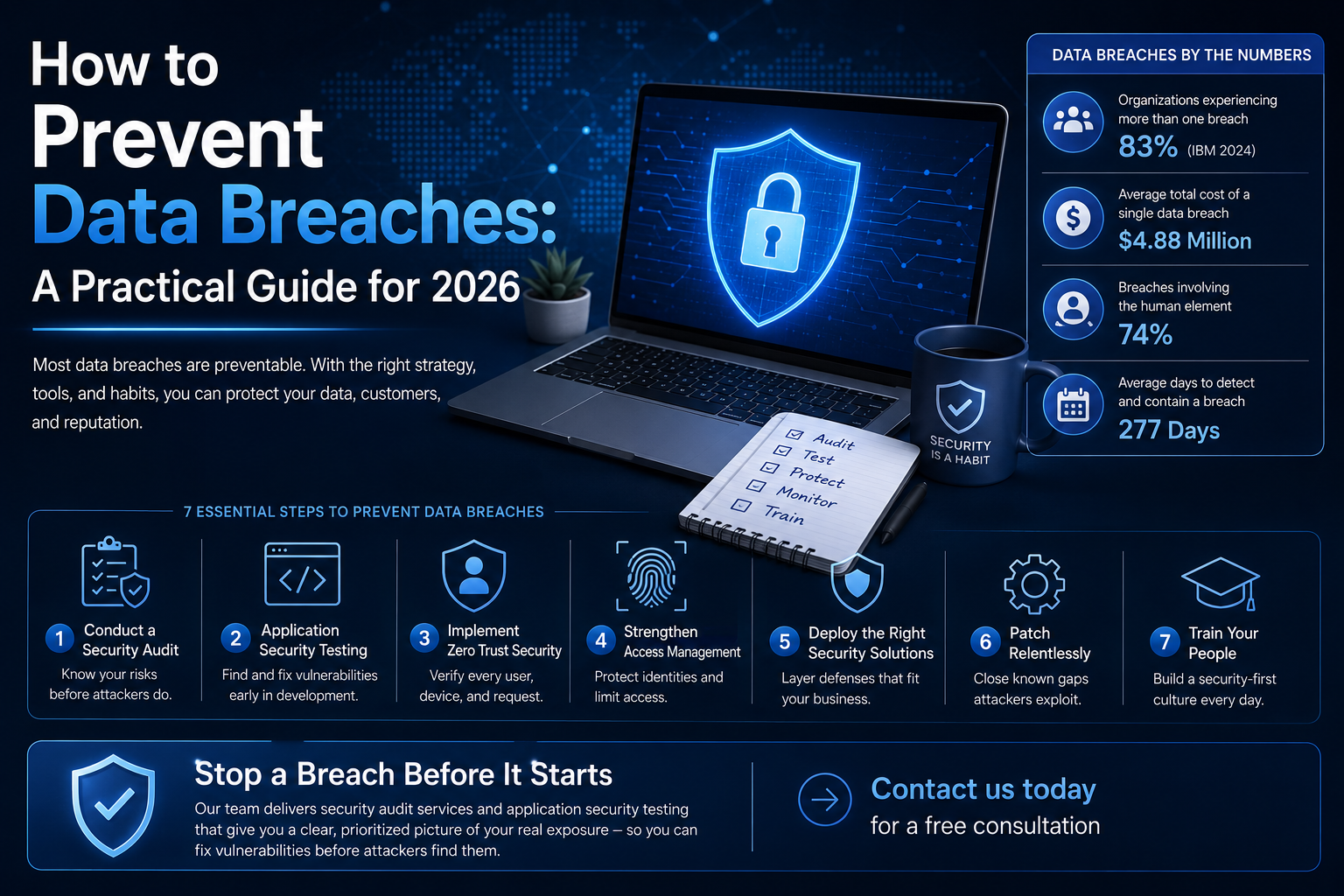
A data breach does not usually happen because a criminal is smarter than your IT team. It happens because one misconfigured server, one reused password, or one unpatched application quietly sat exposed long enough for someone to notice. The uncomfortable truth is that most data breaches are preventable — and that is exactly what this guide is about.
| Reality check: If you read about a competitor’s data breach this week and thought ‘that won’t happen to us’ — that is the single most dangerous assumption in cybersecurity. The organizations that prevent data breaches are not lucky. They are prepared. |
| Statistic | Figure |
| Organizations experiencing more than one breach | 83% (IBM 2024) |
| Average total cost of a single data breach | $4.88 Million |
| Breaches involving the human element | 74% |
| Average days to detect and contain a breach | 277 Days |
1. Conduct a Security Audit Before You Do Anything Else
You cannot fix what you cannot see. Before investing in new tools or policies, get a baseline assessment of your current security posture through professional security audit services. A proper security audit maps every asset in your environment, identifies misconfigurations, reviews access controls, and prioritizes risks by actual business impact.
2. Implement Application Security Testing Throughout Development
Web applications are the number one breach vector in most industries. Application security testing — encompassing SAST (static analysis), DAST (dynamic testing), and SCA (software composition analysis) — must be integrated into your development pipeline, not bolted on at the end.
The concept of shifting left means catching vulnerabilities when a developer is still writing code, rather than discovering them after deployment. Research consistently shows that fixing a critical vulnerability in production costs 30x more than fixing it during development.
- • Integrate SAST tools into your CI/CD pipeline (SonarQube, Checkmarx, Semgrep)
- • Run DAST scans against staging environments before every major release
- • Scan open-source dependencies for known CVEs with SCA tools
- • Conduct manual penetration testing on all customer-facing applications annually
- • Implement a vulnerability disclosure or bug bounty program
3. Deploy Zero Trust Security Architecture
The old perimeter security model — trust everything inside the firewall — is dead. Zero trust security operates on the principle that no user, device, or system is trusted by default — regardless of whether they are inside or outside the corporate network.
4. Strengthen Identity and Access Management
Stolen credentials are behind the majority of data breaches. Practical steps include enforcing multi-factor authentication (MFA) across all accounts, deploying a privileged access management (PAM) solution, eliminating shared accounts where possible, conducting quarterly access reviews to revoke unnecessary permissions, and implementing single sign-on (SSO) with strong authentication policies.
5. Deploy Cybersecurity Solutions That Fit Your Business Size
Every organization needs layered cybersecurity solutions for businesses proportional to their risk profile. A useful framework layers defenses across five domains:
1. Endpoint Protection — Next-generation antivirus and EDR (endpoint detection and response) on every device.
2. Email Security — Advanced anti-phishing, DMARC/DKIM/SPF enforcement, and attachment sandboxing.
3. Network Segmentation — Divide your network so a breach in one area cannot spread unchecked.
4. Data Loss Prevention (DLP) — Monitor and block unauthorized transfers of sensitive data.
5. Security Monitoring & SIEM — Centralized log management and real-time alerting for anomalous behavior.
6. Patch Management: Close the Gaps Attackers Exploit
An estimated 60% of breaches involve vulnerabilities where a patch was already available but not applied. Prioritize critical patches within 24-72 hours of release, automate patching for operating systems and common software wherever possible, and maintain an accurate asset inventory so nothing is forgotten.
7. Train Your People — Consistently
Security awareness training is not a once-a-year compliance checkbox. Meaningful human risk reduction requires monthly simulated phishing campaigns, short-form training modules tied to real-world incidents, a clear process for reporting suspicious activity, and leadership buy-in that normalizes security conversations.
Data Breach Prevention Priority Matrix
| Control | Effort | Impact | Priority |
| MFA on all accounts | Low | Very High | Immediate |
| Patch critical vulnerabilities | Medium | Very High | Immediate |
| Security audit / assessment | Low | High | Immediate |
| Application security testing | Medium | High | Short-term |
| Zero trust architecture | High | Very High | Short-term |
| Security awareness training | Low | Medium | Ongoing |
| SIEM / security monitoring | High | High | Medium-term |
Frequently Asked Questions
What is the most common cause of data breaches in 2026?
Phishing and credential theft remain the most common initial access vectors, followed by exploitation of unpatched vulnerabilities and misconfigured cloud storage. Human error is implicated in the majority of incidents.
Do small businesses need to worry about data breaches?
Absolutely. Over 40% of cyberattacks target small businesses precisely because they often have weaker defenses. Attackers frequently target smaller companies as a stepping stone to their larger partners or supply chain connections.
| 📣 Stop a Breach Before It StartsOur team delivers security audit services and application security testing that give you a clear, prioritized picture of your real exposure — so you can fix vulnerabilities before attackers find them.→ Contact us today for a free consultation |