
Introduction
Machines can now see — and increasingly, they see better than humans in certain high-stakes scenarios. Computer vision, once confined to research labs, has matured into a production-ready technology powering everything from cancer detection to checkout-free retail stores.
But building reliable, scalable computer vision systems is not trivial. It requires deep expertise in deep learning development, carefully curated training data, and infrastructure that can process visual inputs in real time. That’s why more companies are turning to specialized computer vision development services rather than attempting to build these systems entirely in-house.
This guide breaks down what computer vision development actually involves, where it delivers the most business value, what it realistically costs, and how to get started with the right machine learning development company.
What Is Computer Vision Development?
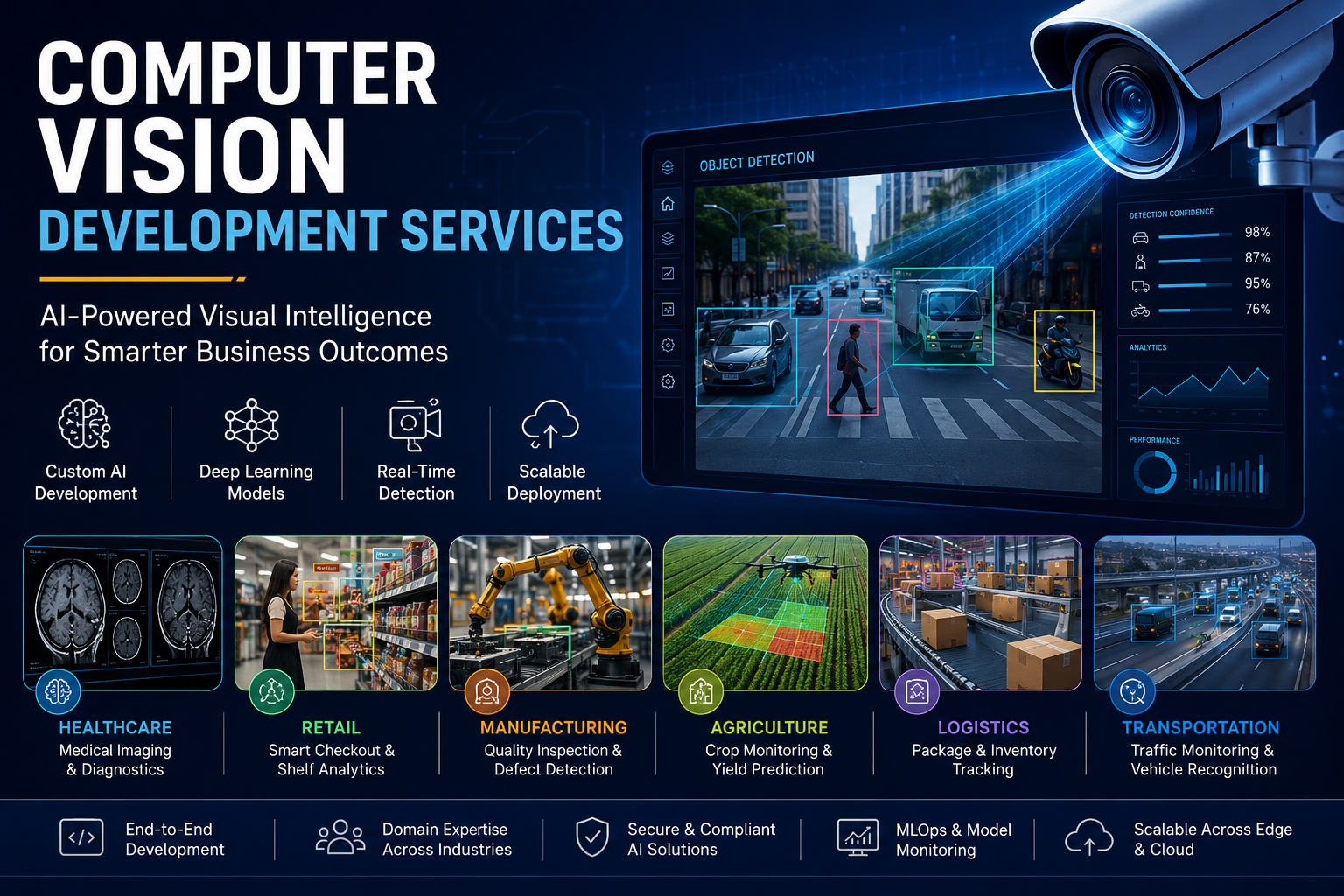
Computer vision is a branch of artificial intelligence that enables software systems to interpret, analyze, and act on visual data — images, video, or real-time camera feeds. At its core, it involves training deep neural networks to recognize patterns: objects, faces, defects, movements, or text embedded in images.
Computer vision development services encompass the full lifecycle of building these systems:
- • Data collection and annotation
- • Model architecture selection (CNNs, transformers, YOLO, etc.)
- • Training and validation on domain-specific datasets
- • Integration with cameras, sensors, or existing software
- • Deployment to edge devices, cloud infrastructure, or both
- • Ongoing monitoring and model retraining
Unlike off-the-shelf software, computer vision solutions are rarely plug-and-play. Each application requires custom AI development tailored to the specific visual domain, lighting conditions, object classes, and performance requirements of the business.
Key Use Cases by Industry
Healthcare & Medical Imaging
Medical imaging is one of the most impactful applications of computer vision. AI models trained on radiology scans, pathology slides, and dermoscopy images can detect anomalies that human clinicians might miss — and do it consistently at scale.
Common applications:
- • Tumor detection in CT and MRI scans
- • Diabetic retinopathy screening from fundus images
- • Pathology slide analysis for cancer grading
- • Surgical assistance and instrument tracking
- • Wound assessment and monitoring
Healthcare computer vision demands extremely high accuracy and must comply with regulatory frameworks like FDA 510(k) or CE marking. A specialized AI software development services partner with healthcare domain experience is essential here.
Retail & E-Commerce
Brick-and-mortar retail is being transformed by visual AI. Major retailers are deploying computer vision to reduce shrink, optimize shelf management, and create frictionless checkout experiences.
Common applications:
- • Automated checkout and cashierless stores
- • Shelf monitoring and planogram compliance detection
- • Customer foot traffic and behavior analytics
- • Product recognition for inventory management
- • Age verification and access control
The ROI in retail is often direct and measurable — reduced labor costs, fewer out-of-stock incidents, and lower shrinkage rates.
Manufacturing & Quality Control
Industrial computer vision is one of the most commercially mature segments. Automated visual inspection systems are faster, more consistent, and ultimately cheaper than manual quality control on production lines.
Common applications:
- • Surface defect detection on metals, glass, textiles, and electronics
- • Assembly verification (correct parts, correct placement)
- • Dimensional measurement and tolerance checking
- • Predictive maintenance through thermal and visual inspection
- • Worker safety monitoring (PPE compliance, hazard zone detection)
In manufacturing, deep learning development enables models to detect defects that are imperceptible to the human eye — and do so at line speed, 24/7 without fatigue.
Agriculture & Food Processing
Common applications:
- • Crop disease and pest detection from drone imagery
- • Yield estimation and harvest planning
- • Grading and sorting produce by size, color, and defect
- • Livestock health monitoring
Logistics & Transportation
Common applications:
- • License plate recognition (LPR/ANPR)
- • Package sorting and barcode-free identification
- • Truck and container inspection at ports
- • Driver monitoring systems (drowsiness, distraction)
- • Autonomous vehicle perception
Core Technologies Behind Modern Computer Vision
Understanding the technical stack helps you evaluate potential AI software development services partners.
Convolutional Neural Networks (CNNs):
The foundational architecture for image classification and object detection. Still widely used for many production applications.
Transformer-Based Vision Models:
Vision Transformers (ViT) and models like CLIP and DINO have pushed state-of-the-art performance significantly, particularly for tasks requiring broader context understanding.
Object Detection Frameworks:
YOLO variants, Faster R-CNN, and DETR are standard frameworks for real-time detection tasks.
Semantic & Instance Segmentation:
Used when pixel-level understanding is required — medical imaging, autonomous driving, and agricultural analysis all rely heavily on segmentation models.
Edge Deployment:
Deploying models on edge hardware (NVIDIA Jetson, Intel Movidius, custom ASICs) is critical for applications requiring low latency or operating in bandwidth-constrained environments.
MLOps for Vision:
Production computer vision requires robust pipelines for data versioning, model monitoring, drift detection, and automated retraining — all part of what a mature machine learning development company should provide.
How Much Does Computer Vision Development Cost?
Cost varies significantly based on complexity, data availability, and deployment requirements. Here is a realistic breakdown:
Proof of Concept (PoC) — $15,000 to $50,000
A focused PoC addresses a single, well-defined visual problem (e.g., detecting a specific type of surface defect). It involves limited data annotation, model training, and a working demo — but not production-ready infrastructure.
Pilot Production System — $50,000 to $200,000
Includes data pipeline development, model optimization for your specific hardware, integration with existing systems, and deployment to a limited production environment. More extensive annotation work and iterative model improvement are included.
Enterprise-Grade Deployment — $200,000 to $1,000,000+
Full-scale custom AI development involving multiple cameras or data streams, edge deployment at scale, integration with ERP/MES/WMS systems, regulatory compliance documentation, and ongoing MLOps support.
Key Cost Drivers
- • Data annotation: Often 30–50% of total project cost for supervised learning tasks
- • Model complexity: Real-time multi-class detection is more expensive than binary classification
- • Hardware: Edge deployment on custom silicon vs. cloud GPU inference
- • Regulatory compliance: Medical and safety-critical applications add significant documentation overhead
- • Ongoing retraining: Visual environments change; models require maintenance
How to Choose a Computer Vision Development Partner
Selecting the right machine learning development company is arguably the most important decision you’ll make. Here is what to evaluate:
Domain Expertise
Computer vision is not a single skill. A team that excels at autonomous vehicle perception may not have the domain knowledge to build a medical imaging diagnostic tool. Look for demonstrated experience in your specific industry vertical.
End-to-End Capability
Avoid fragmented engagements. The best AI software development services providers handle the complete pipeline: data strategy, annotation, model development, integration, deployment, and post-launch monitoring.
Transparency in Model Performance
Be skeptical of vanity metrics. A reputable partner will discuss performance in terms of precision, recall, F1 score, and real-world operating conditions — not just accuracy on a clean test set.
Data Security Practices
Visual data — especially in healthcare, defense, or retail — is sensitive. Ensure your partner has documented data handling policies and appropriate compliance certifications (SOC 2, HIPAA, ISO 27001).
MLOps Maturity
Ask how they handle model drift. Visual environments change — lighting shifts, new product SKUs appear, camera angles change. A mature partner has automated monitoring and retraining workflows.
How to Get Started with Computer Vision Development
Step 1: Define the Business Problem Precisely
“We want computer vision” is not a project brief. Define the specific decision the system needs to make, what data it will operate on, and what success looks like in business terms.
Step 2: Audit Your Data
Existing image or video data is a significant asset. Before engaging a custom AI development partner, catalog what visual data you have, whether it is labeled, and how representative it is of real-world operating conditions.
Step 3: Start with a Scoped PoC
Rather than committing to a full build immediately, commission a time-boxed proof of concept. A good PoC will validate technical feasibility on your data and surface edge cases you had not anticipated.
Step 4: Plan for Integration Early
Computer vision does not operate in isolation. Identify early how the system will integrate with your ERP, quality management system, camera infrastructure, or alerting mechanisms. Integration complexity is frequently underestimated.
Step 5: Establish Ongoing Governance
Plan for model maintenance from day one. Establish who owns model performance, how retraining will be triggered, and how you will handle cases where the model encounters new visual scenarios it was not trained on.
The Bottom Line
Computer vision has moved well beyond experimental status. Across healthcare, retail, manufacturing, and logistics, it is delivering measurable ROI at scale. But successful deployment requires more than picking a framework and training a model — it requires a strategic approach to data, domain expertise, and production infrastructure.
Whether you are investigating your first visual AI application or scaling an existing system, partnering with experienced computer vision development services can dramatically reduce time-to-value and de-risk the investment. The right machine learning development company will bring not just technical capability, but the domain knowledge and production experience to turn visual AI from a proof of concept into a genuine competitive advantage.
Ready to explore computer vision for your business? Start with a scoped discovery engagement to assess your data, define success criteria, and map a realistic path to production.