
If you’re a business leader who isn’t a developer — a CEO, COO, VP of Operations, or department head — conversations about AI implementation can feel like being the only person in the room who didn’t get the memo. Everyone seems to know what ‘LLM fine-tuning’ and ‘vector databases’ mean. You’re nodding along while wondering what any of this actually has to do with running your business.
This guide is written specifically for you. No technical jargon. No assumed background in computer science. Just a clear, practical framework for understanding how to bring AI into your organization in a way that creates real value — without chaos, wasted budgets, or a science experiment that never ships.
First: Change the Question You’re Asking
Most AI implementation projects fail at the starting line because the question is wrong. ‘How do we implement AI?’ is too broad to be useful. It’s like asking ‘How do we implement technology?’ The answer depends entirely on what you’re trying to accomplish.
The right question is: ‘What specific business problem do we want AI to solve?’
Answer that question with precision — and everything else becomes dramatically clearer. The technology choice, the budget, the timeline, the success metrics. It all flows from a well-defined problem.
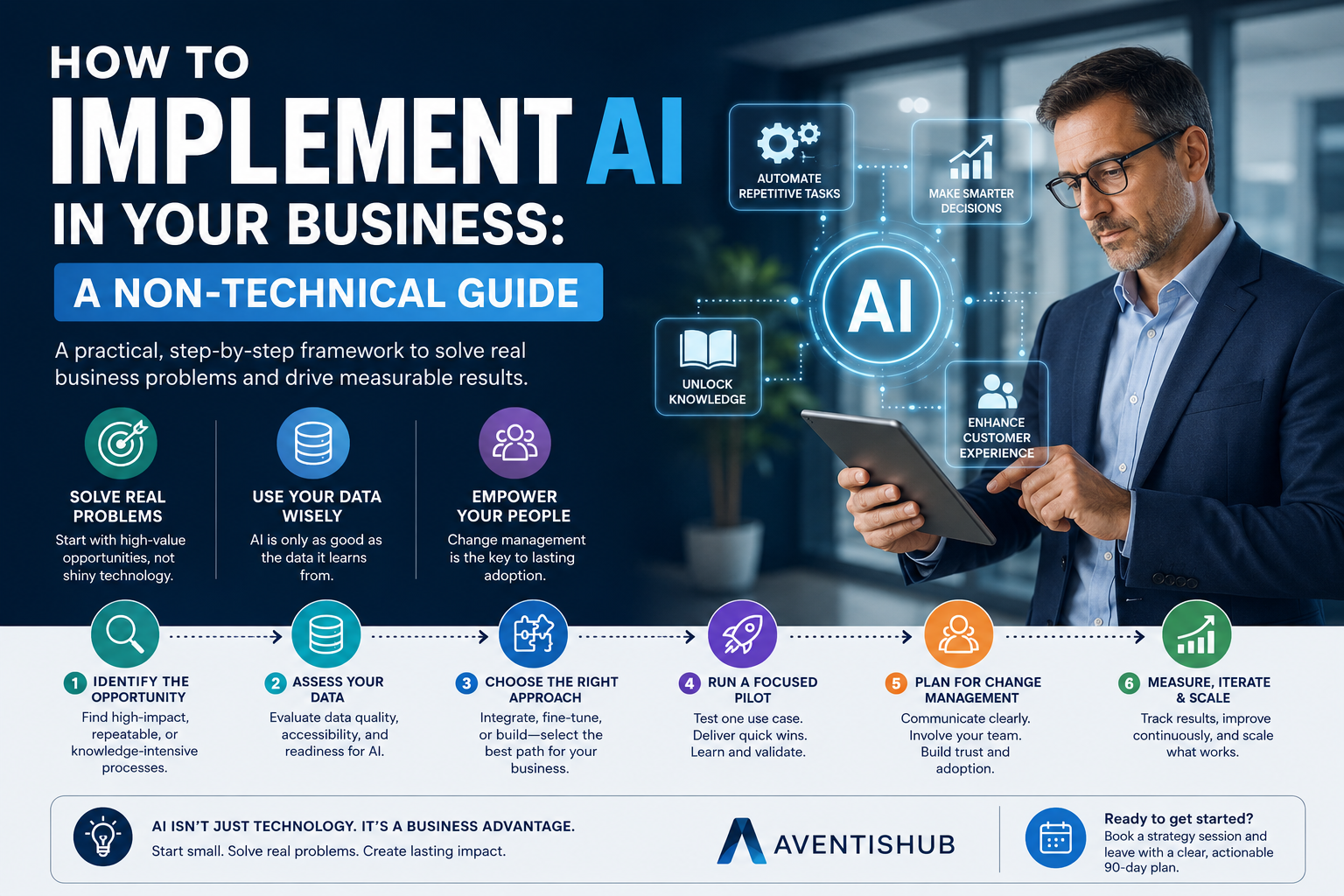
Step 1: Identify Your Highest-Value AI Opportunity
There are thousands of things AI can theoretically do for a business. But you’re not building a technology portfolio; you’re solving a business problem. Start by looking for situations that meet one or more of these criteria:
- High volume, repetitive tasks: Any process your team does dozens or hundreds of times per day — categorizing emails, filling out forms, answering the same customer questions — is a strong AI candidate. The repetition that exhausts humans is exactly what AI handles best.
- Decisions that require pattern recognition across large datasets: If you’re trying to predict customer churn, flag fraudulent transactions, or identify which leads are most likely to convert, AI can analyze patterns in your data that no human team could process manually.
- Knowledge-intensive tasks that scale poorly: If onboarding a new employee requires a senior person to spend 20 hours sharing institutional knowledge, an AI knowledge management system can make that information accessible on demand.
Write down three to five processes in your business that are time-consuming, prone to human error, or difficult to scale. That list is your AI opportunity map.
Step 2: Assess Your Data Readiness
AI learns from data. Before investing in any AI development project, you need an honest assessment of your data situation. This doesn’t require a data scientist — it requires honest answers to a few questions:
- Do you collect data about the process you want to improve?
- Is that data stored in a consistent, accessible format?
- How much historical data do you have? (More is generally better.)
- Does the data contain sensitive information that requires special handling?
If your data is scattered across spreadsheets, email inboxes, and legacy systems with no consistent structure, data preparation will be your first major project — and your most important investment.
Step 3: Choose the Right Build Approach
Not every AI implementation requires building a custom model. In fact, for most business problems, a custom model is overkill. Here’s a practical framework:
Use an AI integration (fastest, lowest cost)
If your goal can be accomplished by connecting an existing AI service — like OpenAI, Claude, or Google Gemini — to your existing software via API, this is almost always the best starting point. You can build a custom-branded AI assistant, a document analyzer, or an automated response system in weeks, not months.
Fine-tune an existing model (moderate cost, higher specificity)
If a general-purpose AI doesn’t perform well enough on your specific domain — medical terminology, legal documents, highly specialized technical content — you can train an existing model on your data to improve performance. This takes longer and costs more, but delivers meaningfully better results for niche applications.
Build a custom model (highest cost, maximum control)
Reserved for situations with genuinely unique requirements — typically large enterprises with proprietary data assets and very specific performance, security, or regulatory needs. This path requires a dedicated ML engineering team and a substantial budget.
Step 4: Run a Focused Pilot
One of the most common and costly AI implementation mistakes is trying to do too much at once. Enterprise-wide AI transformation sounds ambitious, but it’s a recipe for scope creep, delayed timelines, and skeptical stakeholders.
Instead, pick one well-defined use case from your opportunity map and build a small, fast proof of concept. A good pilot has clear success criteria (‘reduce invoice processing time by 40%’), a realistic timeline (6–12 weeks), and a small team of 3–5 people focused exclusively on it.
If the pilot succeeds — even partially — you have a concrete result you can build on. If it doesn’t work as expected, you’ve learned something valuable at minimal cost.
Step 5: Plan for Change Management
This is the step that most technical guides skip entirely: the human element. AI implementation isn’t just a technology project — it’s an organizational change initiative.
Employees worry about job security. Managers worry about losing control. Power users worry about systems that don’t match their mental models. If you don’t actively manage these concerns, resistance will slow or kill even the most technically sound implementation.
Communicate early and often about what the AI system will and won’t do. Involve frontline employees in the design process. Frame AI as a tool that makes their work more interesting, not a replacement. Celebrate early wins publicly.
Step 6: Measure, Iterate, and Scale
After deployment, the work is far from over. Establish a regular review cadence — monthly at minimum — to assess AI performance against your success metrics. Watch for model drift, edge cases, and unintended consequences.
When you have a working system with measured results, you can expand it: more users, more data, more use cases. Scale what works; be willing to sunset what doesn’t.
Common Mistakes to Avoid
- Chasing the technology instead of the problem: Don’t implement AI because competitors are doing it. Implement it because you’ve identified a specific problem it will solve.
- Skipping the data conversation: Garbage in, garbage out. No AI model performs well on poor-quality data.
- Expecting perfection on day one: AI systems improve over time. Deploy with appropriate guardrails and plan for iteration.
- Forgetting about governance: Who is responsible for AI decisions? How are errors escalated? What are the rules around sensitive data? Define this before you go live.
Aventishub works with C-suite leaders and operations teams to design practical AI implementation roadmaps — starting from your business problem, not from the technology. Book a strategy session and leave with a clear, actionable 90-day plan.