You’ve heard the pitch a hundred times: ‘AI will transform your business.’ But when you actually sit down to plan a budget, the numbers start to feel… slippery. Vendors talk in ranges. Agencies quote wildly different figures. And every blog post you find seems either too vague or written for a Silicon Valley startup with a $10 million runway.
This guide cuts through the noise. Whether you’re a small business owner exploring your first AI project or a C-suite leader planning an enterprise-wide rollout, here’s an honest, structured breakdown of what AI development actually costs in 2026 — and how to plan for it without blowing your budget.
Why AI Costs Are Hard to Pin Down
Unlike building a website — where pricing models are relatively standardized — AI development spans an enormous range of complexity. A simple chatbot integrated into your customer service platform is a fundamentally different beast than a custom machine learning model that predicts equipment failures in a manufacturing plant.
Three variables drive most of the cost variance:
- Complexity of the use case: A rule-based FAQ bot is cheap. A computer vision system that inspects products in real time is not.
- Build vs. buy vs. integrate: Do you need a fully custom model, or can you connect an existing API like OpenAI or Google Gemini to your workflow?
- Data readiness: If your data is messy, unstructured, or siloed, cleaning and preparing it adds significant cost before a single line of model code is written.
The Main Cost Categories in AI Development
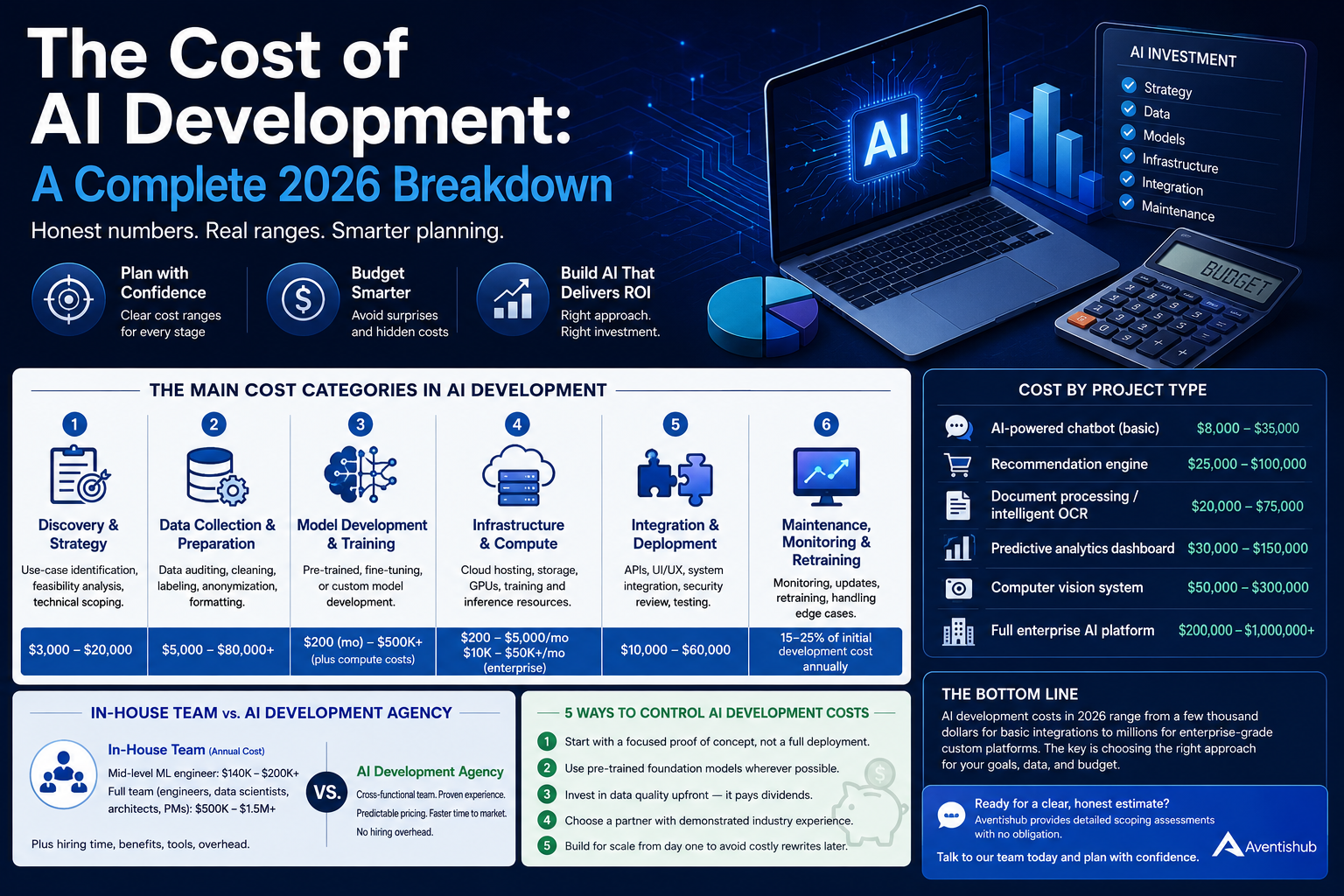
1. Discovery and Strategy
Before any development begins, you need a roadmap. This phase covers stakeholder interviews, use-case identification, feasibility analysis, and technical scoping.
Typical cost range: $3,000 – $20,000 depending on scope and whether you hire an in-house consultant or an external AI strategy firm. Some agencies include this in their project price; others bill it separately.
2. Data Collection and Preparation
This is the phase most businesses underestimate — and the one that most often derails timelines. AI models don’t run on intuition; they run on data. If you don’t have clean, labeled, relevant data, you’ll spend significant time and money getting it ready.
Common tasks include data auditing, deduplication, labeling, anonymization, and formatting. Depending on data volume and quality, this phase can run from $5,000 for a small, well-organized dataset to $80,000 or more for large-scale enterprise data preparation.
3. Model Development and Training
This is where the actual AI work happens. Costs here depend heavily on your chosen approach:
- Using pre-trained models (GPT-4, Claude, Gemini): Lowest cost path. You’re essentially paying for API usage and integration work. Monthly API costs for a small application typically fall between $200 – $2,000.
- Fine-tuning an existing model: You take a foundation model and train it on your specific data. Development costs typically range from $15,000 – $80,000, plus ongoing compute costs.
- Building a custom model from scratch: Reserved for situations with highly unique data or specific performance requirements. Expect $100,000 – $500,000+ and a team of specialized ML engineers.
4. Infrastructure and Compute
AI workloads are computationally intensive. Whether you’re training a model or serving predictions at scale, you’ll need robust infrastructure. Most teams use cloud providers like AWS, Google Cloud, or Azure.
For small to mid-size applications: $500 – $5,000 per month. For enterprise-scale platforms: $10,000 – $50,000+ per month. GPU-intensive training runs can spike costs significantly during development phases.
5. Integration and Deployment
Getting an AI model to work in isolation is one thing. Integrating it into your existing CRM, ERP, mobile app, or internal tools is another challenge entirely. This includes API development, UI/UX work, security review, and testing.
Typical range: $10,000 – $60,000 depending on the number of systems involved and how well-documented your existing stack is.
6. Maintenance, Monitoring, and Retraining
AI is not a set-it-and-forget-it investment. Models drift over time as real-world data changes. You’ll need monitoring pipelines, periodic retraining, and a team to handle edge cases and bugs.
Budget 15–25% of your initial development cost annually for ongoing maintenance.
Cost by Project Type: Quick Reference
AI-powered chatbot (basic): $8,000 – $35,000
Recommendation engine: $25,000 – $100,000
Document processing / intelligent OCR: $20,000 – $75,000
Predictive analytics dashboard: $30,000 – $150,000
Computer vision system: $50,000 – $300,000
Full enterprise AI platform: $200,000 – $1,000,000+
In-House Team vs. AI Development Agency: What’s the Real Cost?
Many companies debate whether to build an internal AI team or partner with an external agency. The honest answer: it depends on your timeline, budget, and how central AI is to your business model.
Hiring a mid-level machine learning engineer in the US costs between $140,000 – $200,000 per year in salary alone, before benefits, equipment, and management overhead. A full in-house team capable of building and maintaining complex AI systems costs $500,000 – $1.5 million annually.
A specialized AI development agency like Aventishub gives you a cross-functional team — data scientists, ML engineers, cloud architects, and product managers — without the hiring overhead. Project-based engagements provide cost predictability, and you benefit from accumulated experience across dozens of implementations.
5 Ways to Control AI Development Costs
- Start with a focused proof of concept, not a full deployment.
- Use pre-trained foundation models wherever your use case allows.
- Invest in data quality upfront — it pays dividends in reduced rework.
- Choose a partner with demonstrated experience in your specific industry.
- Build for scale from day one to avoid expensive architectural rewrites later.
The Bottom Line
AI development costs in 2026 range from a few thousand dollars for basic integrations to millions for enterprise-grade custom platforms. The wide range isn’t a bug — it reflects genuine differences in complexity, data maturity, and business requirements.
The companies that get the best ROI from AI aren’t necessarily the ones who spend the most. They’re the ones who define clear objectives, choose the right build approach for their needs, and work with partners who are transparent about tradeoffs.
Ready to get a clear, honest estimate for your AI project? Aventishub provides detailed scoping assessments with no obligation. Talk to our team today and walk away with a realistic budget you can actually plan around.