
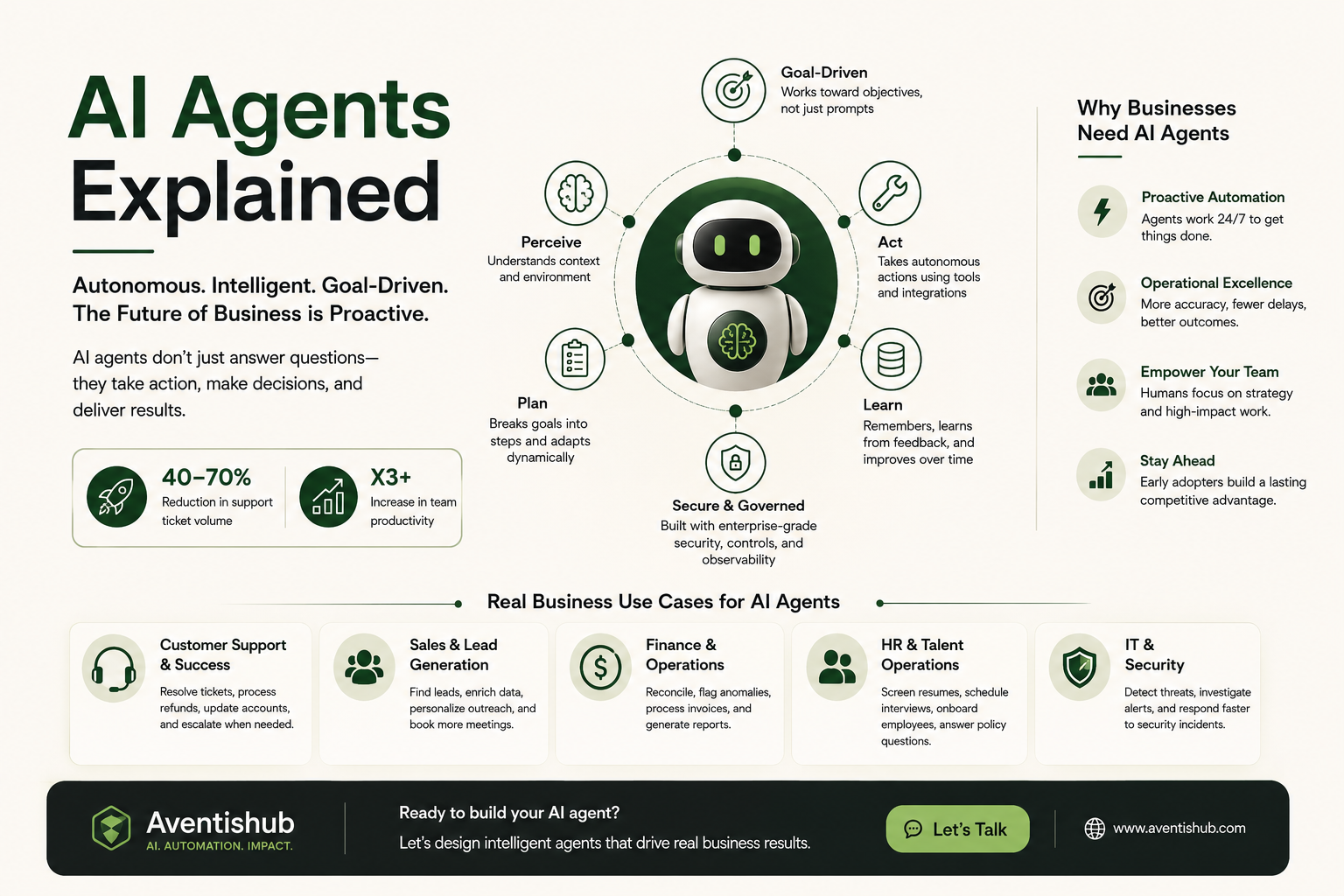
There’s a term spreading through every boardroom, startup pitch deck, and technology conference in 2026: AI agents. It gets used alongside words like ‘automation,’ ‘autonomous,’ and ‘intelligent’ — usually with enough excitement that it’s easy to miss what the technology actually does.
So let’s slow down and be precise. What is an AI agent? How is it different from the AI tools you might already be using? And more importantly, why is it becoming one of the most strategically significant technologies for businesses across every sector?
What Is an AI Agent?
An AI agent is a software system that can perceive its environment, reason about a goal, take autonomous actions, and adapt based on feedback — all without requiring step-by-step human instruction for each task.
That definition packs a lot in. Let’s break it down with a practical example.
Imagine you run a B2B SaaS company. You have a sales team that spends significant time researching leads, qualifying prospects, drafting outreach emails, updating the CRM, and scheduling calls. That’s dozens of micro-tasks per day, each requiring information, judgment, and action.
An AI agent assigned to sales support doesn’t just answer questions. It monitors your CRM for cold leads, researches prospect LinkedIn profiles, drafts personalized outreach emails, sends them on schedule, updates records when a prospect replies, and flags high-intent signals to your human sales reps — all continuously, in the background, without being prompted for each step.
That’s the defining characteristic: an agent acts. It doesn’t just respond when asked.
AI Agents vs. Traditional AI Tools: The Key Difference
Most people’s first experience with AI is reactive: you ask a question, you get an answer. ChatGPT, Copilot, a customer service chatbot — these are responsive systems. They are excellent at what they do, but they wait to be activated.
AI agents flip this dynamic. They operate on goals rather than prompts. You give an agent an objective — ‘keep our customer churn below 5% this quarter’ or ‘ensure all invoices are processed within 48 hours’ — and the agent plans and executes the steps needed to pursue that goal.
This shift from reactive to proactive is why agentic AI is being called the defining technology shift of 2026. It doesn’t just make humans faster at tasks. It offloads entire categories of work.
How AI Agents Actually Work
Under the hood, modern AI agents are built on large language models (LLMs) enhanced with several additional capabilities:
- Tool use: Agents can call external APIs, run code, search the web, query databases, and interact with software systems — not just generate text.
- Memory: Agents can store context across sessions, remembering past interactions, decisions, and outcomes to inform future behavior.
- Planning: Given a complex goal, agents can break it into sub-tasks, prioritize them, handle dependencies, and recover from failures.
- Multi-agent coordination: Enterprise deployments often involve multiple specialized agents working in parallel — one handling research, another handling communication, another handling data entry — coordinated by an orchestration layer.
Real Business Use Cases for AI Agents in 2026
Customer Support and Success
Agents that handle Tier 1 and Tier 2 support independently — resolving tickets, processing refunds, updating account details, and escalating to humans only when genuinely novel situations arise. Companies deploying these systems are reporting 40–70% reductions in support ticket volume reaching human agents.
Sales and Lead Generation
Agents that monitor intent signals, enrich lead profiles, personalize outreach, follow up on stale opportunities, and sync everything to your CRM automatically. The human sales rep focuses exclusively on closing; everything before that conversation is handled autonomously.
Finance and Operations
Agents that reconcile transactions, flag anomalies, generate financial reports, process invoices, and enforce compliance rules — all without the manual data wrangling that consumes finance team bandwidth.
HR and Talent Operations
From screening resumes and scheduling interviews to answering employee policy questions and onboarding new hires, HR agents handle high-volume, process-driven tasks so HR professionals can focus on culture, development, and strategy.
IT and Security
Security agents that monitor network activity, correlate threat signals, investigate alerts, and initiate response playbooks — reducing mean time to detection and response for cyber threats.
Why Ultra-Low Competition Makes This the Right Moment
Here’s a market reality that surprises most business leaders: despite the enormous attention agentic AI receives in technology media, genuine enterprise deployment of AI agents is still in early stages. Most companies are running pilots or proof-of-concepts. Very few have moved to production at scale.
That gap represents a significant competitive advantage window. Businesses that build operational AI agent capabilities now — the processes, the integrations, the governance frameworks — will be operating at a fundamentally different efficiency level than competitors who wait another 18 months.
What Does It Take to Build an AI Agent?
The technical components of a production-grade AI agent include: a foundation model (often GPT-4, Claude, or Gemini), a tool-calling framework, a memory and state management system, an orchestration layer for multi-agent scenarios, security and access controls, and monitoring and observability pipelines.
Building this from scratch requires expertise in LLM engineering, API development, cloud architecture, and product design. It’s why most companies partner with a specialized AI development team rather than attempting to assemble internal capability from zero.
Aventishub specializes in designing and deploying custom AI agents for businesses across industries. Whether you’re exploring a specific use case or planning a broader intelligent automation initiative, our team will help you design an agent architecture that delivers measurable results. Let’s talk.