
Founders and product managers use the terms MVP, prototype, and proof of concept interchangeably more often than they use them correctly. Consequently, teams build the wrong thing a polished prototype when they needed a PoC to validate feasibility, or a technically sophisticated MVP when a prototype would have generated the same customer insight at a fraction of the cost. Furthermore, development partners sometimes contribute to this confusion by framing whatever they prefer to build in the vocabulary the client finds most compelling.
Therefore, this guide provides precise, practical definitions of each term, explains exactly what each one delivers, gives real examples of when each is appropriate, and provides a decision framework for choosing the right starting point for your specific situation. Moreover, understanding this distinction consistently helps founders allocate their first development budget more effectively than any other single piece of knowledge.
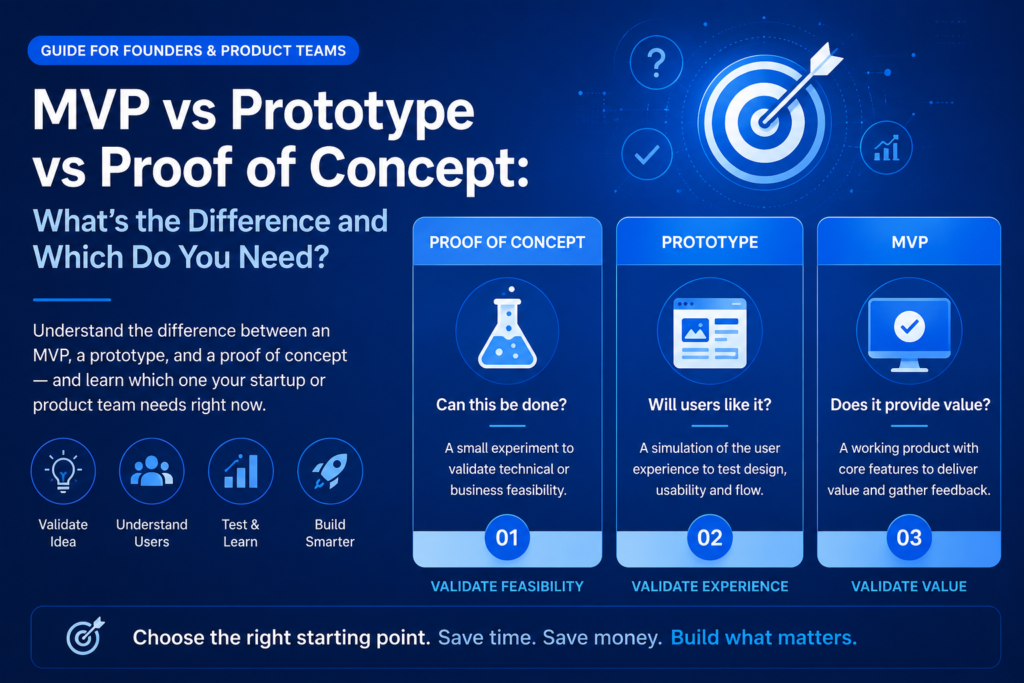
What Is a Proof of Concept (PoC)?
Definition and Purpose
A proof of concept is a small, focused experiment that answers one specific technical or business question: can this be done? Specifically, a PoC validates feasibility — whether a particular technology works as expected, whether an API integration is possible, whether a machine learning model achieves acceptable accuracy on a specific dataset. Furthermore, a PoC does not need a user interface, does not need to be scalable, and does not need to handle edge cases.
What a PoC Looks Like in Practice
For example, a startup building an AI-powered contract analysis tool might build a PoC that feeds twenty sample contracts into a language model and measures extraction accuracy — no interface, no database, just a script and a results spreadsheet. Moreover, a healthcare startup considering AI proof of concept development for diagnostic imaging might run a PoC to determine whether a computer vision model achieves clinically useful accuracy before committing to full product development. As a result, the PoC answers the make-or-break feasibility question before significant investment occurs.
When to Build a PoC
• Specifically, when your product relies on a technology whose feasibility you have not yet validated — AI/ML models, novel API integrations, hardware interfaces, or complex data processing pipelines.
• Furthermore, when an investor or enterprise customer requires technical feasibility evidence before committing to a partnership or contract.
• Additionally, when two technical approaches exist and you need empirical data to choose between them before committing to a full build.
What Is a Prototype?
Definition and Purpose
A prototype simulates the user experience of a product without building the full technical infrastructure behind it. Consequently, it answers the question: will users understand and want this? Specifically, a prototype focuses on validating the user interface, the user flow, and the core value proposition from a usability perspective. Furthermore, prototypes range from low-fidelity paper sketches to high-fidelity interactive mockups that look and feel like a real application but contain no live backend.
What a Prototype Looks Like in Practice
A high-fidelity prototype built in Figma or Adobe XD shows every screen of the intended application with realistic visual design and clickable interactions. As a result, users can navigate through key workflows, experience the proposed interface, and provide feedback on usability and desirability — all without a line of production code being written. Furthermore, Figma prototypes enable A/B testing of different interaction designs before any development commitment is made.
When to Build a Prototype
• When you need to validate your UX approach and information architecture before development begins — specifically to avoid building screens that users find confusing or unappealing.
• Moreover, when pitching to investors or enterprise customers who need to visualize the product before committing. A well-executed prototype communicates product vision more effectively than any verbal description.
• Furthermore, when two competing design directions exist and user testing on each prototype will determine which to build.
• Additionally, when design-development handoff needs precise specifications — a detailed prototype eliminates ambiguity about intended interactions and visual details.
What Is a Minimum Viable Product (MVP)?
Definition and Purpose
An MVP is the smallest version of a product that delivers real value to real users and enables the team to validate whether customers pay for — or consistently use — the core value proposition. Consequently, an MVP is a real, functional product, not a simulation. Furthermore, Eric Ries, who popularized the term in The Lean Startup, specifically defined the MVP as ‘the version of a new product which allows a team to collect the maximum amount of validated learning about customers with the least effort.’ As a result, the MVP is explicitly a learning tool — not a finished product, not a prototype, and not a feature-complete v1.0.
What an MVP Looks Like in Practice
Specifically, Dropbox’s original MVP was a video demonstrating how the product would work — not a functional application. Airbnb’s MVP was a simple website where the founders rented out their own apartment to validate demand. Buffer’s MVP was a two-page website that collected email addresses of people who wanted to schedule social media posts before any scheduling functionality existed. Moreover, these examples illustrate that an MVP often contains far less than founders assume — the minimum threshold is exactly what it sounds like.
When to Build an MVP
• When you have validated that the core value proposition is feasible (PoC) and desirable (prototype) and need to test whether customers actually pay for it in practice.
• Furthermore, when you are ready to acquire your first paying customers and need a functional product to charge for.
• Additionally, when investor interest requires a working product rather than a prototype as evidence of execution capability.
• Specifically, when you need user behaviour data — actual usage patterns, retention rates, feature engagement — that only a real product can generate.
PoC vs Prototype vs MVP: Head-to-Head Comparison
| Factor | Proof of Concept | Prototype | MVP |
| Primary question | Can we build this technically? | Will users want and understand this? | Will users pay for this? |
| Has a real backend? | Yes (experimental) | No | Yes (production-quality) |
| Has a real UI? | No | Yes (simulated) | Yes (real) |
| Real users? | No | Test users for feedback | Yes — paying or active users |
| Typical timeline | 1-4 weeks | 1-3 weeks | 8-20 weeks |
| Typical cost | $2,000 – $15,000 | $3,000 – $15,000 | $20,000 – $100,000+ |
| Output | Feasibility evidence | Design validated, investor-ready demo | Paying customers, usage data |
| When to build next | If technical feasibility is uncertain | When UX needs validation before build | When ready for market validation |
The Sequence: How PoC, Prototype, and MVP Work Together
Specifically, the three artifacts are not mutually exclusive alternatives — they are sequential stages of progressive validation. Therefore, the most resource-efficient path from idea to funded product typically follows this sequence:
1. Build a PoC to validate technical feasibility if the product relies on unproven technology. Consequently, you confirm the foundation exists before designing on top of it.
2. Build a prototype to validate the user experience and value proposition. Furthermore, prototype testing with target users surfaces usability problems that cost ten times more to fix after development than before it.
3. Build an MVP to validate market demand and willingness to pay. Moreover, the MVP uses the prototype as its design specification and the PoC findings to inform technical decisions — making each stage inform the next.
However, not every product needs all three stages. Specifically, if you are building on well-established technology with well-understood user needs — for example, a vertical SaaS for a niche you know intimately — you may move directly to MVP. In contrast, products involving novel AI capabilities, unvalidated user experience concepts, or both benefit from the full PoC-prototype-MVP sequence.
Common MVP Mistakes Founders Make
• Building too much: specifically, including features the team assumes users want before validating whether users want the core feature. Consequently, the MVP becomes a full product that takes six months to build instead of six weeks.
• Confusing an MVP with a low-quality product: furthermore, an MVP is minimal in scope, not minimal in quality. A buggy, unreliable MVP destroys trust with early adopters who are the most forgiving users you will ever have.
• Not defining the specific question the MVP answers: moreover, every MVP must test a hypothesis — ‘users will pay $X per month for this feature.’ Without a specific hypothesis, there is no way to interpret results as success or failure.
• Skipping user feedback collection: additionally, the entire value of an MVP over a full product launch is the learning it generates. Consequently, founders who build an MVP but do not systematically collect, analyse, and act on user feedback lose the primary benefit of the approach.
Frequently Asked Questions
How much does an MVP cost to build?
MVP development costs range from $20,000 for a simple web application with limited features to $100,000+ for a complex platform with integrations, real-time features, or AI components. Furthermore, the cost depends heavily on scope discipline — how rigorously founders exclude non-essential features — and team model. For a full breakdown by app type and team model, see our guide on app development costs in 2026.
How is an MVP different from a beta product?
An MVP is the earliest functional version of a product used to validate a specific hypothesis — typically with a small number of carefully selected early users. In contrast, a beta product is a nearly complete product released to a broader audience specifically to identify bugs and usability issues before public launch. Furthermore, an MVP frequently lacks features that the beta product has, because the MVP’s purpose is learning rather than broad-audience testing.
Should a PoC be built by the same team that builds the product?
Ideally, yes. Specifically, knowledge gained during the PoC — about technical constraints, edge cases, and implementation complexity — is most valuable when it transfers directly to the team that builds the production system. However, some organizations use specialized research teams for AI/ML PoC work and then hand findings to a product engineering team. Furthermore, in this case, thorough documentation of PoC findings and limitations is essential to preserve the learning across team boundaries.
| Not Sure Whether You Need a PoC, Prototype, or MVP?Our startup development team helps founders choose the right starting point for their specific idea — and then builds it with the speed and quality that early-stage validation demands. Book a free 30-minute scoping call and we will tell you honestly what you need to build first.Talk to our team today -> AVENTISHUB |