
How much does it cost to build an app?’ is one of the most searched questions in software development and consequently one of the most frequently answered with either an unhelpfully vague range or a suspiciously precise number that bears no relationship to how software projects actually work. The honest answer is that app development costs vary enormously based on what you are building, who builds it, and how you approach the project.
Furthermore, understanding those variables gives you far more power to control costs than any headline figure does. Therefore, this guide breaks down app development costs in 2026 by app type, team model, geography, complexity tier, and the specific decisions that either multiply or reduce your budget. Moreover, it covers the MVP vs full product distinction that determines whether your first investment is $20,000 or $200,000.
| Important framing: When people ask how much it costs to build an app, they usually mean one of three very different things — an MVP (minimum viable product to validate a concept), a launch-ready product (full feature set for market entry), or a scaled platform (enterprise-grade with advanced features). Consequently, the cost ranges for each tier differ by an order of magnitude. |
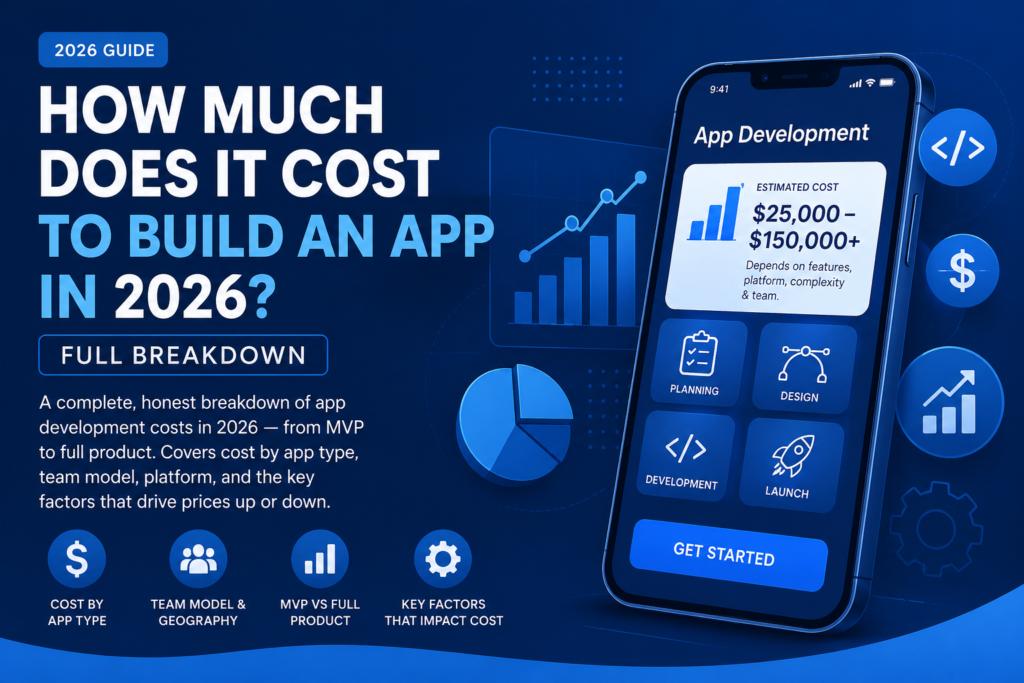
App Development Cost by Type: The Big Picture
| App Type | MVP Cost Range | Full Launch Product | Key Cost Driver |
| Simple web app (CRUD, basic auth) | $15,000 – $35,000 | $40,000 – $80,000 | Scope of features and integrations |
| Mobile app (iOS or Android) | $25,000 – $60,000 | $60,000 – $150,000 | Platform complexity, device testing |
| Mobile app (iOS + Android native) | $50,000 – $120,000 | $100,000 – $250,000 | Two codebases vs cross-platform |
| SaaS platform (B2B) | $40,000 – $100,000 | $100,000 – $400,000+ | Multi-tenancy, billing, permissions |
| Marketplace / two-sided platform | $60,000 – $150,000 | $150,000 – $500,000+ | Two user types, payments, matching |
| AI-powered application | $50,000 – $150,000 | $150,000 – $600,000+ | ML model development, data pipeline |
| Enterprise platform | $150,000+ | $500,000 – $2M+ | Compliance, integrations, scale |
The Factors That Drive App Development Costs Up or Down
Factor 1: Feature Scope and Complexity
Feature scope drives app development cost more than any other single variable. Consequently, teams that define scope precisely before requesting quotes receive estimates that reflect reality. In contrast, teams that describe their app in broad terms receive estimates that reflect the developer’s assumptions — which may or may not match theirs. Specifically, user authentication and account management, real-time features like notifications and messaging, third-party integrations, payment processing, and admin dashboards each add meaningful cost to an app build.
Factor 2: Platform Choice
Building for iOS and Android natively — two separate codebases in Swift and Kotlin — costs roughly twice as much as building for one platform. However, cross-platform frameworks like React Native and Flutter allow teams to build for both platforms from a single codebase at a 20-40% cost premium over a single platform rather than 100%. Furthermore, web apps typically cost less than native mobile apps of equivalent complexity because browsers provide more standardized environments and web development talent commands lower rates than iOS or Android specialists.
Factor 3: Team Model and Geography
| Team Model | Typical Rate Range | Best For |
| In-house team (UK/US) | $120,000 – $200,000+/year per engineer | Long-term product development |
| Agency (UK/US/Western Europe) | $100 – $200/hour | Quality-sensitive projects, IP protection |
| Agency (Eastern Europe) | $40 – $80/hour | Strong quality, lower cost than Western |
| Agency (South/Southeast Asia) | $20 – $50/hour | Budget-constrained MVPs with close oversight |
| Freelancers | $50 – $150/hour (varies widely) | Specific skills, short engagements |
| Hybrid (local PM + offshore dev) | $60 – $100/hour blended | Balance of oversight and cost efficiency |
Factor 4: Design Complexity
Design represents 15-25% of total app development cost in most projects. Specifically, a simple, template-based UI costs significantly less than a custom, brand-differentiated interface with bespoke animations, complex interaction patterns, and extensive user research informing every screen. Moreover, design revisions mid-development — when engineering has already built screens — cost two to three times more than revisions made during the design phase. Therefore, investing adequately in design before development begins consistently reduces total project cost.
Factor 5: Third-Party Integrations
Every third-party integration — payment processors, CRM systems, analytics platforms, email services, mapping APIs — adds development time and ongoing maintenance overhead. Furthermore, integration complexity varies enormously: connecting to a well-documented REST API with an official SDK takes a day. Additionally, integrating with a legacy enterprise system through undocumented SOAP endpoints can take weeks. Consequently, cataloguing required integrations early and researching their complexity directly improves estimate accuracy.
MVP Development Cost Breakdown: What Goes Into Each Phase
| Phase | Typical % of Budget | What Happens |
| Discovery & requirements | 8-12% | User research, requirements documentation, technical scoping |
| UX/UI design | 15-20% | Wireframes, user flows, visual design, prototype |
| Frontend development | 25-30% | User interface implementation across all screens |
| Backend development | 25-35% | API development, database, business logic, integrations |
| QA and testing | 10-15% | Functional testing, performance testing, bug fixing |
| Deployment and DevOps | 5-8% | CI/CD pipeline, cloud infrastructure setup, launch |
| Project management | 8-12% | Coordination, communication, documentation |
Hidden Costs That Founders Frequently Overlook
Ongoing Infrastructure and Hosting
App development cost covers the build — it does not cover the run. Specifically, cloud infrastructure costs (AWS, GCP, Azure) begin the moment the app launches and scale with usage. Moreover, a simple app might cost $50-200 per month to run initially. However, a SaaS platform with thousands of active users might incur $2,000-10,000 per month in infrastructure costs. Therefore, founders must model infrastructure costs as part of their financial planning before signing a development contract.
App Store Fees and Compliance
Apple charges $99 per year for App Store developer membership. Furthermore, Google charges a one-time $25 fee for Play Store access. Additionally, Apple’s App Store and Google Play each take a 15-30% commission on in-app purchases and subscriptions. Consequently, founders building subscription-based apps must factor platform commissions into their pricing and unit economics.
Maintenance and Feature Development Post-Launch
Industry benchmarks suggest that ongoing maintenance — bug fixes, OS compatibility updates, security patches, and minor feature additions — costs 15-20% of the original development budget annually. Furthermore, most apps require significant additional feature development in the 12 months after launch based on user feedback. Therefore, founders should budget for post-launch development as a continuing line item rather than treating the launch as the end of development spending. For more on managing long-term software costs, see our guide on technical debt management.
How to Reduce App Development Costs Without Cutting Quality
• Start with an MVP: build only the features that directly test your core value proposition. Consequently, you validate the concept before committing to full product build costs.
• Use proven third-party services: authentication (Auth0, Firebase Auth), payments (Stripe), notifications (OneSignal), and analytics (Mixpanel) save weeks of development time compared to building from scratch.
• Choose cross-platform development: React Native or Flutter for mobile delivers 70-80% of native performance at 60-70% of native development cost for most use cases.
• Fix scope before development begins: scope changes after development starts cost 3-5x more than scope defined upfront. Therefore, invest in a thorough discovery phase before writing a line of code.
• Hire a fractional CTO for technical oversight: for startups without technical co-founders, a fractional CTO provides architecture direction and vendor selection guidance that prevents expensive technical mistakes.
Frequently Asked Questions
Can I build an app for under $10,000?
Rarely, for a production-ready app. However, no-code and low-code platforms — Bubble, Webflow, Adalo, FlutterFlow — enable founders to build functional MVPs for $2,000-8,000 in platform fees and limited developer support. These platforms work well for validating concepts and acquiring early users. Consequently, many founders use no-code tools for initial validation before investing in custom development. However, no-code platforms impose architectural limits that eventually require migration to custom code as the product scales.
How long does it take to build an app?
A simple MVP takes 8-16 weeks with a focused team. Furthermore, a full-featured mobile app typically takes 16-32 weeks from kickoff to App Store submission. Moreover, complex SaaS platforms or marketplaces run 6-18 months for an initial launch. Therefore, founders planning a specific launch date should work backwards from that date and begin development planning 6 months earlier than the timeline suggests — accounting for delays that are statistically inevitable.
Should I use a freelancer or an agency to build my app?
Agencies provide project management, design, development, and QA as an integrated team — reducing coordination overhead for founders. Moreover, agencies carry insurance and provide continuity if individual team members leave. In contrast, freelancers offer lower rates and direct communication but require founders to manage coordination across disciplines. Consequently, agencies suit founders who want to focus on the product and business while delegating execution. Freelancers suit technical founders who want direct control and can manage the team themselves.
| Ready to Turn Your App Idea Into a Real Product?Our startup app development team delivers transparent, fixed-scope MVPs and full product builds for founders who want to know exactly what they are getting and exactly what it costs. Book a free scoping call and get a real estimate for your specific app.Talk to our team today -> AVENTISHUB |