
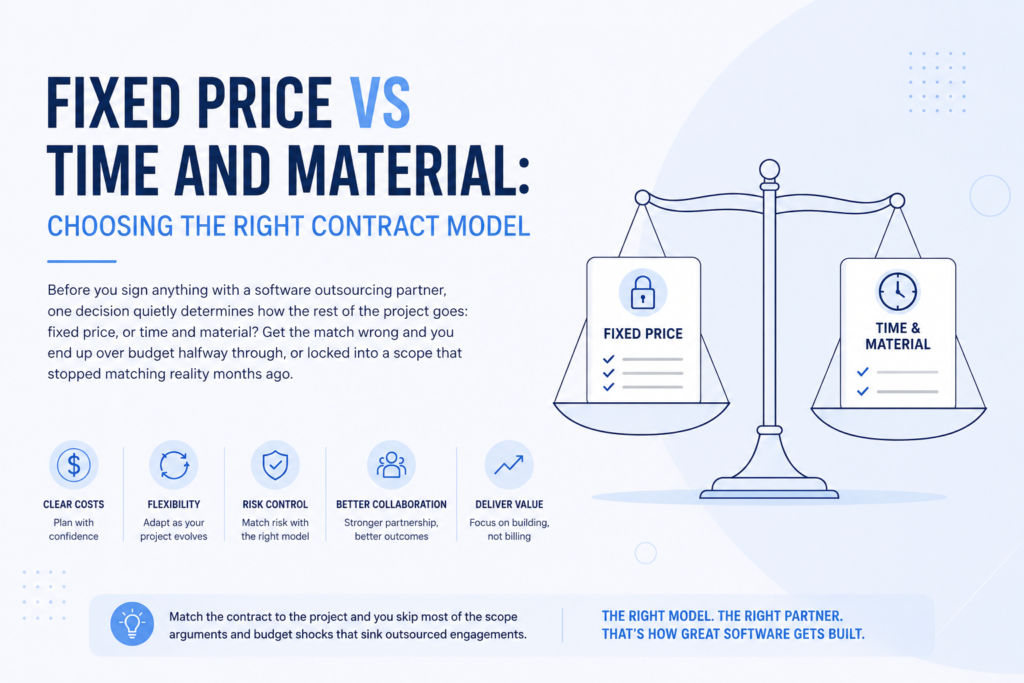
Before you sign anything with a software outsourcing partner, one decision quietly determines how the rest of the project goes: fixed price, or time and material? Get the match wrong and you end up in one of two bad places — over budget halfway through, or locked into a scope that stopped matching reality months ago.
Neither structure is inherently better. The real question is fit: how well-defined your scope actually is, how much risk you’re willing to carry, and how much the requirements are likely to move once work starts. Match the contract to the project and you skip most of the scope arguments and budget shocks that sink outsourced engagements. Miss the match and you’ll spend the back half of the project fighting about billing instead of building.
What a Fixed Price Contract Actually Is
The name gives it away. Before any code is developed, you and the vendor agree on the scope, schedule, and final cost; this amount remains constant regardless of how the job turns out.
The catch is that this only works if the scope was nailed down first. That means detailed specifications, mapped-out user flows, and edge cases discussed in advance — the groundwork a business analyst and a wireframe pass are supposed to cover. Skip that step and the whole arrangement starts to wobble the moment reality diverges from the plan.
Think of it like commissioning a custom cabinet from a woodworker. You describe exactly what you want, they quote a price, and that price doesn’t move just because the wood gave them trouble halfway through.The customer is aware of the number entering . The vendor absorbs whatever goes sideways during the build — an underestimated feature, a two-week delay, a technical wrinkle nobody expected. As long as you don’t ask for anything beyond what was agreed, your cost is locked.
What a Time and Material Contract Actually Is
A time and material (T&M) arrangement bills for actual work performed: hours logged, at rates set in advance. Nothing is locked upfront. The invoice reflects what genuinely happened during the sprint, not a number agreed on before anyone understood the problem.
Scope here isn’t fixed at the start; it’s discovered as the team builds, tests, and reacts to what they learn. Specs give way to sprints. Priorities shift as feedback comes in. What ships at the end can look meaningfully different from what was pitched in the kickoff meeting, and that’s often a sign the process did its job rather than a sign something went wrong. It’s also why agile teams gravitate toward T&M almost by default — iterative development and locked-scope billing don’t sit well together.
A better comparison than furniture: hiring a contractor for a renovation where you know the rough direction but haven’t finalized every detail. You and the contractor work out specifics as the job progresses, and what lands on the final bill is whatever actually got built, not a guess made before demo day.
The trade-off is that risk moves toward the client. If velocity runs slower than expected, or nobody’s actively managing scope and priorities, budgets creep. But there’s an upside worth naming: you’re not paying in advance for risks that might never show up. A fixed price bid usually has a cushion baked in for exactly that uncertainty.Because you are just paying for what actually occurred, there is no buffer with T&M.
Fixed Price vs Time and Material: A Direct Comparison
| Factor | Fixed Price | Time & Material |
| Scope definition | Locked before work starts | Develops as the project unfolds |
| Budget predictability | High — total cost set in advance | Variable — tied to hours actually worked |
| Flexibility | Low — changes need a formal change order | High — reprioritizing between sprints is easy |
| Risk allocation | Vendor carries overrun risk | Client carries scope and time variability |
| Best fit | Stable, well-understood projects | Projects still being figured out |
| Contract management | Simple once scope is set | Needs ongoing, active collaboration |
| Vendor relationship | More transactional | More of an ongoing partnership |
| Speed to start | Slower — scoping takes real time | Faster — work can begin almost immediately |
| Ideal methodology | Waterfall or structured delivery | Agile, iterative builds |
When Fixed Price Actually Makes Sense
Fixed price works well in a narrower set of situations than people assume. Run through these questions before choosing it:
- Is the scope genuinely documented in detail — not just feature names, but workflows and edge cases spelled out ahead of time?
- Is this a project type you’ve seen before, something like a website rebuild, a known integration, or an app with a settled feature list?
- Has the tech stack already been decided? Uncertainty at that layer tends to surface later as scope uncertainty, and that’s exactly what breaks fixed price arrangements.
- Are you operating under a strict budget cap that is unchangeable? If so, fixed price earns its premium even when it costs more overall.
There’s also a procurement reality worth naming honestly: finance teams like fixed price because it maps cleanly onto a purchase order. One number, no movement, a clean audit trail. That’s less about what actually fits the project and more about internal approval processes, but if you’re navigating procurement, it’s a legitimate factor.
One thing worth watching for: vendors who specialize in fixed price work tend to spend real time and money on discovery before quoting. If a vendor offers you a fixed price number without much of a discovery phase, take that as a warning sign. Either they’re guessing at the number, or they’re planning to make up the difference later through change orders.
When Time and Material Fits Better
Most software projects don’t start with a fully-formed spec. Requirements shift. Markets move. Teams discover technical constraints mid-build that nobody could have flagged on day one.Every time something changes, T&M is designed to handle it all without requiring a contract update.
Reach for T&M when:
- There’s no clean precedent for what you’re building. There are nearly always surprises with genuinely new items, and locking a scope before those surprises appear only ensures that change orders will be issued within a few weeks.
- Your team actually works agile. The Agile Manifesto is built around adapting the plan as you learn, and a contract that penalizes every shift in priority works against that on principle.
- Getting to market fast matters more than knowing the final number today. Work can start almost immediately instead of waiting through weeks of requirements documentation.
- You want a partnership dynamic, not a vendor relationship. Under T&M, the team isn’t rewarded for cutting corners to protect a margin. They’re rewarded for doing work good enough to keep the relationship going.
- You’re building inside a startup, or innovating inside a larger company. Plans change. A contract that fights every pivot is a contract working against you.
There’s a quieter argument for T&M too. When a fixed price quote carries real technical uncertainty, vendors pad it, because they have to. That padding can run 20 to 40 percent above what the work would actually cost. If your team keeps velocity steady and scope reasonably disciplined, T&M can genuinely land cheaper than the fixed price alternative.
Hybrid Models: Taking Pieces of Both
The choice isn’t strictly one or the other. A lot of mature outsourcing relationships blend elements from both models.
Fixed first, then flexible. Scope the first milestone, an MVP or working prototype, as fixed price. Ship it, test your assumptions against what actually happened, then shift the rest of the build to T&M. You get budget certainty early, without committing to a rigid structure for work that hasn’t taken shape yet.
T&M with a ceiling. Bill hourly as usual, but cap total spend at an agreed maximum. You keep flexibility during the engagement while guaranteeing a hard stop if things run long.
Phase-by-phase T&M. Break the project into defined stages, bill each one at actual cost, and put a review checkpoint between phases. You get natural pause points without locking every detail down at the start.
These arrangements ask more of both sides — communication has to be consistent and clear — but they often match how complicated, real-world projects genuinely play out.
Negotiating Either Model Without Getting Burned
The billing model matters, but the fine print inside it matters just as much. PMI’s research on project performance points to unclear contract terms, not the billing structure itself, as the source of most vendor disputes. A handful of things worth pinning down before signing, no matter which model you land on:
If you’re going fixed price:
- Spell out exactly what counts as a change order and what doesn’t. Ambiguity here gets expensive fast.
- Build a reasonable number of revision rounds into the base scope so small tweaks don’t trigger a new invoice.
- Settle on acceptance criteria before delivery, not once the work is sitting in front of you.
If you’re going T&M:
- Agree upfront on how often you’ll get reporting — timesheets, sprint velocity numbers, or both.
- Ask for a rate breakdown by role instead of one blended number. A blended rate can hide the fact that you’re paying senior rates while junior staff do most of the actual work.
- Define sprint mechanics early: who sits in planning, what “done” actually means, and how new work gets added to the backlog.
- Include a real exit clause, typically around 30 days’ notice, so either side can walk away if the engagement stops working. Vendors worth working with generally don’t fight you on this.
A well-drafted contract won’t rescue a project that’s already going badly. What it does is close off the ambiguity that turns into a dispute in the first place.
What Actually Breaks a Project
Most comparisons of these two models stop at the billing mechanics, and that’s the wrong place to end the conversation.
A communicative, transparent team running T&M will usually deliver something solid. A fixed price vendor who disappears for three weeks and only resurfaces to raise scope disputes will sink the project regardless of how the contract was structured.
Before picking a model, ask any vendor you’re considering how they handled a past project where requirements changed midway through. Ask what happened the last time they realized they’d underbid a job. The answers tell you more than any rate card comparison will.
Landing on the Right Choice for Your Project
There’s no single correct answer here, only the answer that matches your situation.
Tight, stable scope and a hard budget ceiling point toward fixed price. A product still evolving, with regular feedback loops, points toward T&M. Most real engagements sit somewhere between the two, and the strongest partnerships are structured to reflect that honestly instead of forcing a clean either/or.
In the end, the billing model on paper matters less than whether you’ve found a partner who communicates early, surfaces problems before they snowball, and ships work that holds up. Get that part right, and either contract structure can work fine
FAQs
1. Can I switch from fixed price to T&M partway through a project? You can, but it requires an actual renegotiation, with both sides agreeing on new billing terms and what’s already been delivered under the old one. Most teams don’t attempt this mid-stream. A cleaner path is planning the switch from the start: scope phase one as fixed price, then move to T&M once that milestone ships and both sides have a working sense of how the team operates.
2. Is one model generally better for startups? Time and material tends to fit startups better, since requirements shift quickly in early-stage products. Fixed price only works when a startup already has an unusually clear scope, which is uncommon that early on.
3. Under fixed price, will I ever pay more than the agreed number? Yes, if you ask for changes. Most fixed price agreements include a change order mechanism that adds cost for anything outside the original scope. Fixed price locks the scope, not just the price — anything beyond that scope carries an additional charge.
4. Is T&M inherently riskier for the client? It can be, if nobody’s managing it actively. Regular sprint oversight, clear prioritization, and tracked velocity keep T&M budgets on target. The risk usually comes from a disengaged client, not from the billing model itself.
5. What’s a reasonable hourly rate for an offshore T&M engagement? It varies a lot by region. Pricing data from Clutch generally places senior engineers in Eastern Europe around $40–$80 an hour, while teams across South and Southeast Asia tend to run closer to $25–$55. Those ranges shift with seniority, tech stack, and agency overhead, so rate alone shouldn’t be your main filter — delivery history and communication quality matter just as much.
6. How do vendors protect their margin under T&M? They mostly don’t need to the way fixed price vendors do. Billing for actual hours worked is the protection. That’s part of why T&M often ends up cheaper — there’s no built-in risk premium the way there is with a fixed quote.
7. Can fixed price work for an agile project? It’s a rough fit. The Agile Manifesto centers on responding to change over sticking to a plan, which runs against locked scope by definition. Some vendors market “agile fixed price” packages, but in practice that’s usually T&M capped at the sprint level with different branding. Ask exactly what happens if priorities shift mid-sprint before signing — the answer tells you what you’re really getting.
8. What belongs in a solid T&M contract? At minimum: rates broken out by role rather than one blended figure, an agreed billing cadence, a clear timesheet and sign-off process, defined sprint cadence, a dispute escalation path, a termination clause with fair notice, and clarity on IP ownership. If a proposed contract is missing most of these, send it back before signing.
9. How should I estimate total cost on a T&M project? Ask for a range rather than a single fixed number, based on current scope. A vendor worth working with will give you a realistic low-to-high bracket instead of a false-precision figure, and you can budget around the midpoint. PMI’s Pulse of the Profession research shows cost overruns are common even on carefully planned software projects, so building in a 15–20% contingency isn’t padding, it’s realism.
10. Which model tends to dominate long-term outsourcing relationships? Time and material, generally. Fixed price suits discrete, bounded deliverables better than ongoing work.Long-term product development inherently leans toward T&M or one of the aforementioned hybrid frameworks.