
Nobody picks between staff augmentation vs outsourcing for fun. Usually someone’s roadmap just slipped, or a client tripled the scope of a project without moving the deadline, and now there’s a real decision to make by Friday. Gartner or Statista report on global IT talent shortage] has the broader numbers on why hiring is taking longer across the board, which is the actual reason this question keeps coming up in the first place.
Staff augmentation puts a person inside your team. You keep the standups, the ticketing system, the whole structure you already have, and someone new just joins it. Outsourcing is the opposite move. You hand a piece of work to a team that has its own structure, its own process, and its own way of doing things, and you step back from a lot of the day-to-day.
They’re solving the same shortage. They just don’t feel the same six weeks into the project.
What Is Staff Augmentation?
IT staff augmentation is hiring one developer, tester, or DevOps engineer at a time to work inside your existing setup. Not a team. One person, plugged into what you already run.
Say you need a backend engineer with Postgres experience for four months. You don’t need a new vendor contract or a new process. You need someone who can start in two weeks and already knows the stack, and that’s what this model is built for.
A decent staff augmentation services provider takes a few things off your plate without you having to ask. Instead of forwarding a stack of resumes and hoping one sticks, a decent provider filters candidates by the exact frameworks and tools your production environment already runs on. Payroll and the employment paperwork stay with them. The person you hire reports to your lead, day to day, not to some account manager who checks in once a month by email. Most contracts let you exit in two to four weeks if it’s not working out, and that clause matters more than it sounds like on paper.
Here’s where it breaks, though. This model assumes your internal management already has slack in it. Put a new contractor under a lead who’s already buried, and nothing gets easier. The slowdown just shows up somewhere less obvious, like code review sitting for three extra days. And there’s a real ceiling on how far it scales. Two or three people, fine. A full 20-person team built one augmented hire at a time? That usually falls apart, mostly because your managers run out of hours before the team gets built.
What Is Outsourcing?
Outsourcing is handing off a whole scope of work, with a deadline and a budget attached, to a company that owns getting it done. You stop managing individuals. You start managing a vendor relationship instead, which is a different skill entirely.
Two setups get confused constantly here: dedicated development team and managed development team. The names sound close enough that people use them interchangeably in meetings, which causes real problems later when the contract doesn’t match what someone expected.
A dedicated team is a group of engineers who work only on your project but are employed by the vendor. You still run sprint planning. You still review the code, set priorities, and make the calls day to day, same as you would with an internal team. The vendor just deals with hiring, retention, and finding a replacement if someone quits. Pricing is usually a flat rate per engineer per month regardless of hours logged that week. In practice this sits close to staff augmentation. The vendor’s really just handling payroll.
A managed team is a bigger shift. You get engineers, plus a project manager, plus a delivery process, and what you’re accountable for shifts from hours worked to whether milestones actually landed. Your own management load drops a lot here. Instead of sitting through every standup, you’re reviewing progress at agreed checkpoints, and when a deadline gets missed, fixing it sits on the vendor’s side of the table. What you give up is the granular stuff. You can steer where the roadmap goes. You don’t decide what happens inside this week’s sprint.
Teams that are already stretched on management time usually end up choosing managed teams for exactly that reason. Teams that want a hand in engineering decisions every single day tend to stick with dedicated teams, or just plain staff augmentation.
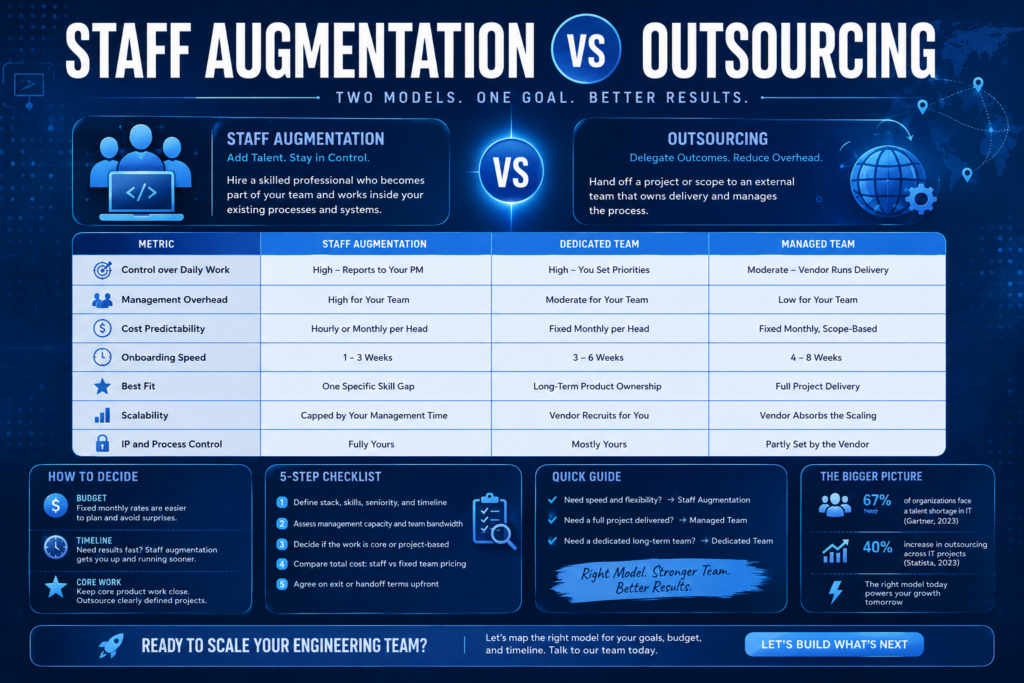
Staff Augmentation vs Outsourcing: Comparison Table
| Metric | Staff Augmentation | Dedicated Team | Managed Team |
| Control over daily work | High, reports to your PM | High, you set priorities | Moderate, vendor runs delivery |
| Management overhead | High for you | Moderate for you | Low for you |
| Cost predictability | Hourly or monthly per head | Fixed monthly per head | Fixed monthly, scope-based |
| Onboarding speed | 1 to 3 weeks | 3 to 6 weeks | 4 to 8 weeks |
| Best fit | One specific skill gap | Long-term product ownership | Full project delivery |
| Scalability | Capped by your management time | Vendor recruits for you | Vendor absorbs the scaling |
| IP and process control | Fully yours | Mostly yours | Partly set by the vendor |
How to Actually Decide: Budget, Timeline, and Core Work
Start with budget. A fixed monthly rate is just easier to plan around than an hourly contract that shifts every time scope changes slightly, and if finance hates surprises on the invoice, that alone can settle the question.
Then timeline. Need someone writing production code inside two weeks? Staff augmentation is really the only model that hits that window. Outsourced teams need time to learn the codebase, get access sorted, and build trust with your team before they’re actually useful, and no vendor pitch makes that ramp-up disappear.
Last, look at how close the work sits to what you actually sell. Keep anything core to the product close, through staff augmentation or a dedicated team, so the knowledge doesn’t leave with the contract. Something with a clear start and end, like a data migration or a round of QA automation, is a fine thing to hand fully to a managed team and stop thinking about.
5-Step Checklist: Evaluating Your Needs Before Choosing a Vendor
- Write down the exact stack, seniority level, and timeframe before calling a single vendor. Vague requirements get you vague proposals back.
- Look at how many more direct reports your current leads can actually take on. Not in an ideal world. Right now, this quarter.
- Decide if this touches your core product or sits closer to something you’d be fine handing off entirely.
- Run the math on hourly staff augmentation versus fixed team pricing across the whole project, not just month one, because that’s where the real gap shows up.
- Nail down what a clean exit or handoff looks like before you sign. Negotiating that after the relationship’s already strained is much harder.
Making the Call
There’s no universal winner between staff augmentation vs outsourcing. It comes down to how much control you want day to day, how much spare management capacity actually exists on your team, and how close the work sits to what makes your product different from everyone else’s.
Plenty of teams run both at once. A small dedicated core team owns the product long term, and staff augmentation fills in around seasonal spikes. internal guide — software development cost breakdown by engagement model] breaks down how those costs actually add up across a full year.
Once you’ve picked a model, managing a distributed team is its own separate problem, and agile management tips for remote engineering teams] covers that. If location factors into the decision too, offshore vs nearshore development comparison is worth reading before anything gets signed.
Ready to Scale Your Engineering Team?
If you’re weighing one senior hire against a full managed team, we can help map that against your actual budget and timeline first. Talk to our team-scaling specialists today for a recommendation built around your situation, not a generic pitch.
FAQ
Are there hidden costs in staff augmentation or outsourcing contracts? Usually. They show up in onboarding time, tooling licenses, and time-zone overlap that never made it into the quoted rate. Get the full breakdown, ramp-up included, before you sign anything.
Who owns the intellectual property when you outsource development work? It needs to be in the contract itself, not assumed from a conversation. Most established vendors will assign full IP to the client, but that has to be written into the master service agreement, because a verbal promise won’t hold up if there’s ever a dispute later.
How do you manage communication challenges with an outsourced or augmented team? Fix an overlap window for live meetings. Put decisions in writing instead of trusting a call nobody wrote down. Name one point of contact on each side, since most of the real delays trace back to messages that got lost, not to time zones themselves.