
Introduction
The phrase “just build an AI for it” has become reflexive in boardrooms and product meetings. But for engineering teams and technology buyers who need to make real architectural decisions, the nuances matter enormously.
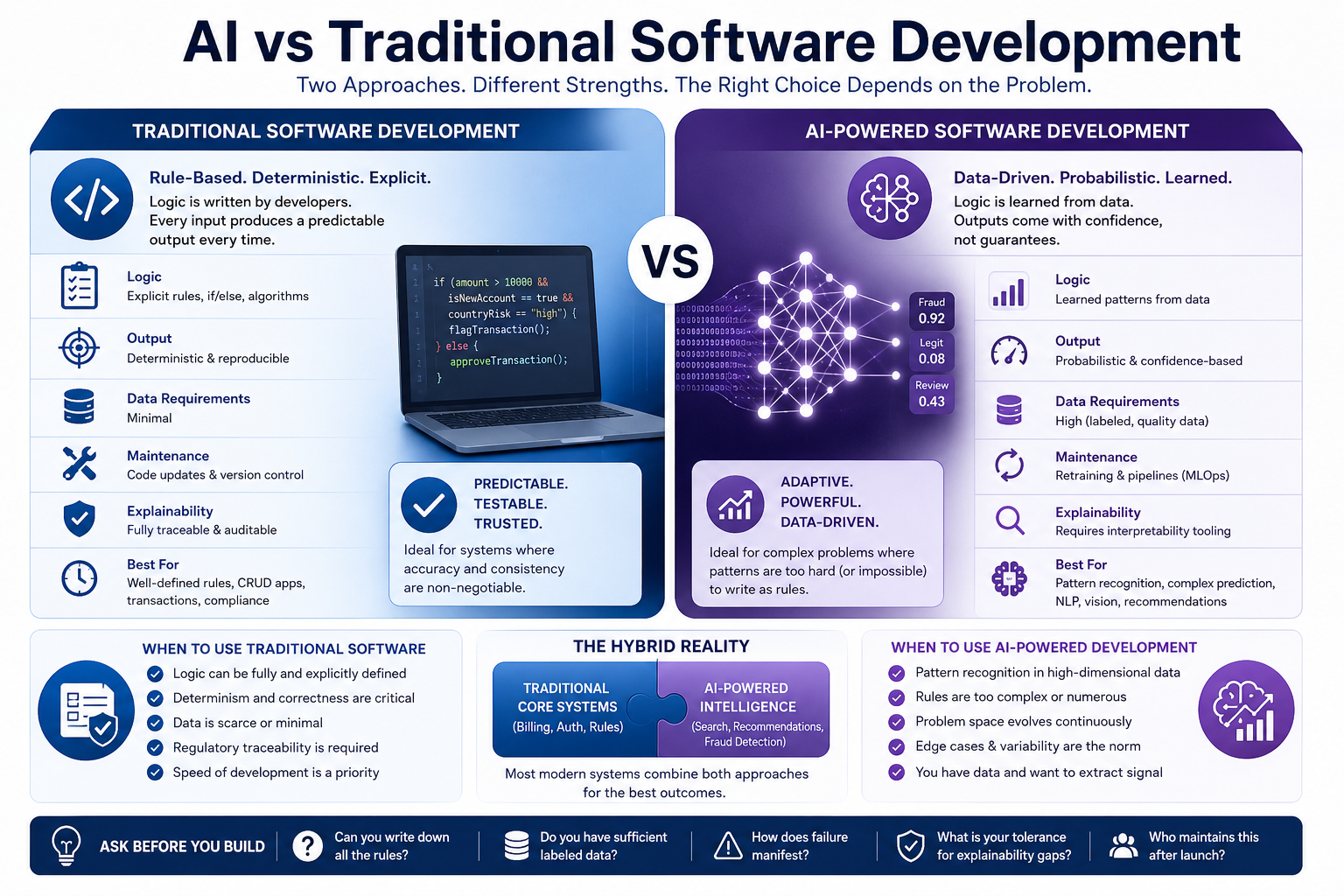
AI vs traditional software development is not simply a question of which approach is more advanced. It is a question of which is appropriate, for the problem, the data, the team, and the timeline. Getting this wrong is expensive in both directions: applying AI where rule-based logic suffices wastes resources, while applying traditional software engineering to inherently probabilistic problems sets projects up to fail.
This guide gives you a practical framework for understanding both paradigms and making the right call.
What Is Traditional Software Development?
Traditional software development, often called rule-based or deterministic software engineering, involves explicitly programming the logic a system follows. A developer writes instructions that define exactly how the software responds to every input.
The output is predictable: given input A, the system will always produce output B. Behavior is deterministic, testable, and fully traceable to the code itself.
Core characteristics:
- Behavior is explicitly defined by human-written code
- Logic follows if/else structures, algorithms, and business rules
- Output is deterministic and reproducible
- Bugs are traceable to specific lines of code
- Changes require developer intervention
Traditional custom software development has produced the vast majority of enterprise software: ERP systems, CRMs, financial platforms, e-commerce engines, mobile apps, and APIs. For well-defined problems with deterministic logic, it remains the right tool.
What Is AI-Powered Software Development?
AI-powered software development refers to building systems where some or all of the core logic is learned from data rather than explicitly coded. Instead of a developer writing rules, a machine learning model infers patterns from large datasets and uses those patterns to make predictions or decisions.
The most common forms include:
- Supervised learning: Models trained on labeled examples to classify, predict, or score
- Deep learning: Neural networks trained on large datasets for complex tasks like image recognition, NLP, or speech
- Large language models (LLMs): Foundation models fine-tuned or prompted for text understanding and generation
- Reinforcement learning: Systems that learn optimal strategies through trial and feedback
Core characteristics:
- Behavior emerges from training data, not explicit rules
- Output is probabilistic, confidence levels, not guaranteed correctness
- Performance improves (or degrades) with data changes
- Bugs manifest as model errors or bias, not code defects
- Changes often require retraining, not just code edits
AI software development services typically involve not just software engineering but also data engineering, model training infrastructure, and MLOps — a broader and more complex discipline than traditional software delivery alone.
Key Differences: A Direct Comparison
1. How Logic Is Defined
In traditional software, logic is explicit. A fraud detection rule might say: “Flag any transaction over $10,000 from a new account.” Every condition is written by a developer.
In AI-powered development, logic is inferred. A fraud detection model trained on millions of historical transactions learns to recognize complex, non-obvious patterns that a human could not feasibly encode into rules. The tradeoff: explicit logic is transparent and controllable; learned logic is more powerful for complex pattern recognition but less interpretable.
2. Data Requirements
Traditional custom software development does not require training data. It needs well-defined requirements and skilled engineers. AI development is fundamentally data-dependent. The quality, quantity, and representativeness of training data directly determines model performance, creating a significant front-loaded investment in data collection, cleaning, and annotation.
3. Performance Characteristics
Traditional software performs consistently. An algorithm that sorts a dataset correctly does so every time, regardless of inputs. AI models have statistical performance. A model with 95% accuracy is wrong 5% of the time, and AI systems require ongoing monitoring because performance can drift as real-world data distributions shift away from training data.
4. Maintenance and Change Management
Traditional software is changed by updating code. Changes are discrete, testable, and reversible. AI systems change through retraining. Updating model behavior requires new data, retraining pipelines, validation against hold-out sets, and careful deployment, workflows that traditional software engineering teams are not designed to handle.
5. Explainability
Traditional software is inherently explainable. You can trace any output to the exact lines of code that produced it. Many AI models, especially deep neural networks, are effectively black boxes. In regulated industries, explainability is not optional and requires dedicated interpretability tooling.
6. Development Timeline and Cost Structure
Traditional software development has a relatively predictable cost curve. AI development has a more front-loaded and variable cost structure. Data acquisition, annotation, and iterative model experimentation make early-phase costs harder to estimate. However, once a model is working well, it can handle tasks that would require enormous amounts of traditional software logic, or that would be impossible to encode at all.
When to Use Traditional Software Development
Traditional software engineering is the right choice when:
- The logic can be fully and explicitly defined, payroll, inventory management, scheduling, and CRUD applications are excellent candidates
- Determinism is a hard requirement, financial reconciliation, legal document generation, and safety-critical systems often require exact, auditable, repeatable outputs
- Data is scarce, supervised learning requires substantial volumes of representative, labeled data
- Regulatory traceability is required, in contexts where every decision must be fully auditable and traceable to written rules
- Speed of development matters more than flexibility, well-scoped traditional software projects are generally faster to deliver than AI projects
When to Use AI-Powered Software Development
AI software development services become the right investment when:
- The problem involves pattern recognition in high-dimensional data, images, natural language, audio, sensor streams, and complex behavioral data contain patterns that are computationally impossible to encode as explicit rules
- The rules are too complex or too numerous to write, customer churn prediction, credit scoring, personalization engines, and demand forecasting involve so many interacting variables that rule-based approaches quickly become unmanageable
- The system needs to handle edge cases gracefully, well-trained AI models can generalize to inputs the developers never explicitly anticipated
- The problem space evolves continuously, spam filters, fraud detection, and content moderation face adversarial evolution that static rule sets cannot keep pace with
- You have data and want to extract signal from it, if your organization has large volumes of historical data, AI development can extract predictive value in ways traditional software cannot
The Hybrid Reality: Most Modern Systems Use Both
The AI vs traditional software development framing is useful for analysis, but in practice, the most robust production systems combine both approaches deliberately. A customer-facing application might use traditional software engineering for its core business logic, authentication, billing, subscription management, while incorporating AI-powered components for search ranking, recommendation, fraud detection, and customer service automation.
The discipline of software engineering increasingly requires practitioners to understand both paradigms and know how to compose them effectively. The decision is not binary; it is architectural.
Questions to Ask Before Choosing Your Approach
- Can you write down all the rules? If yes, you likely do not need AI. If the logic is too complex to fully enumerate, AI is worth considering.
- Do you have sufficient labeled data? Estimate data availability honestly before committing to an AI approach.
- How does failure manifest? If occasional errors are acceptable and confidence scores can triage uncertain cases, AI works well. If every output must be exactly correct, reconsider.
- What is your tolerance for explainability gaps? If regulators or auditors will demand detailed explanations for every decision, ensure your AI approach includes robust interpretability tooling.
- Who maintains this after launch? AI systems require MLOps expertise for monitoring, retraining, and deployment. Factor talent availability into your decision.
Working with a Development Partner on This Decision
One underappreciated value of a strong machine learning development company or custom software development partner is helping you make this architectural decision correctly before writing a line of code.
Be cautious of vendors who push AI solutions reflexively, without thoroughly understanding your requirements, data situation, and operational constraints. Equally, be cautious of partners who dismiss AI wholesale as hype. The best partners will be candid: sometimes the right answer is traditional software, sometimes it is AI, and often it is a thoughtful combination of both.
Summary: Making the Right Call
| Factor | Traditional Software | AI-Powered Software |
| Logic definition | Explicit rules | Learned from data |
| Output type | Deterministic | Probabilistic |
| Data requirements | Minimal | High (labeled data) |
| Maintenance | Code updates | Retraining pipelines |
| Explainability | Full | Requires tooling |
| Best for | Well-defined rules, auditable systems | Pattern recognition, complex prediction |
| Failure mode | Bugs | Model errors and drift |
Neither approach is universally superior. The organizations that build the most effective technology systems are those that understand both paradigms and apply them where they genuinely fit.
Unsure which development approach fits your next project? A structured discovery engagement with an experienced partner can map your requirements to the right architecture — before significant investment is committed.