Introduction
Businesses building IoT products face a growing challenge: devices generate enormous amounts of data, but sending all of it to the cloud is slow, expensive, and sometimes impossible in areas with limited connectivity. This is exactly where edge AI development services step in to change the game.
Edge AI combines artificial intelligence with edge computing, enabling smart processing directly on the device — no cloud round-trip required. If you are an IoT product company, a CTO evaluating new architecture strategies, or an embedded systems engineer, understanding edge AI development is essential for building the next generation of intelligent, responsive, and cost-efficient IoT products.
In this guide, we break down exactly what edge AI development services involve, why they matter for IoT products, the key benefits and challenges, real-world use cases, and how to choose the right partner to build your solution.
What Is Edge AI Development?
Edge AI development refers to the process of designing, training, deploying, and optimizing artificial intelligence models that run directly on edge devices — such as microcontrollers, embedded processors, industrial gateways, or smart sensors — rather than in centralized cloud infrastructure.
Traditional AI systems send raw data to the cloud, process it remotely, and return a result. Edge AI development services eliminate this cycle by running inference directly at the data source.
The key components involved in edge AI development include:
- AI model design and training — building lightweight, efficient models suited for resource-constrained hardware
- Model compression and optimization — techniques like quantization, pruning, and knowledge distillation to reduce model size
- Embedded software development services — writing firmware and runtime software that integrates the AI model into the device
- Hardware-software co-design — selecting the right edge processors (NPUs, DSPs, FPGAs) for specific workloads
- Edge inference engines — deploying models using frameworks like TensorFlow Lite, ONNX Runtime, or OpenVINO
An experienced IoT development company offering edge AI development services will handle all of these layers, from algorithm design to hardware integration and deployment.
How Edge AI Works in IoT Products
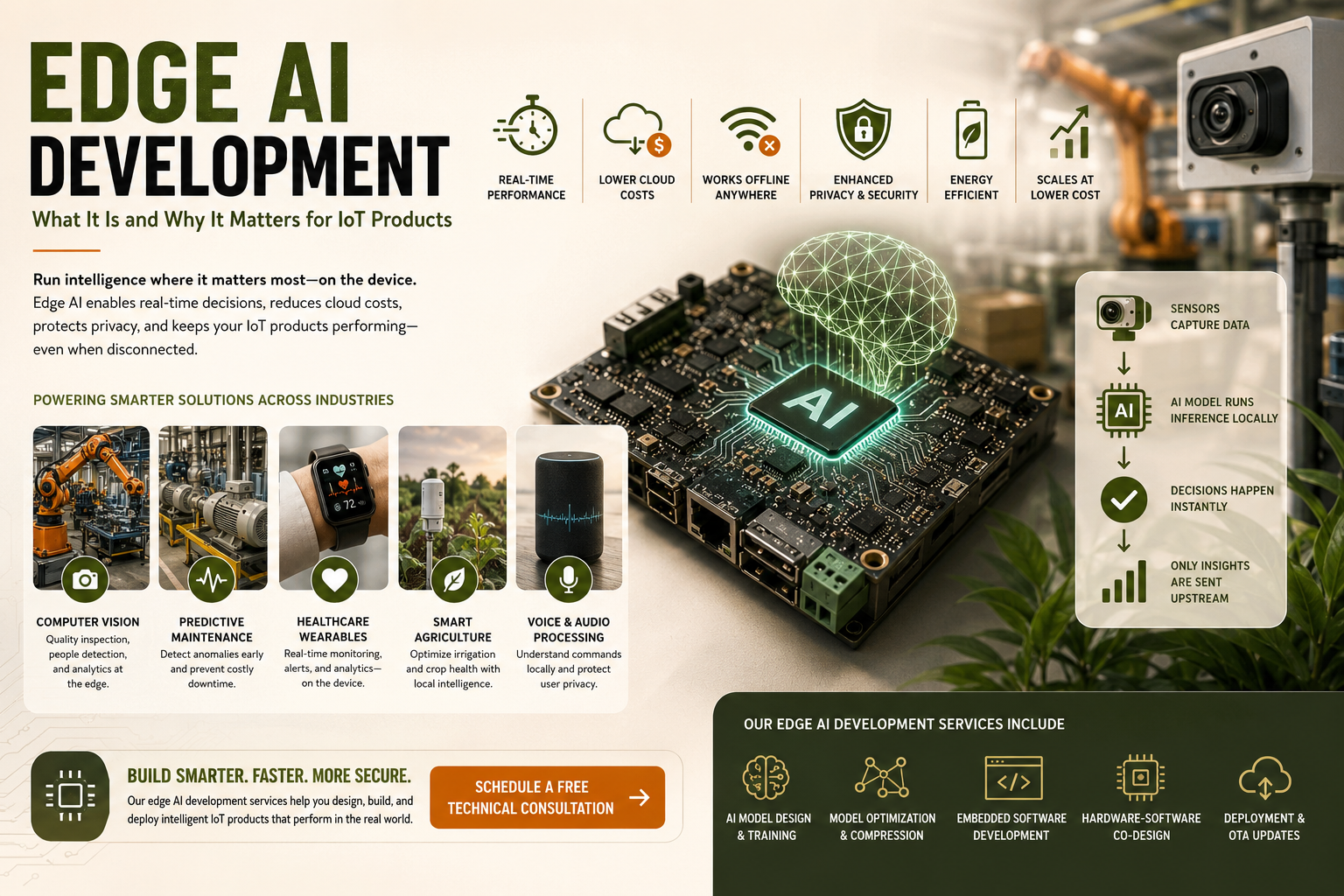
To understand edge AI development services, it helps to trace the data flow in a typical IoT product:
- Sensors collect data — cameras, microphones, accelerometers, temperature sensors, or LiDAR capture environmental signals.
- The AI model runs inference locally — the embedded AI model processes the raw data in real time on the device itself.
- Decisions happen instantly — the device acts on the result without waiting for cloud confirmation.
- Only relevant summaries or anomalies are sent upstream — instead of streaming gigabytes of raw data, the device sends compact, high-value insights.
This architecture is fundamentally different from cloud-dependent IoT. Edge AI development services make this architecture possible by embedding optimized neural networks and computer vision models directly into your hardware.
Why Edge AI Development Matters for IoT Products
Edge AI is not just a technical upgrade — it is a strategic shift that impacts product performance, user experience, cost structure, and competitive positioning. Here is why every serious IoT product team should evaluate edge AI development services today.
1. Real-Time Performance Without Latency
Cloud-dependent AI introduces latency that is unacceptable in many IoT applications. A factory robot making safety decisions, a medical wearable monitoring cardiac activity, or an autonomous vehicle detecting obstacles cannot afford a 200–500ms cloud round-trip. Edge AI development services enable sub-millisecond inference directly on the device, making real-time applications genuinely feasible.
2. Reduced Bandwidth and Cloud Costs
IoT devices can generate terabytes of raw data per day. Transmitting all of it to the cloud is expensive and often impractical. By using AI software development services focused on edge deployment, you process data locally and only transmit meaningful insights. This dramatically cuts bandwidth consumption and cloud infrastructure costs.
3. Offline and Disconnected Operation
Many IoT deployments operate in environments with unreliable or no internet connectivity — remote industrial facilities, agricultural fields, offshore platforms, or underground infrastructure. Edge AI development services ensure your product continues functioning intelligently even when disconnected from the network.
4. Privacy and Data Security
Sensitive data — patient health signals, facial recognition output, private conversations captured by voice devices — never has to leave the device when processed at the edge. This is a critical compliance and trust advantage, especially in healthcare, legal, and consumer electronics markets.
5. Energy Efficiency
Modern embedded software development services combined with purpose-built AI accelerators (like ARM Ethos, Google Edge TPU, or NVIDIA Jetson) enable highly efficient inference with minimal power draw — essential for battery-powered IoT products.
6. Scalability at Lower Cost
When AI runs on the device, scaling from 1,000 to 1,000,000 deployed units does not proportionally increase your cloud compute bill. Edge AI development services shift computational cost to a one-time hardware investment rather than recurring per-unit cloud charges.
Key Use Cases for Edge AI in IoT Products
Edge AI development services are being applied across virtually every industry where IoT devices are deployed. Here are the most impactful current applications:
Computer Vision at the Edge
Computer vision is one of the most mature and widely deployed edge AI capabilities. Use cases include:
- Quality control in manufacturing — cameras running embedded vision models inspect products on the assembly line at thousands of frames per second, flagging defects without human intervention.
- Retail analytics — shelf cameras using edge computer vision count inventory, detect misplaced items, and analyze shopper behavior locally.
- Smart surveillance — edge devices run person detection and anomaly recognition without streaming video footage to a central server.
An experienced IoT development company with computer vision expertise can deploy models like MobileNet, YOLO-Nano, or EfficientDet directly on embedded hardware with GPU or NPU acceleration.
Predictive Maintenance in Industrial IoT
Vibration sensors, temperature monitors, and acoustic sensors on industrial equipment use edge AI development services to detect early signs of mechanical failure. Rather than uploading continuous sensor streams, the device itself flags anomalies and triggers maintenance alerts — reducing downtime and maintenance costs significantly.
Wearable Health Monitoring
Smartwatches and medical wearables use embedded AI models to interpret ECG signals, detect falls, identify sleep stages, and flag irregular heart rhythms. These decisions must happen in real time on the device for both accuracy and battery life. This is a specialized area requiring deep expertise in both AI software development services and embedded hardware constraints.
Smart Agriculture
IoT sensors deployed across large agricultural fields use edge AI to analyze soil moisture, weather conditions, and crop images to make irrigation and treatment decisions locally. Connectivity in rural areas is limited, making edge deployment essential rather than optional.
Voice and Audio Processing
Smart speakers, industrial voice interfaces, and edge assistants use on-device natural language processing models to understand commands locally, sending only intent data — not raw audio — to backend systems. This addresses both latency and privacy concerns simultaneously.
Core Technologies in Edge AI Development Services
Building effective edge AI solutions requires expertise across several interconnected technology domains. Here is what your IoT development company partner should bring to the table:
Embedded Software Development Services
The software layer that runs an AI model on a microcontroller or embedded processor is highly specialized. It requires expertise in C/C++, real-time operating systems (RTOS), driver development, memory management, and power optimization. Embedded software development services form the foundation of any edge AI product.
Model Compression and Optimization
Standard deep learning models designed for cloud GPUs are far too large for edge deployment. Skilled AI software development services teams apply techniques including:
- Quantization — reducing model weights from 32-bit floats to 8-bit integers
- Pruning — removing redundant neurons and connections
- Knowledge distillation — training a small “student” model to mimic a larger “teacher” model
- Neural Architecture Search (NAS) — automatically finding the most efficient architecture for a given hardware target
Edge AI Frameworks
Key deployment frameworks your edge AI development team should master include TensorFlow Lite, PyTorch Mobile, ONNX Runtime, Apache TVM, and vendor-specific SDKs from Qualcomm, NXP, STMicroelectronics, and NVIDIA.
Edge Hardware Platforms
Selecting the right hardware is critical for success. Common platforms used in edge AI development services include:
| Platform | Best For |
| NVIDIA Jetson | High-performance computer vision, robotics |
| Google Coral (Edge TPU) | Power-efficient vision inference |
| STM32 + Cube.AI | Ultra-low power MCU applications |
| Qualcomm AI Engine | Mobile and industrial edge inference |
| Raspberry Pi + Coral | Prototyping and mid-tier deployments |
Challenges in Edge AI Development
Edge AI development services address real problems, but the development process itself comes with meaningful challenges that require experienced teams to navigate:
Hardware constraints — limited RAM, compute, and storage on edge devices demand aggressive optimization that can compromise model accuracy.
Fragmented ecosystem — dozens of hardware platforms, frameworks, and deployment tools create compatibility complexity that adds development time.
Model accuracy vs. efficiency tradeoffs — compressing models for edge deployment often reduces accuracy; skilled teams balance this tradeoff for each use case.
Over-the-air updates — updating AI models on millions of deployed devices securely and reliably requires robust OTA infrastructure.
Testing and validation — verifying that edge AI models behave correctly across diverse real-world conditions requires rigorous embedded testing frameworks.
Partnering with a specialized IoT development company experienced in edge AI development services significantly reduces the risk of these challenges derailing your product timeline.
How to Choose the Right Edge AI Development Partner
Not every software development firm has the specialized skills needed to deliver edge AI development services successfully. When evaluating partners, look for:
- Proven embedded software development services capability — ask for examples of firmware written for resource-constrained devices
- AI model optimization experience — specifically quantization, pruning, and edge inference framework expertise
- Computer vision portfolio — if your product involves cameras or visual data, the team must have demonstrated computer vision deployments at the edge
- Hardware-agnostic approach — the right partner recommends hardware based on your requirements, not their preferred vendor
- End-to-end capability — from model design through embedded integration, testing, and OTA update systems
Learn more about how to evaluate AI development partners →
Edge AI Development Services: What to Expect from the Engagement
A well-structured engagement with an edge AI development services provider typically follows these phases:
- Discovery and feasibility assessment — evaluating your use case, data availability, hardware constraints, and performance targets
- Hardware selection and architecture design — choosing edge processors, connectivity modules, and software stack
- Data collection and model training — gathering labeled data and training initial AI models in cloud environments
- Model optimization and compression — adapting models for target hardware constraints
- Embedded software integration — developing firmware, drivers, and runtime integration
- Testing and validation — on-device testing for accuracy, latency, power consumption, and edge case handling
- OTA deployment and monitoring — building infrastructure for model updates and device health monitoring
Internal Resources
- IoT Product Development: A Complete Guide for CTOs
- Embedded Software Development Services: What Your Product Needs
- AI Software Development Services: How to Choose the Right Team
- Computer Vision Development: Use Cases and Technology Stack
External Resources
- TensorFlow Lite for Microcontrollers – Official Documentation
- NVIDIA Jetson Platform – Edge AI Developer Resources
- Edge AI and Vision Alliance – Industry Consortium
Call to Action
Ready to Build Smarter IoT Products with Edge AI?
Edge AI development services are no longer a future capability — they are a competitive necessity for IoT product teams that need real-time performance, reduced cloud costs, and offline resilience.
Our team of specialists in edge AI development services, embedded software development, computer vision, and IoT product engineering is ready to help you design, build, and deploy edge AI solutions that perform in the real world.
Schedule a Free Technical Consultation →
Whether you are at the concept stage or ready to optimize an existing IoT product with AI capabilities, we will help you move faster and smarter.