
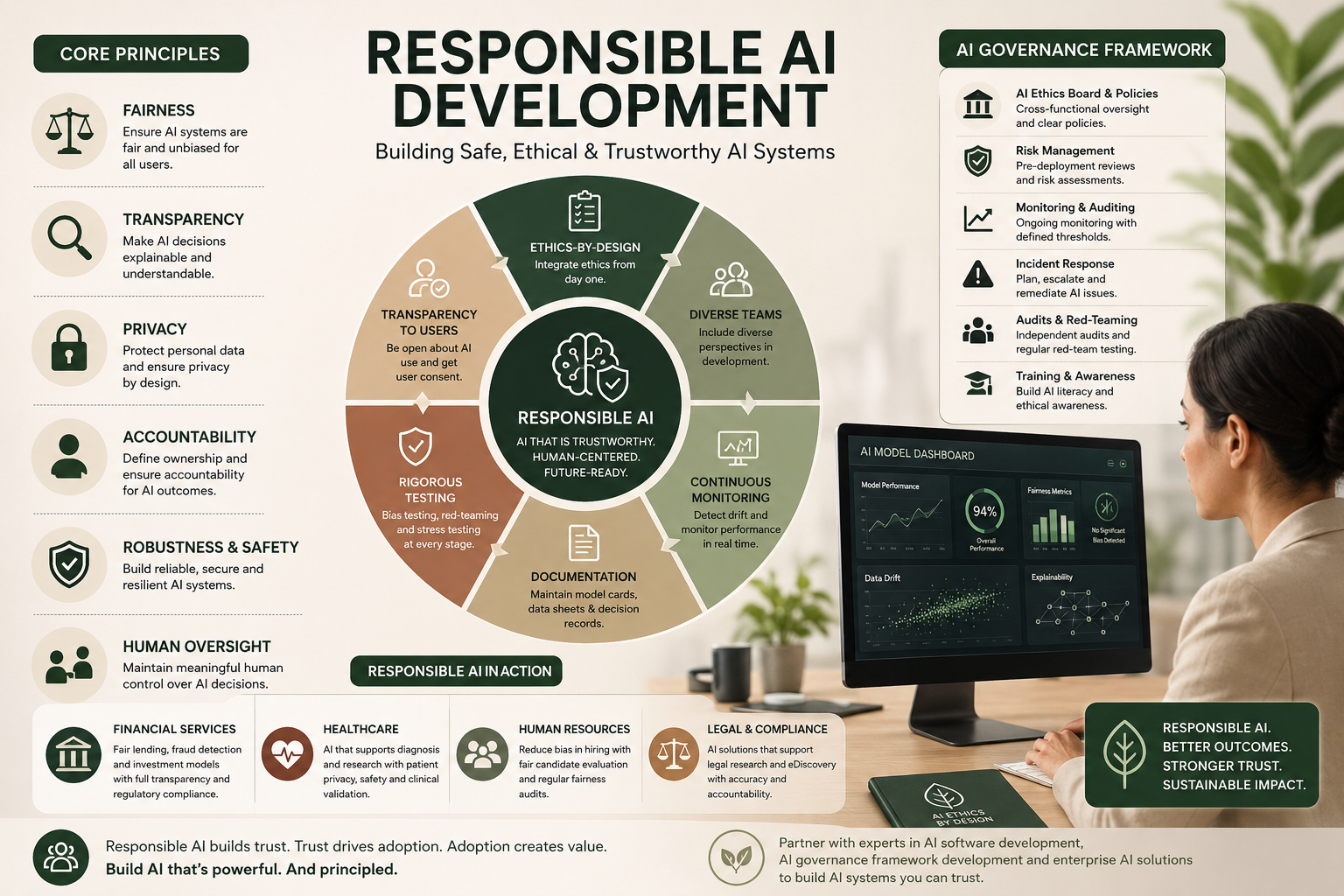
As artificial intelligence becomes embedded in the most consequential decisions of our time — from loan approvals and medical diagnoses to hiring and criminal justice — the stakes for getting AI right have never been higher. Responsible AI development is no longer a philosophical aspiration. It is a business imperative.
For enterprises building or procuring AI systems in 2026, responsible AI development services must be central to the strategy — not an afterthought. This article outlines the core principles, practical best practices, and governance structures your organization needs to develop AI that is not only powerful, but trustworthy.
What Is Responsible AI Development?
Responsible AI development refers to the design, building, and deployment of AI systems in a way that is transparent, fair, accountable, and aligned with human values. It encompasses everything from data collection ethics and model bias testing to regulatory compliance and explainability.
For organizations operating in regulated industries — healthcare, financial services, insurance, legal — responsible AI is not optional. It is a regulatory requirement driven by frameworks such as the EU AI Act, the US AI Executive Order, and sector-specific guidelines from bodies like the FDA and SEC.
But responsible AI also matters for every business. The reputational and financial consequences of an AI system that discriminates, fails unexpectedly, or operates opaquely can be severe and long-lasting.
Core Principles of Responsible AI
1. Fairness and Non-Discrimination
AI models learn from historical data — and historical data often reflects historical biases. A responsible AI system is proactively tested for discriminatory outcomes across demographic groups including race, gender, age, and socioeconomic status. Fairness is not a single metric; it requires careful consideration of the context and trade-offs involved.
2. Transparency and Explainability
Black-box AI systems that cannot explain their decisions are incompatible with responsible deployment. Explainable AI (XAI) techniques enable stakeholders to understand why a model made a specific decision — essential for trust, debugging, and regulatory compliance. This is particularly important in AI software development services for high-stakes domains like credit scoring or medical diagnosis.
3. Privacy and Data Protection
Responsible AI requires rigorous data governance. Personal data must be collected lawfully, stored securely, and used only for its stated purpose. Privacy-preserving techniques such as differential privacy, federated learning, and data anonymization should be standard practice in enterprise AI solutions development.
4. Accountability
Every AI system should have clear human ownership. There must be defined processes for monitoring performance, escalating issues, and remedying harms. When an AI system causes a negative outcome, there must be a traceable chain of accountability — from the data scientists who built the model to the executives who approved deployment.
5. Robustness and Safety
AI systems must perform reliably under real-world conditions, including edge cases, adversarial inputs, and distribution shifts. Rigorous testing across diverse scenarios — including stress testing and red-teaming — is essential before production deployment.
6. Human Oversight
Responsible AI development preserves meaningful human control over AI decisions, particularly in high-stakes contexts. Automated systems should include appropriate human-in-the-loop checkpoints and override capabilities.
Building a Robust AI Governance Framework
Principles alone are insufficient without institutional structures to enforce them. An AI governance framework development effort should establish:
- An AI ethics board or responsible AI committee with cross-functional representation
- Model risk management policies including pre-deployment review gates
- Ongoing model monitoring with defined performance degradation thresholds
- An incident response plan for AI failures or harmful outputs
- Third-party auditing and red-team testing schedules
- Employee training programs on AI ethics and responsible use
Leading organizations are now embedding responsible AI governance directly into their MLOps pipelines — automating fairness checks, bias audits, and explainability reports as part of the model development lifecycle.
The NIST AI Risk Management Framework provides one of the most comprehensive publicly available blueprints for organizations building AI governance frameworks, covering governance, mapping, measuring, and managing AI risks across the full lifecycle.
Responsible AI in Practice: Industry-Specific Considerations
Financial Services
AI models used in lending, fraud detection, and investment management face strict regulatory scrutiny. Fair lending laws require that credit decisions be explainable and free from discriminatory proxies. Regular model validation and regulatory reporting are non-negotiable. Responsible AI development services for finance must include automated bias testing and full audit trails.
Healthcare
AI-powered diagnostic tools, drug discovery models, and clinical decision support systems carry life-or-death implications. Responsible AI in healthcare demands FDA compliance for AI/ML-based medical devices, patient data privacy (HIPAA), and robust clinical validation before deployment. Human clinician oversight remains essential.
Human Resources
AI resume screening and candidate ranking tools can perpetuate historical hiring biases. Responsible AI development for HR applications requires regular fairness audits, diverse training data, and prohibition of protected characteristics as model inputs.
Best Practices for Responsible AI Development Services
Organizations implementing responsible AI should adopt the following best practices throughout the AI development lifecycle:
- Ethics-by-design: Integrate ethical considerations from the problem definition stage, not post-deployment
- Diverse development teams: Include ethicists, domain experts, and affected community representatives alongside engineers
- Bias testing at every stage: Data bias, model bias, and deployment bias must all be addressed
- Documentation rigor: Maintain model cards, data sheets, and decision records for every AI system
- User consent and transparency: Inform users when AI is influencing decisions that affect them
- Continuous monitoring: AI model performance degrades over time — implement automated drift detection
- Red-teaming: Proactively test for adversarial misuse, harmful outputs, and unintended consequences
The Business Case for Responsible AI
Beyond compliance, responsible AI is a competitive differentiator. A 2025 IBM study found that 75% of consumers are more likely to trust and engage with companies they believe use AI responsibly. Enterprises that lead on AI ethics attract better talent, command premium positioning, and avoid the enormous costs of AI-related incidents — regulatory fines, reputational damage, and litigation.
Moreover, responsible AI systems tend to be more robust, better documented, and easier to maintain — which means lower total cost of ownership over the AI system’s lifecycle. Investing in AI governance framework development upfront pays dividends for years.
Conclusion: Responsible AI Is the Only AI Worth Building
In 2026, responsible AI development is the baseline expectation — not a premium add-on. Organizations that cut corners on fairness, transparency, and governance will face growing regulatory, reputational, and operational risks.
By partnering with AI software development services providers who embed responsible AI principles into every project, enterprises can build AI systems that not only perform powerfully but earn the trust of customers, regulators, and society at large.Explore our AI governance framework development services and learn how our enterprise AI solutions team can help you build trustworthy, compliant AI systems that drive lasting business value.