
The most common technical mistake non-technical founders make is not hiring the wrong developer — it is making major technical decisions without senior technical leadership in place to inform them. Consequently, they commit to architecture choices that lock them in, hire developers without the experience to evaluate their work, and build products that solve the right problem on the wrong technical foundation. Fractional CTO services exist specifically to solve this problem for startups that cannot yet justify a full-time technology executive.
Furthermore, fractional CTO services have grown significantly as a category in 2026. As a result, non-technical founders now access the senior technology leadership that was previously available only to well-funded startups with the budget for a full-time CTO salary. This guide explains what fractional CTO services actually involve, when startups need them, and how to evaluate and engage the right provider.
What Is a Fractional CTO?
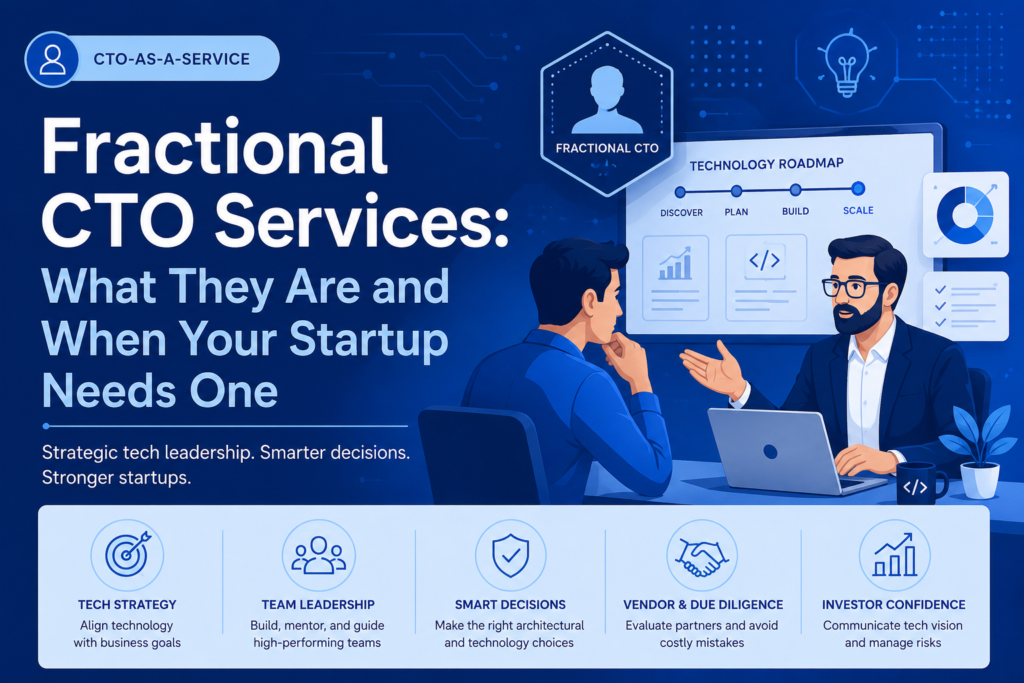
A fractional CTO — also called a CTO-as-a-service or part-time CTO — is an experienced technology executive who provides strategic and technical leadership to one or more startups on a part-time, contract, or retainer basis. Specifically, the fractional CTO performs the strategic functions of a full-time Chief Technology Officer: defining the technology vision, making architectural decisions, evaluating and managing development partners, advising the founding team, and representing the technology function to investors and the board. However, they do so within a defined engagement scope rather than as a dedicated full-time employee. For comparison, virtual CISO services follow the same model for cybersecurity leadership.
What Does a Fractional CTO Actually Do?
Technology Strategy and Roadmap
First, the fractional CTO defines the technology vision aligned with business objectives. Specifically, they translate the founder’s product ambitions into a technical roadmap — identifying what to build, in what order, on what architectural foundation, and with what team. Furthermore, they make the foundational technology choices — programming languages, frameworks, cloud platforms, database designs — that will shape the product’s capabilities and constraints for years.
Development Team Leadership and Oversight
Additionally, the fractional CTO leads the development team or manages the development agency, providing technical direction, code review oversight, and quality standards. Consequently, they catch architectural mistakes before they compound into costly rebuilds. Moreover, they evaluate whether the team’s technical choices are appropriate for the problem, whether timelines are realistic, and whether estimates reflect genuine understanding of the work.
Vendor Selection and Due Diligence
Furthermore, for non-technical founders selecting a development agency or freelance developers, the fractional CTO conducts technical due diligence. Specifically, they review code samples, assess the technical approach proposed for the project, evaluate team composition, and identify red flags in proposals that non-technical founders cannot spot. As a result, the founder avoids the costly mistake of engaging an underqualified development partner.
Investor and Board Communication
Moreover, investors and board members ask technical questions that non-technical founders struggle to answer credibly. The fractional CTO articulates the technology strategy, defends architectural decisions, explains technical risks, and provides the credible technical perspective that investors need before committing capital. Consequently, many founders report that engaging fractional CTO services directly accelerated their fundraising process.
Recruitment and Team Building
Additionally, as the startup hires its first technical employees, the fractional CTO evaluates candidates, conducts technical interviews, and ensures the team builds with the right skills and cultural fit. This function is particularly valuable for non-technical founders who cannot assess the difference between a strong and a weak engineering hire.
Fractional CTO vs Full-Time CTO: The Comparison
| Factor | Full-Time CTO | Fractional CTO Services |
| Annual cost | $180,000 – $350,000 salary + equity | $30,000 – $120,000/year (retainer) |
| Time to hire | 3-6+ months average search | 2-4 weeks to onboard |
| Availability | Full-time, dedicated | Typically 10-30 hours/month |
| Experience breadth | Deep in one or two sectors | Cross-industry pattern recognition |
| Equity dilution | 1-5% typical CTO equity | None or minimal |
| Best stage | Series A+, significant engineering team | Pre-seed through Series A |
| Strategic value | Deep organizational context over time | Immediate expertise, external perspective |
When Does Your Startup Need Fractional CTO Services?
Signal 1: You Are a Non-Technical Founder Building a Technical Product
Specifically, if you cannot evaluate whether a developer’s technical proposal is sound, whether an estimate is realistic, or whether the architecture your team is building will support your growth — you need technical leadership. Furthermore, the cost of getting these decisions wrong far exceeds the cost of fractional CTO services. Consequently, non-technical founders building software products represent the most common and most compelling use case for fractional CTO engagement.
Signal 2: You Are Selecting or Managing a Development Agency
Moreover, development agency selection without technical expertise is high-risk. Agency proposals use technical language that non-technical founders cannot evaluate. Furthermore, agencies do not always flag when their proposed approach has limitations. Therefore, having a fractional CTO review proposals, conduct technical due diligence on shortlisted agencies, and oversee the engagement protects a significant capital investment.
Signal 3: You Are Raising Investment and Need Technical Credibility
Additionally, investor technical due diligence covers architecture, technology choices, team capability, and scalability. Specifically, investors ask questions like: why did you choose this database? How does your system handle ten times current load? What is your approach to security? Consequently, having a senior technical voice available during due diligence — even on a fractional basis — meaningfully improves investor confidence.
Signal 4: Your Technical Co-Founder Has Left or Is Leaving
Furthermore, startups that lose their technical co-founder face an immediate leadership vacuum that threatens product continuity. A fractional CTO bridges this gap — providing technical continuity, managing the team, and supporting the recruitment of a permanent technical leader. Therefore, many startups engage fractional CTO services specifically as a bridging solution during technical leadership transitions.
Signal 5: You Are Hitting Technical Walls That Are Slowing Growth
Moreover, when the product cannot ship fast enough, when the architecture cannot support new features, or when technical debt has accumulated to the point of threatening delivery velocity — a fractional CTO brings the diagnostic capability to identify the root cause and the authority to drive the remediation.
What Fractional CTO Services Typically Cost in 2026
Fractional CTO services typically operate on monthly retainers ranging from $3,000 to $12,000 per month depending on engagement scope, hours committed, and the seniority of the practitioner. Specifically, a light advisory engagement — two to four hours per week focused on strategic guidance — runs at the lower end. Furthermore, a more intensive engagement covering hands-on architecture oversight, weekly leadership meetings, and development team management runs toward the upper end. In contrast, a full-time CTO with equivalent experience commands $180,000 to $350,000 in annual salary plus meaningful equity. Consequently, fractional CTO services deliver equivalent strategic value at 20-40% of the cost.
How to Choose the Right Fractional CTO
1. Verify their startup experience specifically: a fractional CTO with enterprise background but no startup experience understands technology but not the resource constraints, speed requirements, and uncertainty that define startup decision-making.
2. Match their domain expertise to your sector: a fractional CTO with deep SaaS B2B experience brings pattern recognition that a hardware-focused CTO cannot replicate in a SaaS startup context.
3. Assess communication style: specifically, the fractional CTO must explain technical concepts clearly to a non-technical founder. If their explanation of your architecture is incomprehensible, they will not help you make better decisions.
4. Request references from comparable startups: speak directly with two or three founders they have worked with at similar stages. Ask specifically whether the engagement delivered value, whether they communicated well under pressure, and whether they would re-engage.
5. Clarify scope and deliverables explicitly: a clear engagement agreement specifies hours per month, meeting cadence, decision rights, escalation paths during incidents, and the conditions for scope adjustment.
Frequently Asked Questions
Is a fractional CTO the same as a technical advisor?
No — and the distinction matters. A technical advisor provides occasional input, typically in exchange for a small equity stake. In contrast, a fractional CTO holds ongoing accountability for technology decisions, actively manages teams or vendors, and engages on a regular scheduled basis. Furthermore, advisors typically have no operational responsibility. Consequently, founders who need someone to ask occasional questions benefit from an advisor. Founders who need someone driving technical decisions and managing technical execution need a fractional CTO.
Can a fractional CTO help with hiring a full-time CTO later?
Yes — and this is one of the most valuable functions a fractional CTO provides. Specifically, they know what ‘great’ looks like in a CTO candidate, can evaluate technical competence in interviews, and have networks that accelerate candidate identification. Moreover, a fractional CTO who has built context in your business provides invaluable input on culture fit and strategic alignment. Consequently, many founders use fractional CTO services specifically to bridge the period between recognizing the need for permanent technical leadership and completing a successful hire.
| Building Something Technical Without a Technical Co-Founder?Our fractional CTO services give non-technical founders the senior technology leadership they need — from architecture decisions and agency oversight through investor due diligence and team building. Talk to us about what stage you are at and how we can help.Talk to our team today -> AventisHub |