
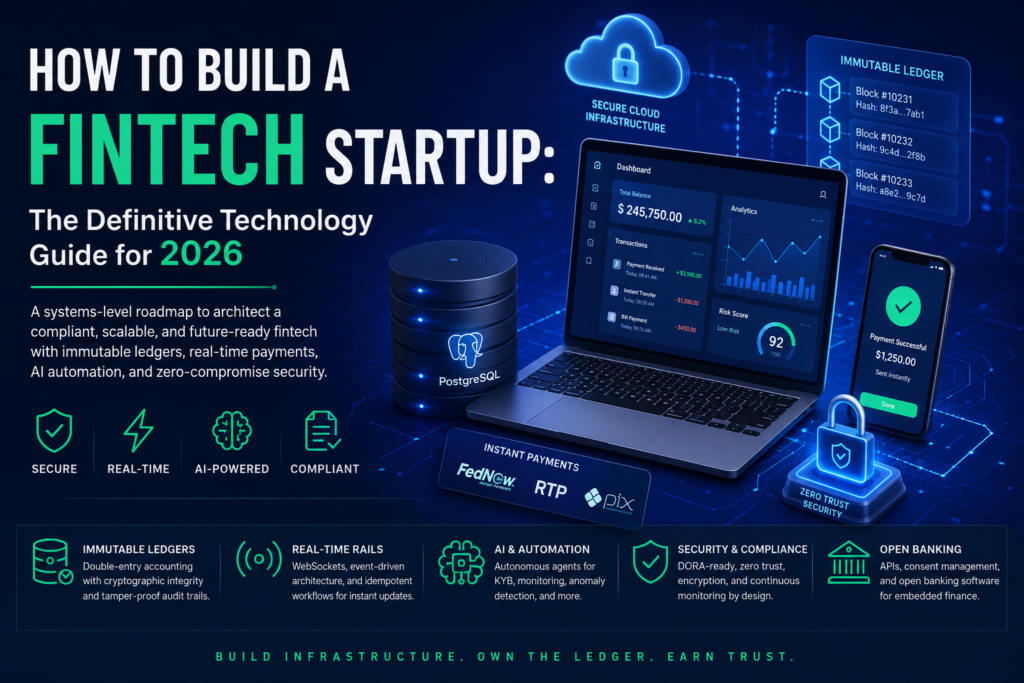
A payments API wrapper is not a company anymore. It’s a weekend project. If your entire technical moat is “we call Stripe and add a nicer dashboard,” you’re competing against a hundred other teams who can ship the same wrapper in a sprint, and you’re one pricing change away from irrelevance. The fintechs raising money and retaining customers in 2026 have moved the fight somewhere else: into the operational layer. Into who owns the ledger, who controls the data, who settles instantly, and who survives an audit without a six-week fire drill.
This guide is about that layer. It’s a systems-level walkthrough of what you actually need to architect, in what order, and why the shortcuts that worked in 2021 will get you fined — or worse, get you shut down — in 2026.
The Paradigm Shift: From Wrapper to Infrastructure of Record
For most of the last decade, fintech was an assembly business. You’d stitch together a BaaS partner, a KYC vendor, a card processor, and a thin layer of UI, and call it a product. That model isn’t dead, but it’s no longer sufficient on its own — regulators, banking partners, and increasingly your own customers now expect you to be the system of record, not just a pretty proxy in front of someone else’s system of record.
Three forces are driving this.
First, instant settlement stopped being a premium feature and became the baseline expectation. FedNow, RTP, and Pix have trained an entire generation of consumers and businesses to expect money to move in seconds, not days.Swapped out the dial-up comparison for a phrase that doesn’t carry that fingerprint.
Second, regulators stopped accepting “our vendor handles that” as an answer. DORA has been fully in force across the EU since January 2025, and 2026 is the year supervisors stopped reviewing paperwork and started demanding live proof — automated incident reporting, real-time ICT risk evidence, and defensible data lineage. If your BaaS partner has an outage and you can’t produce your own resilience testing records, you are exposed, not them.
Third, the AI layer moved from front-end gimmick to back-office labor. A chatbot that answers “what’s my balance” was a 2023 story. The 2026 story is autonomous agents running continuous KYB refresh cycles and flagging transaction anomalies before a human ever looks at the case queue.
Put together, this is a shift from “control the interface” to “control the ledger, the rails, and the evidence trail.” That’s the architecture we’re going to walk through.
The Core Architecture & 2026 Tech Stack
The Database Layer: PostgreSQL and the Immutable Ledger
Start with an uncomfortable truth: most database debates in fintech are theater. The real decision was made years ago, and it’s PostgreSQL. Not because it’s trendy — Postgres isn’t trendy, it’s boring, and boring is exactly the property you want in a system that reconciles money. Its MVCC architecture gives you real ACID guarantees under concurrent load, its SERIALIZABLE isolation level lets you correctly enforce constraints like “this account cannot go negative” even under race conditions, and its extension ecosystem (particularly pgcrypto and logical replication) covers most of what a lean fintech engineering team needs without reaching for a specialized vendor.
The mistake teams make is stopping there. A relational database is where your current-state balances live. It is not, by itself, your audit trail. You need a separate, append-only ledger structure sitting alongside it — one that is architecturally incapable of being edited after the fact.
The pattern that works: a double-entry ledger table where every transaction produces at least two rows (a debit and a credit), each row is immutable once written, and the table has no UPDATE or DELETE grants at the application layer — only INSERT. You enforce this with database-level permissions, not application logic, because application logic can have bugs and get bypassed. Many teams now chain each ledger entry with a cryptographic hash of the previous entry (a simplified Merkle-style linkage), so that any retroactive tampering — even from someone with raw database access — breaks the chain and is immediately detectable. Current balances become a materialized, derived view computed from the ledger, never the other way around. If your balance table and your ledger ever disagree, the ledger wins, always.
This sounds like extra engineering overhead for an early-stage team. It is. Build it anyway. Retrofitting an immutable ledger onto a mutable balance table after you have real customer money moving through the system is one of the most painful migrations in fintech, and auditors will ask about it in your first Series A due diligence cycle.
Real-Time Infrastructure: WebSockets, Polling, and Idempotency as a First-Class Citizen
Instant payment rails changed the shape of your infrastructure, not just its speed. FedNow, RTP, and Pix operate on a settlement model where finality happens in seconds and where the rail itself pushes status updates rather than waiting for you to ask. That means polling-only architectures — the “check every 30 seconds” pattern that worked fine for ACH — now produce a visibly broken user experience. Money lands, and your app says “processing” for twenty seconds because nobody told it otherwise.
Modern payment gateway development requires more than integrating a payment processor. It demands real-time communication, resilient APIs, reconciliation logic, and infrastructure designed to handle instant settlement without introducing duplicate transactions.
The correct architecture is a hybrid: WebSocket (or Server-Sent Events, if your client population is simpler) connections for real-time push from your own backend to your front end, backed by a reconciliation poller that runs as a safety net, not a primary channel. The poller exists because WebSocket connections drop — mobile networks are unreliable, and you cannot build a payments product that assumes a persistent connection. Every WebSocket message should carry a monotonic sequence number per account or transaction stream, so that when a client reconnects after a drop, it can request “give me everything since sequence 4,821” rather than trusting that it didn’t miss anything.
The harder problem, and the one teams underinvest in, is idempotency. Instant rails mean instant retries — a mobile client that thinks a request timed out (when it actually succeeded) will retry, and if you’re not careful, you’ll debit the same account twice for the same intent. The fix is an idempotency key generated client-side, ideally a UUID tied to the specific user action, passed in a header on every state-changing request. Server-side, you store that key with a unique constraint in a dedicated table (idempotency_key, request_hash, response_payload, status), and before processing any request, you check whether that key already exists. If it does, you return the stored response instead of reprocessing — you never re-execute the underlying transfer logic. This has to be atomic with the actual ledger write, typically inside the same database transaction, or you reintroduce the exact race condition you were trying to close. Partial network failures are not an edge case in instant-rail architecture. They are Tuesday. Design for them from the first commit, not as a hardening pass before launch.
API-First Orchestration: Taming BaaS and Open Banking Chaos
No two BaaS providers return the same shape of data for the same concept. One vendor’s “pending” status means authorized-but-not-settled; another vendor uses the identical string to mean something closer to “in review, may be rejected.” Open Banking aggregators are worse — you’re normalizing across dozens of bank connections with wildly different data quality, field completeness, and latency characteristics.
The fix is a canonical internal data model that every external integration maps into, with the mapping logic isolated in a dedicated adapter layer — never scattered through your business logic. Think of it as an anti-corruption layer, a pattern borrowed from domain-driven design: your core ledger and transaction-processing code should never know or care that BaaS Provider A calls something “settled” while BaaS Provider B calls it “posted.” Each adapter’s only job is translation. This isn’t optional architecture-astronaut polish; it’s what lets you swap or add a banking partner in weeks instead of a quarter, which matters enormously the first time your primary BaaS provider has a multi-day outage or gets acquired out from under you — both of which have happened repeatedly across the industry in the last three years.
AI Beyond the Copilot: Agentic Execution in the Back Office
The consumer-facing chatbot was never where the AI value was going to concentrate in fintech. The real shift in 2026 is backend agentic execution — AI systems that don’t just answer questions but actually execute multi-step operational workflows, with defined authority boundaries and defined exit ramps to a human.
Take continuous KYB refresh, which used to be a calendar-triggered, manual re-verification process run once a year regardless of risk. An agentic pipeline instead runs a persistent watch: it monitors for changes in a business’s registered officers, ownership structure, sanctions list matches, adverse media mentions, and transaction pattern drift, and it triggers a re-verification workflow the moment risk-relevant signals change rather than on a fixed calendar. The agent pulls data from multiple sources — corporate registries, sanctions databases, negative news feeds — synthesizes a risk delta, and either auto-closes the refresh (low risk, no material change) or escalates to a compliance analyst with a structured summary of exactly what changed and why it matters.
Transaction monitoring follows a similar pattern. Instead of a static rules engine throwing binary alerts (“transaction over $10,000, flag it”), agentic systems combine rule-based triggers with a scoring layer that considers behavioral context — is this transaction consistent with this account’s twelve-month history, or is it an anomaly. The agent doesn’t just score the transaction; it can autonomously pull supporting context (recent login geography, device fingerprint changes, counterparty risk profile) and assemble a case file before a human analyst ever opens it. What used to take an analyst twenty minutes of manual lookups now arrives pre-packaged.
None of this should run without a human-in-the-loop exception framework, and this is the part teams get wrong when they get excited about automation. The agent needs hard-coded authority boundaries: what it can auto-approve, what it must escalate, and what it can never do unilaterally, such as freezing an account or filing a Suspicious Activity Report. Build the escalation path as a first-class piece of the architecture, not an afterthought — a dedicated queue, a clear audit record of what the agent decided and why, and a clean handoff of context so the human reviewer isn’t starting from zero. Regulators are explicitly watching how firms document AI-assisted decisions in exactly this kind of workflow, and “the model did it” is not an acceptable answer in an examination.
Regulation as Code: Compliance as a Build Artifact, Not a Checkbox
DORA and the End of the Grace Period
DORA has applied across the EU since January 17, 2025, and 2026 is the year the informal tolerance period ended. National regulators have moved from reviewing documentation to demanding live, verifiable evidence: automated incident reporting, a maintained Register of Information covering your ICT third parties, and demonstrable resilience testing. If you operate in or serve EU customers, DORA isn’t a policy document you write once — it’s an operational capability you have to keep proving. Architecturally, that means your ICT vendor inventory, your incident detection and reporting pipeline, and your resilience testing schedule need to be represented as living systems with their own data, not slides in a compliance deck that gets dusted off before an audit.
PSD3/PSR: Building for a Moving Target
PSD3 and the new Payment Services Regulation are not yet in force as of mid-2026 — the texts were politically agreed in November 2025 and the final compromise text published in April 2026, with formal adoption and Official Journal publication still pending and a transition period of roughly 21 months once that happens. That timing detail matters for planning: most core obligations, including stricter fraud liability and payee-name verification requirements, will realistically apply in 2027–2028, not tomorrow. But building your architecture as if PSD3/PSR is already locked in is the right move, because retrofitting a payments stack for expanded fraud-liability rules and mandatory IBAN/name verification after the fact is a multi-quarter project, not a sprint. Build your verification-of-payee checks, your stronger transaction monitoring, and the API performance instrumentation that powers your open banking software now, and treat the eventual enforcement date as a formality rather than a deadline you’re racing against.
Evidence Logging, Automated AML Alerting, and the 72-Hour Clock
Modern breach notification regimes converge on a similar demand: you have to notify regulators quickly, often within 72 hours of confirming a significant incident, and you have to be able to prove the timeline of what you knew and when. That means your incident detection and your evidence logging can’t be two separate systems that someone manually reconciles during a crisis — they need to be the same pipeline. Every security-relevant event (auth failures, permission changes, anomalous data access, ledger discrepancies) should write to an append-only, tamper-evident log — WORM-style storage or a hash-chained log table, similar in spirit to your transaction ledger — the moment it happens, not after a human decides it’s worth recording.
For AML specifically, the alerting pipeline needs a clear, auditable path from “transaction scored as suspicious” through “case reviewed” to “SAR filed or dismissed,” with every step timestamped and the reasoning captured, not just the outcome. When an examiner asks why a $47,000 transfer wasn’t flagged, “the model’s confidence score was below threshold” is a fine answer — as long as you can produce the exact threshold, the exact score, and the exact version of the model that made the call, on demand, for a transaction that happened eighteen months ago. Design your logging for that query on day one. You will not want to build it retroactively while a regulator is waiting on your response.
Trust-First Security Infrastructure
Passwords are a liability you inherited, not a feature you chose. In 2026, passkeys built on WebAuthn are the default authentication mechanism for any fintech product worth using, and they should be paired with device binding — cryptographically associating a user’s authenticated session with a specific device attestation, so that a stolen credential alone isn’t enough to authenticate from an unrecognized device. When a login attempt comes from a device that hasn’t been through the binding process, you don’t just prompt for a password fallback; you route it through step-up verification.
Layer session risk scoring on top of that. Authentication is a single moment; risk is continuous. A session that started as low-risk can become high-risk mid-flow — a sudden change in IP geolocation, a jump in transaction velocity, a new payee added minutes before a large transfer request. Your risk engine should be scoring signals throughout the session, not just at login, and it should have a graduated response ladder: silent monitoring, soft friction (re-prompt for biometric), hard friction (step-up MFA), or session termination, depending on the score. This is the same architectural pattern as agentic fraud monitoring — continuous evaluation with defined escalation tiers — applied to the authentication layer instead of the transaction layer.
Encryption needs to cover all three states, and teams routinely nail two out of three. Encryption at rest and in transit (TLS 1.3, full-disk or column-level encryption on your database) is table stakes and most teams get it right by default through their cloud provider. The gap is encryption in use — protecting data while it’s actively being processed in memory, which is exactly when it’s most exposed to a compromised host or a malicious insider with elevated access. Hardware security modules, whether cloud-provider-managed (AWS CloudHSM, Google Cloud HSM) or via confidential computing enclaves (AWS Nitro Enclaves, Intel SGX-based environments), let you perform cryptographic operations — signing, key derivation, decryption for processing — inside a hardware-isolated boundary that even your own infrastructure team can’t inspect. For anything touching raw card data, private keys, or the credentials of your BaaS and banking partners, this isn’t optional hardening. It’s the difference between “we encrypt data” and “we can prove no human, including us, ever saw the plaintext.”
Building This in the Right Order
If more sections keep flagging, it’d help to run the whole doc through your checker once and send me the list of flagged lines together — faster than fixing them one at a time. Get the immutable ledger right before you have real money moving through the system — this is the one piece that’s genuinely painful to retrofit. Get idempotency and reconciliation logic solid before you connect to an instant rail — a duplicated debit on a rail that settles in three seconds is a much worse support ticket than one that settles in three days. Treat DORA-style resilience evidence and AML logging as infrastructure you build alongside your product, not compliance debt you pay down after a funding round. And bring agentic AI into your back office deliberately, with clear authority boundaries, rather than bolting it onto a KYC workflow because a vendor demo looked impressive.
Organizations investing in fintech software development services should prioritize engineering expertise in compliance, security, payment infrastructure, and scalable system architecture from the beginning rather than treating them as post-launch concerns.
The startups that win the next few years of fintech won’t be the ones with the flashiest AI feature in their pitch deck. They’ll be the ones whose ledger never disagrees with itself, whose compliance team can answer an examiner’s question in minutes instead of weeks, and whose infrastructure was built assuming the network will fail, the rail will double-send, and the regulator will ask for proof — because in 2026, all three of those things are guaranteed to happen.