Few decisions in software development are more consequential — or more frequently misunderstood — than the choice between agile and waterfall methodologies. Teams choose agile because everyone else seems to be doing it, or stick with waterfall because it is familiar, without a clear understanding of the trade-offs each approach entails. The result is predictable: agile teams that lack the discipline to make iteration work, and waterfall projects that are obsolete by the time they launch.
This guide cuts through the ideology to give you a clear, evidence-based comparison of agile vs waterfall software development — covering when each methodology genuinely works, where each breaks down, and how to make the right choice for your specific project and organization.
What Is Waterfall Software Development?
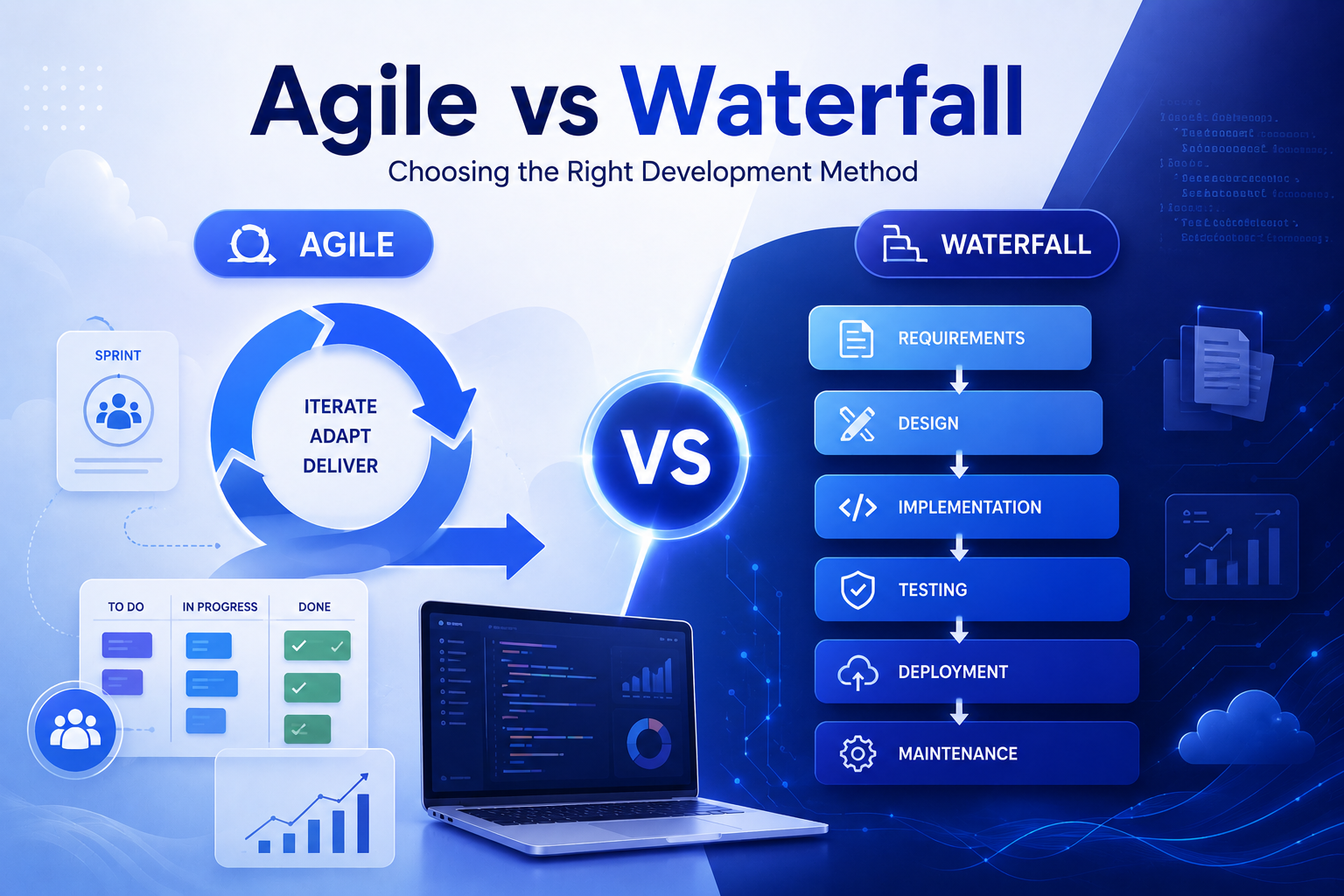
Waterfall is the original sequential software development methodology, first formally described by Winston Royce in 1970 (ironically, in a paper that also noted its flaws). In waterfall, the software development lifecycle progresses through fixed phases in sequence: requirements, design, implementation, testing, deployment, and maintenance. Each phase must be completed and signed off before the next begins. There is no formal mechanism for returning to an earlier phase once it is closed.
Waterfall’s appeal is its predictability and structure. You produce detailed documentation at each phase, you know exactly what you are building before you build it, and progress is easy to measure against milestones. For projects where requirements are fully known upfront and unlikely to change — a government contract with a fixed specification, an embedded system for a medical device — waterfall provides the control and auditability that agile cannot match.
What Is Agile Software Development?
Agile is a family of iterative development methodologies built on the principles of the Agile Manifesto, published in 2001 by 17 software practitioners. Agile prioritizes working software over comprehensive documentation, customer collaboration over contract negotiation, and responding to change over following a plan. Instead of planning everything upfront, agile frameworks like Scrum and Kanban break development into short cycles (typically two-week sprints) that each produce working, demonstrable software.
The most widely used agile framework is Scrum, which organizes work into sprints with defined ceremonies (sprint planning, daily standups, sprint review, retrospective) and roles (Product Owner, Scrum Master, Development Team). Kanban is a lighter framework focused on visualizing and limiting work in progress, often used for continuous flow work like bug fixing and ongoing feature development.
Agile vs Waterfall: Head-to-Head Comparison
| Factor | Waterfall | Agile |
| Requirements | Fully defined upfront | Defined and refined iteratively |
| Delivery | Single release at project end | Working software delivered every sprint |
| Flexibility to change | Low — changes are expensive mid-project | High — scope can evolve each sprint |
| Customer involvement | Heavy at start and end; minimal during build | Continuous throughout development |
| Testing | Phase after development completes | Continuous throughout development |
| Documentation | Comprehensive and upfront | Lightweight, just-in-time |
| Risk management | Risks identified upfront; discovered late | Risks surfaced and addressed iteratively |
| Team structure | Siloed by discipline (analysts, devs, QA) | Cross-functional, self-organizing teams |
| Cost predictability | High — costs defined upfront | Variable — scope drives cost over time |
| Visibility to stakeholders | Limited until delivery | High — demos every sprint |
| Best project size | Large, well-defined | Any size, especially complex/uncertain |
| Regulatory compliance | Strong — documentation trail | Requires deliberate audit trails |
When Waterfall Works Best
Waterfall is the right choice — or at least a defensible one — in a specific set of circumstances that are less common in 2025 than they were in 1995, but still exist:
- • Fixed-price, fixed-scope government or enterprise contracts where requirements are legally specified and change is contractually constrained
- • Hardware-integrated software where physical manufacturing decisions must be locked in before software development begins
- • Highly regulated environments (medical devices, aerospace, nuclear) where every requirement must be traced to a test and audited
- • Short, simple projects with fully understood requirements where the overhead of agile ceremonies would outweigh the benefits
- • Teams with limited agile experience and no coaching support — a poorly executed agile project is worse than a well-executed waterfall project
When Agile Works Best
Agile software development services deliver their greatest value when requirements are expected to evolve, speed-to-market matters, and continuous user feedback can meaningfully improve the product. The State of Agile Report consistently finds that organizations using agile report faster time to market, better alignment with business needs, and higher quality outcomes than those using waterfall for comparable projects.
- • Products where user needs are not fully understood until real users interact with working software
- • Startup and scale-up environments where pivoting based on market feedback is a competitive necessity
- • Long-running development programs where requirements will naturally evolve over months and years
- • Digital product development (web and mobile apps, SaaS platforms) where continuous improvement is the product strategy
- • Teams with experienced agile practitioners who can enforce discipline in the process
| Common misconception: Agile does not mean ‘no planning.’ The most successful agile teams plan meticulously — they just plan at the right level of detail for the current sprint rather than specifying every detail for a project that will run for 18 months. Agile without discipline is not agile — it is chaos with a rebranding. |
Scrum vs Kanban: Which Agile Framework Should You Choose?
Most discussions of agile vs waterfall skip a critical sub-question: if you choose agile, which framework? Scrum and Kanban are the two dominant agile frameworks and they serve different purposes.
| Factor | Scrum | Kanban |
| Work structure | Fixed-length sprints (1-4 weeks) | Continuous flow, no fixed sprints |
| Commitment | Sprint backlog committed at sprint start | Pull work as capacity allows |
| Roles | Product Owner, Scrum Master, Dev Team | No prescribed roles |
| Ceremonies | Sprint planning, standups, review, retro | No prescribed ceremonies |
| Best for | Feature development, new product builds | Ongoing support, bug fixing, ops work |
| Change mid-cycle | Wait for next sprint | Add to backlog and prioritize anytime |
Hybrid Approaches: Scrumfall and SAFe
Many real-world projects do not fit neatly into either agile or waterfall. A common practical approach is ‘Scrumfall’ — waterfall-style upfront planning and design, followed by agile iterative development and testing. This gives structured requirements and architecture while preserving flexibility in implementation. At enterprise scale, frameworks like SAFe (Scaled Agile Framework) and LeSS (Large-Scale Scrum) provide structured approaches for coordinating multiple agile teams working on a single large product.
The Real Cost Comparison: Agile vs Waterfall
The financial comparison between agile and waterfall is more nuanced than most articles acknowledge. Waterfall offers higher upfront cost predictability — you know the total project cost before you start. Agile offers lower total cost of failure — if you build the wrong thing, you discover it after one sprint, not after 18 months.
Research by McKinsey & Company found that large waterfall software projects have a 45% chance of running significantly over budget and a 7% chance of delivering less than 30% of expected value. Agile projects, while individually less cost-predictable, produce working software throughout and allow course correction before major budget has been committed to a wrong direction.
Which Methodology Is Right for Your Project?
| Project Characteristic | Lean Toward Waterfall | Lean Toward Agile |
| Requirement stability | Requirements fully known and stable | Requirements expected to evolve |
| Customer availability | Customer unavailable during build | Customer available for regular feedback |
| Project duration | Short (under 6 months) | Any duration |
| Team experience | New team, limited agile training | Experienced agile practitioners |
| Compliance requirement | Heavy audit trail required | Some compliance, managed with tooling |
| Technology risk | Low — proven stack | High — experimental technology |
| Business risk of wrong product | Low — specification is contractual | High — product-market fit uncertain |
Frequently Asked Questions
Is agile always better than waterfall?
No. Agile is better than waterfall for a specific class of projects — those with uncertain or evolving requirements, high need for stakeholder feedback, and teams with agile experience. For projects with fixed specifications, regulatory audit requirements, or teams lacking agile maturity, waterfall can deliver better outcomes. The decision should be made based on project characteristics, not industry fashion.
Can you switch from waterfall to agile mid-project?
Switching methodologies mid-project is disruptive but sometimes necessary — particularly if a waterfall project is significantly off-track. The transition typically requires a reset: completing or closing the current phase, re-baselining requirements, forming a cross-functional team, and beginning agile ceremonies. It is rarely seamless but has rescued projects that were otherwise heading for failure.
What is the difference between agile and DevOps?
Agile is a software development methodology focused on how teams plan and build software. DevOps is a broader cultural and technical practice that extends agile principles into the delivery and operations pipeline — automating testing, deployment, and infrastructure management to enable continuous delivery. Many modern organizations combine agile development practices with DevOps delivery pipelines for end-to-end efficiency.
| Not Sure Which Development Approach Is Right for Your Project?Our team helps businesses choose the right software development methodology for their specific goals, constraints, and team. From agile sprint-based development to structured delivery for compliance-sensitive environments — we match the process to the problem.Contact us today to get started -> |