
Introduction
In 2024, the playbook was simple. Bolt a thin BaaS wrapper onto a partner bank’s core, ship a mobile app, call yourself a fintech. That playbook is dead. Regulators killed it, and the market buried it. DORA is live. PSD3 and PSR cleared their final Council compromise texts in April 2026 and are heading for Official Journal publication this year. Every institution operating in or selling into the EU now has to prove operational resilience, not just claim it.
That shift changes what outsourcing means. Software development outsourcing used to be a cost lever. Now it’s an architecture decision with regulatory teeth. Who writes your ledger code, where they sit, what they can access, and how fast they can report an incident — all of that determines whether you pass an audit or eat a fine.
This guide breaks down K the way an engineer breaks down a system: by control, by latency, by blast radius. No generic pros-and-cons list. No “it depends” hand-waving. You’ll get a selection framework, a compliance blueprint for DORA and PSD3/PSR, an agentic AI coordination model for distributed teams, and a Zero Trust security posture that works whether your engineers sit in Austin, Kraków, or Manila.
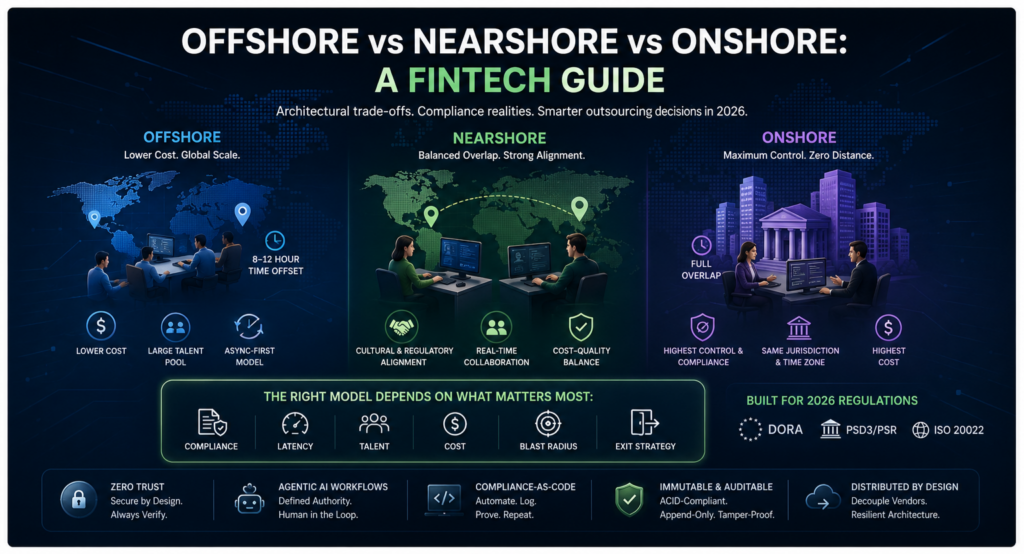
PHASE 1: Decoding the Models — From Hype to Control and Maturity
Strip the marketing language and you’re left with three variables: distance, jurisdiction, and cost. Everything else is a derivative.
Onshore development means your vendor operates in your own country, often your own time zone. You get same-day communication, shared legal jurisdiction, and zero language friction. You pay a premium for it — typically 1.5x to 3x nearshore rates in the US and Western Europe.
Nearshore software development puts your team in an adjacent or nearby region: US firms working with Mexico, Colombia, or Costa Rica; EU firms working with Poland, Romania, or Portugal. You get overlapping working hours, comparable legal frameworks (helpful under GDPR and now DORA’s third-party risk rules), and meaningfully lower cost than onshore.
Offshore software development moves the team further out — India, Vietnam, the Philippines — chasing the deepest cost arbitrage and the largest talent pools. You trade time-zone overlap and cultural proximity for scale and price. A 10-12 hour offset means asynchronous handoffs become mandatory, not optional.
None of these models is “better.” They’re different risk-and-cost profiles, and the fintech-specific twist is this: your outsourcing decision is now a platform decoupling decision. If your core ledger, your KYC/AML pipeline, and your payment orchestration layer all sit with one vendor, in one country, under one legal jurisdiction, you are single-threaded. A vendor insolvency, a geopolitical disruption, or a regulatory action in that jurisdiction takes your whole platform down with it.
DORA’s Article 28 third-party risk requirements exist precisely because regulators watched this failure mode happen. You need contractual exit strategies, documented concentration risk, and — increasingly — open banking software and Open Finance aggregation layers that don’t depend on a single ingestion pipeline built by a single team. Decouple the vendor relationship from the architecture. If one outsourcing partner disappears tomorrow, your data ingestion, your ledger, and your compliance logging should survive on separate rails.
PHASE 2: The Core Selection Framework — Architecture vs. Latency
Here’s what got fintechs fined in 2022 and 2023: treating outsourcing selection as a spreadsheet exercise on hourly rate. That shortcut doesn’t survive contact with a regulator asking for your Register of Information under DORA, or a customer disputing a fraudulent transaction under PSD3’s expanded liability rules. Global standard consistency isn’t optional anymore — every partner, in every region, has to hit the same bar on encryption, audit logging, and incident response, or your weakest vendor becomes your biggest liability.
Outsourcing vs In-House in the Age of Agentic Workflows
The outsourcing vs in-house question used to be about cost. Now it’s about depth versus core. Some capabilities are core to your competitive moat and your regulatory exposure — ledger design, fraud-scoring logic, the agentic AI systems that make autonomous decisions on transaction risk. Keep those in-house, or in tight onshore/nearshore partnerships with deep audit trails. Other capabilities are depth work — UI implementation, QA automation, infrastructure provisioning, integration testing. Those tolerate offshore distance because the blast radius of a mistake is smaller and the audit trail requirement is lighter.
The mistake teams make: outsourcing the agentic decision layer — the code that decides whether a transaction gets flagged, escalated, or auto-approved — to whichever vendor was cheapest, without building in defined authority boundaries and human escalation paths. Under PSD3’s fraud liability rules, you carry the liability regardless of who wrote the code. Keep authority-bearing logic close. Push implementation depth out.
Selection Criteria Matrix
A working matrix for evaluating Onshore, Nearshore, and Offshore against the five variables that actually predict project failure:
| Criteria | Onshore | Nearshore | Offshore |
| Time zone overlap | Full overlap | 2–5 hour offset, workable overlap | 8–12 hour offset, async-first |
| Real-time communication latency | Same-day, often same-hour | Same-day with planning | Next-day handoffs common |
| Cultural/regulatory alignment | Highest — shared jurisdiction | High — often shared trade blocs (EU nearshoring, USMCA) | Variable — requires contractual harmonization |
| Talent pool depth | Narrow, expensive, competitive | Moderate, growing fast (Poland, Romania, Colombia) | Deepest, especially for specialized engineering roles |
| Relative cost (vs onshore baseline) | 1.0x | 0.4x–0.7x | 0.2x–0.4x |
| DORA third-party concentration risk | Lowest | Low-to-moderate | Requires active mitigation (multi-vendor, exit strategy) |
Checklist: When to Choose Onshore vs Nearshore vs Offshore
Choose onshore when:
- The work touches core ledger logic, fraud-decision authority, or anything a regulator will ask you to explain line-by-line.
- You need same-day escalation for production incidents tied to DORA’s 4-hour major-incident notification clock.
- Legal privilege and IP protection carry outsized weight — patent-sensitive algorithmic trading or underwriting logic, for instance.
Choose nearshore when:
- You need daily standups with real overlap, not async handoffs, but full onshore cost is unjustifiable.
- The work sits in the “depth with oversight” zone — API integration, mid-complexity feature builds, dedicated QA — that benefits from live pairing.
- You’re building for EU markets and want a nearshore partner already operating inside comparable GDPR/DORA-adjacent compliance culture.
Choose offshore when:
- The work is well-specified, modular, and reviewable asynchronously — infrastructure automation, test suite expansion, non-authority-bearing feature work.
- You need scale fast and can invest in strong technical leads who bridge the time-zone gap.
- Cost arbitrage materially changes your runway and the risk profile of the work is low enough to tolerate slower feedback loops.
PHASE 3: AI Beyond the Copilot — Agentic Coordination Across Borders
Copilot-style code completion is table stakes now. The real engineering problem in 2026 is agentic AI operating in the backend — systems with defined authority that take actions, not just suggestions, across a distributed team spanning multiple time zones and multiple offshore vs nearshore vs onshore vendor relationships.
Build these agentic workflows with hard boundaries:
- Defined authority, explicit exit ramps. Every agentic process — continuous KYC/KYB refresh, autonomous sanctions and registry monitoring, fraud anomaly flagging with context scoring — needs a documented ceiling on what it can do without a human in the loop, and a clear escalation pipeline when it hits that ceiling. Treat the escalation pipeline as a first-class engineering deliverable, not an afterthought bolted on before an audit.
- ISO 20022 as the message contract. Swift ended MT/ISO 20022 coexistence for cross-border payment instructions on November 22, 2025. Structured and hybrid address formats become mandatory by November 2026, with statement and reporting message retirement continuing through 2027–2028. Every distributed team touching payment messaging — onshore, nearshore, or offshore — needs to build against ISO 20022 message contracts and immutable data adapters from day one. Retrofitting a vendor’s legacy MT-based integration after the fact is expensive and slow.
- Deepfake and synthetic-identity defense at onboarding. Agentic fraud systems now face agentic fraud attacks. Cryptographic injection detection and active liveness checks at the onboarding layer are the baseline countermeasure against AI-synthesized identity fraud — not an enhancement, a requirement, regardless of which region built your onboarding pipeline.
The coordination challenge isn’t the AI. It’s making sure a nearshore team in Bogotá, an offshore team in Ho Chi Minh City, and an onshore compliance function in New York are all enforcing the same authority boundaries on the same agentic pipeline, with no silent divergence in how each region implements the escalation logic.
PHASE 4: Compliance-as-Code and RegTech Integration
Compliance that lives in a PDF nobody reads until an auditor shows up is a liability, not a control. Bake it into CI/CD instead.
DORA incident reporting, correctly implemented: Once you classify an ICT-related incident as major under the Article 18 criteria, the clock starts. Initial notification to your competent authority is due within 4 hours of classification (no later than 24 hours after detection). An intermediate report follows within 72 hours, with a final report due within one month. Your pipeline — regardless of which region’s team built it — needs automated classification triggers, pre-populated reporting templates, and WORM storage for the evidence trail, because “we were still writing the report” is not a defense regulators accept.
PSD3/PSR readiness: The Council published final compromise texts in April 2026, and Coreper approval is moving the package toward formal adoption and Official Journal publication this year. Expect an implementation period of roughly 18 months after entry into force for most obligations, with the payee-name/IBAN verification requirement given additional runway — likely 24 months — to allow system changes. Full application across the market is realistically a 2027–2028 event, not a today event, but the architecture work — verification-of-payee checks, expanded fraud liability handling, dedicated open banking interfaces replacing screen-scraping — needs to start now. Custom payment gateway development that doesn’t already assume verification-of-payee logic and PSR-grade transparency on currency conversion charges will need a costly retrofit.
Evidence and audit logging: Automated AML alerting, immutable logging of every AI-assisted compliance decision (regulators are explicitly watching for documentation of how and why an AI system flagged or cleared a transaction), and WORM storage for anything that might end up in front of a supervisor. This applies identically across your onshore, nearshore, and offshore engineering functions — a compliance gap in your cheapest vendor is still your compliance gap.
PHASE 5: Zero Trust Security and Identity
Distributed outsourcing means distributed attack surface. Assume compromise, everywhere, always.
- Passkeys with device binding for every engineer with production or compliance-data access, regardless of which office — or country — they sit in.
- Session risk scoring that escalates silently through graduated response — step-up authentication, session termination, account lockout — rather than binary allow/deny decisions.
- Multi-layered encryption: TLS 1.3 in transit, KMS-managed keys at rest, and secure enclaves or HSMs protecting data in use, not just at rest — the layer most outsourced teams skip because it’s the hardest to implement correctly.
- AI governance audits covering model lineage, prompt logs, and bias testing for every AI system touching credit decisions, fraud scoring, or onboarding — with the audit trail portable enough that it doesn’t matter which vendor or region built the model.
Zero Trust isn’t a product you buy. It’s an assumption you build into every contract with every outsourcing partner: no implicit trust based on network location, onshore or otherwise.
Call to Action
Choosing between offshore, nearshore, and onshore isn’t a rate-card decision anymore — it’s an architecture decision with DORA, PSD3, and PSR consequences attached. Get it wrong and you’re rebuilding compliance infrastructure under regulatory pressure. Get it right and you’ve built a platform that scales talent access without concentrating risk in a single vendor or jurisdiction.
If you’re evaluating outsourcing models for a live fintech platform, work with fintech software development services that already build to DORA and PSD3/PSR standards — not generalist shops that will learn compliance-as-code on your production system. Talk to a fintech app development company that can show you a working Zero Trust reference architecture, not just a slide deck.
FAQ
Q1: How much time-zone overlap do we actually need between our core engineering team and a nearshore or offshore partner? For anything touching production incident response, aim for a minimum 3-hour daily overlap window — enough for a live standup and a same-day escalation handoff. Nearshore partnerships (US–Latin America, EU–Eastern Europe) typically deliver 2–5 hours natively. Offshore relationships with an 8–12 hour offset need a documented async handoff protocol — written incident summaries, recorded walkthroughs, and a named on-call bridge — because DORA’s 4-hour major-incident notification clock doesn’t pause for a time-zone gap.
Q2: Why does PostgreSQL with ACID guarantees matter for an outsourced ledger implementation, and what does “immutable” actually require? ACID compliance (atomicity, consistency, isolation, durability) guarantees that a ledger transaction either completes fully or not at all, with no partial writes — critical when multiple services or outsourced teams write to the same ledger table concurrently. “Immutable” in a ledger context means append-only design: you never update or delete a transaction row, you append a reversing entry. Enforce this at the database layer, not just in application code, using techniques like write-once triggers or a separate audit schema with restricted UPDATE/DELETE grants — because an outsourced team with full table permissions is a single misconfigured migration away from breaking your audit trail.
Q3: What does “instant rail engineering” require that a standard payment integration doesn’t? Instant payment rails — FedNow in the US, SEPA Instant in the EU — require sub-10-second end-to-end settlement confirmation, which means your fraud-scoring and sanctions-screening logic has to run inline, in real time, not as a post-transaction batch job. That forces architectural changes most outsourced teams haven’t built before: pre-computed risk scores, cached sanctions-list lookups refreshed continuously rather than nightly, and a hard fallback path for when the real-time check times out. Building this with a partner who’s only integrated batch-settlement rails before means a re-architecture, not a bolt-on.
Q4: What does custom payment gateway development actually cost, and what drives the variance? A production-grade custom payment gateway — card processing, ACH, instant rails, PCI DSS Level 1 scope, fraud scoring, and multi-currency support — typically runs from the mid-six-figures to well over a million dollars depending on rail coverage and compliance scope. The biggest cost drivers are PCI DSS certification work, the number of payment rails and currencies supported, and whether you’re building verification-of-payee logic ahead of PSD3/PSR requirements now versus retrofitting it later. Retrofitting is consistently the more expensive path.