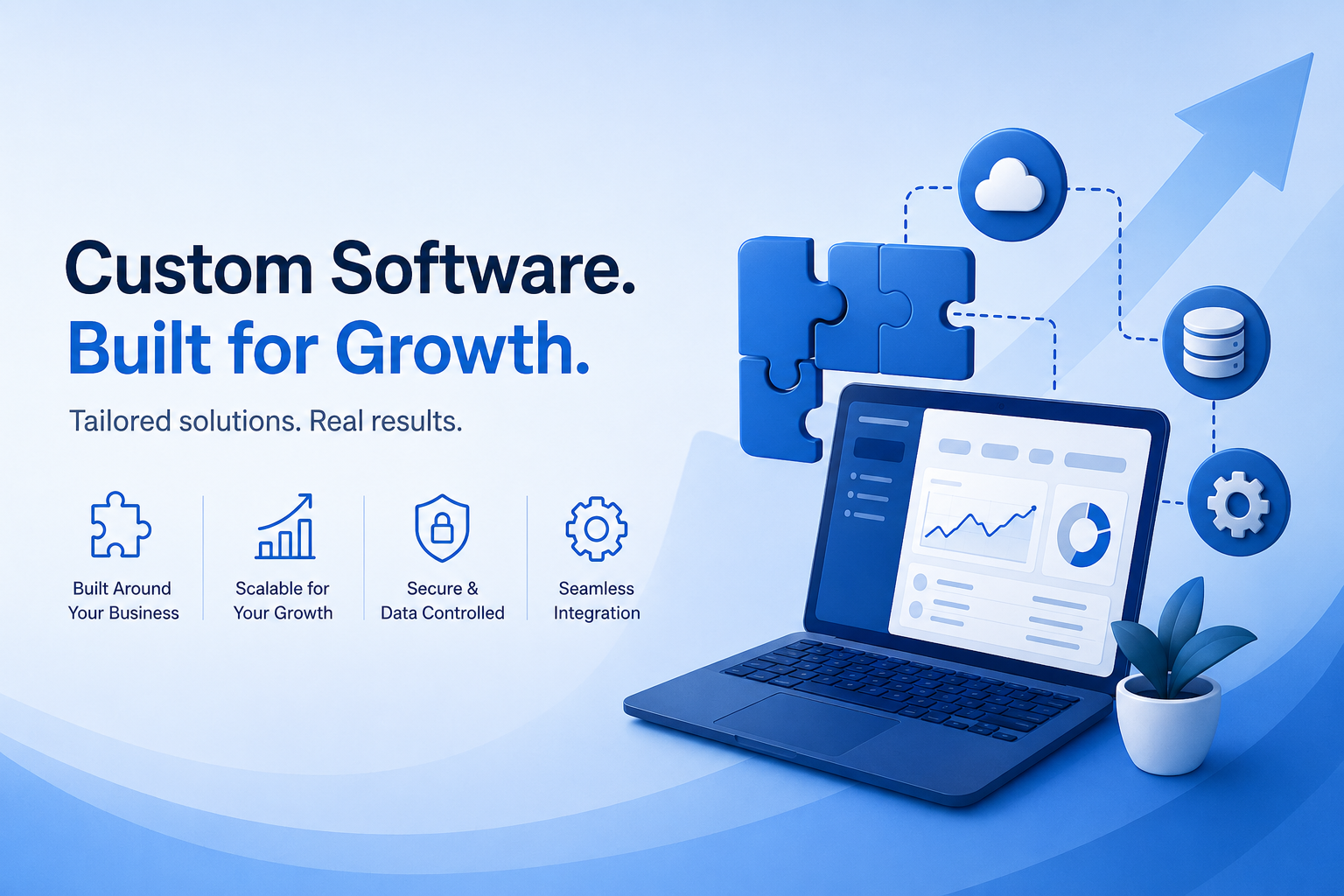
Every growing business reaches a point where the off-the-shelf tools that worked perfectly at 10 employees start to strain at 50, and actively obstruct at 150. You are paying for features you do not use, missing features you desperately need, and watching your team build elaborate workarounds that cost more in lost productivity than a custom solution would have. Custom software development exists to solve exactly this problem — and in 2026, the business case for it is stronger than ever.
This guide covers the concrete, measurable benefits of custom software development for growing businesses, addresses the common objections honestly, and helps you determine whether custom software is the right investment for your current stage and goals.
| Key distinction: Custom software development builds software specifically for your business processes, workflows, and requirements. Off-the-shelf software is built for the broadest possible market and adapted (with varying success) to individual business needs. The right choice depends on how differentiated your processes are and how central software is to your competitive position. |
Benefit 1: Software That Fits Your Business Exactly — Not the Other Way Around
The most fundamental benefit of custom software development is also the most obvious: the software is built around how your business actually works, not around how a vendor assumes businesses like yours work. This distinction matters more than most leaders realize until they have lived with the frustration of forcing business processes into the constraints of an off-the-shelf product.
When you implement off-the-shelf software, you inevitably adapt your processes to the software’s logic — changing approval workflows, restructuring data entry, building spreadsheet workarounds for reporting the platform cannot generate. Each adaptation is a small erosion of operational efficiency. Multiply that across an entire organization, and you are looking at hundreds of hours of lost productivity per year, per tool.
Custom software is built to your specifications. Your approval workflow is encoded exactly as your business requires. Reporting captures the metrics your management team actually uses. Your user interface reflects your team’s real workflow rather than a generic assumption about it. The software serves the business — not the other way around.
Benefit 2: Competitive Differentiation Through Unique Capabilities
If your competitors can buy the same software you are using, that software cannot be a source of competitive advantage. Off-the-shelf platforms commoditize the capabilities they provide — every business in your sector using the same CRM, the same ERP, or the same operations platform has access to identical functionality. Custom software development creates capabilities that are genuinely unique to your business.
Consider the businesses that have built durable competitive advantages on proprietary software: Amazon’s logistics optimization algorithms, Zara’s real-time inventory and production management system, Netflix’s recommendation engine. These are not competitive advantages purchased from a vendor — they are capabilities built specifically for those businesses’ unique strategies and data. While most companies are not Amazon, the same principle applies at every scale: proprietary software capabilities that your competitors cannot replicate are a genuine moat.
Benefit 3: Scalability Designed for Your Growth Trajectory
Off-the-shelf software scales on the vendor’s roadmap, not yours. When you hit the usage limits of a SaaS platform’s tier, you pay more for headroom you may not need. When the platform’s architecture cannot support your data volume or transaction throughput, you either live with performance degradation or face a painful migration.
Custom software is architected with your specific growth trajectory in mind. If you expect to grow from 10,000 to 500,000 transactions per month over three years, the technical architecture — database design, caching strategy, infrastructure approach — is built to support that trajectory from the start. Modern cloud infrastructure makes this more cost-effective than ever: custom software can be deployed on elastic infrastructure that scales automatically with demand and costs proportionally to actual usage.
Benefit 4: Full Integration With Your Existing Systems
Integration is one of the most underappreciated benefits of custom software development. Growing businesses accumulate a portfolio of tools — accounting software, CRM, inventory management, HR platforms, marketing automation — and the friction of getting these systems to talk to each other is a constant drain on efficiency.
Custom software is built with your integration requirements as a first-class concern. Rather than relying on a vendor’s limited integration marketplace or expensive middleware, your custom solution is designed to connect exactly the systems your business uses, passing data between them in real time and eliminating the manual data entry, CSV exports, and reconciliation work that typically fills the gaps between disconnected tools.
Benefit 5: Long-Term Cost Efficiency
The objection every business raises to custom software is cost — and it is a legitimate concern. Custom software development requires a meaningful upfront investment. Off-the-shelf solutions have lower upfront costs and predictable monthly fees. However, the long-term cost comparison is more nuanced than the upfront figures suggest.
| Cost Factor | Custom Software | Off-the-Shelf (SaaS) |
| Upfront cost | Higher — development investment | Low — subscription to start |
| Monthly ongoing cost | Infrastructure + maintenance only | Per-user or usage-based fees that grow with your team |
| Customization cost | Built in | Often expensive add-ons or professional services |
| Integration cost | Designed in from the start | Third-party connectors, APIs, middleware |
| Vendor dependency | None — you own the software | High — price increases, feature changes, discontinuation risk |
| 5-year total cost | Typically lower for mid-to-large teams | Typically lower for small teams with standard needs |
The crossover point — where custom software becomes more cost-efficient than SaaS — depends on team size, usage intensity, and how heavily you need to customize or integrate. For most businesses with 50+ employees heavily using core business software, custom development delivers a positive ROI within three to five years.
Benefit 6: Security and Data Control
When you use a SaaS platform, your business data lives on the vendor’s infrastructure, subject to their security practices, their breach risk, and their data retention policies. For businesses handling sensitive customer data, proprietary business information, or regulated data (healthcare, finance, legal), this represents a significant risk. Data sovereignty — the ability to control exactly where your data lives and who can access it — is increasingly important in a regulatory environment defined by GDPR, HIPAA, and similar frameworks.
Custom software gives you complete control over your data architecture, security controls, and access management. You define the encryption approach, the access control model, the backup strategy, and the data retention policy. For businesses in regulated industries, this control is not optional — it is a compliance requirement.
Benefit 7: No Licensing Fees or Vendor Lock-In
SaaS vendor lock-in is one of the most insidious long-term costs of off-the-shelf software. Once your team’s workflows, your data, and your integrations are built around a platform, switching is painful and expensive — which vendors know and price accordingly. Annual price increases of 10-20% are standard in enterprise SaaS. Features that were free become paid add-ons. Support quality declines as the vendor prioritizes enterprise accounts.
Custom software eliminates vendor lock-in entirely. You own the software and its source code. You are not subject to price increases, feature deprecations, or vendor acquisition risk. The software continues to work exactly as built, indefinitely, without ongoing licensing fees beyond your own infrastructure costs.
Is Custom Software Development Right for Your Business?
Custom software development is not the right choice for every business or every problem. Here is an honest assessment of when it makes sense and when off-the-shelf is the better option:
| Indicator | Custom Software Makes Sense | Off-the-Shelf Likely Sufficient |
| Business process uniqueness | Your processes are genuinely differentiated | Your processes follow industry-standard patterns |
| Team size and growth | 50+ employees or rapid growth trajectory | Small team with stable headcount |
| Integration complexity | Multiple systems need real-time integration | One or two tools, vendor integrations available |
| Competitive importance | Software capability is a competitive differentiator | Software is back-office infrastructure |
| Budget | Upfront investment available | OpEx model preferred, minimal CapEx |
| Compliance | Strict data sovereignty or security requirements | Standard compliance covered by vendor |
Frequently Asked Questions
How much does custom software development cost?
Custom software development costs vary widely by project scope, complexity, and team composition. Simple web applications can be built for $25,000-$75,000. Mid-complexity business applications typically range from $75,000-$300,000. Enterprise-scale platforms can run $500,000 and above. Engaging an experienced custom software development company for a discovery and scoping phase before committing to full development is the best way to get an accurate estimate for your specific requirements.
How long does custom software development take?
A well-scoped custom software project using agile development can deliver a production-ready MVP in 12-20 weeks. Full-featured systems typically take 6-18 months from kickoff to initial launch, with ongoing development continuing to add features after the initial release. Timeline depends heavily on requirements complexity, team size, and how quickly stakeholders can provide feedback during development.
Should I hire an in-house team or use a custom software development company?
For most growing businesses, engaging a custom software development company is more cost-effective and faster to get started than building an in-house team from scratch. A development partner brings assembled expertise, established processes, and proven tooling from day one. In-house teams make sense when software development is core to your business model and you need continuous, deep-product development over many years. Many businesses use a hybrid: a small internal product team working with an external development partner.
| Ready to Build Software That Actually Fits Your Business?Our custom software development team works with growing businesses to design, build, and maintain software solutions tailored to your specific processes, integration needs, and growth goals. From initial scoping to long-term partnership — we build software that becomes a genuine business asset.Contact us today to get started -> |