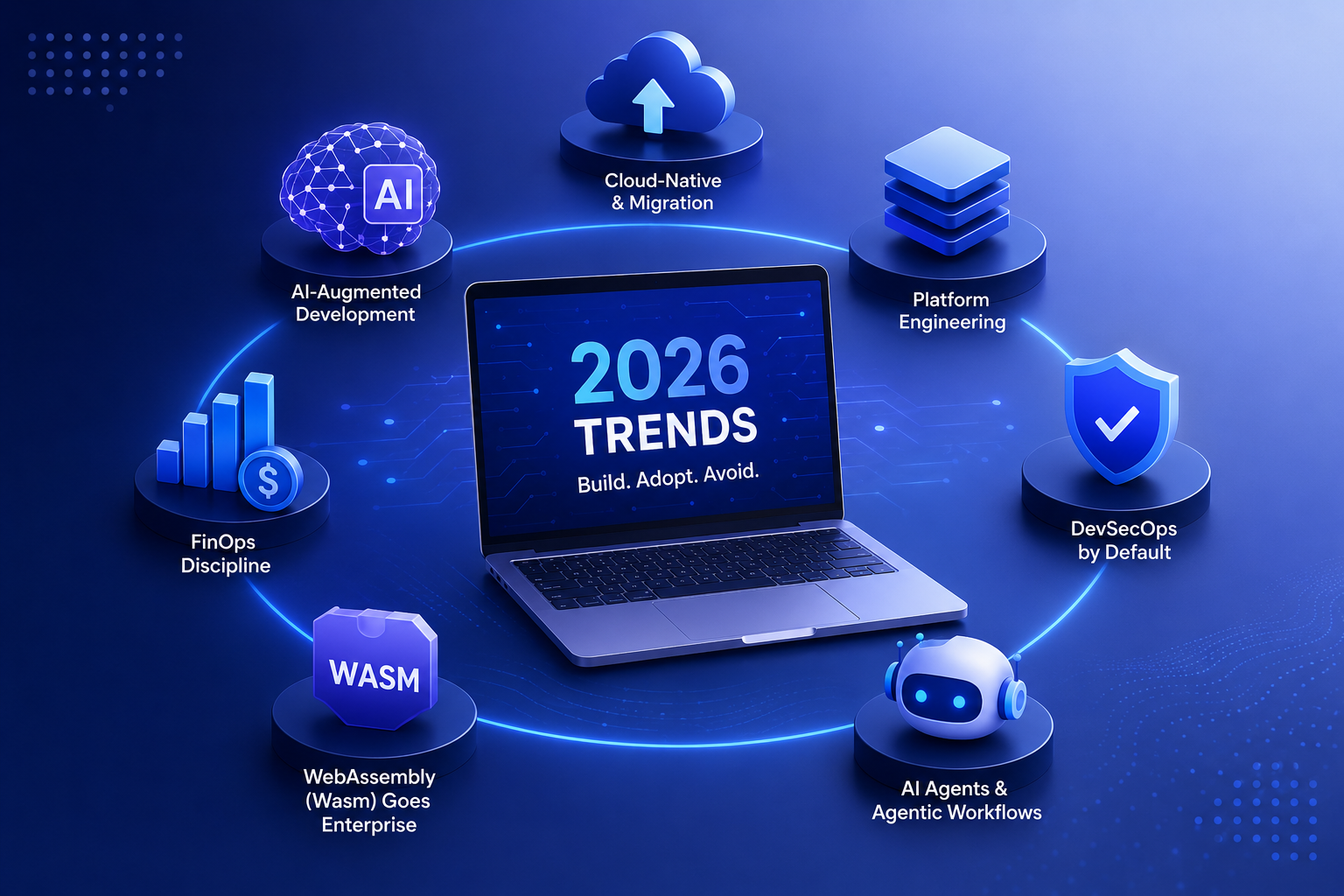
The technology landscape shifts faster every year — and staying ahead of software development trends 2026 is no longer just competitive strategy, it is survival. Whether you are a CTO deciding your technology roadmap, a developer choosing which skills to invest in, or a business leader evaluating where to allocate engineering budget, this guide to software development trends 2026 gives you a clear picture of what to build, what to adopt, and what to avoid. These software development trends 2026 are not predictions — they are patterns already reshaping how software is designed, built, and operated at scale.
1. AI-Augmented Software Development Is Now the Default
The biggest of all software development trends 2026 is the normalization of AI-assisted coding. What began as GitHub Copilot suggesting autocomplete has evolved into full agentic AI software development workflows where AI systems can plan, write, test, and deploy code with minimal human intervention. Tools like Cursor, Devin, and Claude Code are reshaping the developer experience from the ground up.
For engineering teams, the impact of this software development trend 2026 is profound: developer productivity has increased 30–50% in early adopters, according to McKinsey’s developer productivity research. But the risk is equally real — AI-generated code introduces security vulnerabilities at scale if not properly reviewed through AI software development services workflows that include automated security scanning.
- • Build: AI-assisted development workflows with human review gates for security-critical code
- • Adopt: AI software development services and tooling that integrate with your existing CI/CD pipeline
- • Avoid: Deploying AI-generated code to production without automated application security testing
2. Platform Engineering Replaces DevOps as the Organizational Model
Among the most impactful software development trends 2026, platform engineering is fundamentally changing how organizations structure their technology teams. Where DevOps focused on breaking silos between development and operations, platform engineering goes further: dedicated Internal Developer Platform (IDP) teams build self-service infrastructure that lets product teams deploy, scale, and monitor applications without deep infrastructure expertise.
The DORA 2025 State of DevOps Report found that organizations with mature platform engineering practices deploy 3x more frequently and recover 2x faster from incidents. As a software development trend 2026, platform engineering is moving from early-adopter organizations like Spotify and Netflix to mainstream enterprise adoption. Tools like Backstage (CNCF), Port, and Cortex are powering the platform engineering movement.
- • Build: Internal Developer Platforms that give product teams self-service deployment and observability capabilities
- • Adopt: Platform engineering team structures and DevOps consulting services to design your IDP
- • Avoid: Continuing to scale DevOps by adding more ops engineers — platform engineering is more scalable
3. Cloud-Native and Cloud Migration Hit Their Maturity Phase
Cloud migration is still one of the dominant software development trends 2026 — but the conversation has matured from “should we move to cloud?” to “how do we optimize and govern our multi-cloud environment?” According to Flexera’s State of the Cloud 2025 report, 90% of enterprises now operate in multiple clouds, but cloud waste averages 32% of total spend. Cloud migration services in 2026 therefore focus as much on FinOps, cloud governance, and workload optimization as on initial lift-and-shift migrations.
The next phase of the cloud software development trend 2026 is cloud-native refactoring: taking applications that were merely “lifted” to cloud VMs and re-architecting them as containerized, serverless, or event-driven systems that fully leverage cloud elasticity. Specialized cloud migration services teams are in extremely high demand for this modernization work.
- • Build: Cloud-native architectures (Kubernetes, serverless, event-driven) for new greenfield applications
- • Adopt: Cloud migration services with FinOps capabilities to optimize existing cloud spend
- • Avoid: Lift-and-shift migrations without a modernization roadmap — you pay cloud prices for on-prem architecture inefficiency
4. FinOps Becomes a Core Software Development Discipline
As cloud spending spirals, FinOps — the practice of financial accountability in cloud operations — has emerged as one of the most practical software development trends 2026. Engineering teams are increasingly expected to understand and optimize the cost implications of their architectural decisions. FinOps is no longer a finance team responsibility; it is a software engineering competency. DevOps consulting services providers are embedding FinOps practices alongside reliability and security work as part of comprehensive software development trends 2026 service offerings.
- • Build: Cost allocation tagging and rightsizing automation into your cloud deployment pipelines
- • Adopt: FinOps tooling (CloudHealth, Infracost, Kubecost) and DevOps consulting services with cloud cost expertise
- • Avoid: Leaving cloud cost management entirely to the finance team — engineers make the architectural decisions that drive spend
5. WebAssembly (Wasm) Goes Enterprise
One of the more technical but high-impact software development trends 2026 is the enterprise adoption of WebAssembly (Wasm). Originally a browser technology, Wasm has matured into a portable, sandboxed execution environment for server-side workloads. WASI (WebAssembly System Interface) enables Wasm modules to run securely across cloud, edge, and IoT environments with near-native performance. Leading cloud providers including Fastly and Cloudflare are already running production Wasm workloads at scale, and Wasm is increasingly featured in AI software development services for running lightweight inference at the edge.
- • Build: Wasm modules for edge computing, plugin systems, and cross-language component libraries
- • Adopt: WASI runtimes for portable server-side workloads as part of your platform engineering stack
- • Avoid: Ignoring Wasm entirely — it will be a significant software development trend through 2027 and beyond
6. AI Agents and Agentic Workflows Transform Application Architecture
Beyond code generation, the most transformative of the software development trends 2026 is the rise of agentic AI in application architecture. Enterprises are building AI agents — systems that plan, use tools, and take multi-step actions autonomously — into customer-facing products, back-office workflows, and operational systems. This represents a fundamental architectural shift for AI software development services: applications are no longer purely deterministic, request-response systems but probabilistic, reasoning-capable agents.
Frameworks like LangChain, LlamaIndex, and Anthropic’s Agent API are enabling AI software development teams to build production-grade agentic systems. The AI Index Report 2025 from Stanford HAI documents the explosive growth in enterprise AI deployment, with agentic applications at the frontier of this software development trend 2026.
- • Build: Agentic AI workflows for high-value repetitive knowledge work — document processing, customer support, code review
- • Adopt: AI software development services with proven LLM orchestration and evaluation expertise
- • Avoid: Deploying AI agents in production without robust observability, guardrails, and human oversight mechanisms
7. Security Shifts Left — DevSecOps Is Now a Software Development Baseline
No software development trends 2026 guide would be complete without security. DevSecOps — integrating security into every stage of the development pipeline — has moved from advanced practice to baseline expectation. Regulatory pressure (EU Cyber Resilience Act, US Executive Orders on software security) is mandating software bills of materials (SBOMs), secure-by-design development, and documented security testing. This regulatory tailwind makes DevSecOps one of the most durable software development trends 2026 regardless of technology cycles. DevOps consulting services with strong security competency are in exceptionally high demand as organizations navigate compliance requirements.
- • Build: SBOM generation into your CI/CD pipeline services as a compliance and supply chain security foundation
- • Adopt: DevSecOps tooling and DevOps consulting services with application security testing integration
- • Avoid: Treating security as a compliance checkbox — it is a software quality attribute that must be built in
Software Development Trends 2026: What to Avoid
Equally important in any software development trends 2026 guide is knowing where not to invest. Here are the patterns that high-performing engineering teams are deprioritizing:
- • Legacy monolith expansion: Continuing to add features to aging monolithic architectures instead of investing in modular, deployable-independently services is a declining pattern in software development trends 2026
- • Single-cloud lock-in strategies: Building applications deeply dependent on a single cloud provider’s proprietary services limits portability and negotiating power — a risk highlighted across software development trends 2026 analysis
- • Manual security reviews as the only gate: With the speed of AI software development, manual-only security reviews cannot keep pace — automation is non-negotiable
- • Waterfall and big-bang releases: Still found in many enterprises, these patterns are incompatible with the continuous delivery expectations of software development trends 2026
Software Development Trends 2026: Summary Table
| Trend | Category | Action | Service to Engage |
| AI-Augmented Development | AI Software Dev | Build + Adopt | AI software development services |
| Platform Engineering | DevOps Evolution | Adopt | DevOps consulting services |
| Cloud-Native Modernization | Cloud | Build + Adopt | Cloud migration services |
| FinOps | Cloud Cost | Adopt | DevOps consulting services |
| WebAssembly (Wasm) | Runtime | Build | Platform engineering |
| AI Agents in Apps | AI Software Dev | Build | AI software development services |
| DevSecOps as Baseline | Security | Adopt | DevOps consulting services |
Final Thoughts on Software Development Trends 2026
The software development trends 2026 paint a picture of an industry accelerating in every direction simultaneously — faster AI-assisted development, more sophisticated infrastructure abstraction through platform engineering, deeper cloud-native architecture through cloud migration services, and higher security standards through DevSecOps. The organizations that thrive in this environment will not chase every software development trend 2026 — they will choose the trends most aligned with their business model and invest deeply there. Whether you need AI software development services, cloud migration services, or DevOps consulting services to accelerate your adoption of software development trends 2026, the key is starting now. For a broader technology strategy context, the Thoughtworks Technology Radar 2026 provides independent assessment of which technologies are worth adopting, trialing, or avoiding across the full software development trends 2026 landscape.