Most startup ideas fail not because the founders lacked skill or effort, but because they built something nobody wanted — and discovered that fact only after spending months and significant money on development. Furthermore, this is entirely preventable. Startup idea validation is the discipline of generating evidence that your idea solves a real problem for real people before you invest in building the solution. Consequently, founders who validate effectively build the right product faster and at lower cost than those who build first and validate later.
Moreover, the validation techniques available in 2026 are faster and cheaper than at any previous point in startup history. As a result, there is genuinely no excuse for skipping validation — not time pressure, not competitive urgency, and not confidence in your intuition. This guide walks through the complete startup idea validation process, from identifying the problem worth solving to generating concrete evidence that supports a development investment decision.
| The most expensive mistake in software development is building the wrong thing at the right quality. Consequently, startup idea validation specifically answers the question ‘should we build this?’ before the question ‘how do we build this?’ becomes relevant. Furthermore, validation evidence makes development decisions faster, fundraising conversations more credible, and early hiring more focused. |
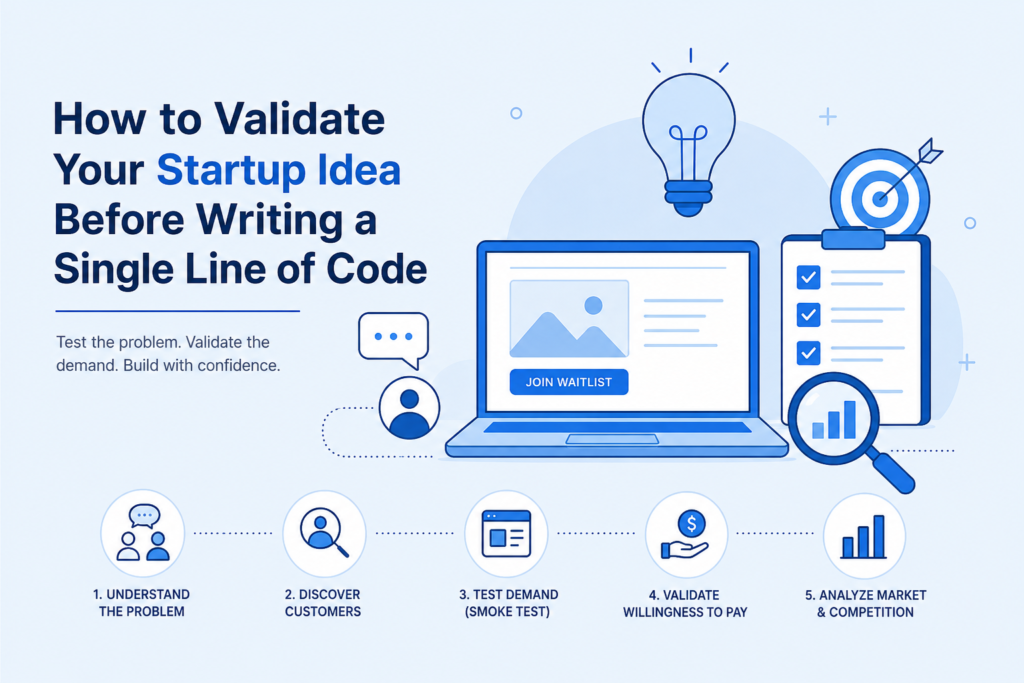
Step 1: Define the Problem Before You Define the Solution
Start With the Problem, Not the Product
The most common validation mistake founders make is beginning with a product concept and then seeking evidence that people want it. Consequently, they find what they are looking for — confirmation — rather than what they need — truth. Therefore, effective startup idea validation starts with the problem, not the solution. Specifically, write a one-sentence problem statement: who experiences this problem, what does the problem prevent them from doing, and how do they currently cope without your solution?
Identify Your Target Customer With Precision
Furthermore, ‘everyone’ is not a customer. Specifically, the more precisely you define the person who experiences the problem most acutely, the more reliable your validation signals become. For example, ‘marketing managers at B2B SaaS companies with 50-200 employees who manage content calendars manually’ is a customer. ‘Small businesses’ is not. As a result, precise customer definition determines who you interview, whose behaviour you observe, and whose willingness to pay you measure.
Step 2: Conduct Customer Discovery Interviews
The Goal of Customer Discovery
Customer discovery — structured interviews with people who match your target customer profile — is the highest-value validation activity available before any development begins. Moreover, Steve Blank’s customer development methodology establishes that the purpose of these interviews is specifically to understand the problem from the customer’s perspective, not to pitch your solution. Consequently, the most productive discovery interviews contain no product demo and no solution description — only questions about the customer’s experience with the problem.
What to Ask in Customer Discovery Interviews
• Tell me about the last time you experienced [problem] — walk me through exactly what happened.
• How do you currently solve or work around this problem?
• What does this problem cost you — in time, money, or missed opportunity?
• Have you looked for solutions? What did you find, and why did those solutions fall short?
• Who else in your organisation experiences this problem?
Furthermore, conduct a minimum of 20 interviews before drawing conclusions. Moreover, record and review each interview rather than relying on memory. Specifically, patterns that appear across 15 of 20 interviews constitute genuine signal. Insights from one or two interviews may reflect individual outliers rather than market patterns.
Synthesising Interview Findings
Additionally, after each batch of interviews, identify the problem statements that recur most frequently, the current workarounds customers rely on most heavily, and the language customers use to describe the problem. Consequently, this language directly informs your positioning, your marketing copy, and your initial feature prioritisation. As a result, founders who complete thorough customer discovery ship products that resonate with buyers from the first day of launch.
Step 3: Test Willingness to Pay — Not Just Interest
Why Interest Is Not Enough
People enthusiastically say they would use a product in an interview and then never pay for it when it launches. Consequently, measuring expressed interest is an unreliable proxy for actual demand. Therefore, effective startup idea validation specifically measures willingness to pay — the point at which a potential customer commits something of value in exchange for the promised product.
Pre-Sale and Letter of Intent Validation
The strongest pre-development validation signal is a pre-sale: a customer pays a deposit or commits via a letter of intent before the product exists. Furthermore, B2B founders can often collect signed letters of intent from potential customers who agree to become paying customers when the product launches, at a specific price point. Moreover, even a verbal commitment on a specific monthly price — recorded in a follow-up email — provides stronger evidence than enthusiasm without commitment. As a result, founders who collect five to ten letters of intent before beginning development enter the build phase with far greater confidence and investor credibility. For a complete guide on building your first version, see the MVP development guide on Aventis Hub.
Step 4: Build a Smoke Test — Before Building the Product
What Is a Smoke Test?
A smoke test — also called a fake door test — presents the promise of your product to potential customers and measures their response, without the product actually existing. Consequently, you measure demand signal from real behaviour rather than interview responses. Furthermore, smoke tests cost dramatically less than building an MVP and generate actionable data within days rather than months.
Landing Page MVP
The most common smoke test is a landing page MVP: a single web page that describes the product, its value proposition, and a clear call to action — typically an email sign-up, a waitlist registration, or a payment initiation. Specifically, tools like Carrd, Webflow, or even a Notion page enable founders to build a convincing landing page in hours without any development investment. Furthermore, driving paid traffic — even $200-500 in Google or LinkedIn ads — to the page and measuring click-through and sign-up rates generates quantitative demand evidence within 48 hours.
Interpreting Smoke Test Results
Moreover, a 3-5% conversion rate from ad click to email sign-up indicates meaningful interest. Additionally, a 15%+ conversion rate suggests strong product-market fit potential. In contrast, sub-1% conversion rates across multiple landing page variants indicate that either the value proposition needs refinement or the target market does not experience the problem acutely enough to seek a solution. Consequently, these signals are far more actionable than any number of enthusiastic verbal responses in interviews.
Step 5: Validate With a Prototype Before Committing to Development
A clickable prototype — built in Figma or Adobe XD — simulates the user experience of your product without building the backend infrastructure. Furthermore, prototypes enable structured usability testing: do potential customers understand what the product does, can they complete key workflows without instruction, and does the experience match the value proposition you described? As a result, prototype testing surfaces UX assumptions that, if left unvalidated, generate expensive rework after development begins. For a detailed comparison of validation artifacts, the Aventis Hub blog covers MVP vs prototype vs PoC in depth.
Step 6: Evaluate the Market Size and Competitive Landscape
Total Addressable Market Assessment
A validated problem with no viable market does not become a fundable business. Consequently, founders must assess market size alongside customer and demand validation. Furthermore, Statista and IBISWorld provide market sizing data across hundreds of sectors. Additionally, bottom-up sizing — counting the number of target customers and multiplying by realistic revenue per customer — often produces more defensible market size estimates than top-down approaches.
Competitive Landscape Analysis
Moreover, a market with no competitors does not indicate opportunity — it frequently indicates that many others have tried and found insufficient demand. Therefore, analyse existing alternatives carefully: what do they do well, where do they fall short, and what specific gap does your solution address? Specifically, your competitive differentiation must be grounded in the customer discovery evidence you collected — not in your assumptions about what customers prefer.
The Startup Idea Validation Checklist
| Validation Stage | Activity | Evidence You Need | Time Required |
| Problem validation | Customer discovery interviews (20+) | Consistent problem description across 70%+ of interviews | 2-3 weeks |
| Demand validation | Landing page smoke test | 3%+ conversion on targeted traffic | 1 week |
| Willingness to pay | Pre-sales / letters of intent | 5+ signed LOIs at target price point | 2-4 weeks |
| UX validation | Prototype usability testing | Target users complete key tasks without instruction | 1-2 weeks |
| Market validation | TAM analysis + competitive audit | Addressable market >$10M; clear differentiation | 1 week |
Furthermore, Aventis Hub’s product discovery services help founders design and execute structured validation programmes before any development investment begins. Consequently, our clients enter development with evidence rather than assumptions. For additional context on what comes after validation, see our guides on custom software development benefits and software development lifecycle.
Frequently Asked Questions
How long should startup idea validation take?
A thorough validation programme — covering customer discovery, a smoke test, and a prototype usability test — typically takes four to eight weeks. Furthermore, this investment prevents the far more costly scenario of building for three to six months and discovering insufficient demand at launch. Consequently, founders who compress validation below two weeks frequently collect insufficient signal to make confident build decisions.
What if my idea requires keeping it secret during validation?
Founders consistently overestimate the risk that competitors will steal their idea during validation. Furthermore, execution is the actual competitive advantage in most markets — not the idea itself. Moreover, an NDA in customer discovery interviews is rarely necessary and often damages trust. Specifically, the risk of building the wrong product without validation is orders of magnitude higher than the risk that a competitor intercepts an unbuilt concept from a discovery interview.
Can I validate a B2B SaaS idea without a product?
Yes — and B2B validation is often more concrete than B2C validation precisely because business buyers make purchasing decisions with documented criteria and measurable budgets. Consequently, a well-structured discovery process produces specific price sensitivity data, decision-maker identification, and willingness to pay evidence that shapes not just the product but the go-to-market strategy. Additionally, signed letters of intent from business buyers represent compelling fundraising evidence that early-stage investors value highly.
| Ready to Validate Your Startup Idea the Right Way?Aventis Hub’s product discovery services help founders design validation programmes that generate real evidence before a single line of code is written. We combine startup technology consulting with structured customer discovery to give you the confidence to build — or the clarity to pivot.Book a free consultation with Aventis Hub today -> |