
Knowing how to outsource software development in 2026 means treating it as an architecture decision, not a procurement decision. The teams that get this right — whether they’re scaling a fintech platform or shipping a consumer app — evaluate technical fit, regulatory exposure, and delivery infrastructure before they ever look at a rate card. This guide breaks down the five phases that separate a successful software development outsourcing engagement from an expensive rebuild eighteen months later.
The stakes are higher than they were even two years ago. Composable architectures, agentic monitoring, open finance regulation, and real-time settlement rails have all moved from “future roadmap” to “day-one requirement.” A partner who can’t speak fluently to these realities isn’t a discount — they’re a liability wearing a lower hourly rate.
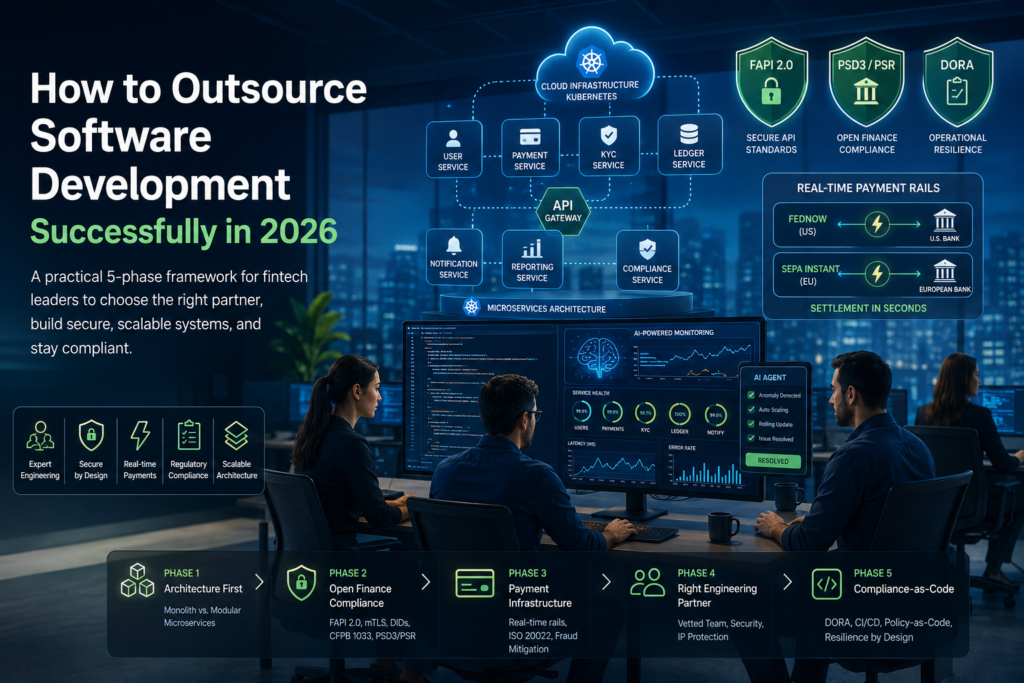
Why Outsourcing Software Development Looks Different in 2026
Three forces have converged to change what “good” looks like in an outsourcing relationship this year.
First, cloud infrastructure costs and talent scarcity have pushed more enterprises toward a dedicated development team model rather than fixed-bid projects, because iterative, compliance-heavy fintech builds don’t fit neatly into a static scope document.
Second, regulatory frameworks — DORA, the incoming PSD3/PSR package, and open banking rules — now dictate specific engineering patterns, not just paperwork. Third, AI-assisted development has changed the economics of offshore delivery, but it has also raised the bar for what a technically credible partner should be able to demonstrate.
Phase 1: Core Tech Stack — Monolith vs. Modular Microservices
Before signing with an offshore software development team, force a conversation about architecture. Get this wrong and the fix isn’t a patch. It’s a rebuild eighteen months from now, once transaction volume and compliance scope have both outgrown what the original design could handle.
A monolith is fine for a small team shipping an early MVP with low transaction complexity — nothing about that setup punishes you early on. Fintech changes the math. Once payments, KYC, and multi-jurisdictional compliance enter the picture, modular, composable microservices become the default, and most teams end up splitting the system whether they planned to or not.
Containers and Kubernetes are table stakes at this point; if a partner hesitates when asked about their orchestration approach, that’s worth noting on its own. The real shift in 2026 sits one layer up. Agentic AI now watches microservice health directly — catching latency drift or error spikes and making the call to scale or roll back before anyone’s paged at 3 a.m. Don’t take that claim at face value, though. Ask a prospective partner to walk through one real incident: what got caught, how it got triaged, what actually fixed it. If the honest answer is “a dashboard and an on-call engineer,” their monitoring is still manual — it just has better graphs.
Monolithic vs. Modular Microservices Architecture (2026)
| Dimension | Monolithic Architecture | Modular Microservices |
| Deployment model | Single deployable unit | Independently deployable services |
| Scaling | Scale the entire application | Scale individual services on demand |
| Fault isolation | A single failure can affect the whole app | Failures are contained to one service |
| Compliance segmentation | Difficult to isolate regulated data flows | Regulated data can live in dedicated, auditable services |
| Time to market (MVP) | Faster initially | Slower initial setup, faster long-term velocity |
| Infrastructure | Simpler ops, single codebase | Requires Kubernetes/Docker, service mesh, CI/CD maturity |
| Best fit | Early-stage MVPs, low transaction volume | Fintech platforms, payment rails, multi-team scaling |
| Agentic AI monitoring fit | Limited — coarse-grained signals | Native — per-service telemetry enables autonomous tuning |
The takeaway: don’t outsource a monolith you’ll pay to unwind in eighteen months. If your roadmap includes payments, open banking, or multi-region compliance, insist on a modular services approach from day one — even if the MVP is smaller.
Phase 2: Data Portability and Open Finance Compliance
If your product touches consumer financial data, open banking software is no longer an optional module — it’s core infrastructure. This is where a generalist agency and a specialized fintech app development company diverge sharply.
Security architecture: FAPI 2.0, mTLS, and fine-grained authorization
The OpenID Foundation finalized the FAPI 2.0 Security Profile as a Final Specification in early 2025, with the companion Message Signing specification following later that year. Any partner building open finance APIs in 2026 should be implementing against FAPI 2.0, not the legacy FAPI 1.0 Advanced profile. Concretely, that means:
- Sender-constrained tokens via mutual TLS (mTLS) or DPoP, so a stolen bearer token can’t be replayed from a different client.
- Pushed Authorization Requests (PAR) to prevent authorization-request tampering.
- Tokenized fine-grained authorization, scoping access down to specific accounts, data fields, or transaction types rather than blanket account access.
- W3C-compliant Decentralized Identifiers (DIDs) for portable, verifiable identity credentials that reduce reliance on any single centralized identity provider — increasingly relevant as open finance extends beyond payment accounts into pensions, insurance, and investment data.
Regulatory reality check: CFPB 1033 and PSD3/PSR
Regulatory accuracy matters here, and the picture is genuinely unsettled on both sides of the Atlantic.
In the United States, the CFPB’s Section 1033 open banking rule was finalized in October 2024, but as of mid-2026 it is enjoined by a federal court and under active reconsideration — the original April 2026 compliance deadlines passed without becoming binding enforcement triggers. Build toward the rule’s underlying principles (consumer-permissioned data access, standardized formats) but don’t assume a fixed enforcement date; monitor CFPB rulemaking directly.
In the EU, PSD3 and the Payment Services Regulation (PSR) reached final agreed text between Parliament and Council in April 2026, with Official Journal publication expected in the following months. Once in force, PSR — unlike its directive predecessor — applies directly across member states without national transposition, though full applicability is phased in over roughly 18–24 months. Fintech teams operating in the EU should be designing for PSD3/PSR’s stricter open banking API governance and IBAN-name verification requirements now, ahead of the compliance runway.
Phase 3: Transaction Infrastructure and Payment Gateway Development
This is where payment gateway development decisions have the least room for error. Settlement infrastructure choices made in month one are extraordinarily expensive to reverse once transaction volume scales.
Real-time settlement rails
Native integration with FedNow in the U.S. and Real-Time SEPA (SCT Inst) in the EU is now a baseline expectation for any platform claiming instant payment capability, not a premium feature. Both rails clear in seconds, which fundamentally changes fraud-detection windows — there is no batch-processing buffer to catch a bad transaction after the fact.
ISO 20022 messaging
ISO 20022 is the structured-data messaging standard underpinning FedNow, SEPA Instant, and most modernized real-time gross settlement systems globally. A simplified pain.001 (Customer Credit Transfer Initiation) message illustrates the structured richness this standard demands compared to legacy formats:
<Document xmlns=”urn:iso:std:iso:20022:tech:xsd:pain.001.001.09″>
<CstmrCdtTrfInitn>
<GrpHdr>
<MsgId>OUTSRC-2026-0001</MsgId>
<CreDtTm>2026-07-10T09:15:00Z</CreDtTm>
<NbOfTxs>1</NbOfTxs>
<InitgPty>
<Nm>Aventis Fintech Client Ltd</Nm>
</InitgPty>
</GrpHdr>
<PmtInf>
<PmtInfId>PMT-INS-0001</PmtInfId>
<PmtMtd>TRF</PmtMtd>
<ReqdExctnDt><Dt>2026-07-10</Dt></ReqdExctnDt>
<CdtTrfTxInf>
<Amt><InstdAmt Ccy=”EUR”>2500.00</InstdAmt></Amt>
<CdtrAgt><FinInstnId><BICFI>EXAMPLEXX</BICFI></FinInstnId></CdtrAgt>
<Cdtr><Nm>Beneficiary Example</Nm></Cdtr>
<CdtrAcct><Id><IBAN>DE00000000000000000000</IBAN></Id></CdtrAcct>
<RmtInf><Ustrd>Invoice 2026-0417</Ustrd></RmtInf>
</CdtTrfTxInf>
</PmtInf>
</CstmrCdtTrfInitn>
</Document>
The structured Cdtr, CdtrAcct, and RmtInf fields aren’t decorative — they’re what enables automated reconciliation and the enhanced fraud screening ISO 20022 was designed to support.
Fraud mitigation at sub-100ms clearing windows
Real-time rails compress fraud-decisioning to a window where traditional rules-based scoring struggles to keep pace. Two threats define the 2026 fraud landscape specifically:
- Deepfake biometrics targeting liveness checks during onboarding and step-up authentication, requiring challenge-response liveness detection and multi-modal verification rather than single-frame facial matching.
- Synthetic identity generation, where fabricated identities built from real and fictitious data points pass individual verification checks but fail behavioral and network-graph analysis.
A credible engineering partner should describe fraud infrastructure that scores transactions in-line, in under 100 milliseconds, using pre-computed risk signals and graph-based identity clustering rather than synchronous third-party API calls that blow the settlement window.
Phase 4: Sourcing the Dev Team — In-House vs. Specialized Partner
Once the architecture is settled, the sourcing decision becomes tactical. In-house hiring gives you direct oversight and institutional knowledge retention, but fintech engineering talent — particularly people fluent in FAPI 2.0, ISO 20022, and real-time settlement — is scarce and expensive, with hiring cycles that can run three to six months per senior role.
A specialized fintech app development company compresses that timeline dramatically and brings pattern-matched experience from prior regulated builds. The trade-off is governance: you’re extending trust to an external team with access to sensitive data flows, which is exactly why the screening process matters more than the rate card.
Whether you’re evaluating a partner to outsource web development for a customer-facing portal or to build a core ledger microservice, the same screening discipline applies — the stakes just scale with what’s being touched.
5-Step Screening Process for a Fintech Outsourcing Partner
- Request a regulated-project portfolio, not a generic case study list. Ask specifically for examples involving payment processing, KYC/AML, or open banking APIs — and ask who on the team, by name, worked on them.
- Verify security certifications and audit history. SOC 2 Type II, ISO 27001, and evidence of a recent penetration test are non-negotiable baselines for any team touching financial data.
- Run a paid technical assessment before the full engagement. A scoped two-to-four-week sprint reveals code quality, communication cadence, and how the team handles ambiguity far better than any sales call.
- Interview the actual engineers, not just the account manager. Ask them to walk through how they’d design a FAPI 2.0-compliant authorization flow or handle an ISO 20022 message failure — vague answers are a red flag.
- Confirm IP assignment, data residency, and offboarding terms in writing before signing. Source code ownership, encryption-key custody, and a clean data-deletion process on contract termination should be explicit contract clauses, not verbal assurances.
Phase 5: Compliance-as-Code — Embedding DORA and PSD3/PSR Into CI/CD
The most mature outsourcing partners in 2026 no longer treat regulatory compliance as a pre-launch checklist. They treat it as executable configuration embedded directly in the CI/CD pipeline — compliance-as-code.
The EU’s Digital Operational Resilience Act (DORA) has been in force since January 2025 and requires demonstrable ICT third-party risk management, incident reporting capability, and resilience testing — obligations that map cleanly onto pipeline gates rather than quarterly audits. In practice, this looks like:
- Automated ICT third-party risk scoring that blocks a deployment if a new dependency or sub-processor hasn’t been logged in the DORA register.
- Incident-reporting simulations run as part of scheduled resilience testing, with results version-controlled alongside the codebase.
- PSD3/PSR-aligned SCA (Strong Customer Authentication) test suites that run against every payment-flow pull request, failing the build if a transaction path bypasses required authentication factors.
- Policy-as-code tools (e.g., Open Policy Agent) enforcing data-residency and encryption requirements at deploy time, not as a manual review step.
This approach turns “we’re compliant” from a claim your partner makes into something your pipeline logs prove, build by build.
Getting This Right the First Time
Outsourcing software development successfully in 2026 comes down to one discipline: evaluate architecture and regulatory fluency before you evaluate price. A partner who can speak precisely to FAPI 2.0 token flows, ISO 20022 message structures, and DORA-aligned pipeline gates will save you a rebuild — and a regulatory finding — that a cheaper generalist never will.
If you’re an enterprise leader or founder evaluating a technical engineering partner for a fintech build, our team specializes in exactly this: composable architecture, open finance compliance, and real-time payment infrastructure, delivered as a dedicated engineering team rather than a project-shop handoff. Reach out to scope your build.
Frequently Asked Questions
What should a 2026-ready outsourced tech stack actually include?
At minimum: containerized services orchestrated via Kubernetes, a modular (not monolithic) service boundary around any regulated data flow, FAPI 2.0-compliant API security for anything touching financial accounts, and observability tooling that feeds an agentic monitoring layer rather than static threshold alerts. If a proposed stack skips any of these for a fintech build, treat it as a scope gap, not a cost saving.
How should data models be structured for open finance compliance when outsourcing?
Data models should separate consent-scoped, third-party-shareable fields from internal-only fields at the schema level — not enforced later through application logic. Pair this with tokenized, fine-grained authorization so a single API scope maps to a narrow, auditable data slice, and use W3C-compliant DIDs where portable, verifiable identity is required across institutions. This structure holds up regardless of which direction CFPB 1033 or PSD3/PSR’s final implementing rules land.
How do I protect IP and source code ownership when I outsource software development?
Get IP assignment written explicitly into the master services agreement — not implied by a standard work-for-hire clause — specifying that all code, architecture documentation, and pipeline configuration transfer to you on payment, not on contract completion. Require source code escrow or continuous repository access (not delivery only at project end), and confirm in writing how encryption keys and credentials are handled at offboarding so you’re never locked out of your own system.