If you’re building an AI-powered application in 2026, choosing the right large language model (LLM) is one of the most important technical decisions you’ll make. The debate around OpenAI vs Google Gemini vs Claude has become central to product strategy, AI infrastructure planning, and enterprise software development.
The AI landscape has evolved dramatically in the last 18 months. Today, three platforms dominate the enterprise and developer conversation:
- OpenAI
- Google Gemini
- Anthropic Claude
Each platform excels in different areas — coding, multimodal AI, long-context reasoning, safety, or enterprise integration. The best choice depends entirely on your application architecture, user experience goals, and operational budget.
In this guide, we’ll compare OpenAI GPT-4o vs Google Gemini vs Claude across performance, pricing, multimodal capabilities, safety, developer tools, and enterprise readiness to help you choose the best AI model for your app.
What Developers Should Compare in an LLM Platform
When evaluating the best LLM for production AI applications, technical teams usually focus on six core areas:
1. Model Capability
How well does the model perform across:
- Reasoning
- Coding
- Writing
- Summarization
- Data analysis
- Agentic workflows
2. Context Window
How much information can the AI process in a single request?
This matters for:
- Large document analysis
- Long conversations
- Full codebase processing
- Legal and healthcare applications
3. Multimodal AI Support
Can the model understand:
- Images
- PDFs
- Audio
- Video
- Structured documents
4. API Reliability & Developer Experience
Developers care about:
- Latency
- API uptime
- SDK quality
- Documentation
- Rate limits
- Ecosystem maturity
5. Pricing at Scale
The real cost of an AI app depends heavily on:
- Token usage
- Context size
- Output length
- Fine-tuning requirements
6. AI Safety & Compliance
For enterprise AI applications, data governance and safety are now critical decision factors.
OpenAI: The Ecosystem Leader for AI App Development
Why Developers Choose OpenAI
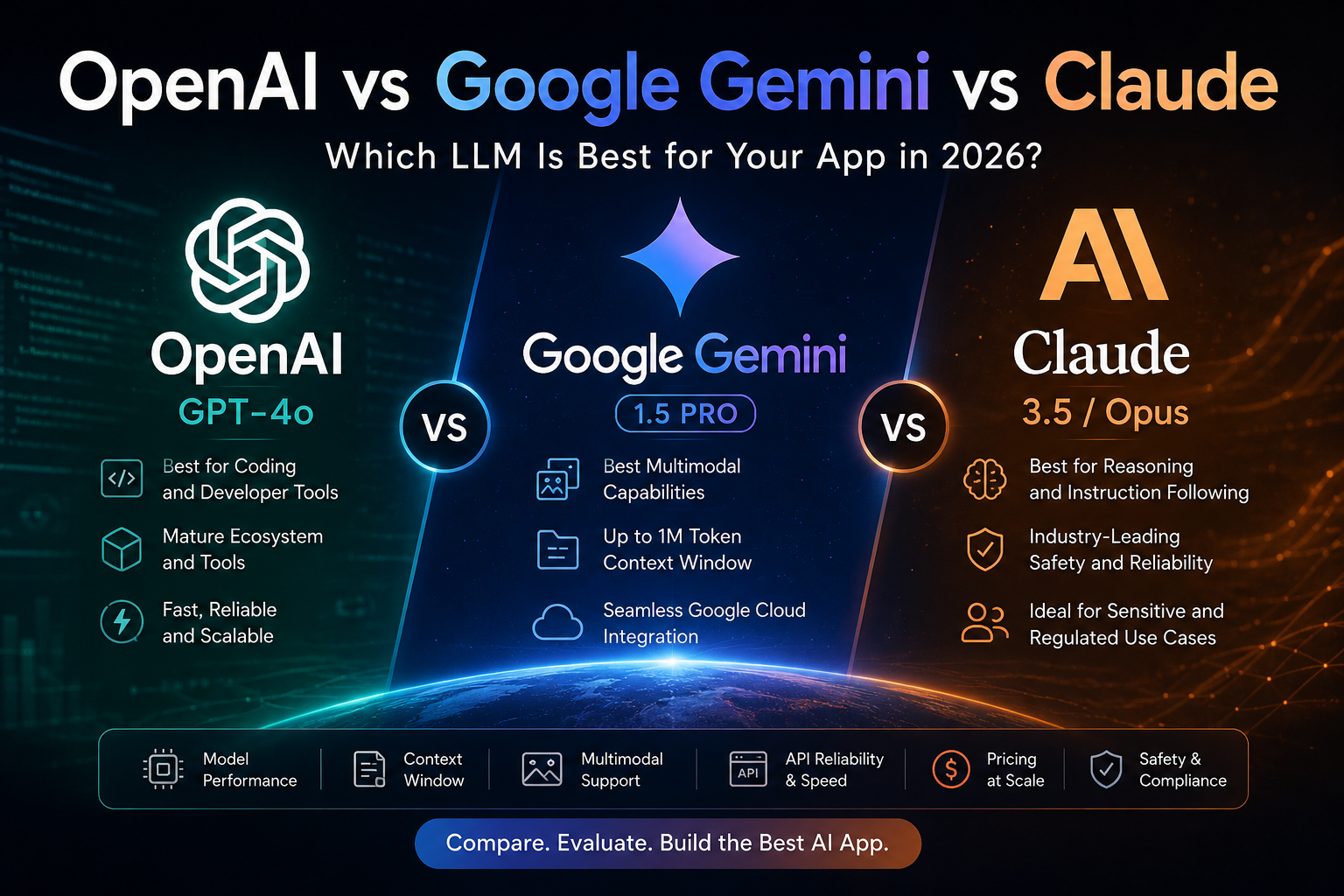
When comparing OpenAI vs Google Gemini vs Claude, OpenAI remains the default starting point for many engineering teams because of its mature ecosystem and developer-first tooling.
Models like GPT-4o and the newer reasoning-focused o-series continue to rank among the best AI models for:
- Code generation
- Software debugging
- Technical reasoning
- AI copilots
- Developer productivity tools
OpenAI also offers one of the strongest ecosystems in AI development:
- Function calling
- Structured outputs
- Fine-tuning APIs
- Assistants API
- Retrieval integrations
- Extensive third-party tooling
For startups and enterprise teams alike, OpenAI often provides the fastest path from prototype to production.
Best Use Cases for OpenAI
OpenAI is particularly strong for:
- AI coding assistants
- SaaS copilots
- Developer tools
- Technical chatbots
- AI agents
- Automation platforms
OpenAI Limitations
Despite its strengths, OpenAI has some tradeoffs:
- Higher costs at scale for large-context applications
- Requires Retrieval-Augmented Generation (RAG) for current information
- Enterprise teams may require enhanced privacy agreements
For many businesses, the biggest challenge isn’t performance — it’s balancing token costs with user growth.
Google Gemini: The Best Multimodal AI Model
Why Gemini Stands Out
In the Claude vs Gemini vs GPT-4o comparison, Google Gemini leads in multimodal AI capabilities.
Gemini was designed from the ground up to process:
- Text
- Images
- Audio
- Video
- Code
- Large documents
This makes Gemini exceptionally powerful for:
- Document intelligence platforms
- Media analysis tools
- AI search applications
- Knowledge management systems
- Enterprise workflow automation
One of Gemini’s biggest competitive advantages is its massive context window.
Gemini’s Massive Context Window
Google Gemini 1.5 Pro supports up to 1 million tokens, making it one of the best LLMs for:
- Large codebases
- Legal analysis
- Research workflows
- Long-form conversations
- Multi-document reasoning
For businesses already using Google Cloud infrastructure, Gemini integrates naturally with:
- Google Workspace
- BigQuery
- Vertex AI
- Google Cloud Platform (GCP)
This dramatically reduces implementation overhead for enterprise teams.
Best Use Cases for Gemini
Gemini is ideal for:
- Multimodal AI applications
- Enterprise document processing
- AI-powered search
- Video analysis
- Research assistants
- GCP-native architectures
Gemini Limitations
Google Gemini still trails OpenAI in some developer ecosystem areas:
- Smaller third-party integration ecosystem
- Less mature developer tooling
- Some variability in output consistency across tasks
However, Google is rapidly closing the gap.
Anthropic Claude: The Best AI Model for Reasoning and Safety
Why Enterprises Prefer Claude
In the growing conversation around OpenAI vs Google Gemini vs Claude, Claude has become the preferred model for organizations prioritizing:
- AI safety
- Instruction-following
- Long-form reasoning
- Sensitive content handling
- Enterprise reliability
Claude 3.5 and Claude Opus are widely regarded as the best AI models for nuanced reasoning and structured outputs.
Developers building complex AI agents frequently report that Claude follows system prompts more consistently than competing models.
This matters enormously in production AI systems where predictability is essential.
Claude’s Biggest Strength: Instruction Following
Claude excels at:
- Multi-step workflows
- Complex reasoning chains
- Structured JSON outputs
- Long-form writing
- Customer-facing AI systems
This makes Claude especially valuable in:
- Healthcare AI
- Legal tech
- Financial services
- Mental health applications
- Enterprise copilots
Claude and AI Safety
Anthropic has positioned itself as a leader in responsible AI development.
Compared with competitors, Claude is generally considered:
- Less likely to generate harmful outputs
- Better at handling sensitive conversations
- More resistant to hallucination-prone agreement behavior
For regulated industries, this can be a major deciding factor.
Claude Limitations
Claude can sometimes feel more conservative in:
- Creative writing
- Experimental outputs
- Marketing-focused content generation
Pricing is competitive, though not always the cheapest option for high-volume inference workloads.
OpenAI vs Google Gemini vs Claude: Side-by-Side Comparison
| Feature | OpenAI GPT-4o | Google Gemini | Anthropic Claude |
|---|---|---|---|
| Best for Coding | ✅ Excellent | Good | Very Good |
| Best for Multimodal AI | Very Good | ✅ Excellent | Good |
| Largest Context Window | Good | ✅ Excellent | Very Good |
| Instruction Following | Very Good | Good | ✅ Excellent |
| AI Safety | Good | Good | ✅ Excellent |
| Enterprise Integrations | Excellent | ✅ Excellent for GCP | Very Good |
| Developer Ecosystem | ✅ Best | Growing | Growing |
| Agentic Workflows | Very Good | Good | ✅ Excellent |
The Rise of Multi-LLM Architectures
One major trend in enterprise AI development is the shift toward multi-LLM architectures.
Instead of relying on a single provider, many companies now combine multiple AI models in one application stack.
A common architecture looks like this:
- OpenAI handles coding and technical reasoning
- Claude manages customer-facing interactions
- Gemini processes long documents and multimodal inputs
This approach reduces vendor lock-in while optimizing performance for each workflow.
Although it adds orchestration complexity, multi-model AI systems are becoming standard for production-grade AI platforms.
How to Choose the Best LLM for Your AI App
If you’re still deciding between OpenAI vs Google Gemini vs Claude, here’s a practical framework:
Choose OpenAI If:
- You’re building developer tools
- Coding performance matters most
- You need the strongest ecosystem
- You want rapid prototyping
Select Gemini If:
- Your app relies heavily on multimodal AI
- You process large documents
- You’re deeply integrated into Google Cloud
- Long-context reasoning is essential
Choose Claude If:
- You need reliable instruction following
- You’re building AI agents
- Your application handles sensitive information
- Safety and compliance are mission-critical
Still Unsure?
The best approach is often to run real-world evaluations:
- Test 50–100 actual user scenarios
- Compare outputs side-by-side
- Score accuracy, latency, and usability
- Benchmark costs under expected scale
Production AI decisions should be driven by application-specific performance — not benchmark marketing.
Final Thoughts
There is no universal winner in the OpenAI vs Google Gemini vs Claude debate.
Each model represents a different philosophy:
- OpenAI leads in ecosystem maturity and coding
- Gemini dominates multimodal AI and context scale
- Claude excels in reasoning, safety, and structured workflows
The best AI architecture in 2026 is increasingly hybrid, flexible, and optimized around use-case-specific strengths.
As the LLM market evolves, businesses that remain model-agnostic will likely gain the greatest long-term advantage.
Need Help Choosing the Right AI Stack?
Whether you’re building an AI SaaS platform, enterprise copilot, automation tool, or multimodal application, choosing the right LLM architecture can dramatically impact performance, scalability, and cost.
Aventishub AI Development Services
Aventishub helps startups and enterprises build production-grade AI applications using OpenAI, Google Gemini, Claude, and hybrid multi-LLM systems.
Schedule a technical consultation today and discover the best AI architecture for your business.