
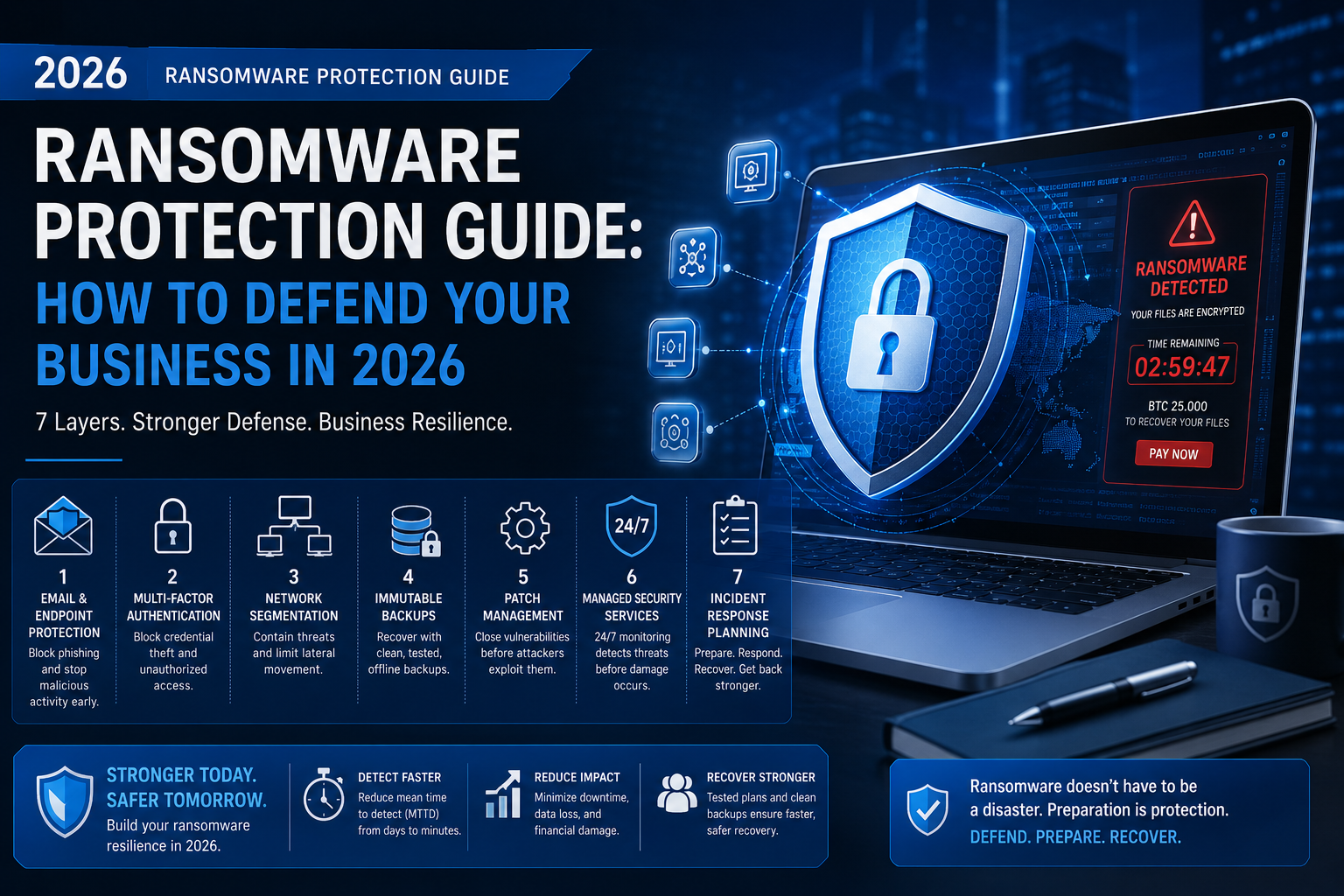
Ransomware is no longer just a threat to large enterprises — it is an existential risk for businesses of every size, across every industry. This ransomware protection guide gives you everything you need to understand how ransomware works, how attacks unfold, and — most critically — how to implement ransomware protection that actually works in 2026. Whether you are a healthcare organization, a manufacturer, or an SME, this ransomware protection guide will help you defend your operations, protect your data, and minimize the damage if the worst happens.
Why Ransomware Is at an All-Time High in 2026
Ransomware attacks increased by over 70% in the past two years, according to Verizon’s Data Breach Investigations Report. Ransomware-as-a-Service (RaaS) has lowered the barrier for attackers — criminal groups now license ransomware toolkits the way legitimate companies license software. The average ransom demand exceeded $2.7 million in 2025. More alarming: even organizations with ransomware protection measures in place are being successfully attacked, because ransomware tactics are evolving faster than traditional defenses. This makes a current, comprehensive ransomware protection guide more critical than ever.
How Ransomware Attacks Work: The Kill Chain
Before implementing ransomware protection, you need to understand how attacks unfold. A typical ransomware attack follows these stages:
1. Initial Access: Attackers gain entry via phishing emails, exposed RDP, VPN vulnerabilities, or compromised credentials. Ransomware protection at this stage means email filtering, MFA, and patching.
2. Lateral Movement: Once inside, attackers move quietly across your network, identifying critical systems and backups. Managed security services with network monitoring detect this phase.
3. Privilege Escalation: Attackers acquire admin credentials to maximize the impact of encryption. Security code hardening and privileged access management provide ransomware protection here.
4. Data Exfiltration: Modern ransomware groups steal data before encrypting it — enabling double extortion. Ransomware protection services with DLP (Data Loss Prevention) address this.
5. Encryption & Ransom Demand: Files are encrypted and a ransom note appears. Without ransomware protection, recovery options are limited to paying or restoring from backups.
The Ransomware Protection Framework: 7 Layers of Defense
Layer 1: Email and Endpoint Protection
Over 90% of ransomware attacks begin with a phishing email. First-line ransomware protection requires advanced email filtering that goes beyond spam detection — scanning for malicious links, attachments, and impersonation attacks. Pair this with endpoint detection and response (EDR) tools that can identify ransomware behavior in real time. This is the foundation of any effective ransomware protection guide.
Layer 2: Multi-Factor Authentication (MFA)
Compromised credentials are the second most common ransomware entry point. Enforcing MFA across all remote access points — VPNs, email, admin consoles — dramatically reduces your attack surface. This single ransomware protection measure blocks the majority of credential-based attacks. According to Microsoft Security Intelligence, MFA blocks over 99.9% of account compromise attacks.
Layer 3: Network Segmentation
If ransomware does breach your perimeter, network segmentation limits how far it can spread. Isolating critical systems — production databases, backups, SCADA systems — means a ransomware attack on one segment cannot immediately encrypt your entire environment. Managed security services providers typically include network segmentation design as part of a comprehensive ransomware protection architecture.
Layer 4: Immutable, Offline Backups
This is the single most important element of any ransomware protection guide: a tested, immutable backup strategy. Follow the 3-2-1-1-0 rule — 3 copies of data, on 2 different media types, with 1 offsite copy, 1 offline (air-gapped) copy, and 0 errors verified by regular restore tests. Ransomware specifically targets and deletes shadow copies and connected backups, so air-gapped offline backups are essential for effective ransomware protection.
Layer 5: Patch Management and Vulnerability Reduction
Unpatched vulnerabilities — particularly in VPNs, remote desktop tools, and web-facing servers — are a primary attack vector for ransomware. A disciplined patch management process is non-negotiable ransomware protection. Ransomware protection services often include vulnerability scanning to identify and prioritize the exposures attackers are actively exploiting.
Layer 6: Managed Security Services (MSSP) and 24/7 Monitoring
Ransomware attackers operate around the clock — most attacks are deployed during nights, weekends, and holidays when IT teams are off. Managed security services providers offer 24/7 Security Operations Centre (SOC) monitoring that detects ransomware indicators before encryption begins. A quality managed security services provider reduces mean time to detect (MTTD) from days to minutes — which is the difference between a contained incident and a full-scale disaster.
Layer 7: Incident Response Planning
Even the best ransomware protection guide acknowledges that no defense is 100% effective. Incident response services prepare your organization to respond decisively when ransomware strikes. A tested incident response plan covers: immediate isolation procedures, forensic evidence preservation, communication protocols, ransom decision frameworks, and recovery sequencing. Organizations with mature incident response services recover 3x faster and spend 50% less on breach costs, according to IBM’s Security Cost of a Data Breach study.
Ransomware Protection for Healthcare: Special Considerations
Cybersecurity for healthcare deserves its own section in this ransomware protection guide because healthcare organizations face unique challenges. Cybersecurity for healthcare must account for:
- • Connected medical devices: MRI machines, infusion pumps, and patient monitoring systems often run outdated operating systems that cannot be easily patched, creating significant ransomware exposure
- • HIPAA compliance: A ransomware attack on healthcare data triggers mandatory breach notification requirements under HIPAA, compounding the regulatory risk beyond the operational disruption
- • Life-safety implications: Ransomware in healthcare directly threatens patient safety — hospitals have been forced to divert emergency patients during ransomware attacks
- • 24/7 operations: Healthcare cannot afford extended downtime, making rapid incident response services and clean-room recovery capabilities mandatory components of cybersecurity for healthcare
For sector-specific guidance on cybersecurity for healthcare and ransomware, the HHS Health Sector Cybersecurity Coordination Center (HC3) publishes updated threat intelligence and ransomware protection guides tailored to healthcare providers.
Ransomware Protection Checklist: What to Do Right Now
| Priority | Action | Owner | Timeline |
| Critical | Enable MFA on all remote access | IT Security | This week |
| Critical | Verify offline backup integrity with restore test | IT Operations | This week |
| High | Deploy EDR on all endpoints | IT Security | 30 days |
| High | Segment critical systems from general network | Network Team | 30 days |
| High | Conduct ransomware incident response tabletop exercise | Security & Leadership | 30 days |
| Medium | Engage managed security services for 24/7 SOC | CISO / Leadership | 60 days |
| Medium | Launch phishing simulation and security awareness training | HR + Security | 60 days |
| Medium | Complete vulnerability scan and patch critical exposures | IT Security | 60 days |
Should You Pay the Ransom? What This Ransomware Protection Guide Recommends
This is the most difficult question in any ransomware protection guide. The official position of the FBI and CISA is clear: do not pay. Paying the ransom funds criminal organizations, does not guarantee data recovery (only 65% of paying victims recover all their data), and marks you as a compliant target for repeat attacks. With robust ransomware protection including tested backups and a rehearsed incident response services plan, you should never be in a position where paying is your only option. However, organizations without adequate ransomware protection sometimes face genuine no-choice scenarios — which is precisely why building your ransomware protection guide defenses before an attack is not optional.
Final Thoughts on Ransomware Protection in 2026
Ransomware is the most disruptive cyber threat businesses face today, and this ransomware protection guide has outlined why no single tool provides complete ransomware protection. The organizations that survive and recover quickly invest in layered defenses: endpoint protection, MFA, network segmentation, immutable backups, managed security services, and tested incident response services. Whether you are building a ransomware protection program from scratch or hardening an existing one, use this ransomware protection guide as your baseline. For additional resources, review CISA’s Ransomware Guide — one of the most authoritative public references on ransomware protection and response available.