
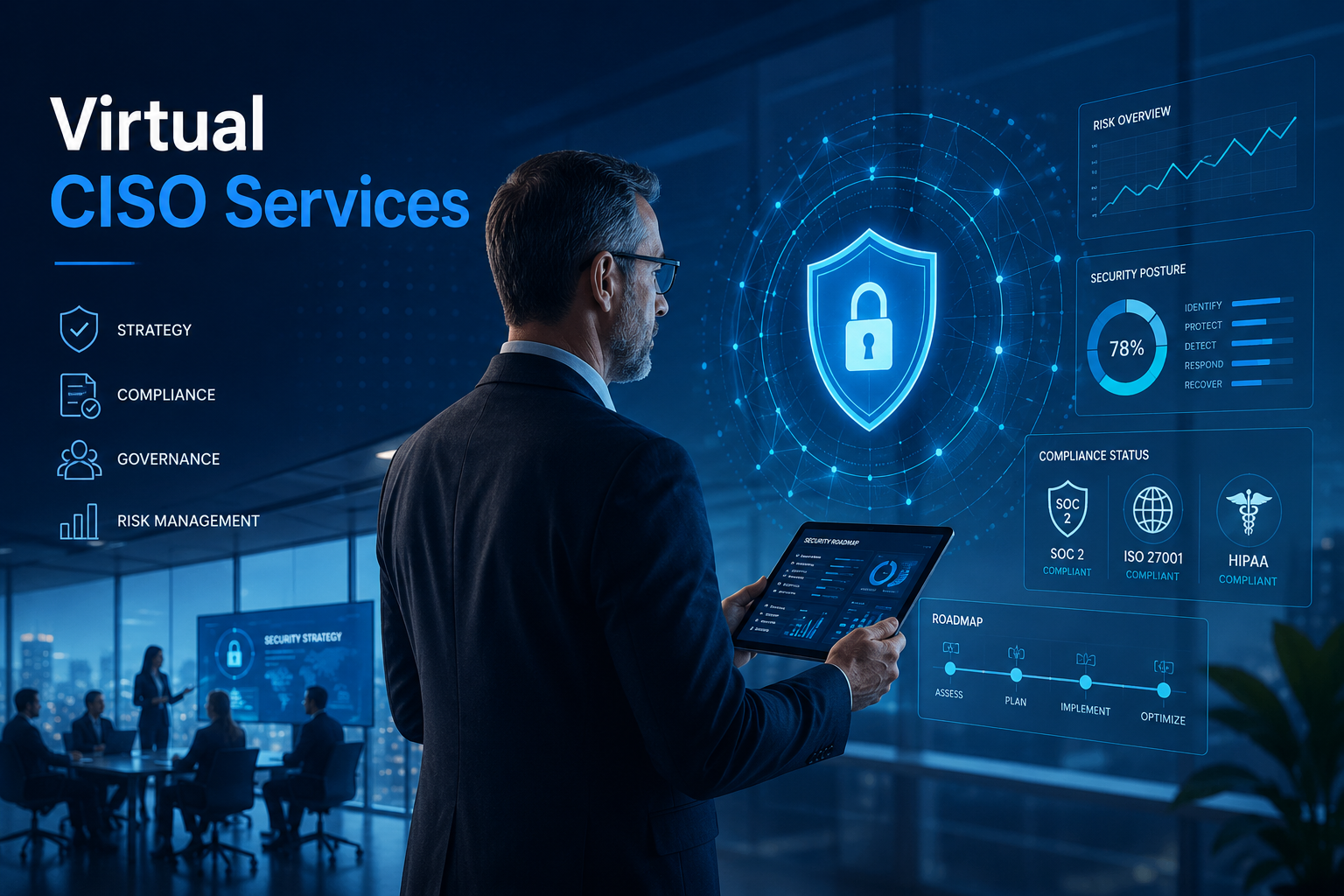
You know your business needs stronger cybersecurity leadership. You have compliance requirements building, customers asking for security evidence, and a threat landscape that grows more complex every quarter. But a full-time Chief Information Security Officer commands a salary of $200,000-$400,000 before benefits, equity, and support staff. For most small and mid-sized businesses, that equation simply does not work. Virtual CISO services exist precisely to close this gap — and in 2026, they are one of the fastest-growing engagements in cybersecurity.
What Is a Virtual CISO?
A virtual CISO — also called a fractional CISO, vCISO, or CISO-as-a-Service — is an experienced cybersecurity executive who provides strategic security leadership to your organization on a part-time, contract, or retainer basis. Rather than hiring a full-time CISO, you engage a virtual CISO service provider whose experts divide their time across multiple client organizations.
The virtual CISO performs all the strategic functions of a traditional CISO — building and owning the security strategy, managing compliance programs, advising the board and executive team, overseeing security vendors, and leading incident response — but does so within a defined engagement scope and at a fraction of the full-time cost.
| A virtual CISO is not a managed security service. An MSSP provides operational security monitoring and response. A vCISO provides strategic leadership, governance, and executive accountability. Many organizations benefit from both working in tandem. |
What Does a Virtual CISO Actually Do?
The specific responsibilities of a vCISO engagement vary by organization and need, but most virtual CISO services encompass the following:
Security Strategy and Roadmap Development
The vCISO assesses your current security posture, identifies gaps relative to your risk profile and industry requirements, and builds a multi-year security roadmap with prioritized initiatives. This strategic document becomes your organization’s security investment plan — tied to business risk rather than technology preferences.
Compliance and Framework Management
For organizations pursuing SOC 2, ISO 27001, HIPAA, PCI DSS, or other compliance certifications, the vCISO owns the compliance program. They scope the engagement, coordinate with auditors, build the required policies and controls, and track remediation through to certification.
Board and Executive Communication
One of the most valuable contributions a vCISO makes is translating technical security risk into business language that boards and executive teams can act on. Boards are increasingly required to demonstrate cybersecurity oversight — the vCISO provides the structured reporting and risk communication that makes this possible.
Vendor and Third-Party Risk Management
The vCISO evaluates your security vendor stack, manages relationships with managed security service providers, conducts third-party risk assessments, and ensures your security spend delivers measurable value.
Incident Response Planning and Oversight
Virtual CISO services typically include building or validating your incident response plan, conducting tabletop exercises with your leadership team, and providing executive coordination support during an actual incident. This is an area where many SMBs are dangerously underprepared.
Security Awareness and Culture
The vCISO drives security culture from the top — establishing policies, overseeing employee training programs, and creating accountability structures that make security a shared organizational responsibility rather than solely an IT function.
Virtual CISO vs Full-Time CISO: A Practical Comparison
| Factor | Full-Time CISO | Virtual CISO Services |
| Annual Cost | $200,000 – $400,000+ (salary + benefits + equity) | $40,000 – $150,000/year (engagement dependent) |
| Availability | Full-time dedicated | Part-time / retainer (typically 10-40 hrs/month) |
| Time to Hire | 3-6+ months average | 2-4 weeks to onboard |
| Experience Breadth | Single industry background | Typically cross-industry (multiple clients) |
| Strategic Value | High — deep organizational context | High — diverse perspective + best practices |
| Operational Execution | Can own execution directly | Typically advisory; partners with internal staff |
| Best For | Enterprise, regulated industry, high-risk | SMB, startup, mid-market, pre-IPO scaling |
Does Your Business Need Virtual CISO Services?
Virtual CISO services are not the right fit for every organization. Here are the clearest signals that your business would benefit:
- • You are pursuing SOC 2, ISO 27001, or other compliance certification and lack internal expertise to drive the program.
- • Your enterprise customers are sending security questionnaires and your answers are costing you deals.
- • You have experienced a security incident and need strategic leadership to build proper defenses going forward.
- • Your board or investors are asking about your cybersecurity governance and you lack executive-level answers.
- • You are growing rapidly and your security program has not kept pace with your risk exposure.
- • You have a small IT team handling security reactively with no strategic direction or formal program.
- • You operate in a regulated industry (healthcare, finance, legal) but cannot justify a full-time CISO salary.
How to Choose the Right Virtual CISO Service Provider
The quality of virtual CISO services varies significantly across providers. When evaluating options, look for these indicators of genuine expertise:
1. Verified credentials — CISSP, CISM, CRISC, or equivalent certifications. Ask for evidence of certification, not just claims on a website.
2. Relevant industry experience — A vCISO who has led healthcare security programs brings different value to a hospital than a fintech-focused practitioner. Match experience to your sector.
3. Defined engagement structure — What deliverables will you receive? How many hours per month? What does escalation look like during an incident? Vague proposals are a red flag.
4. References from comparable organizations — Ask to speak with two or three current clients at similar company sizes and risk profiles. A reputable provider will facilitate this easily.
5. Independence from vendor kickbacks — Some vCISO providers earn referral fees from security vendors they recommend. Ensure your provider has a conflict-of-interest policy.
What Does a Virtual CISO Engagement Cost?
Virtual CISO services are typically structured as monthly retainers ranging from $3,000 to $15,000 per month depending on engagement scope, company size, and provider experience. Project-based engagements — such as a compliance readiness assessment or incident response plan — may be scoped separately. Compared to a full-time CISO at $250,000-$400,000 per year, even the upper range of vCISO pricing represents 40-60% cost savings for equivalent strategic output.
Frequently Asked Questions
How is a virtual CISO different from a cybersecurity consultant?
A cybersecurity consultant typically delivers a defined project — a penetration test, a risk assessment, a policy review — and then exits. A virtual CISO is an ongoing strategic partner who holds executive accountability for your security program over time. The vCISO attends board meetings, manages your security roadmap, responds to incidents, and builds your program month over month. Consultants execute; virtual CISOs lead.
Can a virtual CISO work for a startup?
Absolutely — and many of the best use cases for virtual CISO services are early-stage companies. A startup pursuing enterprise contracts or SOC 2 certification for the first time benefits enormously from fractional CISO expertise. The vCISO builds a security program that is appropriate for the company’s current stage while being designed to scale. Most startups cannot justify a full-time CISO until Series B or C, but they need credible security leadership from the moment they handle customer data.
How quickly can a vCISO make an impact?
Within the first 30 days, a good virtual CISO should complete a gap assessment, present initial risk findings to leadership, and deliver a prioritized security roadmap. Compliance milestones, policy development, and vendor rationalization typically unfold over 90-180 days. The speed of impact depends heavily on organizational readiness and how actively leadership engages with the program.
| Call to Action: Get the Senior Security Leadership Your Business Needs — Without the Full-Time CostOur virtual CISO services give growing businesses access to experienced cybersecurity executives on a flexible retainer. From compliance programs to board reporting to incident response — we provide the strategic leadership your security program needs. Book a free discovery call today.Contact us today for a free consultation -> |