
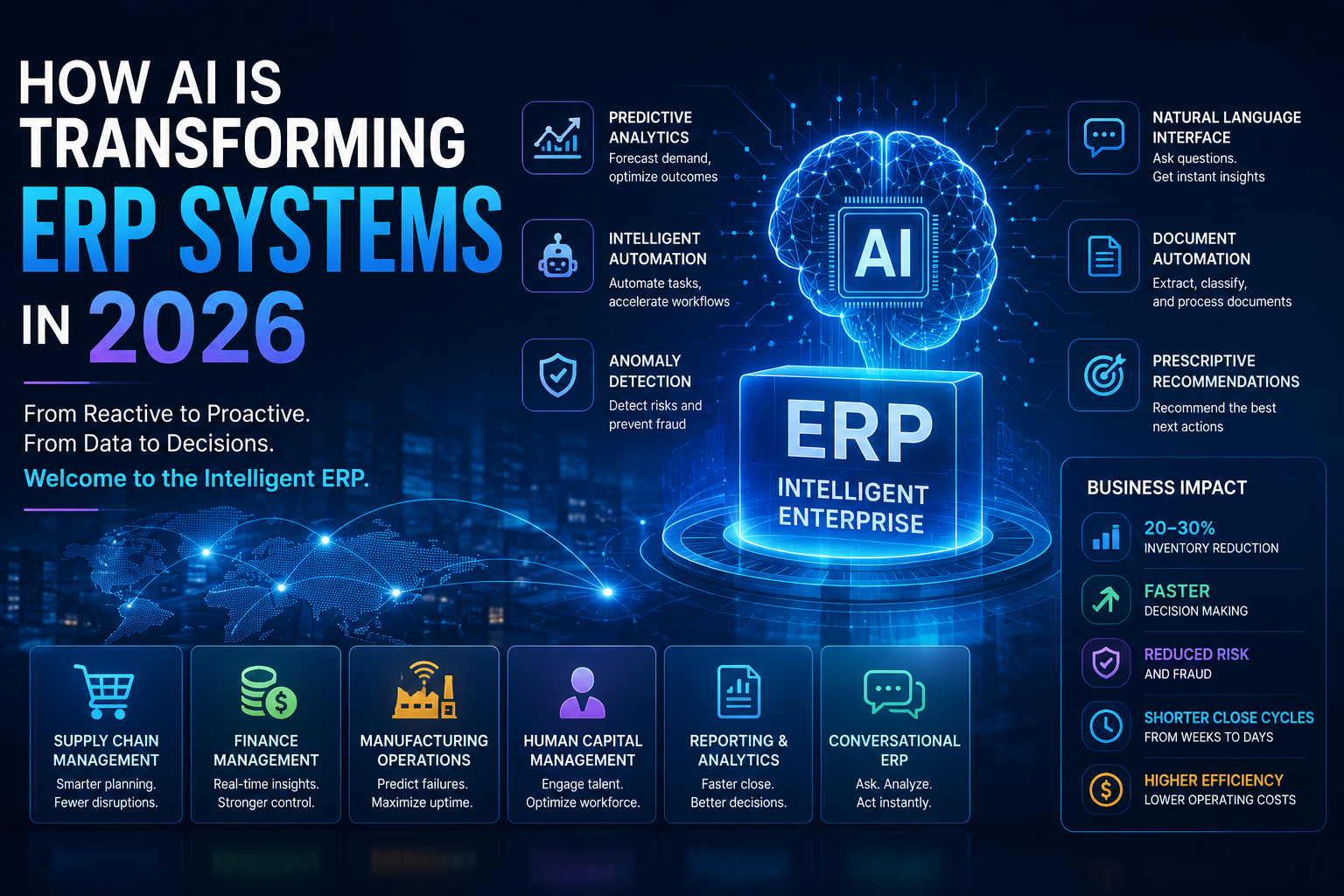
Enterprise Resource Planning systems have long been the operational backbone of large organizations. But traditional ERP systems, even sophisticated ones, are fundamentally reactive: they record what has already happened.
In 2026, a new generation of AI-powered ERP systems is fundamentally rewriting that story. By embedding machine learning, natural language processing, and predictive analytics directly into ERP workflows. This transformation is creating a significant competitive divide between organizations that have upgraded their ERP with AI capabilities.
The Limitations of Traditional ERP Systems
Before exploring what AI-powered ERP systems can do, it is worth understanding what traditional ERP systems cannot do well:
- • They require manual data entry, which introduces errors and delays
- • They generate reports based on historical data, providing no predictive insight
- • They lack the ability to detect anomalies in real time
- • They require highly skilled users to extract meaningful insights from complex data
- • They cannot adapt workflows dynamically based on changing business conditions
These limitations become particularly costly in volatile environments where the ability to predict and respond instantly is a decisive advantage.
What Makes an ERP System “AI-Powered”?
An AI-powered ERP system integrates machine learning models, NLP interfaces, computer vision, and advanced analytics directly into core ERP modules. Rather than being a separate analytics layer, AI becomes embedded in the workflow itself.
Key AI capabilities integrated into modern ERP platforms include:
- • Predictive analytics for demand forecasting, inventory optimization, and financial planning
- • Intelligent automation for routine transactions, approvals, and compliance checks
- • Anomaly detection for fraud prevention and operational exception management
- • Natural language interfaces allowing users to query ERP data conversationally
- • Automated document processing using computer vision and NLP
- • Prescriptive recommendations for procurement, resource allocation, and scheduling
Top Use Cases: AI Transforming ERP in 2026
1. Intelligent Supply Chain Management
Supply chain disruptions have become the defining operational challenge of the decade. AI-powered ERP systems address this with multi-variable demand forecasting models that analyze historical sales, weather patterns, macroeconomic indicators, and supplier lead times simultaneously. The result: procurement teams receive automated purchase recommendations days or weeks before shortages occur, with confidence intervals that help prioritize actions.
Leading manufacturers using AI-enhanced ERP software development report inventory reduction of 20-30% while simultaneously improving fill rates — a trade-off that was previously considered impossible.
2. Financial Anomaly Detection and Fraud Prevention
AI models trained on millions of financial transactions can identify patterns invisible to human reviewers. In the ERP context, this means real-time flagging of duplicate invoices, unusual payment patterns, policy violations, and potential fraud — before payments are processed rather than after. This alone can save enterprises millions annually.
3. Predictive Maintenance in Manufacturing ERP
For manufacturers, unplanned downtime is catastrophically expensive. AI integration services embedded in manufacturing ERP modules can process sensor data from connected machinery to predict equipment failures days in advance, enabling maintenance scheduling that minimizes disruption. This integration of IoT and AI within ERP is one of the most compelling use cases in enterprise software development today.
4. Automated Financial Close and Reporting
The monthly and quarterly financial close is a labor-intensive process in most enterprises. AI-powered ERP automates reconciliations, flags discrepancies, pre-populates journal entries, and generates first-draft reports — compressing close cycles from weeks to days while improving accuracy.
5. HR and Workforce Intelligence
AI-powered HR modules within ERP platforms can predict employee turnover, optimize workforce scheduling, identify skills gaps, and automate routine HR transactions. For large enterprises managing thousands of employees, these capabilities create substantial operational leverage.
6. Conversational ERP Interfaces
Natural language interfaces are dramatically lowering the barrier to ERP insight. Instead of navigating complex menus and running custom reports, business users can simply ask: ‘What were our top three suppliers by volume last quarter?’ or ‘Which product lines are at risk of stockout this month?’ and receive instant, accurate responses.
Custom ERP Development vs. Upgrading Existing Platforms
Organizations exploring AI-powered ERP face a fundamental choice: upgrade existing platforms like SAP or Oracle with AI modules, or invest in custom ERP development built with AI-native architecture from the ground up.
The right choice depends on several factors:
- • Existing ERP investment: Organizations deeply invested in SAP S/4HANA or Oracle Fusion may find AI enhancement more cost-effective than replacement
- • Industry-specific requirements: Highly specialized industries often benefit from custom ERP development that perfectly matches their workflows
- • Scalability needs: Custom-built ERP systems offer greater flexibility as business models evolve
- • Data architecture: AI performance is highly dependent on data quality and structure — custom builds can be architected from inception around AI data requirements
According to Gartner’s ERP research, by 2026 over 70% of enterprise ERP implementations will include embedded AI capabilities — up from less than 20% in 2022.
Key Considerations for AI-Powered ERP Implementation
Successfully implementing an AI-powered ERP system requires more than technology selection. Organizations must address:
- • Data quality and governance: AI models are only as good as the data they are trained on — data cleansing and governance are pre-requisites
- • Change management: AI-powered ERP changes how people work — comprehensive training and adoption programs are essential
- • Integration architecture: AI-powered ERP must integrate with existing systems — APIs, data lakes, and middleware must be designed for real-time data flows
- • Security and compliance: ERP systems contain the most sensitive business data — AI capabilities must be implemented within robust security frameworks
- • Phased deployment: AI capabilities should be rolled out incrementally, starting with high-value, lower-risk use cases
Conclusion: The Intelligent ERP Is Not the Future — It Is Now
The transformation of ERP systems through AI is accelerating rapidly. In 2026, organizations still operating static, report-centric ERP systems are operating at a structural disadvantage. The enterprises that move now to implement AI-powered ERP capabilities — whether through platform upgrades or custom ERP development — will establish competitive moats that are difficult for laggards to overcome.
The journey begins with the right technology partner. Whether you are evaluating AI integration services for your existing ERP platform or planning a complete AI-native enterprise software development project, the decisions you make today will define your operational capabilities for the next decade.
Learn more about our custom ERP development and AI integration services to discover how we can help you build an intelligent ERP system tailored to your industry and business model.