Introduction: One of the Most Important Architecture Decisions You’ll Make
Here’s a scenario that plays out in engineering teams every day: someone kicks off a new project, opens up a whiteboard (or a Miro board), and someone asks “are we going serverless or containers?”
The room splits. The serverless advocate talks about zero infrastructure management and automatic scaling. The containers person brings up vendor lock-in and cold start latency. An hour later, you’ve made a decision mostly based on who argued more confidently — not necessarily what was actually right for the project.
Sound familiar?
Serverless vs containers is one of those architecture decisions that can shape your project’s cost, complexity, and scalability for years. Getting it right matters — and it starts with really understanding what each approach offers, and where each one breaks down.
This guide gives you an honest, practical comparison so you can make the call with confidence.
Need help designing a cloud-native architecture that’s built for your specific use case? Aventis Hub’s cloud-native development services help teams architect applications that scale without unnecessary complexity.
What Is Serverless Architecture?
“Serverless” is a bit of a misleading name — there are absolutely servers involved. What it really means is that you don’t manage those servers. The cloud provider handles all the underlying infrastructure, and you just deploy your code.
The most common serverless compute model is Functions as a Service (FaaS), with examples like:
In a serverless model, your code runs in response to events — an HTTP request, a message in a queue, a file upload, a scheduled timer. The platform spins up an execution environment, runs your function, and tears it down. You pay only for the compute time you actually use, measured in milliseconds.
Beyond FaaS, the serverless umbrella also covers managed databases (DynamoDB, PlanetScale), serverless containers (AWS Fargate), and fully managed application platforms (Vercel, Netlify).
What Are Containers?
Containers are a way of packaging your application and all its dependencies into a portable, consistent unit that can run anywhere — your laptop, a CI/CD pipeline, a cloud VM, or a Kubernetes cluster.
Docker popularized containers, and Kubernetes became the dominant platform for orchestrating them at scale — managing deployment, scaling, networking, and health checks across fleets of containers.
In a containerized architecture, you define your application as one or more container images, deploy them to a container orchestration platform, and manage how they scale, communicate, and recover from failures.
Popular container orchestration options include:
- Kubernetes (self-managed or via EKS, GKE, AKS)
- AWS ECS (Elastic Container Service)
- Google Cloud Run (serverless containers — a fascinating hybrid)
- AWS Fargate (containers without managing EC2 instances)
Serverless vs Containers: Head-to-Head Comparison
1. Operational Complexity
This is probably the starkest difference between the two.
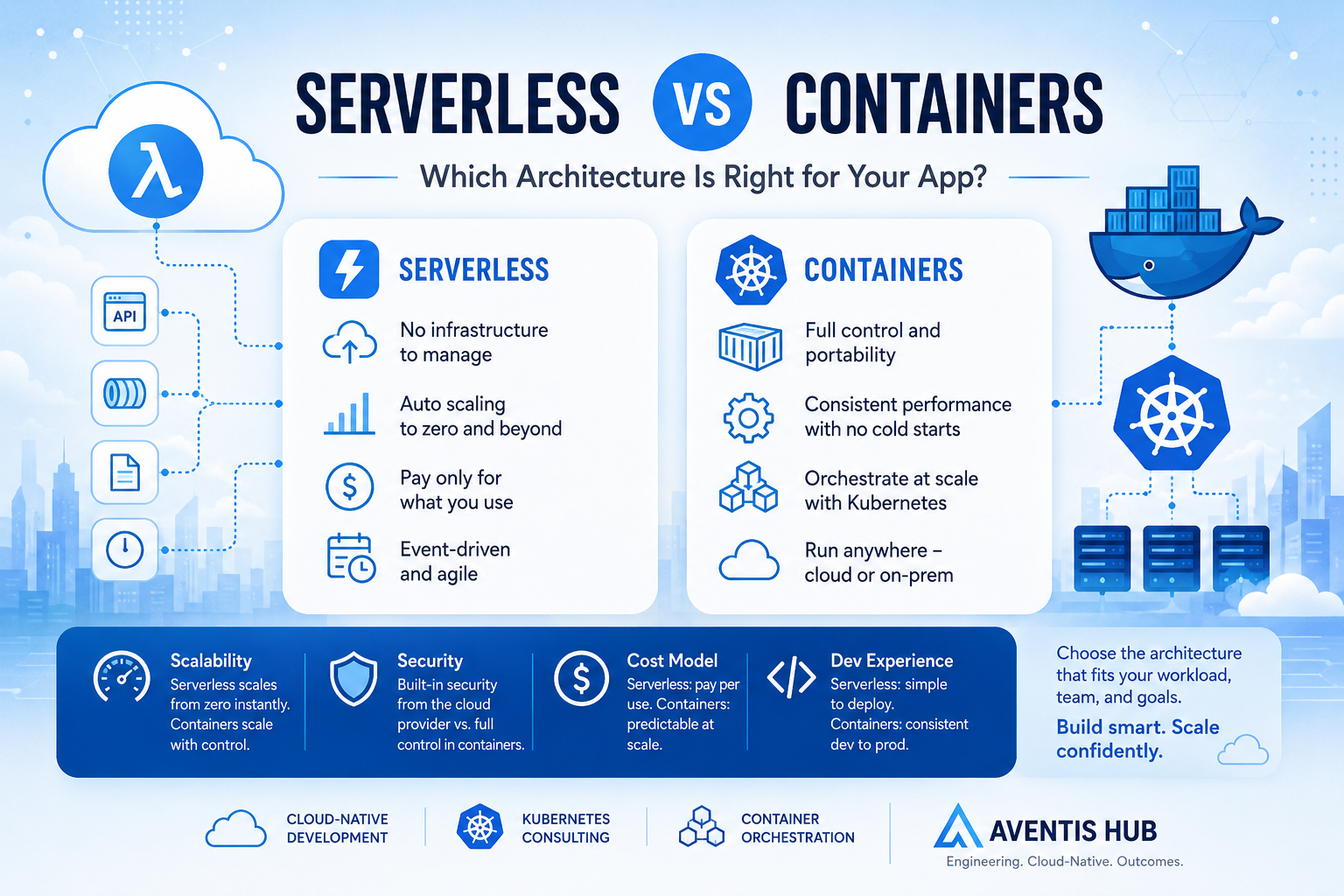
Serverless: The cloud provider manages the infrastructure entirely. You don’t patch servers, manage clusters, configure load balancers, or worry about node health. Your operational surface area is dramatically smaller. For small teams or teams without dedicated DevOps/SRE resources, this is a massive advantage.
Containers: You gain full control, but that control comes with responsibility. Running Kubernetes in production is a significant operational undertaking. You need to manage cluster upgrades, networking (ingress, service meshes), storage, secrets management, scaling policies, and more. Even with managed Kubernetes like EKS or GKE, there’s still substantial operational overhead.
Winner for simplicity: Serverless — by a wide margin.
2. Cost Model
Serverless: You pay per invocation and per unit of compute time. For workloads with variable or unpredictable traffic, this can be extremely cost-efficient — you’re not paying for idle resources. At low traffic volumes, serverless is often nearly free. But at very high, sustained throughput, per-invocation pricing can become more expensive than dedicated containers.
Containers: You pay for the underlying compute (EC2 instances, managed node groups, etc.) whether or not your containers are actively serving traffic. This can be wasteful for bursty or low-traffic workloads. But for high and consistent throughput, reserved instances or committed use discounts can make containers significantly cheaper.
Winner: Depends on your traffic pattern. Serverless wins at low/variable load; containers win at high sustained load.
3. Scalability
Serverless: Scales automatically and near-instantly — from zero to thousands of concurrent executions without any configuration. This is one of serverless’s biggest superpowers for unpredictable workloads.
Containers: Can scale well with Kubernetes Horizontal Pod Autoscaler and cluster autoscaling, but spinning up new nodes takes time (minutes, not seconds). Scaling is more configurable but requires more setup and tuning. Our Kubernetes consulting services help teams build scalable container architectures that autoscale efficiently without over-provisioning.
Winner: Serverless for bursty, rapid-scale scenarios. Containers for fine-grained, predictable scaling requirements.
4. Performance and Latency
Serverless cold starts are a real consideration. When a serverless function hasn’t been invoked recently, the first request triggers a “cold start” — the platform needs to initialize the execution environment before running your code. Cold starts can add hundreds of milliseconds to latency, which matters for user-facing APIs. Techniques like Lambda SnapStart and keeping functions “warm” can mitigate this, but it remains a genuine limitation.
Containers avoid cold starts entirely. Once a container is running, it responds at application-level speed. For latency-sensitive applications — real-time APIs, gaming backends, financial services — this is often a deciding factor.
Winner: Containers for consistent low-latency workloads.
5. Vendor Lock-In
Serverless tends to create more vendor lock-in. AWS Lambda functions use AWS-specific SDKs, event sources, and infrastructure glue. Migrating a complex serverless application from AWS to GCP isn’t trivial. Frameworks like Serverless Framework and AWS SAM help with abstraction, but the lock-in is real.
Containers are fundamentally more portable. A Docker container runs consistently across any environment that supports Docker or Kubernetes. Cloud-native development with containers gives you the freedom to move between cloud providers or run on-premises with much less friction.
Winner: Containers for portability and cloud-agnostic deployments.
6. Development Experience
Serverless can feel magical when it works — deploy a function and it’s live in seconds. But local development can be awkward. Emulating cloud-specific event triggers, testing integrations with other managed services, and debugging distributed serverless workflows requires extra tooling (like LocalStack for AWS service emulation).
Containers provide a consistent development-to-production experience. If it runs in Docker locally, it runs in production. This predictability is valuable for complex applications. Tools like Docker Compose make local multi-service development straightforward.
Winner: Containers for development consistency; Serverless for deployment simplicity.
When to Choose Serverless
Serverless is a strong choice when:
You have event-driven, intermittent workloads. APIs that get hit occasionally, background jobs that run on a schedule, webhook processors, image resizing pipelines — these are natural fits for serverless. You’re not paying for idle time.
Your team is small and doesn’t have DevOps resources. Serverless dramatically reduces the operational surface area. A three-person startup with no dedicated infrastructure person can ship a production API without ever touching a server.
You’re building microservices with independent scaling needs. Each function scales independently, which is ideal for architectures where different components have dramatically different traffic patterns.
Time to market is critical. Serverless reduces the time between “I have an idea” and “it’s in production.” No cluster setup, no Dockerfiles, no load balancer configuration.
Building a new serverless application and want to get the architecture right from day one? Aventis Hub’s serverless application development services help teams design and build serverless architectures that scale without becoming a maintenance nightmare.
When to Choose Containers
Containers are the right choice when:
You have long-running, stateful workloads. Machine learning inference servers, real-time data pipelines, websocket servers, and background workers that maintain state are poor fits for serverless. Containers handle these naturally.
You need consistent, low-latency performance. If cold starts are unacceptable — financial services, gaming, real-time APIs — containers give you the consistency serverless can’t.
Your application is large and complex. Monolithic applications, large APIs with complex dependencies, and applications that are difficult to decompose into small functions often run more smoothly as containers.
You need portability and avoid vendor lock-in. If multi-cloud or on-premises deployment is a business requirement, containers are the clear choice.
You’re running ML/AI workloads. Training and serving machine learning models typically requires specific hardware (GPUs), large dependencies, and persistent resource allocation — all better suited to containers. Kubernetes has strong support for GPU workloads via NVIDIA device plugin.
Running Kubernetes in production and struggling with complexity, cost, or scalability? Aventis Hub’s Kubernetes consulting services and container orchestration services help you simplify operations and build clusters that run reliably at any scale.
What About the Middle Ground? Cloud Run, Fargate, and Serverless Containers
One of the most interesting developments in cloud architecture is the emergence of serverless containers — services that let you run containers without managing the underlying infrastructure.
Google Cloud Run and AWS Fargate are the best examples. You package your app as a container (keeping portability and consistency), but you don’t manage any servers or clusters. The platform handles scaling, including scaling to zero.
This hybrid approach is genuinely compelling for many use cases:
- You get the portability and consistency of containers
- You avoid the operational overhead of managing Kubernetes
- You get serverless-like scaling and pricing
- Cold starts are possible but often minimal for containerized workloads
If you’re on the fence between serverless and containers, serverless containers might be your Goldilocks answer.
Serverless vs Containers: The Decision Framework
Here’s a quick framework for making the call:
| Factor | Serverless | Containers |
| Traffic pattern | Bursty / unpredictable | Consistent / high volume |
| Team DevOps maturity | Low | Medium–High |
| Latency requirements | Tolerant of cold starts | Low-latency, consistent |
| Workload type | Event-driven, stateless | Long-running, stateful |
| Portability | Lower | Higher |
| Cost at scale | Can be expensive | More predictable |
| Development simplicity | Higher | Medium |
The Bottom Line: Serverless vs Containers
There’s no universal winner in the serverless vs containers debate — and any article that tells you otherwise is oversimplifying.
Serverless wins when you want to minimize operational overhead, you have bursty or unpredictable workloads, and you’re optimizing for development speed and simplicity. It’s especially powerful for event-driven microservices and small teams moving fast.
Containers win when you need portability, consistent performance, control over your environment, and the ability to run complex, long-running, or stateful workloads. They’re the right foundation for large-scale, production-grade systems.
And serverless containers (Cloud Run, Fargate) are worth serious consideration as a pragmatic middle ground — especially if you’re starting a new project and want the best of both worlds.
The best architecture is the one that fits your team’s skills, your workload’s characteristics, and your organization’s operational capacity — not the one that’s most fashionable.
Ready to Build the Right Architecture for Your App?
Making the wrong architectural choice early is expensive to fix. Making the right one sets your team up to ship fast and scale confidently.
Aventis Hub provides serverless application development, container orchestration services, Kubernetes consulting, and cloud-native development expertise — to help you make the right architectural decisions and build them well.
👉 Talk to our engineering team and let’s design the right architecture for your application.
Further reading: