
Building a SaaS platform is one of the most consequential technical undertakings a founder makes — and consequently one of the most frequently underestimated. The economics of SaaS are extraordinarily attractive: recurring revenue, low marginal cost per additional customer, and compounding retention. However, building the platform that delivers those economics requires navigating a specific set of architectural, product, and operational decisions that differ meaningfully from building a conventional web application.
Furthermore, the decisions founders make in the first few months of SaaS development — about architecture, multi-tenancy model, billing infrastructure, and technology stack — create constraints that shape the product for years. Therefore, this step-by-step guide covers everything founders need to understand to build a SaaS platform that scales from zero to enterprise customers without requiring a costly rebuild.
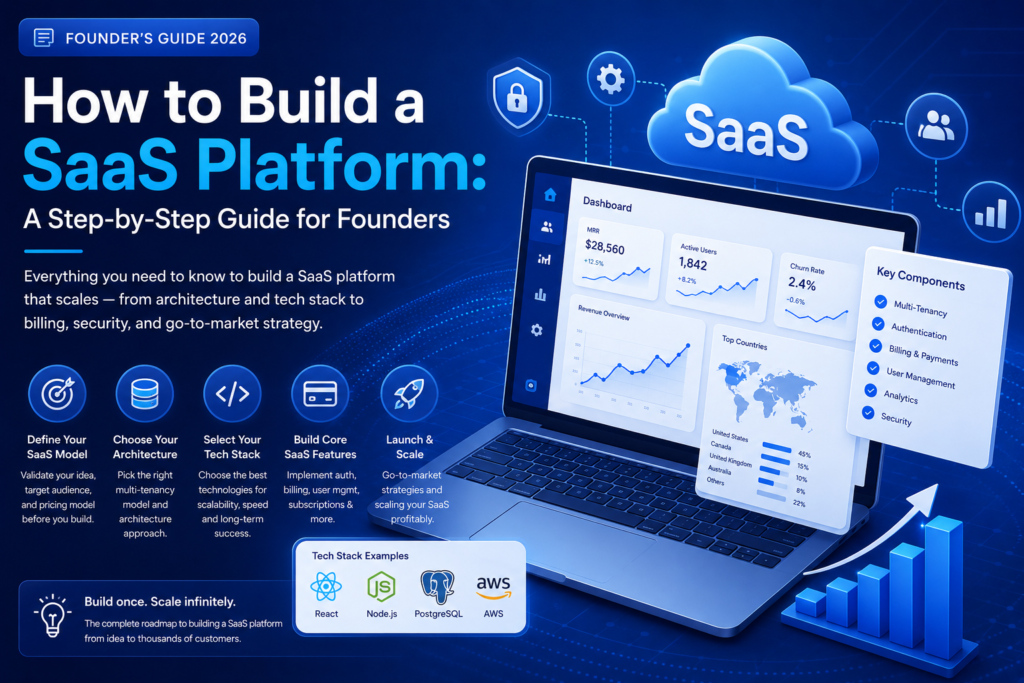
Step 1: Define Your SaaS Model Before Writing Any Code
Identify Your Target Customer and Use Case
Specifically, the most common mistake founders make is beginning SaaS development before understanding exactly who the product serves and what specific workflow it replaces or improves. Consequently, they build features based on assumptions rather than validated customer needs. Therefore, before any technical work begins, founders should conduct structured customer discovery interviews with at least 20 potential users, map the specific workflow the SaaS will address, and identify the one or two features without which no customer would pay.
Choose Your Pricing Model
Moreover, pricing model directly influences architecture. Per-seat pricing requires user management features. Usage-based pricing requires metering infrastructure. Tiered plans require feature gating. Additionally, freemium models require conversion tracking. As a result, selecting a pricing model before architecture begins ensures the technical design accommodates the business model rather than requiring expensive retrofitting later.
Step 2: Choose Your SaaS Architecture Model
Multi-Tenancy: The Core SaaS Architectural Decision
Multi-tenancy — serving multiple customers from a single software instance — is the architectural characteristic that makes SaaS economics work. Consequently, it is also the most consequential early architectural decision. Three multi-tenancy models exist, each with different cost, complexity, and compliance implications:
| Model | Description | Best For | Trade-Off |
| Shared database, shared schema | All tenants share one database and schema, separated by tenant_id | Cost-efficient SaaS, non-regulated markets | Data isolation complexity; one breach affects all |
| Shared database, separate schema | All tenants in one database but separate schemas/namespaces | Balanced approach | More complex migrations; better isolation |
| Separate database per tenant | Each customer gets their own database instance | Enterprise, regulated industries (HIPAA, GDPR) | Higher cost; easier compliance and customization |
Monolith vs Microservices for Early-Stage SaaS
Furthermore, most SaaS founders should start with a well-structured monolith rather than microservices. Specifically, a monolith ships faster, costs less to operate, and is easier to refactor as the product evolves. Microservices add operational overhead that early-stage teams rarely justify. Moreover, as our guide on microservices vs monolithic architecture explains, the right time to extract microservices is when specific scaling or team coordination problems demand it — not as a default starting architecture.
Step 3: Select Your SaaS Technology Stack
Backend Framework
The backend handles business logic, database access, authentication, and API endpoints. Consequently, framework choice significantly affects development speed and available talent. Popular and well-supported options include Node.js with Express or NestJS (JavaScript/TypeScript, large ecosystem), Ruby on Rails (fast prototyping, convention over configuration), Django (Python, excellent for data-heavy SaaS), and Laravel (PHP, mature ecosystem). Moreover, all of these options support the features SaaS platforms require — multi-tenancy, background jobs, WebSockets — and have extensive deployment documentation.
Frontend Framework
React remains the dominant SaaS frontend framework in 2026, specifically because of its component ecosystem, talent availability, and Next.js meta-framework for server-side rendering. Furthermore, Vue.js provides a gentler learning curve for smaller teams. Additionally, for SaaS platforms requiring real-time collaboration features — shared dashboards, live editing — Svelte’s reactivity model offers performance advantages. However, team familiarity and available talent should ultimately drive this decision above framework-specific feature comparisons.
Database Selection
PostgreSQL is the default choice for most SaaS platforms in 2026. It provides ACID compliance, JSON support for flexible schemas, row-level security for tenant isolation, and a rich extension ecosystem. Moreover, managed PostgreSQL services — AWS RDS, Supabase, Neon — eliminate database administration overhead. Additionally, Redis handles caching, session storage, and background job queues. For SaaS platforms with specific search requirements, Elasticsearch or Typesense complement the primary database.
Step 4: Build Authentication and Access Control
Authentication Infrastructure
Authentication in SaaS must support multiple login methods (email/password, Google SSO, Microsoft SSO, SAML for enterprise), multi-factor authentication, and invitation-based team onboarding. Furthermore, building authentication from scratch introduces significant security risk. Consequently, most SaaS teams use purpose-built authentication services — Auth0, Clerk, or Supabase Auth — rather than building identity management in-house. These services handle password hashing, session management, OAuth flows, and MFA out of the box.
Role-Based Access Control
Additionally, SaaS platforms require granular permission systems so that team administrators control what each user can see and do. Specifically, role-based access control (RBAC) assigns users to roles (admin, editor, viewer) and maps roles to permissions. Moreover, enterprise customers frequently request custom roles and fine-grained permissions as a condition of purchase. Therefore, designing a flexible RBAC model early — rather than retrofitting it when the first enterprise deal depends on it — saves significant future engineering cost.
Step 5: Implement Billing and Subscription Management
Use Stripe — Do Not Build Billing From Scratch
Billing infrastructure — subscription management, invoicing, proration, dunning for failed payments, tax calculation — is one of the most complex components of a SaaS platform. Consequently, virtually every SaaS startup uses Stripe Billing rather than building payment infrastructure from scratch. Stripe handles subscription lifecycle management, automatic retry logic for failed payments, invoice generation, and integration with accounting software. Moreover, Stripe’s revenue recognition features satisfy audit requirements for enterprise sales.
Feature Gating for Tiered Plans
Furthermore, tiered pricing plans require feature gating — the ability to enable or disable specific features based on a customer’s subscription tier. Specifically, hard-coded feature gates become maintenance nightmares as plans evolve. Therefore, most SaaS teams implement feature flag infrastructure — LaunchDarkly, Unleash, or a custom flag service — that decouples feature availability from code deployments. As a result, the product and growth teams adjust plan features without requiring engineering deployments.
Step 6: Build Your SaaS MVP and Validate Before Scaling
Before investing in scalability, advanced features, or enterprise infrastructure, founders must validate that customers pay for the core value proposition. Consequently, the SaaS MVP strategy focuses ruthlessly on the single workflow that delivers the most value. Moreover, as our guide on MVP vs Prototype vs PoC explains, an MVP is specifically designed to acquire paying customers — not to showcase technical sophistication or feature completeness.
Specifically, a SaaS MVP should include the core value-delivery feature, user authentication and basic team management, a working billing integration with at least one paid plan, and basic analytics to understand user behaviour. Furthermore, it should deliberately exclude advanced reporting, extensive integrations, mobile apps, and enterprise SSO until paying customers demand them.
[Internal Link: MVP vs Prototype vs PoC: What’s the Difference and Which Do You Need? -> /blog/mvp-vs-prototype-vs-poc]
Step 7: Set Up Monitoring, Observability, and Support Infrastructure
Monitoring and Alerting
A SaaS platform that goes down without the team knowing costs customer trust and revenue. Consequently, monitoring infrastructure — specifically uptime monitoring, error tracking, and performance monitoring — must deploy before launch, not after. Furthermore, tools like Sentry for error tracking, Datadog or New Relic for infrastructure monitoring, and Pingdom or Better Uptime for uptime monitoring give teams real-time visibility into system health.
Customer Support Infrastructure
Moreover, customer support infrastructure — a help desk tool, in-app chat, and documentation portal — directly affects churn rates. Specifically, customers who cannot get help when they encounter problems cancel subscriptions. Therefore, launching with at least basic support infrastructure (Intercom, Crisp, or Zendesk) and a getting-started documentation site reduces early churn meaningfully.
[Internal Link: How Much Does It Cost to Build an App in 2026? -> /blog/how-much-does-it-cost-to-build-an-app]
[Internal Link: Fractional CTO Services: What They Are and When Your Startup Needs One -> /blog/fractional-cto-services]
Frequently Asked Questions
How long does it take to build a SaaS platform?
A focused SaaS MVP with core functionality, authentication, and billing integration typically takes 12-20 weeks with a small dedicated team. Furthermore, a full-featured SaaS platform with enterprise features, advanced reporting, and multiple integrations typically takes 9-18 months from kickoff to general availability. Consequently, founders planning a specific launch date should add 20-30% buffer to their initial timeline estimate to account for inevitable scope refinement and integration complexity.
Do I need a technical co-founder to build a SaaS platform?
Not necessarily. Founders without technical backgrounds successfully build SaaS platforms by partnering with experienced SaaS development companies or engaging fractional CTO services for technical leadership. However, non-technical founders who manage development entirely on their own — without any technical oversight — frequently encounter costly mistakes in architecture decisions, vendor selection, and scope management. Therefore, some form of senior technical input significantly reduces risk even when the founder does not write code.
| Ready to Build Your SaaS Platform?Our SaaS development company works with founders at every stage — from technical validation and architecture design through full-stack development, billing integration, and launch. We build SaaS platforms that scale from your first customer to your first thousand.Talk to our team today -> AventisHub |