
Customer relationship management has always been the art of knowing your customers — their needs, preferences, behaviors, and the right moment to engage. For decades, CRM systems have helped businesses store and organize this knowledge. But storing data and truly understanding customers are very different things.
AI-powered CRM development is closing that gap. By layering machine learning, natural language processing, and predictive analytics on top of customer data, modern CRM systems are evolving from passive record-keeping tools into active intelligence engines that help sales, marketing, and service teams make smarter decisions, faster.
In this guide, we explore what makes a CRM AI-powered, the concrete business benefits it delivers, the key features to look for or build, and how organizations can approach custom CRM development to create a platform perfectly suited to their needs.
What Is an AI-Powered CRM?
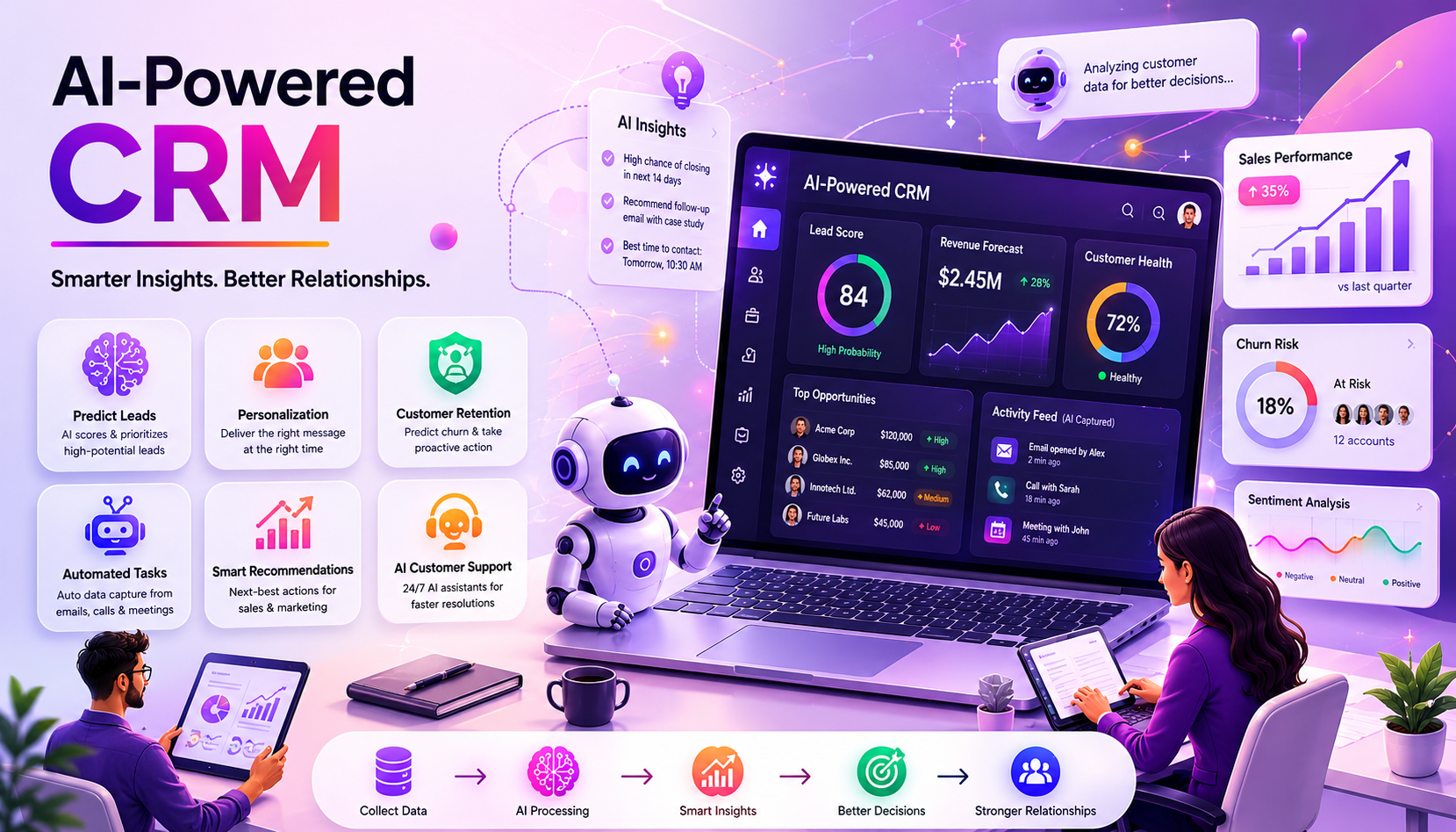
An AI-powered CRM integrates machine learning models and AI algorithms directly into core CRM functions — contact management, sales pipeline management, marketing automation, and customer service. Unlike traditional CRM systems that require humans to manually interpret data and decide on actions, AI-powered CRM proactively generates insights, predictions, and recommendations.
The distinction is significant. A traditional CRM tells you that a prospect opened your email. An AI-powered CRM tells you that this particular prospect has a 78% probability of converting within the next 14 days based on their behavior pattern — and recommends the specific follow-up action that has historically produced the best results for similar prospects.
Key Benefits of AI-Powered CRM Development
1. Predictive Lead Scoring and Prioritization
One of the most immediate and measurable benefits of AI integration in CRM is intelligent lead scoring. Machine learning models trained on your historical win/loss data can score every prospect in your pipeline based on hundreds of variables — not just the handful a human could track. Sales teams stop wasting time on low-probability leads and focus on opportunities most likely to close.
Companies implementing AI-powered lead scoring report sales productivity improvements of 30-40% and win rate increases of 20-25% on average.
2. Churn Prediction and Customer Retention
Acquiring a new customer costs five to seven times more than retaining an existing one. AI-powered CRM systems continuously monitor customer engagement signals — product usage, support ticket frequency, email engagement, payment behavior — and flag accounts showing early warning signs of churn. This gives customer success teams the intelligence to intervene proactively, often before the customer is even consciously thinking about leaving.
3. Personalization at Scale
Modern customers expect personalized experiences across every touchpoint. AI enables CRM software development teams to build systems that automatically tailor communication content, timing, channel, and offer based on individual customer profiles and real-time behavioral signals. What was once possible only for enterprise customers with massive marketing teams is now achievable at scale through machine learning development.
4. Automated Data Entry and CRM Hygiene
Data quality is the perennial CRM challenge. Sales reps hate manual data entry, and the result is incomplete, outdated CRM records. AI-powered CRM systems use NLP to automatically capture and log activities from emails, call transcripts, and calendar events, keeping records current without human effort. This dramatically improves the data quality that all AI models depend on — creating a virtuous cycle of better data leading to better AI insights.
5. Intelligent Sales Coaching
AI analysis of sales call recordings, email sequences, and deal progressions enables CRM systems to provide specific, data-driven coaching recommendations. Rather than generic best practice advice, AI-powered CRM can tell a specific rep: ‘Your deals that include a product demo in week 2 close at twice the rate of those that do not’ — actionable insight derived from that individual’s actual performance data.
6. Conversational AI for Customer Service
AI-powered chatbots and virtual assistants integrated with CRM data can handle a substantial portion of routine customer service inquiries — order status, FAQs, appointment scheduling, basic troubleshooting — with zero wait time and 24/7 availability. When escalation is needed, the AI hands off to a human agent with full context, dramatically improving resolution efficiency.
Core Features of an AI-Powered CRM System
When evaluating or building an AI-powered CRM through custom CRM development, these are the essential AI feature categories to prioritize:
- • Predictive analytics engine: Lead scoring, churn prediction, deal health monitoring, revenue forecasting
- • NLP-powered activity capture: Automatic logging from emails, calls, and meetings
- • Recommendation engine: Next-best-action guidance for sales, marketing, and service teams
- • Sentiment analysis: Real-time analysis of customer communications to gauge relationship health
- • Segmentation intelligence: Dynamic customer segmentation based on behavioral and predictive attributes
- • Conversational AI: Chatbots, virtual assistants, and voice-enabled CRM interfaces
- • Anomaly detection: Flagging unusual patterns in deal progression, customer behavior, or revenue trends
- • Reporting and dashboards: AI-generated insights and narrative summaries alongside traditional metrics
Should You Build or Buy an AI-Powered CRM?
Major CRM platforms including Salesforce Einstein, HubSpot AI, and Microsoft Dynamics 365 Copilot have invested heavily in AI capabilities. For many organizations, these platforms provide a strong starting point.
However, custom CRM development becomes the superior choice when:
- • Your business model has highly specialized customer relationship workflows not served by generic platforms
- • You need deep integration with proprietary systems, custom data sources, or industry-specific tools
- • Data privacy requirements restrict use of third-party cloud CRM platforms
- • You want to build proprietary AI models trained exclusively on your customer data for competitive advantage
- • Long-term licensing costs for enterprise CRM platforms outweigh the investment in a custom-built solution
The global CRM market is projected to exceed $157 billion by 2030 according to Grand View Research — with AI-native CRM platforms capturing an increasingly dominant share of new investment.
How to Build an AI-Powered CRM: The Development Process
Building a custom AI-powered CRM is a sophisticated undertaking that requires careful planning and specialized expertise. Here is a high-level overview of the development process:
- • Discovery and requirements: Map customer journey touchpoints, define key use cases, establish data architecture requirements
- • Data infrastructure: Design data pipelines, integration layers, and data warehousing to support AI models
- • Core CRM module development: Build contact management, pipeline management, activity logging, and reporting foundation
- • AI model development: Build and train machine learning models for lead scoring, churn prediction, recommendation, and NLP features using machine learning development best practices
- • Integration layer: Connect with email, calendar, telephony, marketing automation, and ERP systems
- • Testing and validation: Extensive QA including model accuracy testing, bias testing, and user acceptance testing
- • Deployment and monitoring: Production deployment with model performance monitoring and continuous improvement pipelines
This process typically involves cross-functional teams of CRM architects, data scientists, ML engineers, UI/UX designers, and business analysts — making it essential to choose an AI integration services partner with proven CRM delivery experience.
Conclusion: AI-Powered CRM Is the New Standard
In 2026, the question is not whether to add AI to your CRM strategy — it is how deeply and strategically to do so. Sales teams equipped with AI-powered insights consistently outperform those relying on intuition and manual analysis. Customer service powered by AI delivers faster, more consistent experiences. Marketing driven by AI personalization generates substantially higher engagement and conversion.
Whether you choose to enhance an existing platform or invest in a bespoke custom CRM development project, the critical success factor is choosing the right technology partner — one that understands both the technical complexity of AI development and the commercial realities of customer relationship management.
Discover how our custom CRM development and machine learning development teams can help you build an AI-powered CRM that gives your business a genuine, sustainable competitive edge.