
APIs are the building blocks of modern software. They are how your mobile app talks to your backend, how your services talk to each other, how your platform integrates with partners, and how your data moves between systems. The choice of API style — REST, GraphQL, or gRPC — is one of the most consequential early decisions in any software project, and it is one of the decisions most frequently made by convention rather than by deliberate evaluation of the trade-offs.
This guide provides a complete, honest comparison of REST, GraphQL, and gRPC — covering how each works, where each excels, where each struggles, and the specific scenarios that should push you toward one choice over another. Whether you are designing a new API from scratch, evaluating an existing API’s fitness for new use cases, or selecting a style for a microservices communication layer, this comparison gives you the information to make the decision correctly.
What Is REST?
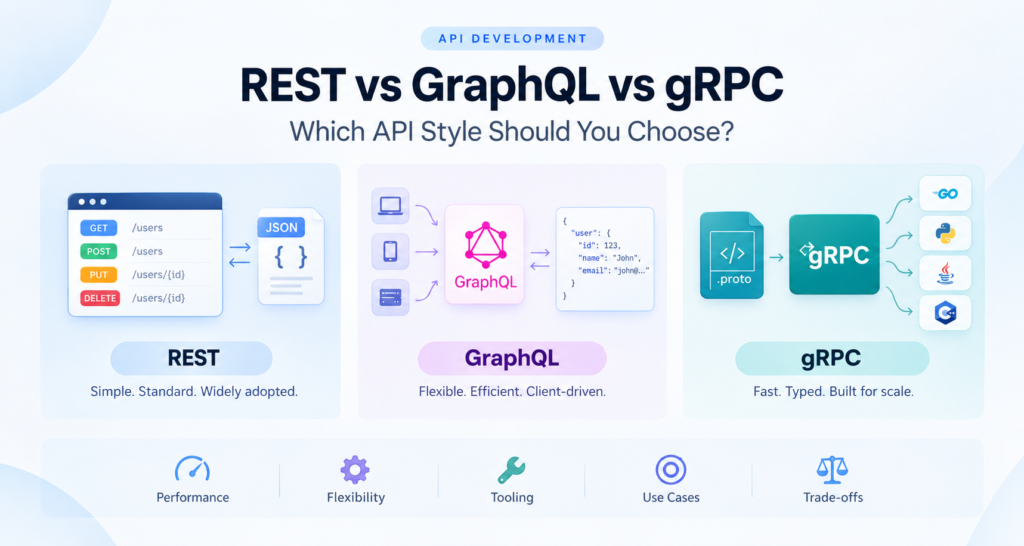
REST (Representational State Transfer) is an architectural style for distributed hypermedia systems, defined by Roy Fielding in his 2000 doctoral dissertation. REST is not a protocol — it is a set of constraints and principles. In practice, REST APIs use HTTP as the transport layer, represent resources as URLs (https://api.example.com/users/123), and use standard HTTP verbs (GET, POST, PUT, PATCH, DELETE) to define operations. REST responses are typically JSON, though XML and other formats are technically valid.
REST has become the dominant API style for public-facing web APIs primarily because of its simplicity, its alignment with HTTP semantics, and its ubiquitous tooling support. Every programming language, framework, and API testing tool supports REST natively. Its conventions are widely understood by developers across the industry.
What Is GraphQL?
GraphQL is a query language and runtime for APIs, developed by Facebook in 2012 and open-sourced in 2015. Rather than exposing fixed endpoints that return fixed data shapes, GraphQL exposes a single endpoint and allows clients to specify exactly what data they need in each request — no more, no less. The client sends a query describing the shape of the response, and the server returns precisely that data.
GraphQL was created to solve a specific problem Facebook faced with their mobile API: clients were either over-fetching (receiving far more data than they needed, wasting bandwidth and parsing time) or under-fetching (making multiple requests to assemble the data needed for a single screen). GraphQL’s client-driven data fetching eliminated both problems. The pattern proved so valuable that it has since been adopted by GitHub, Shopify, Twitter, Airbnb, and hundreds of other large-scale API platforms.
What Is gRPC?
gRPC is a high-performance, open-source remote procedure call (RPC) framework developed by Google and released in 2016. Unlike REST and GraphQL, which communicate over HTTP/1.1 using text-based formats like JSON, gRPC uses HTTP/2 as its transport layer and Protocol Buffers (protobuf) as its serialization format — a binary encoding that is significantly smaller and faster to parse than JSON. gRPC uses a contract-first approach: services are defined in .proto files that specify the service methods and message types, from which client and server code is generated automatically.
gRPC was built by Google for internal microservice communication, where performance, type safety, and code generation across multiple languages are critical requirements. It supports four communication patterns: unary (single request, single response), server streaming, client streaming, and bidirectional streaming — capabilities that REST cannot natively support.
REST vs GraphQL vs gRPC: Head-to-Head Comparison
| Factor | REST | GraphQL | gRPC |
| Transport | HTTP/1.1 or HTTP/2 | HTTP/1.1 or HTTP/2 | HTTP/2 only |
| Data format | JSON (typically), XML | JSON | Protocol Buffers (binary) |
| Performance | Good | Good (depends on resolver) | Excellent — binary serialization |
| Type system | No native type system | Strongly typed schema | Strongly typed (.proto) |
| Flexibility (client) | Fixed response shapes | Client specifies exact data needed | Fixed method signatures |
| Over/under fetching | Common problem | Eliminated by design | Not applicable (specific methods) |
| Streaming support | Limited (SSE, WebSocket workaround) | Subscriptions via WebSocket | Native bidirectional streaming |
| Browser support | Excellent | Excellent | Limited — requires gRPC-Web proxy |
| Caching | HTTP caching works natively | Complex — POST-based queries not cached | Not HTTP-cacheable by default |
| Learning curve | Low — widely understood | Medium — query language, resolver concept | High — protobuf, code generation, HTTP/2 |
| Tooling ecosystem | Mature — universal | Growing — strong for major languages | Growing — best in Go, Java, C++ |
| Versioning | URL versioning (/v1/, /v2/) | Schema evolution (non-breaking) | Service versioning in .proto |
| Best for | Public APIs, CRUD, simple integrations | Complex UIs, mobile APIs, flexible clients | Internal microservices, high-performance, streaming |
When to Choose REST
REST remains the right choice — and often the best choice — in a wide range of scenarios. Choose REST when:
• You are building a public API that will be consumed by external developers. REST’s universality means any developer with any stack can integrate immediately without learning a new query language or toolchain.
• Your API maps naturally to CRUD operations on resources. If your core operations are creating, reading, updating, and deleting clearly defined resources (users, orders, products), REST’s resource-oriented design is a natural fit. The OpenAPI specification provides excellent tooling for documenting, mocking, and testing REST APIs.
• You need native HTTP caching. REST’s alignment with HTTP semantics means GET responses can be cached at the browser, CDN, and gateway layer without additional infrastructure. This is a significant performance and cost advantage for read-heavy APIs.
• Your team has limited API design experience. REST’s conventions are widely understood and extensively documented. The learning curve for developers joining a REST API project is minimal compared to GraphQL or gRPC.
• You are building webhooks or event-driven integrations. REST-based webhook patterns are the industry standard for event notification between services.
When to Choose GraphQL
GraphQL delivers its greatest value when the API consumer’s data needs are complex, variable, or both. Choose GraphQL API development when:
• You are building APIs consumed by mobile applications where network efficiency matters. GraphQL’s ability to fetch exactly the data needed in a single request reduces payload sizes and round trips — directly improving mobile app performance and battery life.
• Multiple client types (web, mobile, third-party) need different data shapes from the same underlying data. Instead of maintaining multiple REST endpoints or versioned responses for different clients, GraphQL lets each client query exactly what it needs.
• Your data model is graph-like with complex relationships. Social networks, knowledge graphs, and content management systems with rich relationships between entities benefit from GraphQL’s ability to traverse and return nested relationship data in a single query.
• Your frontend teams need to iterate independently of backend teams. GraphQL’s client-driven queries mean frontend developers can request new data shapes without requiring backend API changes — removing a major coupling and coordination bottleneck.
• You want a strongly typed, self-documenting API. GraphQL’s schema provides introspection — clients can query the API itself to understand what types and operations are available, enabling powerful developer tooling.
When to Choose gRPC
gRPC’s performance and streaming capabilities make it the right choice in specific scenarios where REST and GraphQL cannot compete. Choose gRPC when:
• You are building internal microservice communication where performance is critical. gRPC’s binary serialization is 5-10x more efficient than JSON for equivalent data, and its HTTP/2 transport supports multiplexing, header compression, and connection reuse — all of which matter at high request volumes.
• You need bidirectional streaming. Real-time features — live dashboards, collaborative editing, game state synchronization, IoT telemetry — often require server-to-client and client-to-server streaming that REST cannot cleanly support. gRPC’s native streaming is purpose-built for these patterns.
• You are working in a polyglot environment where type-safe, auto-generated client libraries across multiple languages would reduce integration effort. gRPC’s protobuf compiler generates idiomatic client code for Go, Java, Python, C++, Ruby, and more from a single .proto definition.
• Your team has the DevOps infrastructure to support gRPC — specifically HTTP/2 load balancers, gRPC-aware health checking, and (if browser clients need access) a gRPC-Web translation layer.
Using Multiple API Styles in the Same System
Real-world systems rarely make a single API style choice for the entire architecture. The most pragmatic approach for complex systems is to use each style where it provides the most value:
| System Layer | Recommended API Style | Rationale |
| Public API (external developers) | REST | Universal compatibility, HTTP caching, simple documentation |
| Mobile and web frontend to backend | GraphQL | Flexible queries, reduced over-fetching, single endpoint |
| Internal microservice communication | gRPC | Performance, streaming, type safety, code generation |
| Webhooks and event notifications | REST | Industry standard for push notifications |
| Real-time streaming data | gRPC or WebSocket | Native streaming support |
| Third-party integrations | REST | Lowest friction for integration partners |
This layered approach — sometimes called the API gateway pattern — uses an API gateway to expose a unified external interface (REST or GraphQL) while internal services communicate via gRPC for performance. The client never needs to know that multiple API styles exist behind the gateway.
REST vs GraphQL vs gRPC: Migration Considerations
If you are evaluating whether to migrate an existing API to a different style, these considerations apply:
• REST to GraphQL: Migration is usually additive rather than replacement. GraphQL can be layered over existing REST endpoints initially, with the GraphQL resolvers calling REST APIs internally. This allows gradual migration without client-breaking changes.
• REST to gRPC: Typically a significant architectural change requiring new tooling, updated clients, and infrastructure changes. Usually only undertaken when performance evidence clearly demonstrates that REST is the bottleneck.
• GraphQL to REST: Rare — typically only when the GraphQL schema has become so complex that it is a maintenance burden, or when query performance problems cannot be resolved through better resolver design.
[Internal Link: API Development and Integration Services -> /services/api-development]
[Internal Link: Microservices vs Monolithic Architecture: A Complete Comparison -> /blog/microservices-vs-monolithic]
[Internal Link: The Software Development Lifecycle Explained: All 7 Phases -> /blog/software-development-lifecycle]
Frequently Asked Questions
Is GraphQL replacing REST?
No — and the framing of GraphQL as a REST replacement is a persistent misconception. GraphQL solves a specific set of problems (flexible data fetching, complex data relationships, multiple client types) that REST does not handle well. REST solves a different set of problems (public APIs, simple CRUD, HTTP caching, universal compatibility) that GraphQL is not optimized for. Most large systems use both, applying each where it provides the most value rather than standardizing on one exclusively.
Does gRPC work in web browsers?
Not natively. gRPC requires HTTP/2 framing that browsers do not expose to JavaScript. gRPC-Web is a specification that allows browser clients to communicate with gRPC services through a proxy (such as Envoy) that translates between gRPC-Web and standard gRPC. For public APIs consumed by browsers, REST or GraphQL remains the practical choice. gRPC is primarily a server-to-server and native mobile client protocol.
Which API style is best for a startup building their first product?
REST is the default recommendation for most startups building their first product. It has the lowest learning curve, the most extensive tooling, the best documentation ecosystem, and the most developer familiarity. The overhead of GraphQL schema design and the operational complexity of gRPC are rarely justified at early stage. As the product scales and specific pain points emerge — mobile performance issues, multiple client types with different data needs, high-volume internal microservice communication — adding GraphQL or gRPC to the architecture at that point is well-motivated and lower risk than building on them speculatively from day one.
| Need Expert Help Designing or Modernizing Your API Architecture?Our API development services cover REST, GraphQL, and gRPC across the full lifecycle — from architecture design and implementation through documentation, testing, and ongoing integration support. Talk to our team about your API requirements and we’ll help you choose and build the right approach.Talk to our team today -> |