Choosing the right tech stack for a SaaS product is one of the most consequential early decisions a technical founder makes — and one of the decisions most frequently overthought. Consequently, founders spend weeks evaluating framework benchmarks and Reddit debates instead of building. Moreover, the honest reality is that several technology combinations can successfully power a SaaS product. The question is not which stack is theoretically best, but which stack best fits your team’s experience, your product’s specific requirements, and your growth trajectory.
Furthermore, this guide covers the proven SaaS tech stack choices across every layer of the architecture — frontend, backend, database, infrastructure, and tooling — with specific recommendations for different team profiles and product types. Additionally, it addresses the AI-native stack requirements that differentiate SaaS products built for 2026 from those built on assumptions from 2020.
| The best SaaS tech stack is the one your team executes fastest, not the one that wins technology comparison articles. Consequently, a team of experienced Django developers building a SaaS on Django outperforms the same team building on a theoretically superior framework they are learning for the first time. Therefore, weight existing team expertise heavily in your stack decision. |
SaaS Frontend: React Remains the Default Choice
Why React Dominates SaaS Frontends
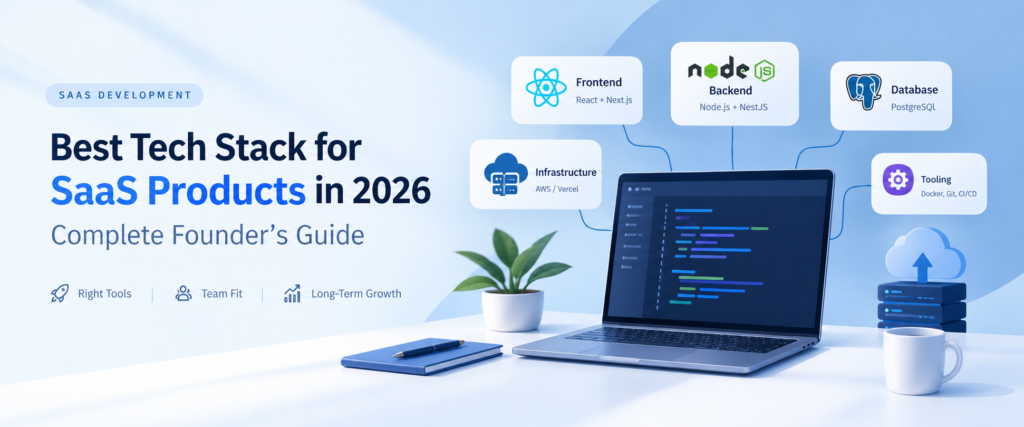
React remains the dominant SaaS frontend framework in 2026. Specifically, its component-based architecture naturally maps to the UI patterns SaaS products require — dashboards, data tables, modal forms, navigation sidebars, and real-time data displays. Furthermore, the React ecosystem provides purpose-built component libraries — Shadcn/UI, Radix UI, and Headless UI — that dramatically reduce the time required to build polished SaaS interfaces. Moreover, React developer talent is more widely available than for any other frontend framework, which matters for team building as the product scales.
Next.js as the Meta-Framework
Additionally, Next.js has become the standard meta-framework layered on React for SaaS products. It provides server-side rendering for marketing pages and SEO-critical content, static generation for documentation and help centres, API routes that eliminate the need for a separate lightweight backend for simple operations, and built-in image optimisation. Consequently, most SaaS teams build their full product — marketing site, application, and documentation — within a single Next.js project.
When to Consider Alternatives
However, Vue.js and Svelte merit consideration in specific circumstances. Vue’s gentler learning curve suits teams with limited React experience. Furthermore, Svelte’s compile-time reactivity offers genuine performance advantages for SaaS products with complex real-time data visualisation requirements. In contrast, Angular — while mature and well-suited to enterprise internal tools — carries higher initial complexity than most SaaS startups justify.
SaaS Backend: Three Proven Options in 2026
Node.js with NestJS — Best for JavaScript Teams
NestJS provides a structured, opinionated framework built on Node.js that brings architectural discipline to JavaScript backends without the convention-over-configuration approach of frameworks like Rails. Specifically, it uses TypeScript throughout, provides a dependency injection system, and organises code into modules that map naturally to SaaS domain concepts. Furthermore, sharing TypeScript types between a Next.js frontend and a NestJS backend eliminates an entire class of client-server type mismatch bugs. Consequently, JavaScript-native teams building B2B SaaS products increasingly choose NestJS as their backend framework of choice.
Django (Python) — Best for Data-Intensive SaaS
Furthermore, Django remains the strongest choice for SaaS products where data processing, analytics, machine learning integration, or scientific computation plays a central role. Python’s dominance in the AI and data science ecosystem means that SaaS products requiring LLM integration, data pipelines, or ML model inference are most naturally built on a Python backend. Moreover, Django’s built-in ORM, admin interface, and authentication system accelerate early development significantly. Additionally, as Aventis Hub covers in our AI-powered application development guide, Python backends provide the most natural integration path for AI capabilities.
Ruby on Rails — Best for Rapid MVP Development
Moreover, Ruby on Rails consistently delivers the fastest time from zero to working product for teams comfortable with Ruby. Its convention-over-configuration philosophy, built-in generators, and opinionated project structure eliminate many decisions that slow teams down in less prescriptive frameworks. Specifically, Rails’ Hotwire framework — combining Turbo and Stimulus — enables reactive, real-time SaaS interfaces without a separate frontend framework, reducing architectural complexity significantly for early-stage products.
SaaS Database: PostgreSQL as the Default, Specialised Stores for Specific Needs
PostgreSQL: The SaaS Database Standard
PostgreSQL is the default database choice for SaaS products in 2026, and for good reason. Furthermore, it provides ACID compliance for transactional integrity, native JSON support for flexible schema requirements, row-level security for tenant data isolation, full-text search for basic search requirements, and an extension ecosystem that covers time-series data, geospatial queries, and vector storage for AI features. Moreover, managed PostgreSQL services — Supabase, Neon, AWS RDS, Railway — eliminate database administration overhead entirely for early-stage teams.
Redis for Caching and Real-Time Features
Additionally, Redis complements PostgreSQL in virtually every SaaS architecture. Specifically, it handles application caching — storing computed results to reduce database load — session storage for stateless application servers, background job queuing through Redis-backed job processors like Sidekiq (Ruby) or Bull (Node.js), and rate limiting for API endpoints. Consequently, adding Redis to a PostgreSQL-backed SaaS architecture significantly improves performance without architectural complexity.
When to Add Specialised Data Stores
Furthermore, specific SaaS product types benefit from specialised databases alongside PostgreSQL. Search-heavy SaaS products — document management, CRM, content platforms — benefit from Typesense or Elasticsearch for full-text search performance that PostgreSQL cannot match at scale. Additionally, SaaS products with AI features increasingly require a vector database — Pinecone, Weaviate, or pgvector as a PostgreSQL extension — for semantic search and retrieval-augmented generation. As Aventis Hub’s guide on RAG vs fine-tuning explains, vector storage is foundational to most enterprise AI features in 2026.
SaaS Infrastructure: Cloud-Native From Day One
Choosing Your Cloud Provider
AWS, Google Cloud, and Azure all provide the infrastructure a SaaS product needs. Consequently, the choice often comes down to team familiarity, geographic availability requirements, and specific managed service preferences. Furthermore, Aventis Hub’s comparison of AWS vs Azure vs Google Cloud covers this decision in depth. For most early-stage SaaS products, AWS provides the widest managed service selection and the deepest third-party integration ecosystem. However, Google Cloud is increasingly compelling for SaaS products that rely heavily on AI and machine learning infrastructure, given Google’s AI research leadership and Cloud TPU access.
Containerisation and Orchestration
Moreover, containerising SaaS applications with Docker standardises deployment environments and eliminates the classic ‘works on my machine’ development problem. Furthermore, for SaaS products beyond initial MVP stage, Kubernetes orchestration — managed through AWS EKS, Google GKE, or Azure AKS — provides horizontal scaling, automated health checking, and rolling deployments. Additionally, the serverless vs containers comparison on Aventis Hub helps teams decide whether Kubernetes overhead is justified at their specific scale.
The Complete SaaS Tech Stack Recommendation by Team Profile
| Team Profile | Frontend | Backend | Database | Infrastructure |
| JavaScript-native team | Next.js + React | NestJS (TypeScript) | PostgreSQL + Redis | AWS / Vercel + Railway |
| Python / AI-focused team | Next.js + React | Django or FastAPI | PostgreSQL + pgvector | GCP / AWS + Cloud Run |
| Small team, fast MVP | Next.js + React | Ruby on Rails | PostgreSQL | Heroku / Render / Railway |
| Enterprise SaaS (scale) | Next.js + React | NestJS or Go | PostgreSQL + Redis + Elasticsearch | AWS EKS + RDS |
| AI-native SaaS product | Next.js + React | FastAPI (Python) | PostgreSQL + Pinecone/pgvector | GCP + Cloud Run |
Essential SaaS Tooling: Authentication, Billing, and Observability
Authentication
Specifically, SaaS products require multi-provider authentication, multi-factor authentication, and team invitation flows. Building these from scratch introduces security risk and consumes significant engineering time. Consequently, most SaaS teams use Clerk, Auth0, or Supabase Auth to handle the full authentication lifecycle. Furthermore, these services provide enterprise SSO (SAML/OIDC) as a paid tier feature, which becomes essential when enterprise customers make it a procurement requirement.
Billing and Subscription Management
Moreover, Stripe Billing is the standard for SaaS subscription management. It handles recurring billing, proration, failed payment retry logic (dunning), invoice generation, and tax calculation across jurisdictions. Additionally, Stripe’s metered billing API supports usage-based pricing models that increasingly characterise AI-powered SaaS products where cost scales with consumption.
Observability and Monitoring
Furthermore, SaaS products require monitoring infrastructure from day one — not as an afterthought. Specifically, Sentry handles error tracking across frontend and backend, alerting the team to production errors with full context immediately. Additionally, Datadog or Grafana Cloud provides infrastructure and application performance monitoring. Consequently, teams with observability tooling in place detect and resolve production issues in minutes rather than discovering them through customer support tickets.
For a complete guide to building on the right stack, see Aventis Hub’s SaaS development services and our deep-dives on microservices architecture and DevOps for startups.
Frequently Asked Questions
Should I use a monorepo or separate repositories for my SaaS stack?
Monorepos — where frontend, backend, and shared packages live in a single repository — simplify code sharing, coordinated deployments, and dependency management for small SaaS teams. Furthermore, tools like Turborepo and Nx make monorepo management practical even for teams new to the pattern. Consequently, most early-stage SaaS teams benefit from a monorepo, with separate repositories becoming more appropriate as engineering team size and service independence requirements grow.
How important is TypeScript for a SaaS product?
TypeScript has become effectively standard for production SaaS development in 2026. Specifically, it catches an entire class of runtime errors at compile time, improves IDE tooling and code navigation, and makes onboarding new engineers significantly faster by making intent explicit in code. Furthermore, the overhead of adding TypeScript to a Next.js and NestJS project is minimal. Consequently, teams that skip TypeScript for speed reasons early typically spend more time debugging type-related errors in production than the adoption would have cost.
| Need a SaaS Development Partner Who Knows the Right Stack for Your Product?Aventis Hub builds SaaS products on proven, scalable tech stacks matched to your team, your product, and your growth trajectory. From stack selection and architecture design through full-stack development and launch — we build SaaS platforms that scale from your first customer to your first thousand.Book a free consultation with Aventis Hub today -> |