
Ask ten people in banking what “fintech” means and you’ll get ten different answers. Ask them what it’ll mean by the end of 2026, and most will pause before answering.
That pause is the story worth paying attention to. The industry has grown out of its scrappy startup phase, back when the whole pitch was “disrupt a slow bank with a nicer app.” Financial technology is turning into something less flashy and more permanent — the plumbing that businesses run on, whether or not they’d ever call themselves a fintech company.
So if you’re building in this space, studying it, or just curious where your money actually goes when you tap a card, here’s the honest rundown. Not a listicle of buzzwords. The stuff that’s actually changing, why it matters, and where the money and attention are moving next.
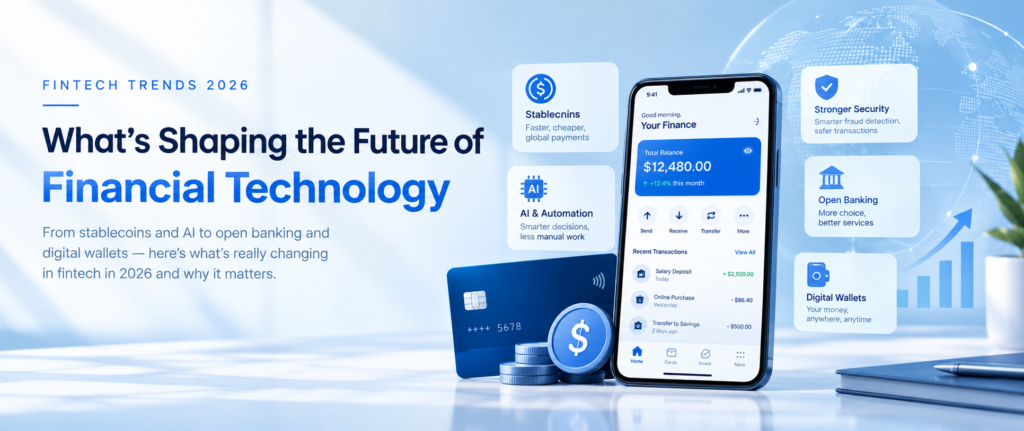
Why 2026 Doesn’t Feel Like the Last Fintech Boom
Between roughly 2015 and 2021, fintech ran on a simple playbook: raise money, acquire users fast, worry about profit later. A lot of founders treated “someday we’ll be profitable” as an acceptable answer in board meetings. It mostly worked, until it didn’t.
That playbook is dead now. Fintech companies are pulling in something like $650 billion in global revenue, and the ones actually winning aren’t the loudest marketers — they’re the ones that figured out how to be big, profitable, and regulator-friendly at the same time. Three things that used to be in tension with each other. Now they’re basically table stakes.
What that looks like on the ground: fewer moonshot pitch decks, more finance teams asking a question that sounds boring but isn’t — does this thing make money, and will it survive an audit? Founders who can’t answer both halves confidently are having a harder time raising than they would have five years ago.
Five Things Actually Driving Fintech Right Now
1. Stablecoins Stop Being a Crypto Sideshow
For a long time, stablecoins sat in an awkward middle ground. Too “crypto” for traditional finance folks to take seriously, too boring for crypto true believers chasing the next big token. Nobody was quite sure what to do with them.
That’s changing fast. Businesses moving money across borders are looking at stablecoins as a genuinely practical option — not because they’re trendy, but because the old correspondent banking system is slow and expensive, and stablecoin rails often aren’t. Regulatory clarity has helped a lot here too, especially in the US, where clearer rules have made both incumbents and startups more comfortable building on top of digital assets instead of just watching from the sidelines.
Here’s what actually matters if you build things: this stopped being a crypto story. It’s a payment gateway development story now. If your company is routing cross-border settlements today, you’re probably already asking whether a stablecoin rail could take a three-day settlement down to minutes, and knock your fee structure down from a flat percentage to something closer to a rounding error.
Practical takeaway: if international payments are part of your business — payroll, marketplaces, remittances, whatever — this is the year to pilot a stablecoin rail alongside what you’re already using. Don’t tear out the old system. Run both, compare the numbers, then decide.
2. AI Quits Being a Chatbot and Starts Doing Actual Work
Remember 2023, when every company bolted a chatbot onto its app and called the whole thing “AI-powered”? That phase is basically over, thankfully. What’s replacing it is agentic AI — systems that don’t just answer a customer’s question but actually go do something: approve a low-risk transaction, flag a fraud pattern the moment it appears, reconcile a set of accounts overnight, even negotiate terms on a B2B invoice without a human clicking a single button.
Some people in the industry are taking this further and predicting that general-purpose AI assistants become the actual front door for everyday financial decisions — meaning banks and fintechs get quietly demoted to API endpoints sitting behind the AI layer, doing the work but getting none of the brand recognition. That’s a spicy prediction, and I’d file it under “provocative” rather than “certain.” But it points at something real: if an AI assistant becomes the interface people trust, the institution underneath risks turning invisible.
Fraud is the other side of this coin, and it’s not a comfortable one. Generative AI is making scams and fraud attempts more convincing, not less — which means fraud detection has to get sharper at roughly the same rate the attacks are getting smarter. Network-level fraud detection, where a system spots patterns across dozens of institutions instead of just one company’s isolated data, is turning into a real competitive edge rather than a checkbox feature.
Practical takeaway: if you’re commissioning fintech app development, put real budget toward AI that acts, not just AI that chats back at customers. Fraud scoring, automated back-office reconciliation, and genuinely useful nudges toward better financial habits — that’s where the return actually shows up on a P&L statement.
3. Open Banking Finally Grows Into the Hype
Open banking has been “the next big thing” for nearly a decade now, which is long enough that people started rolling their eyes at the phrase. In 2026 it’s finally behaving like the thing it was always supposed to be.
API-based tools paired with open banking regulation now let institutions pull in alternative data instantly — which speeds up lending decisions and, done thoughtfully, extends credit to people a traditional credit score would’ve quietly rejected. Consumer expectations have caught up with the technology too. A large majority of people now expect their primary bank to connect cleanly with whatever other financial apps they already use, and treat that as a genuine dealbreaker — not a nice bonus — when choosing where to bank.
This is exactly why open banking software development stopped being a compliance afterthought and became core roadmap work at most banks. If your institution’s app can’t talk to a customer’s budgeting tool, their brokerage account, or their accounting software, you’re not behind on features. You’re missing the basics.
Embedded finance is riding the same current. Retailers, gig-economy platforms, and random SaaS tools that have nothing to do with banking are quietly weaving lending, payments, and insurance directly into their own products, using the exact same API rails that power open banking on the consumer side.
Practical takeaway: treat your API layer like an actual product, not internal plumbing nobody thinks about. The teams winning here document their APIs the way they’d document a customer-facing feature — because at this point, that’s precisely what it is.
4. Growth Recenters Around Markets Silicon Valley Used to Ignore
“Fintech innovation” used to be shorthand for San Francisco and London, full stop. That’s not true anymore, and hasn’t been for a while if you’ve been paying attention. Latin America has quietly become one of the strongest engines of global fintech growth, driven by digital payments, remittances, and an actual push toward financial inclusion — not just another feature update nobody asked for.
This changes the calculus for anyone deciding where to build. Fintech app development country choice used to be mostly about where engineering talent was cheap. Now it’s also about where regulatory sandboxes actually welcome experimentation, where mobile-first populations are underbanked and genuinely want better tools, and where local payment habits — mobile money, informal lending, cash culture — already dominate daily life in ways a US-first app just wasn’t designed for. Teams that take the time to understand those local habits build products that stick. Teams that just translate a US app into another language usually don’t.
A similar trend is emerging across the Asia-Pacific region, although it is being driven more by established institutions than by startups. Established banks and asset managers there are modernizing legacy operations through cloud migration and AI-driven data platforms instead of waiting around to get disrupted by some scrappy newcomer.
Practical takeaway: if you’re scoping out neobank development, resist treating “emerging market” as one blob. A neobank built for urban Brazil and one built for rural Southeast Asia need genuinely different onboarding flows, KYC processes, and assumptions about which payment rails people actually trust.
5. The Whole Business Model Tilts Toward B2B
Consumer apps still get the headlines and the app-store screenshots, but the money’s quietly flowing somewhere else — toward B2B infrastructure, the unglamorous layer that other fintechs and traditional banks build their products on top of. The reasoning is pretty simple once you say it out loud: recurring, contracted revenue from businesses is a lot more predictable than trying to win over individual consumers one download at a time.
You can see this in how modular, API-first platforms are pitching themselves these days — not as another app for a customer to download, but as the scalable, regulation-ready layer that other companies plug into across multiple markets at once. It’s a less exciting sell than “the app that’ll change how you save money,” but it’s a sturdier business.
Practical takeaway: before you build yet another consumer-facing app, be honest with yourself about whether your real edge — KYC, payments processing, ledger management, whatever it is — is worth more licensed to the dozens of companies that need it than sold directly to end users who’ll churn in six months.
Where Fintech Investment Is Actually Going: A Quick Comparison
| Focus Area | 2023-era priority | 2026 priority |
| Payments | Consumer P2P apps | Cross-border stablecoin rails, embedded B2B payments |
| AI | Customer-facing chatbots | Agentic fraud detection, automated back-office work |
| Banking APIs | Compliance checkbox | Core product differentiator, baseline expectation |
| Geography | US/UK-centric | Latin America, Asia-Pacific, mobile-first emerging markets |
| Business model | Consumer acquisition | B2B infrastructure, recurring contracts |
What This Actually Means for You
If you’re a founder: pick your fintech app development country based on regulatory friendliness and actual local payment habits, not just where engineering is cheap. And before writing another line of consumer-facing code, ask hard whether your core tech is worth more as a licensed B2B product than as another app fighting for downloads.
If you’re a bank or credit union: open banking software development isn’t optional anymore, and it isn’t defensive either. It’s how you keep the customers you already have, since most of them now treat seamless connectivity as the baseline, not a perk you get credit for offering.
If you’re building payment infrastructure: payment gateway development in 2026 means stablecoin settlement is one option on the menu, not a fringe experiment you mention in an investor deck to sound current. Customers moving money internationally will notice the difference in speed and cost, and they’ll remember which provider gave it to them.
If you’re scoping a neobank: neobank development now competes on trust and deep localization, not novelty. There are already plenty of neobanks. There aren’t nearly enough that understand one underserved segment really, really well.
Key Takeaways
- Fintech has entered a profitability-first era — roughly $650 billion in global revenue, with investors now rewarding regulatory maturity over pure growth-chasing.
- Stablecoins are becoming real payment infrastructure for cross-border transactions, not a crypto curiosity on the sidelines.
- AI in fintech is moving from customer-facing chat toward back-office automation and real-time fraud detection.
- Open banking and embedded finance have become baseline consumer expectations, not optional add-ons — most banking customers now treat interoperability as a dealbreaker.
- Latin America and Asia-Pacific are emerging as genuine growth engines, reshaping where fintech app development actually happens.
- The dominant business story of 2026 is B2B infrastructure, not another consumer app chasing downloads.
Frequently Asked Questions
What are the biggest fintech trends 2026 is defined by? The clearest ones: stablecoins becoming real payment infrastructure, agentic AI taking on operational work instead of just chatting, open banking maturing into a genuine competitive requirement, growth shifting toward Latin America and Asia-Pacific, and business models tilting from consumer apps toward B2B infrastructure.
Is fintech app development still a good investment in 2026? Yes — but the winning bets increasingly favor infrastructure and B2B tools over standalone consumer apps, since contracted recurring revenue has held up better than consumer acquisition spending.
Which country is best for fintech app development right now? There’s no single right answer.The answer largely depends on the specific needs of your target users. Latin America continues to lead in digital payments and cross-border remittance innovation, while several Asia-Pacific markets are making notable progress in institutional modernization. Match the country to your actual customers and their payment habits, not just to where engineering is cheapest.
What does open banking software development actually involve in 2026? Mostly building and maintaining secure APIs that let third-party apps access account data and initiate payments with a customer’s consent, plus the compliance and consent-management layers regulators now expect as standard.
Can businesses rely on stablecoins for secure payments? Regulatory clarity has improved a lot, which is part of why investor confidence has grown. That said, businesses should still check the specific issuer’s backing, regulatory standing, and settlement partners before leaning on it for core payment flows — not all stablecoins are built the same.
In what ways is AI transforming fraud detection in fintech? Modern fraud tools increasingly rely on network-level intelligence — comparing patterns across many institutions and apps rather than working off one company’s isolated data — which helps catch coordinated fraud rings earlier, before they spread.
How do embedded finance and open banking differ? Open banking gives third parties permissioned access to a customer’s existing bank data and accounts. Embedded finance is when non-financial companies — retailers, marketplaces, SaaS platforms — build financial products like lending or payments directly into their own product, often using that same underlying infrastructure.
Are neobanks still a worthwhile investment in 2026? Yes, but the real opportunity has narrowed toward serving one underserved segment genuinely well, rather than launching yet another general-purpose digital bank into an already crowded field.