
Every successful software product eventually faces the same challenge: the architecture that performed perfectly at a thousand users starts to buckle at a hundred thousand. Response times climb. Databases lock. Servers crash under load. Founders and engineering leaders who do not plan for software scalability from the outset pay for that oversight in emergency infrastructure work, frustrated users, and competitive opportunity lost during outages.
Furthermore, software scalability is not purely a technical concern. It directly affects business continuity, customer experience, and the speed at which engineering teams can ship new features. Consequently, building scalable software is one of the most important investments a growing business makes. This guide covers the essential software scalability best practices that engineering teams apply to build systems designed to grow alongside the businesses they serve.
| Definition: Software scalability refers to a system’s ability to handle increasing load — more users, more data, more transactions — without degrading performance or requiring a complete architectural overhaul. A scalable system grows gracefully. An unscalable system requires expensive emergency intervention. |
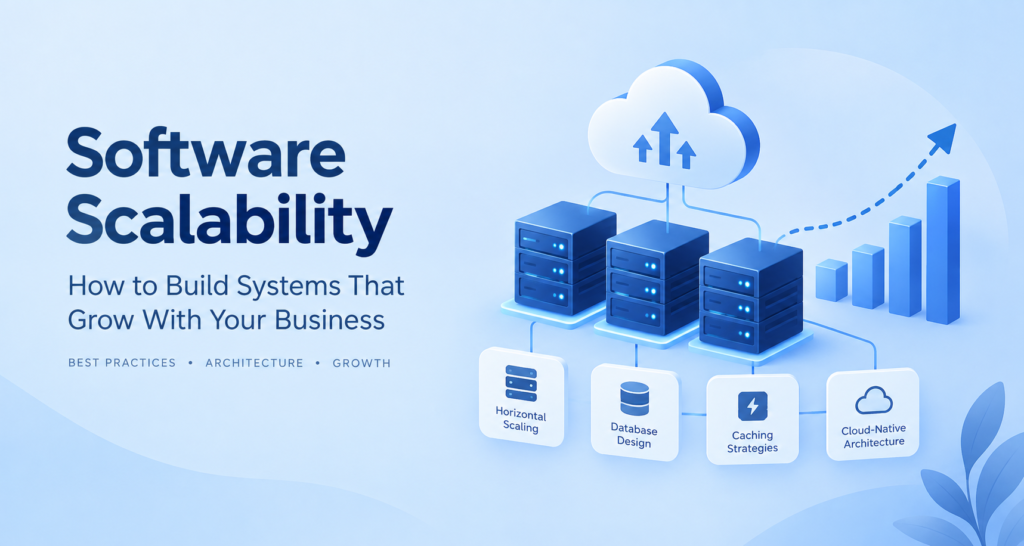
Understanding the Two Dimensions of Software Scalability
Vertical Scaling: Scaling Up
Vertical scaling means adding more resources — CPU, RAM, storage — to existing servers. It is, in many cases, the fastest path to immediate capacity relief. However, vertical scaling has hard physical limits. Moreover, it creates single points of failure: one powerful server means one catastrophic failure point. Consequently, most modern scalability strategies treat vertical scaling as a short-term measure rather than a long-term architecture.
Horizontal Scaling: Scaling Out
Horizontal scaling means adding more servers rather than bigger ones. As a result, the system distributes load across multiple instances, eliminates single points of failure, and scales theoretically without limit. However, horizontal scaling introduces coordination complexity — specifically, how instances share state, how requests route to the right instance, and how data stays consistent across nodes. Cloud platforms such as AWS, Google Cloud, and Azure have made horizontal scaling dramatically more accessible through managed auto-scaling, load balancers, and container orchestration.
Software Scalability Best Practice 1: Design for Statelessness
Stateless architecture is the foundation of horizontal scalability. In a stateless system, each request carries all the information the server needs to process it. The server holds no session state between requests. As a result, any server instance handles any request — which means adding more instances immediately increases capacity without routing complexity.
In contrast, stateful architectures tie users to specific server instances through session affinity. Consequently, adding servers does not proportionally increase capacity because individual servers still carry fixed user loads. Therefore, engineering teams building for scalability move session state to external stores — Redis, Memcached, or database-backed session management — so that any instance serves any request freely.
Software Scalability Best Practice 2: Use Caching Strategically
Why Caching Transforms Scalability
Caching stores the results of expensive operations — database queries, API calls, complex calculations — so that subsequent requests retrieve the cached result rather than repeating the work. Furthermore, caching reduces database load, cuts response times, and lowers infrastructure costs simultaneously. Consequently, it delivers more scalability improvement per engineering hour than almost any other technique.
The Three Caching Layers
First, CDN caching handles static assets and cacheable pages at the network edge, serving content from servers geographically close to users. Second, application-level caching — using tools like Redis or Memcached — stores computed results and database query outputs in memory. Third, database query caching reduces repeated execution of identical queries. Moreover, HTTP cache headers (Cache-Control, ETag) instruct browsers and proxies to cache responses client-side, further reducing server load. Together, these three layers dramatically reduce the number of requests that reach your database.
Cache Invalidation: The Hard Part
However, caching introduces a critical challenge: cache invalidation. Specifically, when underlying data changes, cached copies must update or expire before users see stale results. Therefore, teams must design explicit cache invalidation strategies alongside caching implementation. In addition, time-to-live (TTL) settings control how long cached data remains valid before automatic expiry — balancing freshness against load reduction.
Software Scalability Best Practice 3: Design Your Database for Scale
Read Replicas and Write Sharding
Databases frequently become the bottleneck in scaling systems, because most applications read data far more often than they write it. Consequently, adding read replicas — copies of the primary database that handle read queries — offloads a significant share of database traffic without touching write performance. Furthermore, for write-heavy workloads, database sharding distributes data across multiple database instances, each responsible for a subset of the data.
Choose the Right Database for Each Job
Moreover, not all data belongs in a relational database. NoSQL databases such as MongoDB, DynamoDB, and Cassandra handle specific workloads — document storage, key-value lookups, time-series data — at scales that relational databases struggle to match. Additionally, search databases like Elasticsearch handle full-text search queries that would cripple a relational system. Therefore, scalable architectures frequently use multiple database technologies, each optimized for its specific access pattern.
Index Thoughtfully
Specifically, database indexes dramatically speed read queries by allowing the database to locate records without scanning entire tables. However, every index slows write operations and consumes storage. As a result, index design requires deliberate trade-off analysis — adding indexes where read speed matters most while avoiding over-indexing on tables with high write volumes.
Software Scalability Best Practice 4: Adopt Asynchronous Processing
Synchronous processing — where users wait for every operation to complete before receiving a response — creates scalability bottlenecks because slow operations block server threads. Consequently, asynchronous processing decouples time-consuming tasks from the user-facing request cycle. For example, when a user submits an order, the system immediately confirms receipt and processes payment in the background rather than making the user wait for the entire fulfillment pipeline to complete.
Message queues — including RabbitMQ, Apache Kafka, and AWS SQS — enable this pattern by buffering work between producers (the web server receiving requests) and consumers (the workers processing tasks). Furthermore, message queues provide natural back-pressure: when consumers fall behind, the queue grows rather than the system crashing. Additionally, this pattern enables horizontal scaling of worker processes independently of web servers, precisely targeting the component under load.
Software Scalability Best Practice 5: Build on Cloud-Native Architecture
Auto-Scaling and Managed Services
Cloud-native architecture specifically designs systems to exploit the on-demand elasticity of cloud platforms. Consequently, cloud application development services build auto-scaling groups that add server instances when load increases and remove them when load decreases — automatically and without manual intervention. Moreover, managed services — AWS RDS, Google Cloud Spanner, Azure Cosmos DB — handle database scaling, replication, and failover without requiring engineering teams to manage that infrastructure themselves.
Containers and Orchestration
Furthermore, container-based deployment — using Docker and Kubernetes — standardizes how software runs across environments and enables rapid horizontal scaling. Specifically, Kubernetes orchestrates containers across server clusters, handling load distribution, health checking, and rolling deployments automatically. As a result, engineering teams deploy confidently at any scale without manual infrastructure coordination.
Software Scalability Best Practice 6: Embrace Microservices at the Right Stage
Microservices architecture decomposes applications into independently deployable services, each scaling separately based on its specific load. Consequently, a high-traffic search service scales independently of a low-traffic admin service — eliminating the waste of scaling everything together. However, microservices introduce operational complexity that small teams frequently underestimate. Therefore, most engineering leaders recommend starting with a well-structured monolith and extracting services only when specific scaling bottlenecks justify the overhead. In addition, microservices development requires mature DevOps practices — specifically CI/CD pipelines, distributed tracing, and container orchestration — before the benefits outweigh the costs.
Software Scalability Best Practice 7: Load Test Before You Need To
Load testing simulates peak traffic conditions against a system before real users encounter them. Consequently, engineering teams identify bottlenecks in controlled conditions rather than during production incidents. Tools like k6, Apache JMeter, and Locust generate realistic traffic patterns against staging environments. Moreover, load testing should specifically target the traffic volumes the system expects to reach — not just current levels — so that scaling decisions reflect future growth rather than present state.
Furthermore, chaos engineering — deliberately injecting failures into running systems — validates that scaling infrastructure handles failure modes gracefully. Specifically, tools like Netflix’s Chaos Monkey randomly terminate instances to verify that auto-scaling and failover operate correctly in practice rather than just in theory.
Scalability Patterns Summary
| Pattern | What It Solves | Key Tool / Approach |
| Stateless architecture | Enables horizontal scaling of application servers | JWT tokens, Redis session store |
| CDN + caching layers | Reduces database and server load dramatically | Redis, Cloudflare, HTTP cache headers |
| Read replicas | Offloads read queries from primary database | AWS RDS replicas, PostgreSQL streaming |
| Message queues | Decouples slow tasks from user request cycle | RabbitMQ, Kafka, AWS SQS |
| Auto-scaling | Matches infrastructure capacity to real-time demand | AWS Auto Scaling, Kubernetes HPA |
| Microservices | Scales hot services independently | Docker, Kubernetes, service mesh |
| Database sharding | Distributes write load across database instances | Vitess, CockroachDB, DynamoDB |
| Load testing | Identifies bottlenecks before production failures | k6, JMeter, Locust |
Frequently Asked Questions
When should a startup start thinking about software scalability?
Founders should address software scalability from the first architectural decision — not because premature optimization is good, but because certain architectural choices create scalability debt that costs exponentially more to fix later. Specifically, designing for statelessness, choosing cloud infrastructure, and avoiding shared mutable state costs nothing at the outset but saves enormous remediation effort at scale. However, implementing complex scaling patterns — microservices, sharding, event-driven architectures — before the business needs them wastes engineering capacity. Consequently, the right approach layers scalability investment against demonstrated growth milestones.
What is the most common scalability bottleneck in web applications?
The database is the most common bottleneck in scaling web applications, specifically because most web applications are read-heavy and databases handle concurrent reads less efficiently than application servers handle concurrent requests. Moreover, unoptimized queries, missing indexes, and N+1 query patterns — where the application executes one database query per item in a loop — compound this bottleneck at scale. Therefore, database query optimization and read replica deployment typically deliver the highest scalability return on early investment.
| Building a System That Needs to Scale? Let’s Design It Right.Our custom software development services and cloud application development team help businesses design scalable architectures from the ground up — or modernize existing systems to handle the growth that matters. Talk to our engineers about your scalability requirements.Talk to our team today -> |