
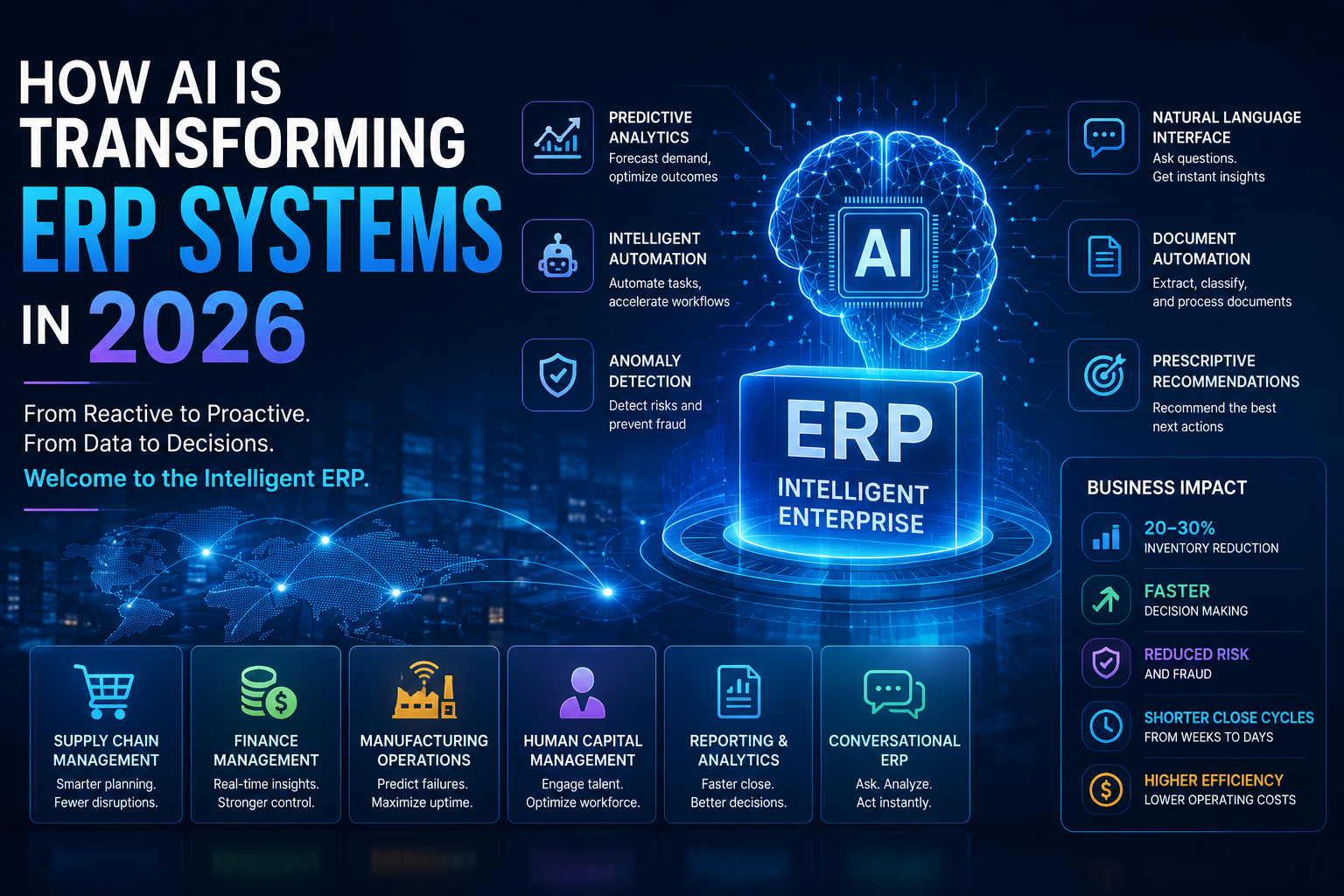
Enterprise Resource Planning systems have long been the operational backbone of large organizations. But traditional ERP systems, even sophisticated ones, are fundamentally reactive: they record what has already happened. In 2026, a new generation of AI-powered ERP systems is fundamentally rewriting that story. By embedding machine learning, natural language processing, and predictive analytics directly into ERP workflows. This transformation is creating a significant competitive divide between organizations that have upgraded their ERP with AI capabilities. The Limitations of Traditional ERP Systems Before exploring what AI-powered ERP systems can do, it is worth understanding what traditional ERP systems cannot do well: These limitations become particularly costly in volatile environments where the ability to predict and respond instantly is a decisive advantage. What Makes an ERP System “AI-Powered”? An AI-powered ERP system integrates machine learning models, NLP interfaces, computer vision, and advanced analytics directly into core ERP modules. Rather than being a separate analytics layer, AI becomes embedded in the workflow itself. Key AI capabilities integrated into modern ERP platforms include: Top Use Cases: AI Transforming ERP in 2026 1. Intelligent Supply Chain Management Supply chain disruptions have become the defining operational challenge of the decade. AI-powered ERP systems address this with multi-variable demand forecasting models that analyze historical sales, weather patterns, macroeconomic indicators, and supplier lead times simultaneously. The result: procurement teams receive automated purchase recommendations days or weeks before shortages occur, with confidence intervals that help prioritize actions. Leading manufacturers using AI-enhanced ERP software development report inventory reduction of 20-30% while simultaneously improving fill rates — a trade-off that was previously considered impossible. 2. Financial Anomaly Detection and Fraud Prevention AI models trained on millions of financial transactions can identify patterns invisible to human reviewers. In the ERP context, this means real-time flagging of duplicate invoices, unusual payment patterns, policy violations, and potential fraud — before payments are processed rather than after. This alone can save enterprises millions annually. 3. Predictive Maintenance in Manufacturing ERP For manufacturers, unplanned downtime is catastrophically expensive. AI integration services embedded in manufacturing ERP modules can process sensor data from connected machinery to predict equipment failures days in advance, enabling maintenance scheduling that minimizes disruption. This integration of IoT and AI within ERP is one of the most compelling use cases in enterprise software development today. 4. Automated Financial Close and Reporting The monthly and quarterly financial close is a labor-intensive process in most enterprises. AI-powered ERP automates reconciliations, flags discrepancies, pre-populates journal entries, and generates first-draft reports — compressing close cycles from weeks to days while improving accuracy. 5. HR and Workforce Intelligence AI-powered HR modules within ERP platforms can predict employee turnover, optimize workforce scheduling, identify skills gaps, and automate routine HR transactions. For large enterprises managing thousands of employees, these capabilities create substantial operational leverage. 6. Conversational ERP Interfaces Natural language interfaces are dramatically lowering the barrier to ERP insight. Instead of navigating complex menus and running custom reports, business users can simply ask: ‘What were our top three suppliers by volume last quarter?’ or ‘Which product lines are at risk of stockout this month?’ and receive instant, accurate responses. Custom ERP Development vs. Upgrading Existing Platforms Organizations exploring AI-powered ERP face a fundamental choice: upgrade existing platforms like SAP or Oracle with AI modules, or invest in custom ERP development built with AI-native architecture from the ground up. The right choice depends on several factors: According to Gartner’s ERP research, by 2026 over 70% of enterprise ERP implementations will include embedded AI capabilities — up from less than 20% in 2022. Key Considerations for AI-Powered ERP Implementation Successfully implementing an AI-powered ERP system requires more than technology selection. Organizations must address: Conclusion: The Intelligent ERP Is Not the Future — It Is Now The transformation of ERP systems through AI is accelerating rapidly. In 2026, organizations still operating static, report-centric ERP systems are operating at a structural disadvantage. The enterprises that move now to implement AI-powered ERP capabilities — whether through platform upgrades or custom ERP development — will establish competitive moats that are difficult for laggards to overcome. The journey begins with the right technology partner. Whether you are evaluating AI integration services for your existing ERP platform or planning a complete AI-native enterprise software development project, the decisions you make today will define your operational capabilities for the next decade. Learn more about our custom ERP development and AI integration services to discover how we can help you build an intelligent ERP system tailored to your industry and business model.
Responsible AI Development: Best Practices for Safe and Ethical AI Systems
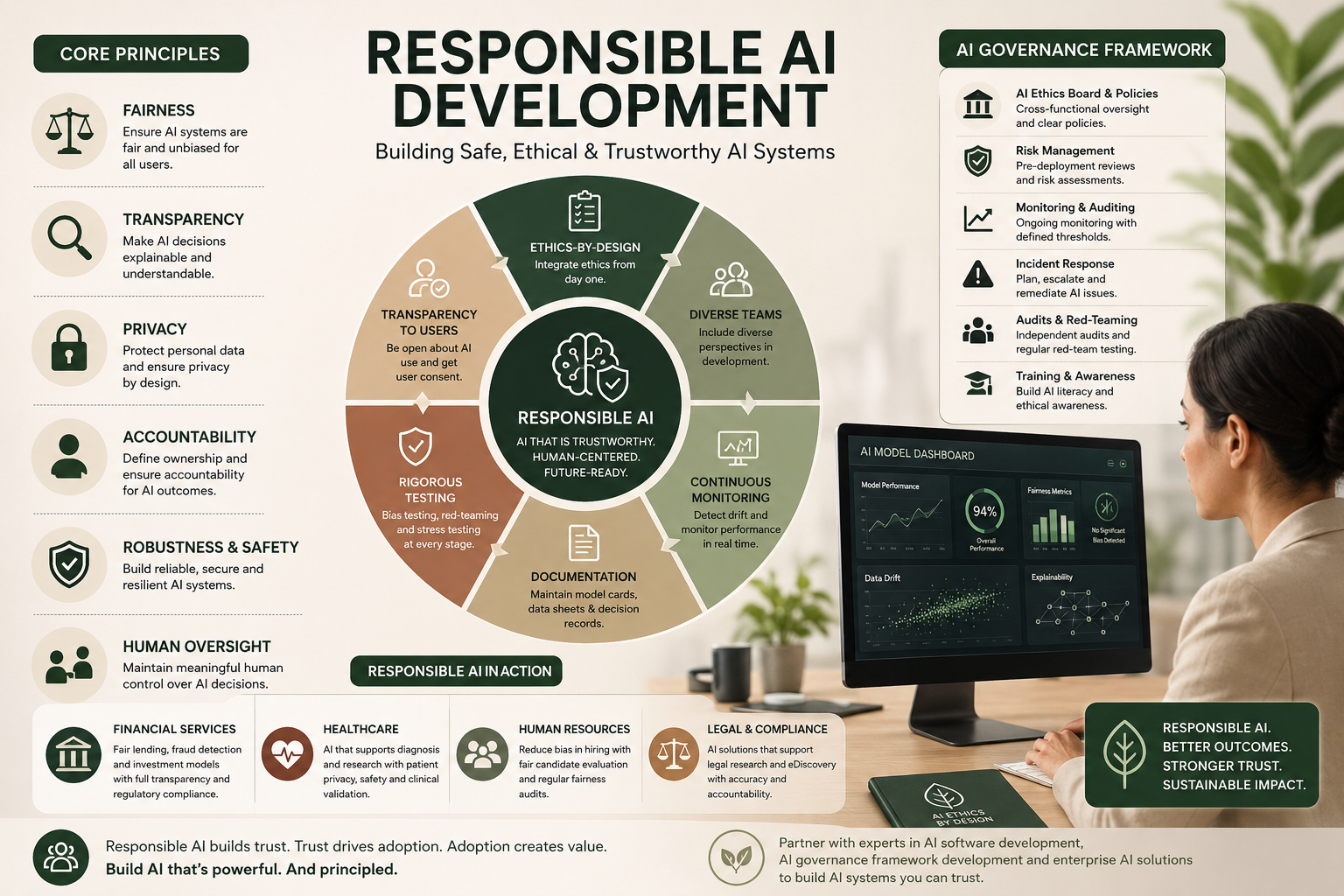
As artificial intelligence becomes embedded in the most consequential decisions of our time — from loan approvals and medical diagnoses to hiring and criminal justice — the stakes for getting AI right have never been higher. Responsible AI development is no longer a philosophical aspiration. It is a business imperative. For enterprises building or procuring AI systems in 2026, responsible AI development services must be central to the strategy — not an afterthought. This article outlines the core principles, practical best practices, and governance structures your organization needs to develop AI that is not only powerful, but trustworthy. What Is Responsible AI Development? Responsible AI development refers to the design, building, and deployment of AI systems in a way that is transparent, fair, accountable, and aligned with human values. It encompasses everything from data collection ethics and model bias testing to regulatory compliance and explainability. For organizations operating in regulated industries — healthcare, financial services, insurance, legal — responsible AI is not optional. It is a regulatory requirement driven by frameworks such as the EU AI Act, the US AI Executive Order, and sector-specific guidelines from bodies like the FDA and SEC. But responsible AI also matters for every business. The reputational and financial consequences of an AI system that discriminates, fails unexpectedly, or operates opaquely can be severe and long-lasting. Core Principles of Responsible AI 1. Fairness and Non-Discrimination AI models learn from historical data — and historical data often reflects historical biases. A responsible AI system is proactively tested for discriminatory outcomes across demographic groups including race, gender, age, and socioeconomic status. Fairness is not a single metric; it requires careful consideration of the context and trade-offs involved. 2. Transparency and Explainability Black-box AI systems that cannot explain their decisions are incompatible with responsible deployment. Explainable AI (XAI) techniques enable stakeholders to understand why a model made a specific decision — essential for trust, debugging, and regulatory compliance. This is particularly important in AI software development services for high-stakes domains like credit scoring or medical diagnosis. 3. Privacy and Data Protection Responsible AI requires rigorous data governance. Personal data must be collected lawfully, stored securely, and used only for its stated purpose. Privacy-preserving techniques such as differential privacy, federated learning, and data anonymization should be standard practice in enterprise AI solutions development. 4. Accountability Every AI system should have clear human ownership. There must be defined processes for monitoring performance, escalating issues, and remedying harms. When an AI system causes a negative outcome, there must be a traceable chain of accountability — from the data scientists who built the model to the executives who approved deployment. 5. Robustness and Safety AI systems must perform reliably under real-world conditions, including edge cases, adversarial inputs, and distribution shifts. Rigorous testing across diverse scenarios — including stress testing and red-teaming — is essential before production deployment. 6. Human Oversight Responsible AI development preserves meaningful human control over AI decisions, particularly in high-stakes contexts. Automated systems should include appropriate human-in-the-loop checkpoints and override capabilities. Building a Robust AI Governance Framework Principles alone are insufficient without institutional structures to enforce them. An AI governance framework development effort should establish: Leading organizations are now embedding responsible AI governance directly into their MLOps pipelines — automating fairness checks, bias audits, and explainability reports as part of the model development lifecycle. The NIST AI Risk Management Framework provides one of the most comprehensive publicly available blueprints for organizations building AI governance frameworks, covering governance, mapping, measuring, and managing AI risks across the full lifecycle. Responsible AI in Practice: Industry-Specific Considerations Financial Services AI models used in lending, fraud detection, and investment management face strict regulatory scrutiny. Fair lending laws require that credit decisions be explainable and free from discriminatory proxies. Regular model validation and regulatory reporting are non-negotiable. Responsible AI development services for finance must include automated bias testing and full audit trails. Healthcare AI-powered diagnostic tools, drug discovery models, and clinical decision support systems carry life-or-death implications. Responsible AI in healthcare demands FDA compliance for AI/ML-based medical devices, patient data privacy (HIPAA), and robust clinical validation before deployment. Human clinician oversight remains essential. Human Resources AI resume screening and candidate ranking tools can perpetuate historical hiring biases. Responsible AI development for HR applications requires regular fairness audits, diverse training data, and prohibition of protected characteristics as model inputs. Best Practices for Responsible AI Development Services Organizations implementing responsible AI should adopt the following best practices throughout the AI development lifecycle: The Business Case for Responsible AI Beyond compliance, responsible AI is a competitive differentiator. A 2025 IBM study found that 75% of consumers are more likely to trust and engage with companies they believe use AI responsibly. Enterprises that lead on AI ethics attract better talent, command premium positioning, and avoid the enormous costs of AI-related incidents — regulatory fines, reputational damage, and litigation. Moreover, responsible AI systems tend to be more robust, better documented, and easier to maintain — which means lower total cost of ownership over the AI system’s lifecycle. Investing in AI governance framework development upfront pays dividends for years. Conclusion: Responsible AI Is the Only AI Worth Building In 2026, responsible AI development is the baseline expectation — not a premium add-on. Organizations that cut corners on fairness, transparency, and governance will face growing regulatory, reputational, and operational risks. By partnering with AI software development services providers who embed responsible AI principles into every project, enterprises can build AI systems that not only perform powerfully but earn the trust of customers, regulators, and society at large.Explore our AI governance framework development services and learn how our enterprise AI solutions team can help you build trustworthy, compliant AI systems that drive lasting business value.
What Is an AI Readiness Assessment and Does Your Business Need One?
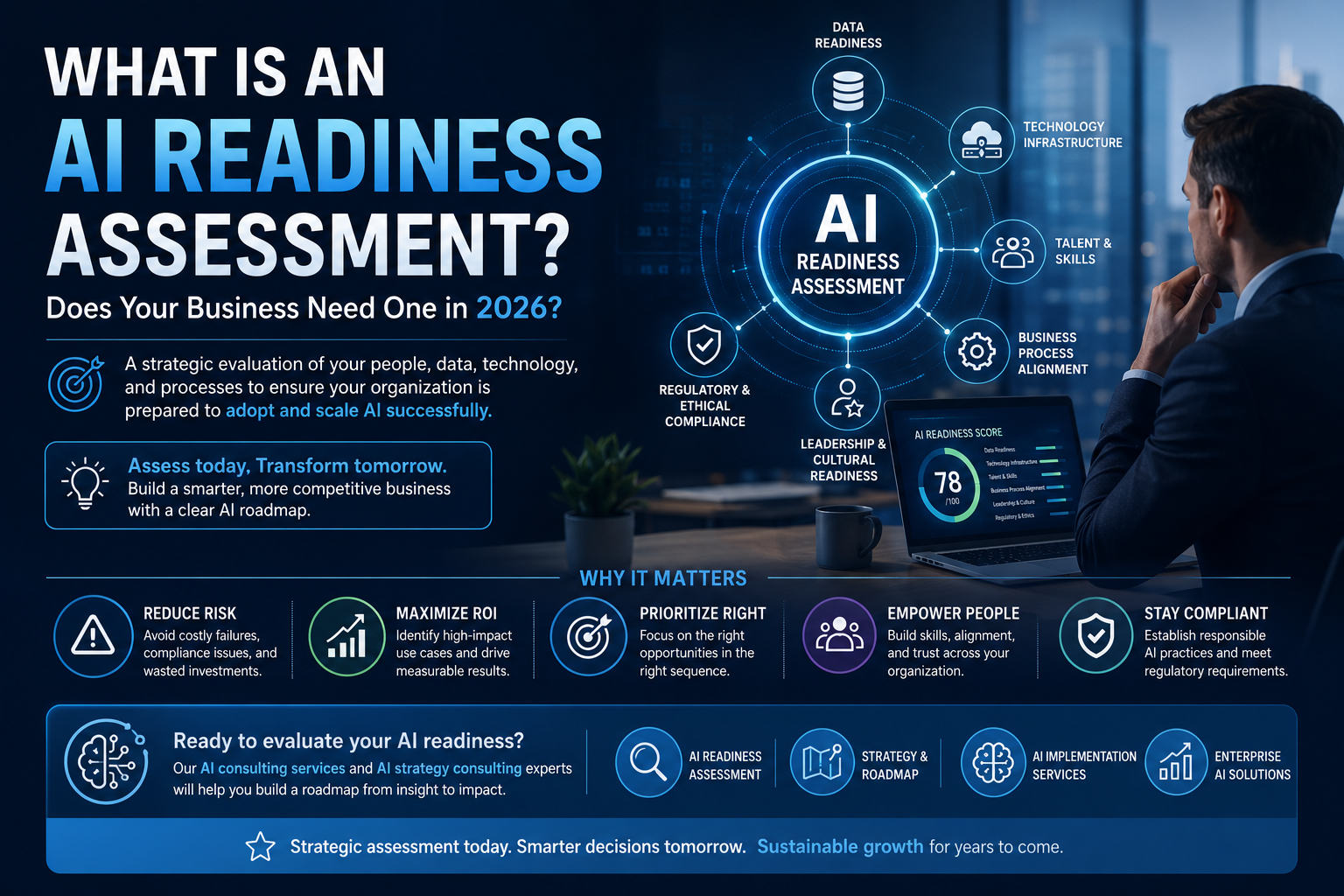
Artificial intelligence is no longer a future concept — it is actively reshaping how businesses operate, compete, and grow. Yet despite widespread enthusiasm, many organizations rush into AI adoption without first asking the most critical question: Are we actually ready? This is precisely where an AI readiness assessment becomes invaluable. Whether you are a mid-sized enterprise exploring automation or a large corporation planning a full-scale digital transformation, understanding your AI readiness is the essential first step before investing in any AI implementation services. In this guide, we break down exactly what an AI readiness assessment is, what it covers, and why it could be the smartest move your business makes this year. What Is an AI Readiness Assessment? An AI readiness assessment is a structured evaluation process that determines how prepared your organization is to adopt, implement, and scale artificial intelligence technologies. Think of it as a diagnostic health check — not just for your technology stack, but for your data infrastructure, workforce capabilities, organizational culture, and strategic alignment. Conducted typically by an experienced AI consulting services provider, a readiness assessment examines multiple dimensions of your business to identify gaps, opportunities, and risks before any AI project begins. The goal is not to determine whether you should use AI, but rather how, where, and in what sequence you should implement it for maximum impact. Key Dimensions Evaluated in an AI Readiness Assessment 1. Data Readiness AI systems run on data. One of the most common reasons AI projects fail is poor data quality, inconsistent data governance, or fragmented data silos. An AI readiness assessment evaluates: If your organization lacks clean, centralized data, even the most sophisticated AI algorithms will underperform. This phase often surfaces the need for data engineering investments before AI development can begin. 2. Technology Infrastructure AI workloads are computationally intensive. The assessment reviews your current IT landscape — including cloud computing capabilities, API integrations, cybersecurity posture, and scalability — to determine whether your infrastructure can support AI systems in production. 3. Talent and Skills Gap Analysis A technology is only as powerful as the people using it. The readiness assessment maps your current workforce skills against the competencies needed for AI adoption, identifying training needs, hiring priorities, and whether you need to partner with an external AI strategy consulting firm for specialized expertise. 4. Business Process Alignment AI should solve real business problems. Assessors work with stakeholders to identify which processes are high-value candidates for automation, augmentation, or intelligent decision-making — and which are not suitable for AI in their current form. 5. Leadership and Cultural Readiness Perhaps the most underestimated dimension: organizational culture. Is your leadership aligned on AI strategy? Is there a culture of data-driven decision making? Do employees trust and understand AI tools? These human factors often make or break AI adoption. 6. Regulatory and Ethical Compliance With growing regulatory scrutiny around AI — from the EU AI Act to sector-specific guidelines — enterprises must evaluate legal risks and establish responsible AI frameworks before deployment. This is especially critical in healthcare, finance, and legal sectors. Why Your Business Needs an AI Readiness Assessment Before Anything Else Many organizations skip this step and pay for it dearly. Here is what typically happens when AI projects launch without a readiness assessment: A comprehensive readiness assessment prevents all of these scenarios. It creates a clear, prioritized roadmap for AI implementation that is grounded in your actual business context — not generic best practices. According to McKinsey’s research on AI adoption in enterprises, organizations that invest in structured planning before AI deployment are significantly more likely to achieve sustainable ROI. How AI Consulting Services Guide the Assessment Process Conducting an AI readiness assessment internally can be challenging — especially when internal teams lack AI expertise or carry organizational blind spots. This is why partnering with a specialized AI consulting services provider adds tremendous value. An experienced AI strategy consulting partner brings: The output is not just a report — it is an actionable AI strategy that connects your immediate readiness gaps to long-term transformation goals. From there, your consulting partner can guide you through AI implementation services, including proof-of-concept development, model training, and full production deployment. Signs Your Business Is Ready for an AI Assessment Right Now Not sure if the timing is right? Here are clear indicators that your organization should conduct an AI readiness assessment immediately: What to Expect After the Assessment Once your AI readiness assessment is complete, you will receive a comprehensive document that includes: This roadmap becomes the foundation for every subsequent AI initiative — from small-scale automations to enterprise-wide AI solutions that transform your core business processes. Conclusion: Make AI Readiness Your Competitive Advantage In 2026, the question is not whether your business will adopt AI — it is how strategically you will do it. An AI readiness assessment is not a cost; it is an investment in avoiding costly mistakes and accelerating time-to-value from your AI initiatives. Whether you are starting your AI journey or trying to rescue a stalled project, the assessment gives you clarity, confidence, and a concrete path forward. Partner with a trusted AI consulting services provider today and transform your AI ambitions into measurable business outcomes. Ready to evaluate your AI readiness? Explore our AI consulting services and AI strategy consulting offerings to get started with a customized assessment for your organization.
AI vs Traditional Software Development: Key Differences and When to Use Each
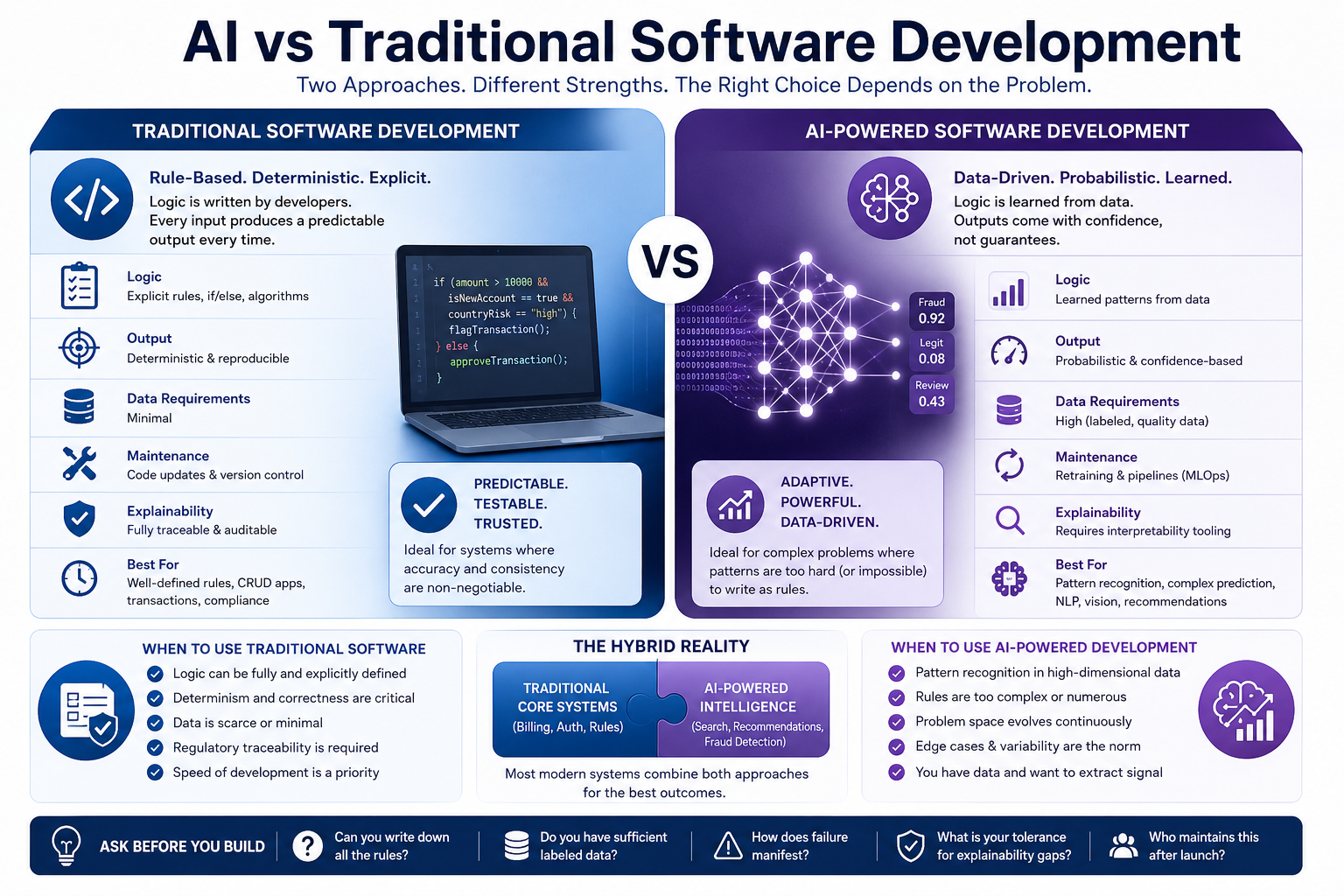
Introduction The phrase “just build an AI for it” has become reflexive in boardrooms and product meetings. But for engineering teams and technology buyers who need to make real architectural decisions, the nuances matter enormously. AI vs traditional software development is not simply a question of which approach is more advanced. It is a question of which is appropriate, for the problem, the data, the team, and the timeline. Getting this wrong is expensive in both directions: applying AI where rule-based logic suffices wastes resources, while applying traditional software engineering to inherently probabilistic problems sets projects up to fail. This guide gives you a practical framework for understanding both paradigms and making the right call. What Is Traditional Software Development? Traditional software development, often called rule-based or deterministic software engineering, involves explicitly programming the logic a system follows. A developer writes instructions that define exactly how the software responds to every input. The output is predictable: given input A, the system will always produce output B. Behavior is deterministic, testable, and fully traceable to the code itself. Core characteristics: Traditional custom software development has produced the vast majority of enterprise software: ERP systems, CRMs, financial platforms, e-commerce engines, mobile apps, and APIs. For well-defined problems with deterministic logic, it remains the right tool. What Is AI-Powered Software Development? AI-powered software development refers to building systems where some or all of the core logic is learned from data rather than explicitly coded. Instead of a developer writing rules, a machine learning model infers patterns from large datasets and uses those patterns to make predictions or decisions. The most common forms include: Core characteristics: AI software development services typically involve not just software engineering but also data engineering, model training infrastructure, and MLOps — a broader and more complex discipline than traditional software delivery alone. Key Differences: A Direct Comparison 1. How Logic Is Defined In traditional software, logic is explicit. A fraud detection rule might say: “Flag any transaction over $10,000 from a new account.” Every condition is written by a developer. In AI-powered development, logic is inferred. A fraud detection model trained on millions of historical transactions learns to recognize complex, non-obvious patterns that a human could not feasibly encode into rules. The tradeoff: explicit logic is transparent and controllable; learned logic is more powerful for complex pattern recognition but less interpretable. 2. Data Requirements Traditional custom software development does not require training data. It needs well-defined requirements and skilled engineers. AI development is fundamentally data-dependent. The quality, quantity, and representativeness of training data directly determines model performance, creating a significant front-loaded investment in data collection, cleaning, and annotation. 3. Performance Characteristics Traditional software performs consistently. An algorithm that sorts a dataset correctly does so every time, regardless of inputs. AI models have statistical performance. A model with 95% accuracy is wrong 5% of the time, and AI systems require ongoing monitoring because performance can drift as real-world data distributions shift away from training data. 4. Maintenance and Change Management Traditional software is changed by updating code. Changes are discrete, testable, and reversible. AI systems change through retraining. Updating model behavior requires new data, retraining pipelines, validation against hold-out sets, and careful deployment, workflows that traditional software engineering teams are not designed to handle. 5. Explainability Traditional software is inherently explainable. You can trace any output to the exact lines of code that produced it. Many AI models, especially deep neural networks, are effectively black boxes. In regulated industries, explainability is not optional and requires dedicated interpretability tooling. 6. Development Timeline and Cost Structure Traditional software development has a relatively predictable cost curve. AI development has a more front-loaded and variable cost structure. Data acquisition, annotation, and iterative model experimentation make early-phase costs harder to estimate. However, once a model is working well, it can handle tasks that would require enormous amounts of traditional software logic, or that would be impossible to encode at all. When to Use Traditional Software Development Traditional software engineering is the right choice when: When to Use AI-Powered Software Development AI software development services become the right investment when: The Hybrid Reality: Most Modern Systems Use Both The AI vs traditional software development framing is useful for analysis, but in practice, the most robust production systems combine both approaches deliberately. A customer-facing application might use traditional software engineering for its core business logic, authentication, billing, subscription management, while incorporating AI-powered components for search ranking, recommendation, fraud detection, and customer service automation. The discipline of software engineering increasingly requires practitioners to understand both paradigms and know how to compose them effectively. The decision is not binary; it is architectural. Questions to Ask Before Choosing Your Approach Working with a Development Partner on This Decision One underappreciated value of a strong machine learning development company or custom software development partner is helping you make this architectural decision correctly before writing a line of code. Be cautious of vendors who push AI solutions reflexively, without thoroughly understanding your requirements, data situation, and operational constraints. Equally, be cautious of partners who dismiss AI wholesale as hype. The best partners will be candid: sometimes the right answer is traditional software, sometimes it is AI, and often it is a thoughtful combination of both. Summary: Making the Right Call Factor Traditional Software AI-Powered Software Logic definition Explicit rules Learned from data Output type Deterministic Probabilistic Data requirements Minimal High (labeled data) Maintenance Code updates Retraining pipelines Explainability Full Requires tooling Best for Well-defined rules, auditable systems Pattern recognition, complex prediction Failure mode Bugs Model errors and drift Neither approach is universally superior. The organizations that build the most effective technology systems are those that understand both paradigms and apply them where they genuinely fit. Unsure which development approach fits your next project? A structured discovery engagement with an experienced partner can map your requirements to the right architecture — before significant investment is committed.
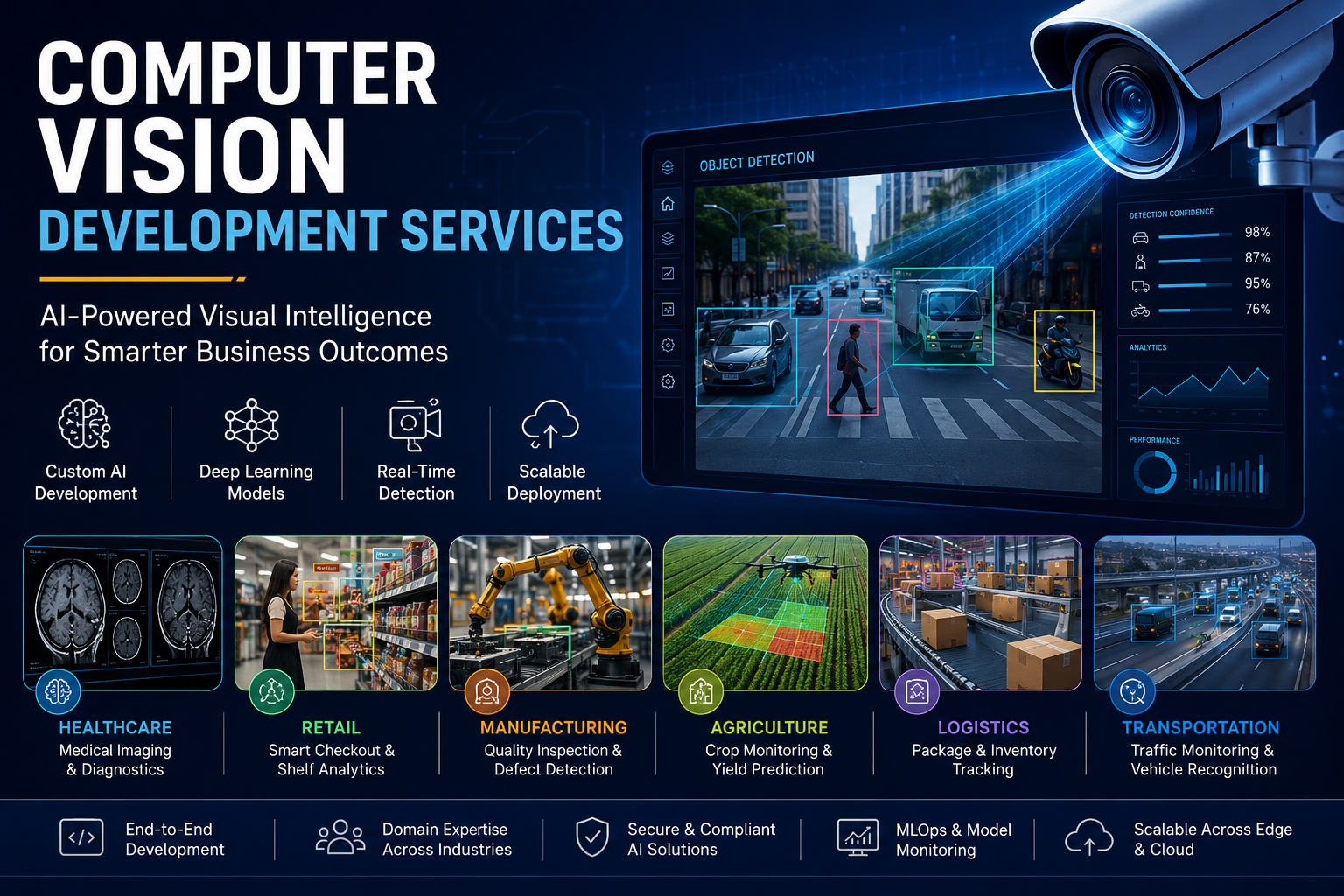
Computer Vision Development: Use Cases, Cost & How to Get Started
Introduction Machines can now see — and increasingly, they see better than humans in certain high-stakes scenarios. Computer vision, once confined to research labs, has matured into a production-ready technology powering everything from cancer detection to checkout-free retail stores. But building reliable, scalable computer vision systems is not trivial. It requires deep expertise in deep learning development, carefully curated training data, and infrastructure that can process visual inputs in real time. That’s why more companies are turning to specialized computer vision development services rather than attempting to build these systems entirely in-house. This guide breaks down what computer vision development actually involves, where it delivers the most business value, what it realistically costs, and how to get started with the right machine learning development company. What Is Computer Vision Development? Computer vision is a branch of artificial intelligence that enables software systems to interpret, analyze, and act on visual data — images, video, or real-time camera feeds. At its core, it involves training deep neural networks to recognize patterns: objects, faces, defects, movements, or text embedded in images. Computer vision development services encompass the full lifecycle of building these systems: Unlike off-the-shelf software, computer vision solutions are rarely plug-and-play. Each application requires custom AI development tailored to the specific visual domain, lighting conditions, object classes, and performance requirements of the business. Key Use Cases by Industry Healthcare & Medical Imaging Medical imaging is one of the most impactful applications of computer vision. AI models trained on radiology scans, pathology slides, and dermoscopy images can detect anomalies that human clinicians might miss — and do it consistently at scale. Common applications: Healthcare computer vision demands extremely high accuracy and must comply with regulatory frameworks like FDA 510(k) or CE marking. A specialized AI software development services partner with healthcare domain experience is essential here. Retail & E-Commerce Brick-and-mortar retail is being transformed by visual AI. Major retailers are deploying computer vision to reduce shrink, optimize shelf management, and create frictionless checkout experiences. Common applications: The ROI in retail is often direct and measurable — reduced labor costs, fewer out-of-stock incidents, and lower shrinkage rates. Manufacturing & Quality Control Industrial computer vision is one of the most commercially mature segments. Automated visual inspection systems are faster, more consistent, and ultimately cheaper than manual quality control on production lines. Common applications: In manufacturing, deep learning development enables models to detect defects that are imperceptible to the human eye — and do so at line speed, 24/7 without fatigue. Agriculture & Food Processing Common applications: Logistics & Transportation Common applications: Core Technologies Behind Modern Computer Vision Understanding the technical stack helps you evaluate potential AI software development services partners. Convolutional Neural Networks (CNNs): The foundational architecture for image classification and object detection. Still widely used for many production applications. Transformer-Based Vision Models: Vision Transformers (ViT) and models like CLIP and DINO have pushed state-of-the-art performance significantly, particularly for tasks requiring broader context understanding. Object Detection Frameworks: YOLO variants, Faster R-CNN, and DETR are standard frameworks for real-time detection tasks. Semantic & Instance Segmentation: Used when pixel-level understanding is required — medical imaging, autonomous driving, and agricultural analysis all rely heavily on segmentation models. Edge Deployment: Deploying models on edge hardware (NVIDIA Jetson, Intel Movidius, custom ASICs) is critical for applications requiring low latency or operating in bandwidth-constrained environments. MLOps for Vision: Production computer vision requires robust pipelines for data versioning, model monitoring, drift detection, and automated retraining — all part of what a mature machine learning development company should provide. How Much Does Computer Vision Development Cost? Cost varies significantly based on complexity, data availability, and deployment requirements. Here is a realistic breakdown: Proof of Concept (PoC) — $15,000 to $50,000 A focused PoC addresses a single, well-defined visual problem (e.g., detecting a specific type of surface defect). It involves limited data annotation, model training, and a working demo — but not production-ready infrastructure. Pilot Production System — $50,000 to $200,000 Includes data pipeline development, model optimization for your specific hardware, integration with existing systems, and deployment to a limited production environment. More extensive annotation work and iterative model improvement are included. Enterprise-Grade Deployment — $200,000 to $1,000,000+ Full-scale custom AI development involving multiple cameras or data streams, edge deployment at scale, integration with ERP/MES/WMS systems, regulatory compliance documentation, and ongoing MLOps support. Key Cost Drivers How to Choose a Computer Vision Development Partner Selecting the right machine learning development company is arguably the most important decision you’ll make. Here is what to evaluate: Domain Expertise Computer vision is not a single skill. A team that excels at autonomous vehicle perception may not have the domain knowledge to build a medical imaging diagnostic tool. Look for demonstrated experience in your specific industry vertical. End-to-End Capability Avoid fragmented engagements. The best AI software development services providers handle the complete pipeline: data strategy, annotation, model development, integration, deployment, and post-launch monitoring. Transparency in Model Performance Be skeptical of vanity metrics. A reputable partner will discuss performance in terms of precision, recall, F1 score, and real-world operating conditions — not just accuracy on a clean test set. Data Security Practices Visual data — especially in healthcare, defense, or retail — is sensitive. Ensure your partner has documented data handling policies and appropriate compliance certifications (SOC 2, HIPAA, ISO 27001). MLOps Maturity Ask how they handle model drift. Visual environments change — lighting shifts, new product SKUs appear, camera angles change. A mature partner has automated monitoring and retraining workflows. How to Get Started with Computer Vision Development Step 1: Define the Business Problem Precisely “We want computer vision” is not a project brief. Define the specific decision the system needs to make, what data it will operate on, and what success looks like in business terms. Step 2: Audit Your Data Existing image or video data is a significant asset. Before engaging a custom AI development partner, catalog what visual data you have, whether it is labeled, and how representative it is of real-world operating conditions.
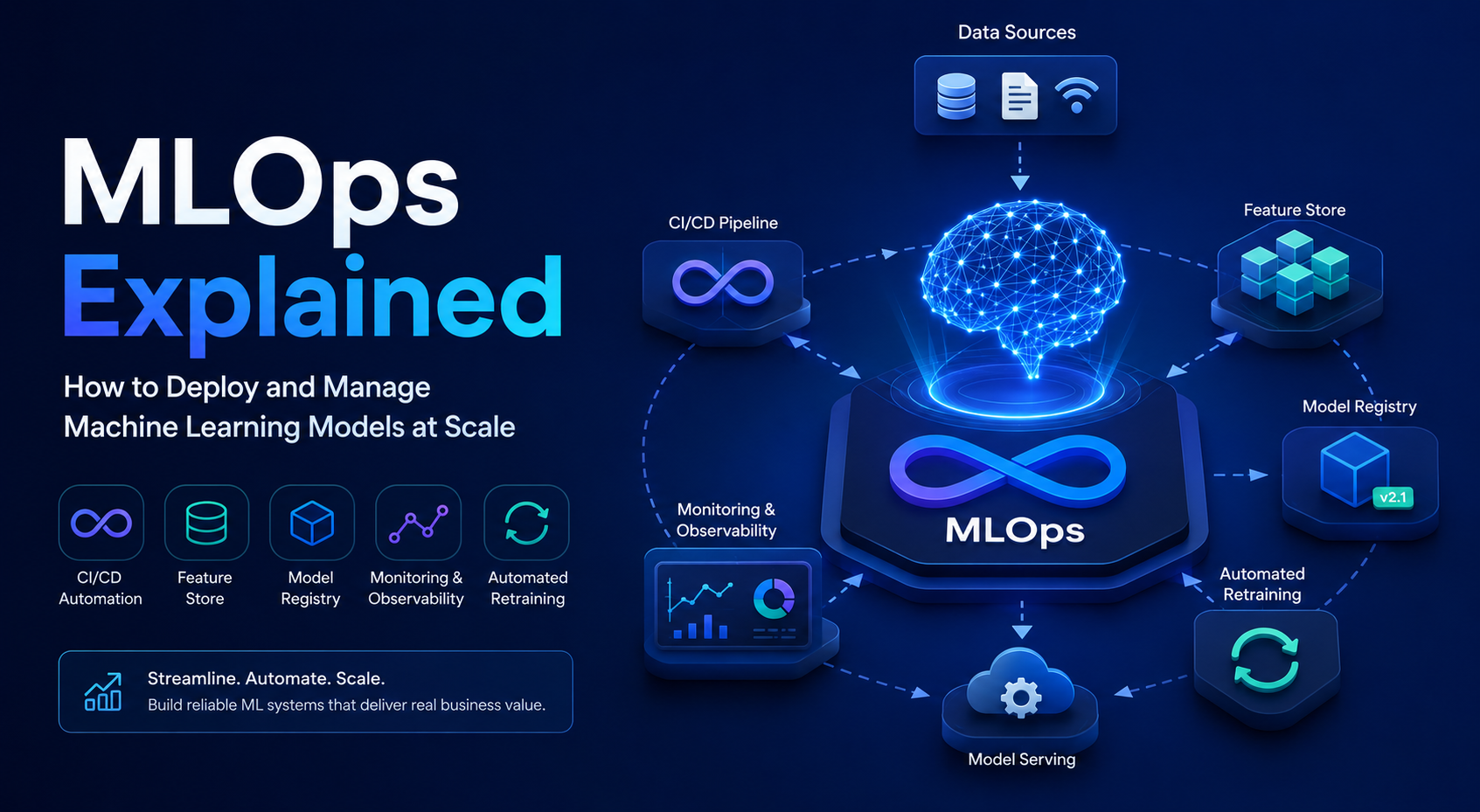
MLOps Explained: How MLOps Services Help Deploy and Manage Machine Learning Models at Scale
MLOps