
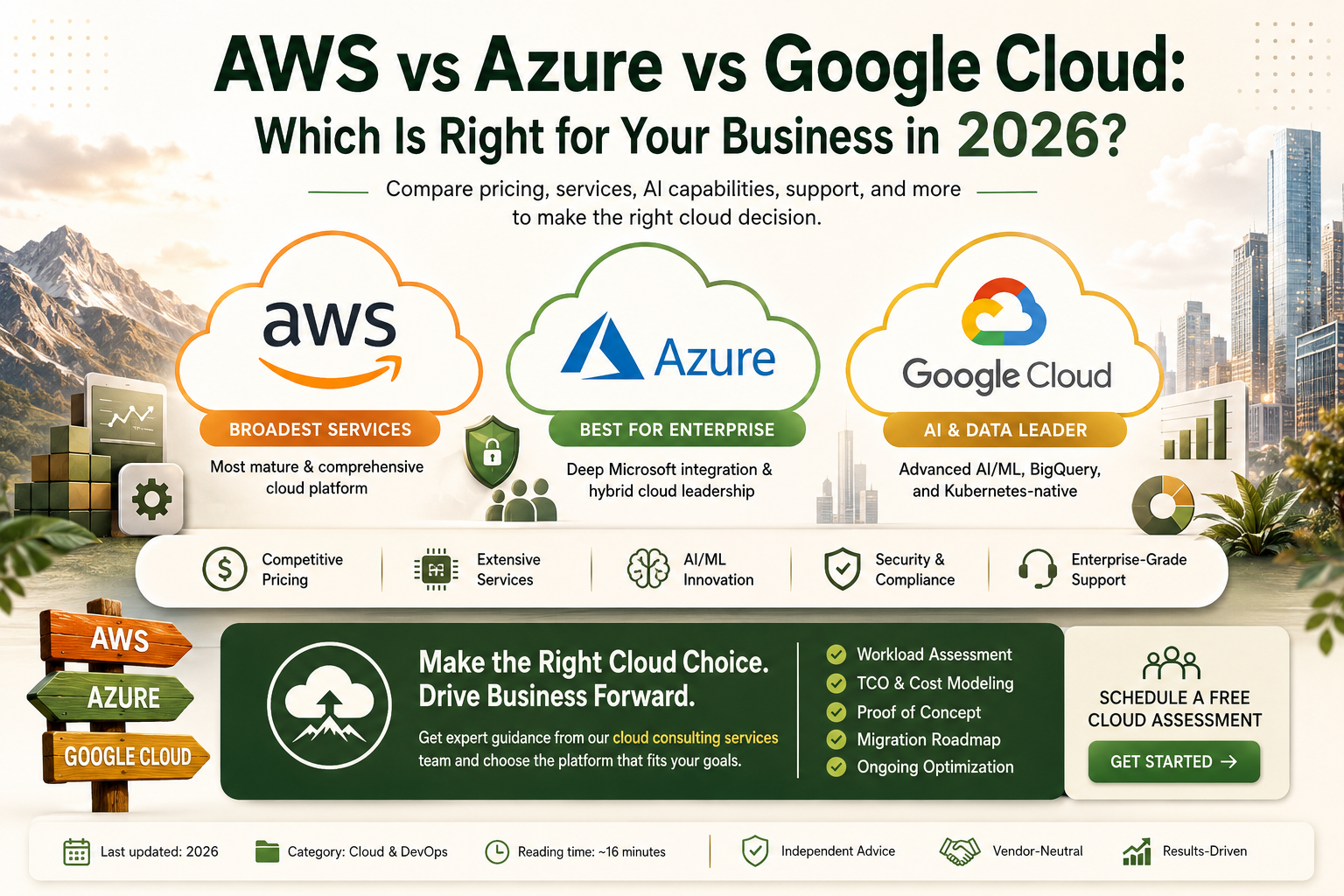
Introduction
It is the most consequential cloud decision your organization will make: AWS vs Azure vs Google Cloud. Choose the right platform and you gain a scalable, cost-efficient foundation for growth. Choose poorly and you face years of migration headaches, escalating costs, and technical constraints that limit what your business can build.
This comparison guide is written for business decision-makers, CTOs, and IT leaders evaluating cloud platforms in 2026. We compare Amazon Web Services, Microsoft Azure, and Google Cloud Platform across every dimension that matters — market position, services breadth, AI and ML capabilities, pricing, enterprise support, compliance, and the scenarios where each platform wins.
We also cover when to engage professional cloud consulting services to guide your decision, and how AWS consulting services and Azure consulting services partners can help you navigate the complexity of platform selection and migration.
AWS vs Azure vs Google Cloud: Market Position in 2026
Understanding the market landscape provides important context for the AWS vs Azure vs Google Cloud decision.
Amazon Web Services (AWS) remains the cloud market leader by revenue share, capturing approximately 31–33% of global cloud infrastructure spending. AWS launched in 2006 and has the most mature, deepest catalog of cloud services of any provider. Its breadth and ecosystem depth make it the default choice for many organizations, particularly startups, digital-native companies, and organizations without existing Microsoft or Google enterprise relationships.
Microsoft Azure holds approximately 22–25% market share and has grown aggressively by leveraging Microsoft’s dominant enterprise software relationships. Organizations already using Microsoft 365, Active Directory, Teams, Dynamics, and SQL Server find Azure integration compelling and often cost-advantaged. Azure is the leading cloud platform for enterprise, government, and hybrid deployment scenarios.
Google Cloud Platform (GCP) holds approximately 10–12% market share but is growing faster than the other two. Google Cloud’s differentiated advantages lie in data analytics (BigQuery), AI/ML services (Vertex AI), and Kubernetes-native infrastructure (Google invented Kubernetes). GCP attracts data-driven organizations, companies with significant AI workloads, and teams that value Kubernetes-native architecture.
This market context is not a recommendation — it is background. The right answer to AWS vs Azure vs Google Cloud depends on your specific workloads, team skills, vendor relationships, and strategic priorities.
AWS vs Azure vs Google Cloud: Core Services Comparison
Compute
All three providers offer equivalent core compute capabilities — virtual machines, containers, serverless functions, and managed Kubernetes.
| Capability | AWS | Azure | Google Cloud |
| Virtual Machines | EC2 (widest instance variety) | Azure VMs (strong Windows integration) | Compute Engine |
| Serverless Functions | Lambda (most mature) | Azure Functions | Cloud Functions |
| Managed Kubernetes | EKS | AKS | GKE (most Kubernetes-native) |
| Container Instances | Fargate, ECS | Azure Container Apps | Cloud Run |
AWS wins on sheer variety of instance types and the maturity of Lambda and ECS/Fargate ecosystems. Google Cloud wins for organizations with Kubernetes-first architectures, as GKE is widely regarded as the most capable and easiest to operate managed Kubernetes service. Azure wins for organizations with Windows Server workloads and tight Microsoft ecosystem integration.
Storage
| Capability | AWS | Azure | Google Cloud |
| Object Storage | S3 (industry standard) | Azure Blob Storage | Cloud Storage |
| Block Storage | EBS | Azure Managed Disks | Persistent Disk |
| File Storage | EFS, FSx | Azure Files, NetApp | Filestore |
| Archive Storage | S3 Glacier | Azure Archive | Cloud Storage Archive |
AWS S3 is the industry standard for object storage and has the most extensive ecosystem of tools, integrations, and third-party support. Azure Blob Storage and Google Cloud Storage are functionally equivalent for most use cases.
Databases
All three platforms offer a wide range of managed database services. Key differentiators:
- AWS has the broadest managed database portfolio, including Aurora (MySQL/PostgreSQL compatible), DynamoDB (NoSQL), Redshift (data warehousing), ElastiCache, and Neptune (graph).
- Azure excels for SQL Server workloads with Azure SQL Managed Instance, and offers Cosmos DB — one of the best globally distributed multi-model databases available.
- Google Cloud dominates with BigQuery for large-scale analytics (widely considered the best cloud data warehouse) and Spanner for globally distributed ACID-compliant relational databases.
If data analytics and large-scale SQL workloads are central to your business, Google Cloud’s BigQuery advantage in the AWS vs Azure vs Google Cloud comparison is significant.
AI and Machine Learning: AWS vs Azure vs Google Cloud
AI and ML capabilities are an increasingly decisive factor in the AWS vs Azure vs Google Cloud comparison. All three providers have invested heavily in AI services, but their positioning is quite different.
AWS AI/ML Services
AWS offers the broadest catalog of managed AI services through Amazon SageMaker (end-to-end ML platform), Bedrock (foundation model API access), Rekognition (computer vision), Comprehend (NLP), Transcribe, Polly, and Forecast. Bedrock provides access to models from Anthropic, Meta, Mistral, and Amazon Nova through a unified API.
SageMaker is the most comprehensive cloud ML platform for teams that need full control over the model lifecycle — data preparation, training, evaluation, deployment, and monitoring.
Azure AI Services
Azure’s AI strategy centers on its deep partnership with OpenAI. Azure OpenAI Service provides enterprise-grade access to GPT-4, GPT-4o, DALL-E, and other OpenAI models with the security, compliance, and SLA guarantees that enterprise buyers require.
For organizations building AI applications on OpenAI models, Azure is the premier cloud transformation services platform. Azure AI Studio provides a unified development environment for building, evaluating, and deploying AI applications. Azure also offers Cognitive Services for vision, speech, language, and search AI capabilities.
Google Cloud AI/ML Services
Google Cloud’s AI/ML capabilities are arguably the most technically advanced in the AWS vs Azure vs Google Cloud comparison. They trains its own frontier models (Gemini), owns TPU infrastructure purpose-built for AI training and inference, and offers Vertex AI — a comprehensive ML platform with AutoML, model training, serving, and MLOps capabilities.
For organizations with significant AI/ML development needs, Google Cloud’s native AI infrastructure and the BigQuery ML integration create a differentiated platform. Cloud consulting services specializing in AI workloads increasingly recommend Google Cloud for ML-heavy architectures.
Bottom line on AI: Azure wins for OpenAI-based applications. Google Cloud wins for organizations with serious ML development workloads. AWS wins for breadth and ecosystem of managed AI services.
Hybrid and Multi-Cloud: AWS vs Azure vs Google Cloud
Many enterprise organizations operate in hybrid environments — some workloads in cloud, some on-premises — or use multiple cloud providers simultaneously.
Azure: The Hybrid Leader
Azure Hybrid Benefits and Azure Arc make Azure the strongest hybrid cloud platform in the AWS vs Azure vs Google Cloud comparison. Arc extends Azure management, security policy, and Kubernetes orchestration to on-premises, multi-cloud, and edge environments. For organizations with long-running on-premises infrastructure that cannot migrate quickly, Azure provides the most seamless hybrid story.
AWS: Outposts for On-Premises
AWS Outposts brings AWS infrastructure and services to on-premises data centers, enabling a consistent AWS experience for latency-sensitive or data residency-constrained workloads. While robust, AWS Outposts requires capital investment in dedicated hardware.
Google Cloud: Anthos for Multi-Cloud
Google’s Anthos platform enables consistent Kubernetes-based workload management across Google Cloud, AWS, Azure, and on-premises environments. For organizations committed to a Kubernetes-first, multi-cloud architecture, Anthos is a powerful platform. Cloud consulting services specializing in multi-cloud strategies often include Anthos in their architecture recommendations.
Pricing: AWS vs Azure vs Google Cloud
Pricing comparison across AWS vs Azure vs Google Cloud is complex because it depends heavily on the specific services, regions, usage patterns, and committed use agreements involved. That said, here are meaningful generalizations:
Compute Pricing
Google Cloud is generally 10–20% less expensive for standard compute instances compared to AWS and Azure. Google Cloud also offers sustained use discounts automatically (no reservation required) and the best per-second billing granularity.
AWS Reserved Instances and Savings Plans offer significant discounts (up to 72%) for committed 1–3 year usage. Azure Reserved Instances offer comparable discounts and combine with Azure Hybrid Benefits for significant Windows and SQL Server savings.
Data Transfer and Egress
Egress fees — charges for data leaving the cloud — are a significant and often underestimated cost with all three providers. Google Cloud has historically offered more favorable egress pricing for multi-cloud scenarios. All providers charge for data transfer between regions.
AI and Advanced Services
For AI services, Azure OpenAI Service pricing is competitive for production-scale LLM API consumption. AWS Bedrock pricing varies by model and is generally competitive. Google Cloud Vertex AI offers aggressive pricing for organizations with high-volume inference workloads.
Enterprise Discounts and Committed Use
All three providers offer enterprise discount programs for large committed spends. For organizations spending $1M+ annually, negotiated enterprise agreements can substantially reduce list pricing. Engaging cloud consulting services or AWS consulting services / Azure consulting services partners can help secure favorable commercial terms.
Enterprise Support: AWS vs Azure vs Google Cloud
Enterprise-grade support is critical for production workloads. All three providers offer tiered support plans:
| Support Tier | AWS | Azure | Google Cloud |
| Entry Enterprise | $15,000/mo (Enterprise) | Included in EA (Unified) | $150/mo (Enhanced) |
| Premium/Dedicated | Enterprise On-Ramp, TAM | Premier/Unified with CSM | Premium with TAM |
| Response Time (Critical) | 15 minutes | 15 minutes | 15 minutes |
All three providers offer comparable response times and support quality at enterprise tier. The key differentiator is the quality of proactive guidance — AWS consulting services partners and Microsoft Unified Support packages often provide more hands-on architectural review and proactive optimization than the standard support packages.
Compliance and Security: AWS vs Azure vs Google Cloud
All three major cloud providers offer extensive compliance certifications and security tooling. Key certifications held by all three include SOC 1/2/3, ISO 27001, PCI-DSS, HIPAA, FedRAMP, and GDPR compliance capabilities.
Azure leads in government and defense cloud compliance, with dedicated Azure Government regions and DoD CC SRG IL2/IL4/IL5 certifications. For US federal and defense workloads, Azure GovCloud is the most mature option.
AWS has the broadest global compliance certification catalog and strong FedRAMP authorization for AWS GovCloud. AWS organizations in regulated industries benefit from an extensive partner ecosystem of compliance-focused AWS consulting services providers.
Google Cloud has made significant compliance investments, particularly for healthcare (HIPAA BAA) and financial services (PCI DSS). Google’s BeyondCorp zero-trust security model is technically sophisticated and attractive to security-forward organizations.
When to Choose AWS
AWS is the right choice when:
- Your team is already skilled in AWS services and the ecosystem
- You need the deepest catalog of services with the most mature third-party integrations
- Your workload is primarily Linux-based and cloud-native
- You are a startup or scale-up that wants access to the broadest ecosystem of tools, SaaS integrations, and AWS Marketplace solutions
- Your AI strategy centers on multiple foundation model providers via Bedrock
AWS consulting services partners can help you architect, migrate, and optimize workloads on AWS — from initial landing zone setup to full cloud transformation.
When to Choose Azure
Azure is the right choice when:
- Your organization is heavily invested in the Microsoft stack (M365, Active Directory, SQL Server, Dynamics, Teams)
- You want the best enterprise integration and hybrid cloud story
- Your AI strategy is built around OpenAI models (GPT-4, DALL-E, Whisper)
- You operate in government, defense, or heavily regulated industries requiring Azure GovCloud
- You want to maximize savings on Windows Server and SQL Server licensing through Azure Hybrid Benefits
Azure consulting services partners specialize in seamless Microsoft ecosystem integration, enterprise identity management, and hybrid connectivity scenarios.
When to Choose Google Cloud
Google Cloud is the right choice when:
- Data analytics is central to your business — BigQuery is the best cloud data warehouse available
- Your team is Kubernetes-first and values the most capable managed Kubernetes service (GKE)
- AI/ML development is a core capability — Vertex AI and TPU access provide unique advantages
- You value cost efficiency and want sustained use discounts without upfront commitments
- Your application architecture is microservices-based and you want the best serverless and container-native platform
AWS vs Azure vs Google Cloud: Quick Decision Matrix
| Priority | Best Choice |
| Broadest services catalog | AWS |
| Microsoft ecosystem integration | Azure |
| OpenAI / GPT-4 applications | Azure |
| Data analytics and BigQuery | Google Cloud |
| Kubernetes-native architecture | Google Cloud |
| Hybrid / on-premises integration | Azure |
| Government and defense compliance | Azure |
| Best cost efficiency (compute) | Google Cloud |
| Largest partner ecosystem | AWS |
| AI/ML platform depth | Google Cloud |
| Startup ecosystem and tooling | AWS |
The Case for Multi-Cloud in 2026
Many enterprise organizations in 2026 are not choosing just one cloud platform — they are deliberately using two or three. A multi-cloud strategy uses each provider where it wins:
- AWS for primary application workloads and the broadest service ecosystem
- Azure for Microsoft-integrated identity, compliance, and enterprise applications
- Google Cloud for data analytics (BigQuery) and AI/ML workloads (Vertex AI)
While multi-cloud adds operational complexity, the right cloud transformation services partner can help you manage this complexity through unified governance, cost management, and security tooling that spans providers.
How Cloud Consulting Services Accelerate Your Decision
The AWS vs Azure vs Google Cloud decision involves dozens of variables specific to your organization’s workloads, team skills, commercial relationships, and strategic goals. Engaging professional cloud consulting services early in the process delivers several advantages:
- Workload assessment — mapping your specific applications and data workloads to the cloud services best suited to run them
- Total cost modeling — building realistic 3-year TCO models for each platform including migration, consumption, and optimization costs
- Proof of concept guidance — designing targeted PoCs that validate performance and cost assumptions for critical workloads
- Negotiation support — helping you structure committed use agreements and enterprise discount programs that maximize your investment
- Migration planning — building the phased migration roadmap once the platform decision is made
Whether you need AWS consulting services, Azure consulting services, Google Cloud advisory, or a multi-cloud strategy, working with an experienced cloud consulting services partner reduces risk and accelerates time to value.
Internal Resources
- Cloud Migration Guide 2026: Steps, Costs, and What to Watch Out For →
- Cloud Cost Optimization: 12 Strategies to Reduce Your Cloud Bill →
- DevOps as a Service: How to Accelerate Cloud-Native Development →
- Kubernetes vs Serverless: Choosing the Right Cloud Architecture →