
The way software teams build, deploy, and maintain systems is changing — fast. For nearly two decades, DevOps has been the gold standard for engineering culture. But in 2026, a new discipline is taking center stage: platform engineering. Understanding the debate around platform engineering vs DevOps is no longer optional for engineering leaders — it’s essential.
This guide breaks down what platform engineering actually is, how it compares to traditional DevOps, and why so many organizations are making the switch. Whether you’re a CTO evaluating your engineering strategy or a technical founder scaling your team, this explainer will help you make an informed decision.
What Is Platform Engineering?
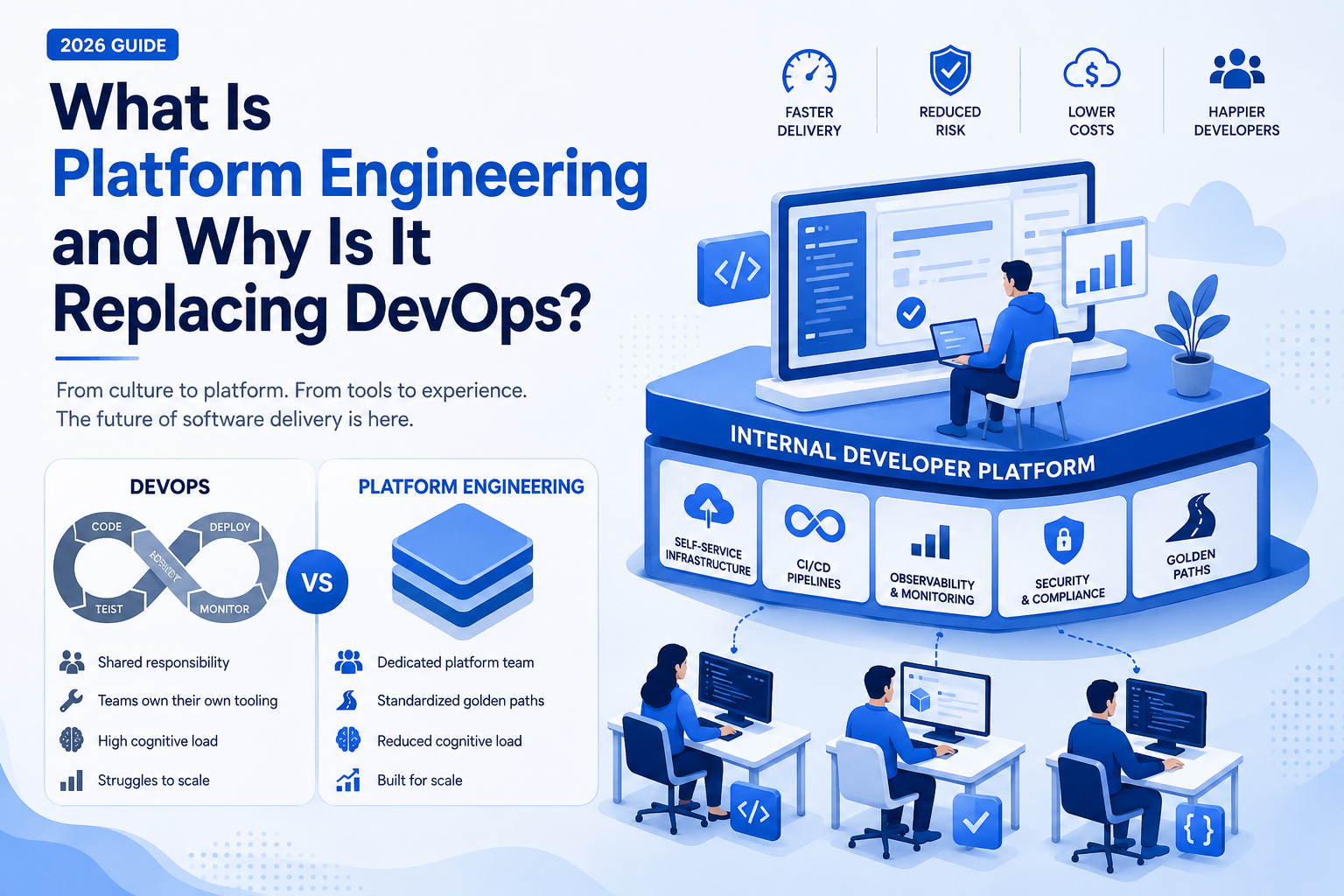
Platform engineering is the discipline of designing and building internal developer platforms (IDPs) — curated, self-service toolchains and infrastructure that enable software developers to build, test, deploy, and operate applications without constant support from operations or DevOps teams.
Think of it as building a “product” for your own developers. Instead of every team managing their own CI/CD pipelines, cloud configurations, monitoring stacks, and deployment workflows, a dedicated platform engineering team creates a standardized, paved-road experience that abstracts away infrastructure complexity.
Key components of a modern internal developer platform typically include:
- Self-service infrastructure provisioning (cloud resources on demand)
- Standardized CI/CD pipelines integrated into developer workflows
- Observability and monitoring built in by default
- Security and compliance guardrails enforced at the platform level
- Golden paths — opinionated, pre-approved patterns for common engineering tasks
Platform engineering is the organizational layer that powers all of this. It’s less about individual tooling and more about treating developer experience as a first-class product. Learn more about platform engineering from CNCF
What Is DevOps (and What Did It Solve)?
Before diving into platform engineering vs DevOps, it’s worth briefly revisiting what DevOps was designed to solve.
DevOps emerged as a cultural and technical movement in the late 2000s to break down the wall between development teams (who wrote code) and operations teams (who kept it running). The goal was to enable faster, more reliable software delivery through shared ownership, automation, and continuous integration and deployment.
DevOps consulting services helped organizations adopt practices like:
- Infrastructure as Code (IaC)
- Automated testing and deployment
- Continuous monitoring and feedback loops
- Shared on-call responsibilities
DevOps worked — and still works — incredibly well in many contexts. But as organizations scaled, a new set of problems emerged that DevOps wasn’t designed to solve.
Platform Engineering vs DevOps: What’s Actually Different
The platform engineering vs DevOps debate isn’t about which approach is “better” in isolation. It’s about which model fits the complexity and scale of modern engineering organizations. Here’s how they compare:
| Dimension | DevOps | Platform Engineering |
| Primary focus | Culture + collaboration | Internal developer experience |
| Ownership model | Shared (Dev + Ops) | Dedicated platform team |
| Scalability | Struggles at scale | Designed for scale |
| Developer autonomy | Varies widely | High — via self-service |
| Cognitive load on devs | Often high | Reduced via abstractions |
| Tooling approach | Teams choose their own | Standardized golden paths |
The Cognitive Load Problem
One of the biggest reasons platform engineering is gaining traction over traditional DevOps is the cognitive load issue. In a pure DevOps model, developers are expected to be responsible for everything — from writing code to managing Kubernetes clusters, configuring monitoring, and responding to on-call incidents.
This “you build it, you run it” philosophy sounds empowering, but in practice it can overwhelm developers, slow down feature delivery, and increase burnout. Platform engineering solves this by giving developers curated, self-service tools so they can focus on what they do best: building products.
From Siloed Ops to Internal Product Teams
In traditional DevOps, operations functions are distributed across teams. In platform engineering, a centralized platform team operates like a product team — complete with a roadmap, SLAs, and developer-facing documentation. This shift is a fundamental change in organizational design, not just tooling.
Site reliability engineering services often sit alongside platform engineering teams, handling production reliability while the platform team focuses on developer experience and toolchain abstraction.
Why Platform Engineering Is Trending in 2026
Several macro trends are converging to make platform engineering the dominant paradigm for technology organizations right now:
1. Cloud Complexity Has Exploded
Modern cloud-native architectures involve dozens of managed services, microservices, container orchestration, serverless functions, and multi-cloud environments. The cognitive overhead required to manage all of this in a DevOps model has become unsustainable for most teams. Cloud DevOps services can help bridge the gap, but platform engineering provides a structural solution.
2. Developer Experience Is a Competitive Advantage
The best engineers choose employers based on how productive they feel. Organizations that invest in platform engineering report dramatically faster onboarding, higher developer satisfaction, and better retention. DORA (DevOps Research and Assessment) metrics like deployment frequency and lead time for changes improve measurably when internal developer platforms are in place. Review the DORA metrics report
3. Standardization Reduces Risk at Scale
When every team manages their own infrastructure and tooling, you get sprawl — inconsistent security configurations, redundant tooling costs, and unpredictable reliability. Platform engineering enforces consistency, which reduces risk and makes audits, compliance, and incident response significantly easier.
4. The Rise of Platform Engineering Teams at Leading Companies
Organizations like Spotify (creators of Backstage), Netflix, Airbnb, and LinkedIn have all publicly discussed their investment in internal developer platforms. These aren’t vanity projects — they’re strategic infrastructure investments that directly impact engineering velocity. Explore Spotify’s Backstage platform
Does Platform Engineering Replace DevOps Entirely?
No — and it’s important to be precise here. Platform engineering vs DevOps isn’t a zero-sum debate.
DevOps principles — automation, collaboration, continuous delivery, shared ownership — remain foundational. Platform engineering takes those principles and builds organizational and technical structures around them that scale better.
You might think of it this way: DevOps is a philosophy; platform engineering is a function that operationalizes that philosophy at scale.
Many organizations are transitioning from informal DevOps practices to dedicated platform engineering teams. DevOps consulting services remain valuable during this transition, helping companies redesign their engineering organizations, select the right toolchain, and build the governance models that make platform engineering work.
When Should You Invest in Platform Engineering?
Not every organization needs a dedicated platform engineering team. Here’s a rough guide:
Consider platform engineering if:
- Your engineering team has grown beyond 30–50 developers
- Developer onboarding takes weeks or months
- You’re running multiple product teams with redundant infrastructure tooling
- Your DevOps team is a bottleneck — teams are waiting on ops to provision resources
- You’re dealing with significant cloud cost sprawl or compliance challenges
Stick with DevOps-first if:
- You’re a startup with fewer than 20 engineers
- You’re still finding product-market fit and speed-of-iteration is paramount
- Your infrastructure footprint is relatively simple and consistent
That said, even early-stage companies benefit from adopting platform engineering principles — standardized pipelines, infrastructure as code, and clear deployment patterns — even if a formal platform team comes later.
Building a Platform Engineering Capability: Where to Start
Transitioning to platform engineering doesn’t happen overnight. Here’s a practical starting sequence:
- Audit your current developer experience — survey your developers on pain points, bottlenecks, and time spent on non-product work
- Identify your highest-friction workflows — deployment, environment setup, and observability are common starting points
- Choose your internal developer platform approach — options include building on top of Backstage, Port, Cortex, or a custom solution
- Staff a platform team — typically a mix of senior SREs, DevOps engineers, and a product manager focused on developer experience
- Establish feedback loops — treat your developers as customers and continuously improve the platform based on their feedback
If you’re uncertain where to start, partnering with an experienced team offering platform engineering services or DevOps consulting services can dramatically accelerate the process. An external partner can benchmark your current state, design your internal developer platform architecture, and help you avoid the most common pitfalls.
The Business Case for Platform Engineering
For engineering leaders making the case to executive stakeholders, platform engineering delivers measurable ROI through:
- Faster time to market — developers ship features faster when infrastructure friction is removed
- Reduced incident rates — standardized tooling and guardrails reduce misconfiguration and security vulnerabilities
- Lower cloud costs — centralized visibility and policy enforcement reduces cloud waste (read more about this in our guide on [FinOps strategies for cloud cost optimization])
- Higher developer retention — productive developers stay; frustrated ones leave
- Scalability — onboarding a new team of 10 engineers takes days, not months
These aren’t theoretical benefits. Gartner predicted that by 2026, 80% of large software engineering organizations would establish platform engineering teams as a way to accelerate application delivery. Read Gartner’s platform engineering research
Ready to Make the Shift?
Whether you’re evaluating platform engineering for the first time or actively planning a transition from traditional DevOps, getting the organizational design and toolchain selection right from the start matters enormously.
Our platform engineering services help engineering organizations design, build, and operate world-class internal developer platforms. From initial assessment through full implementation, our team brings deep expertise in Kubernetes, cloud DevOps services, site reliability engineering services, and developer experience design.
Talk to our platform engineering team today →
Frequently Asked Question
Is platform engineering just DevOps with a new name?
No. While platform engineering builds on DevOps principles, it represents a fundamentally different organizational model — a dedicated team that treats internal tooling as a product, rather than distributed DevOps responsibilities across all teams.
What skills does a platform engineer need?
Platform engineers typically combine expertise in cloud infrastructure, Kubernetes, CI/CD tooling, programming (often Go or Python), and developer experience design. Strong communication skills are also critical since platform engineers serve internal developer customers.
How does site reliability engineering fit with platform engineering?
SRE and platform engineering are complementary disciplines. SREs typically focus on production reliability and incident response, while platform engineers focus on the toolchain and developer experience. Many organizations run both functions in parallel, and some companies merge them into a unified infrastructure organization.
How long does it take to build an internal developer platform?
A basic internal developer platform can be operational in 3–6 months. A mature, feature-rich platform typically takes 12–18 months to build out — though incremental value is delivered throughout the process.