
Speed is a startup’s most powerful competitive advantage. The ability to ship features, iterate on user feedback, and recover from failures faster than your competitors can be the difference between a company that wins its market and one that doesn’t. DevOps for startups is the engineering discipline that makes sustainable speed possible — not just in the early days, but as your product and team scale.
This guide is written specifically for technical founders, engineering leads, and CTOs building out their engineering culture and infrastructure. You’ll learn the DevOps fundamentals that matter most for startups, the most common mistakes early-stage teams make, and how to build a CI/CD pipeline that scales with your growth.
Why DevOps Matters More for Startups Than You Think
Many founders treat DevOps as something large enterprises do — a complexity tax for organizations with hundreds of engineers. This is a mistake that compounds quickly.
The reality is that DevOps for startups pays its biggest dividends early. A well-implemented DevOps culture means:
- Your developers spend more time building product features and less time debugging deployment failures
- New engineers can contribute to production within days of joining, not weeks
- Incidents are caught earlier, recovered from faster, and are less likely to recur
- You can confidently ship multiple times per day without fear of breaking production
These capabilities aren’t luxuries — they’re infrastructure that determines how fast your company can learn and grow. And the cost of not having them compounds: every month you delay building a proper DevOps foundation, you’re accumulating technical debt that becomes more expensive to unwind. Read the DORA State of DevOps Report
The Core Pillars of DevOps for Startups
DevOps for startups doesn’t mean implementing every DevOps practice from day one. It means building the right foundation in the right order. Here are the four pillars every startup should prioritize:
Pillar 1: Version Control and Branching Strategy
This sounds obvious, but a surprising number of early-stage teams haven’t established clear branching conventions, code review processes, or commit policies. Your version control system (Git, almost certainly) is the backbone of your entire engineering workflow.
Adopt a simple, clear branching strategy early. For most startups, a trunk-based development model or a lightweight GitFlow variant works well. The key is consistency — everyone on the team follows the same conventions, and merging to main always triggers automated quality checks.
Pillar 2: Automated Testing
Manual testing is the enemy of speed. Every time a developer has to manually verify that their changes didn’t break something, you’re adding friction, slowing down delivery, and creating opportunities for human error.
A comprehensive automated testing strategy for startups typically includes:
- Unit tests — fast, isolated tests that verify individual functions and components
- Integration tests — verify that services and components work correctly together
- End-to-end tests — simulate real user workflows through your application
- Smoke tests — fast sanity checks that run post-deployment to verify basic functionality
You don’t need 100% test coverage from day one. Start with the highest-risk paths — authentication, payment flows, data mutations — and expand coverage systematically over time.
Pillar 3: Continuous Integration and Continuous Delivery (CI/CD)
A CI/CD pipeline is the heartbeat of DevOps for startups. Continuous Integration means every code change is automatically built, tested, and validated before it can be merged. Continuous Delivery means that code in your main branch is always in a deployable state — and ideally deployed to production automatically or with a single human approval step.
CI/CD pipeline services dramatically reduce the risk of shipping code. Instead of infrequent, high-stakes “release days” where everything is deployed at once, you ship small, incremental changes continuously — making it easier to identify what caused any problem and roll it back quickly.
Popular CI/CD platforms for startups include GitHub Actions, GitLab CI/CD, CircleCI, and Buildkite. For most startups, GitHub Actions is the lowest-friction starting point given its tight integration with GitHub and generous free tier. Explore GitHub Actions documentation
Pillar 4: Infrastructure as Code (IaC)
If your team is manually configuring servers, databases, and cloud resources through web consoles, you’re accumulating invisible technical debt. Infrastructure as Code means your entire cloud environment is defined in version-controlled configuration files — reproducible, auditable, and deployable in minutes.
Terraform is the most widely adopted IaC tool and works across AWS, GCP, Azure, and dozens of other providers. AWS-native teams may prefer CloudFormation or the AWS CDK. Pulumi is gaining traction for teams that prefer writing infrastructure in TypeScript or Python.
The payoff: when something breaks, you can rebuild your entire environment from scratch. When you need to spin up a new environment (staging, QA, performance testing), it takes minutes. When a new engineer joins, they’re not dependent on tribal knowledge to understand how your infrastructure works.
Building Your First CI/CD Pipeline: A Practical Starting Point
If your startup is starting from scratch with DevOps for startups, here’s a practical implementation sequence that delivers value at each step rather than requiring a massive upfront investment:
Week 1–2: Source Control Hygiene
- Establish branch protection rules on your main branch
- Require pull requests with at least one reviewer approval before merge
- Set up basic commit linting to enforce clear commit messages
Week 2–4: Automated Testing Foundation
- Integrate your test suite into your version control system
- Configure tests to run automatically on every pull request
- Block merges when tests fail
Week 4–8: CI/CD Pipeline Setup
- Set up automated build and test pipelines using CI/CD pipeline services or a self-managed tool
- Configure automated deployment to a staging environment on merge to main
- Add deployment to production behind a manual approval gate
Week 8–12: Infrastructure as Code
- Define your cloud infrastructure in Terraform or your IaC tool of choice
- Store IaC configuration in version control alongside application code
- Set up automated infrastructure validation in your CI/CD pipeline
Month 3–6: Observability and Monitoring
- Implement structured logging, metrics collection, and distributed tracing
- Set up alerting for key signals (error rates, latency, resource saturation)
- Build dashboards that give your team clear visibility into production health
This sequence is designed to deliver compounding value — each step makes the next one more impactful. Explore infrastructure as code with Terraform
Common DevOps Mistakes Startups Make
Understanding DevOps for startups also means recognizing the pitfalls that slow teams down. Here are the most common mistakes early-stage engineering teams make:
Mistake 1: Treating DevOps as an Infrastructure Problem
DevOps is first and foremost a cultural practice — it’s about collaboration, shared ownership, and continuous improvement. Teams that implement CI/CD tooling without changing how developers and operations people work together often end up with automated versions of the same siloed behaviors.
Mistake 2: Skipping Tests to Ship Faster
The pressure to move fast often leads startup teams to de-prioritize automated testing. This works in the very short term but creates a vicious cycle: as the codebase grows, untested code becomes harder to change safely, velocity drops, and developers spend more time debugging production issues rather than building features. DevOps implementation services often help teams break this cycle by establishing testing practices that fit their current stage.
Mistake 3: Manual Deployments
If deploying your application requires a developer to SSH into a server and run commands, or manually execute a sequence of steps, your deployment process is a reliability risk. Manual steps introduce human error, make deployments stressful, and slow down your ability to respond to incidents.
Mistake 4: Treating Security as an Afterthought
Security should be integrated into your CI/CD pipeline from the beginning — not bolted on after an incident. Static analysis security testing (SAST), dependency vulnerability scanning, and secret detection tools can all run automatically in your pipeline with minimal overhead. Explore DevSecOps practices
Mistake 5: No Incident Response Process
At some point, production will break. Teams that haven’t defined a basic incident response process — how to detect, communicate, mitigate, and learn from incidents — end up in chaotic, high-stress situations that take longer to resolve. Even a simple runbook and a defined on-call rotation is significantly better than nothing.
When to Bring in External DevOps Help
DevOps for startups is something many founding teams try to build entirely in-house — and for small teams with strong DevOps experience, that can work well. But there are situations where bringing in DevOps consulting services or DevOps as a service accelerates outcomes significantly:
- You’re a product-focused founding team without deep infrastructure expertise, and DevOps implementation is a distraction from product development
- You’ve inherited technical debt from rapid early growth — inconsistent environments, fragile deployments, and missing automation — and need to stabilize without halting product development
- You’re preparing for a compliance requirement — SOC 2, ISO 27001, HIPAA — and need to implement DevOps practices that satisfy audit requirements
- Your engineering team is scaling rapidly and you need to establish DevOps standards before inconsistent practices become entrenched
- You’re migrating to the cloud or re-platforming your infrastructure, and want experienced guidance on architectural decisions that are hard to reverse
DevOps as a service models allow startups to access senior DevOps expertise without committing to a full-time hire — particularly valuable in the early stages when your infrastructure needs are evolving rapidly.
Measuring DevOps Performance: The DORA Metrics
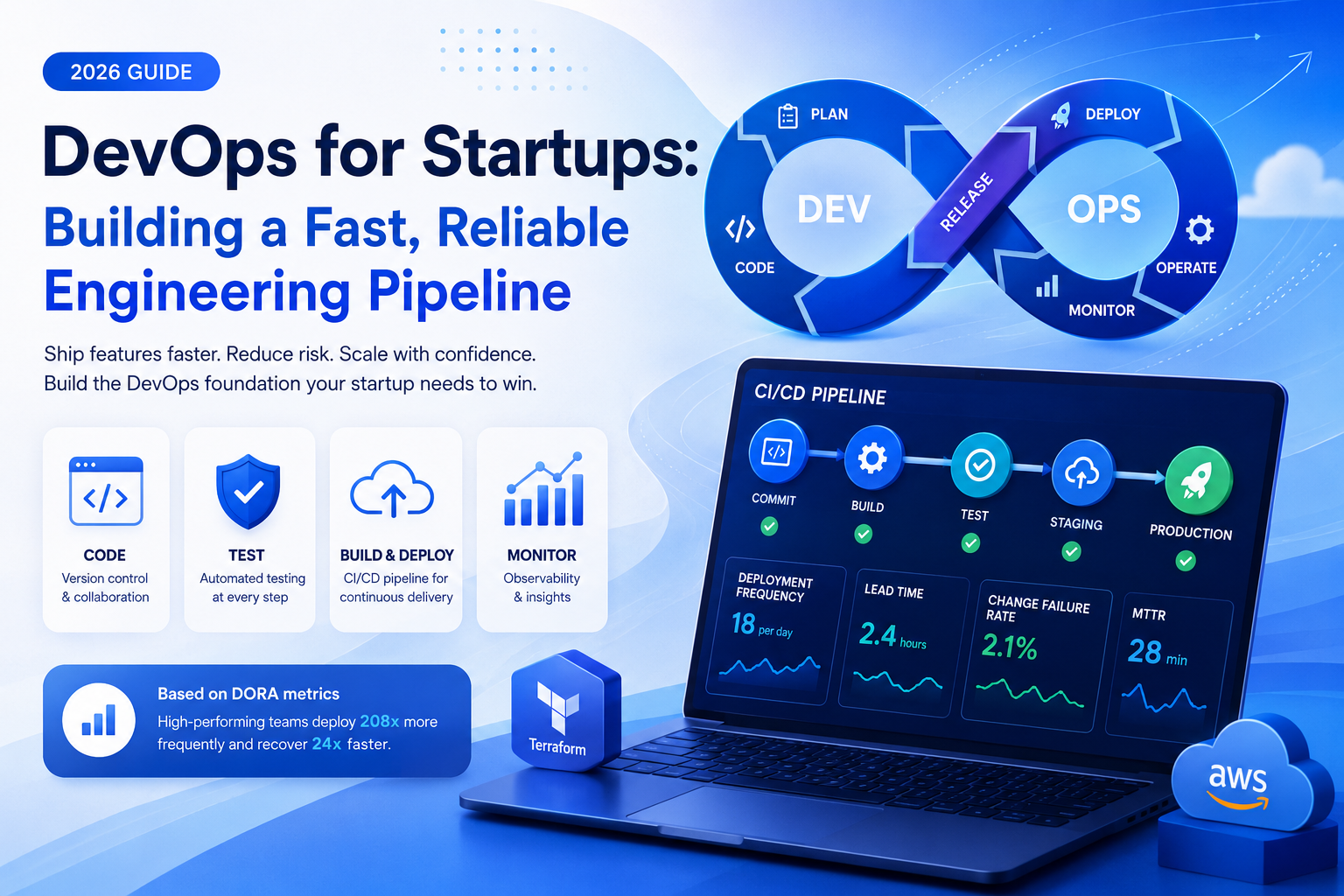
How do you know if your DevOps for startups investment is working? The most widely accepted framework for measuring DevOps performance is the DORA (DevOps Research and Assessment) four key metrics:
- Deployment Frequency — how often your team successfully deploys to production
- Lead Time for Changes — how long it takes for a code change to reach production
- Change Failure Rate — what percentage of deployments cause incidents or require rollback
- Mean Time to Recovery (MTTR) — how long it takes to restore service after an incident
Elite-performing teams deploy multiple times per day, have lead times measured in hours, maintain change failure rates below 5%, and recover from incidents in under an hour. You don’t need to hit elite numbers from day one — but tracking these metrics gives you an objective signal of whether your DevOps practices are improving over time. Benchmark your team with DORA metrics
Scaling DevOps as Your Startup Grows
The DevOps for startups practices that work beautifully for a 5-person team need to evolve as you scale to 20, 50, and 100+ engineers. Common scaling challenges include:
- Pipeline performance — CI/CD pipelines that run in 5 minutes with one team take 45 minutes with ten teams running thousands of builds per day
- Environment management — maintaining consistent staging, QA, and production environments across multiple product teams
- Organizational design — deciding when to create a dedicated DevOps or platform engineering team versus keeping DevOps responsibilities distributed
Many scaling startups find that their initial DevOps implementation served them well for Series A but needs a significant rethink for Series B and beyond. This is a natural evolution — the right architecture at each stage looks different, and recognizing when your current approach is becoming a bottleneck is a sign of engineering maturity.
Building Your DevOps Foundation: The Investment That Pays for Itself
DevOps for startups is not overhead — it’s the infrastructure that makes every other engineering investment more valuable. A well-implemented DevOps foundation means faster feature development, fewer production incidents, more confident deployments, and an engineering culture that attracts top talent.
The teams that win in competitive markets are those that can learn faster than their competitors. A strong DevOps pipeline — with automated testing, continuous delivery, and robust observability — is what makes fast, sustainable learning possible.
Our DevOps consulting services and DevOps implementation services are designed specifically for startups and high-growth engineering teams. From CI/CD pipeline setup through cloud infrastructure design and DevOps as a service models, we help technical founders build the engineering foundation their product deserves.
Talk to our DevOps team about your startup’s needs →
Frequently Asked Questions
When should a startup start investing in DevOps?
Ideally from day one — even simple practices like automated testing and a basic CI/CD pipeline pay dividends immediately. That said, it’s never too late to start. The sooner you establish a DevOps foundation, the less technical debt you’ll have to unwind later.
How much does it cost to set up a CI/CD pipeline for a startup?
The tooling costs for a basic CI/CD pipeline are relatively low — GitHub Actions, for example, is free for public repositories and includes generous free minutes for private repositories. The main investment is engineering time. Working with CI/CD pipeline services or a DevOps consulting team can reduce the time to implementation significantly.
Do we need a dedicated DevOps engineer as a startup?
Not necessarily in the very early stages. Many startups begin with DevOps responsibilities distributed across the engineering team or leverage DevOps as a service for specialized expertise. A dedicated DevOps hire typically becomes cost-effective when your engineering team reaches 15–20 developers.
What’s the difference between DevOps and SRE for a startup?
DevOps is a cultural practice focused on collaboration and continuous delivery. Site Reliability Engineering (SRE) is Google’s approach to applying software engineering practices to operations and reliability. For most startups, starting with DevOps principles and incorporating SRE practices as you scale (especially around incident response and reliability engineering) is the right sequence.
How do I convince my co-founders to invest in DevOps early?
Frame DevOps investment in terms of business outcomes rather than technical practices: faster feature delivery, reduced time spent debugging production issues, and the ability to respond to competitive threats quickly. Engineering velocity is a business metric — and DevOps is the infrastructure that determines it.