
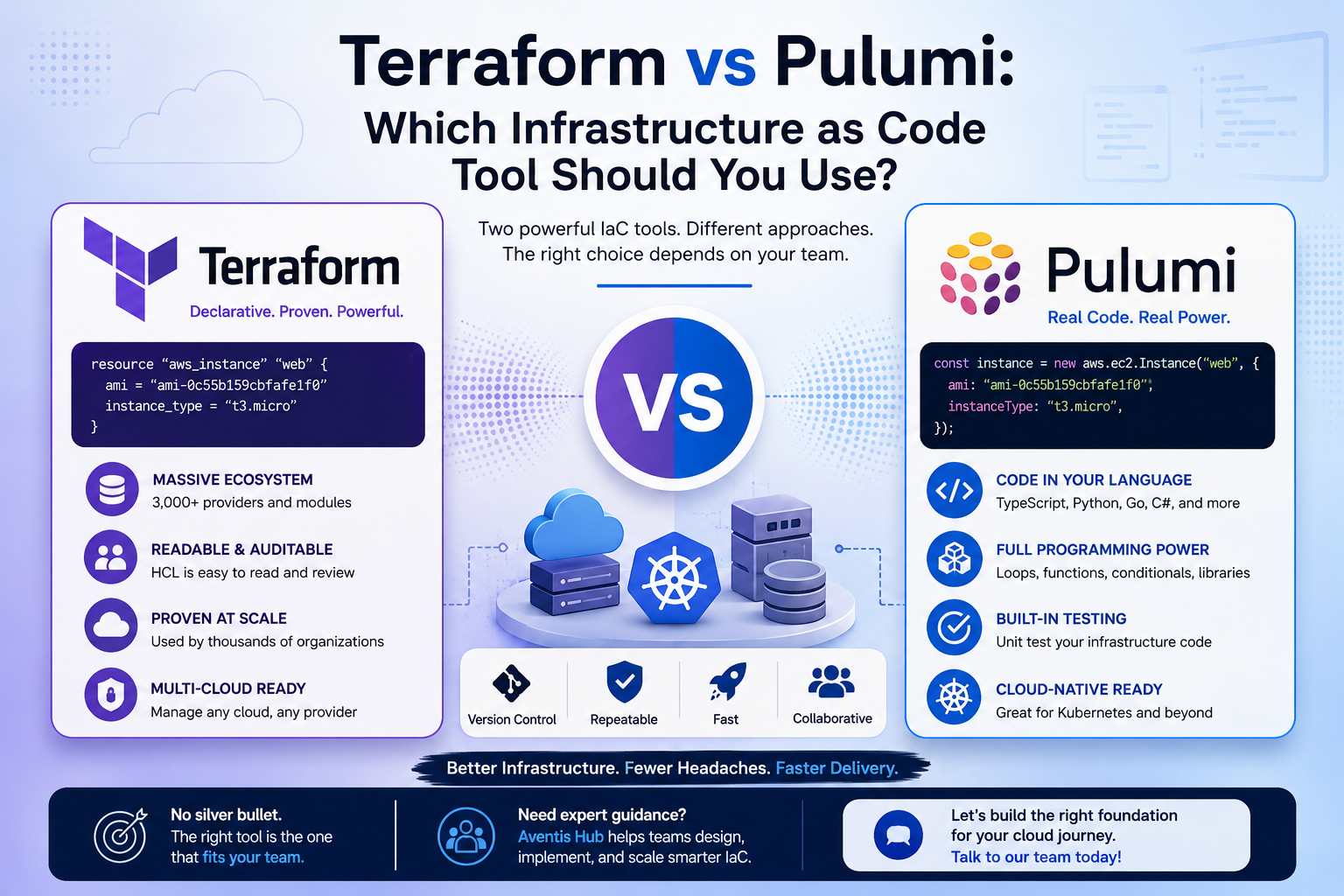
Introduction: The IaC Debate Everyone in DevOps Is Having
If you’ve spent any time in cloud infrastructure, you’ve probably heard this debate come up in Slack channels, engineering standups, and late-night Googling sessions: Terraform vs Pulumi — which one should we actually use?
Both tools promise to make infrastructure as code (IaC) easier, faster, and more reliable. Both have passionate communities behind them. And both can absolutely get the job done. But choosing the wrong one for your team can mean months of technical debt, onboarding headaches, and a whole lot of “why did we pick this again?” moments.
In this guide, we’re cutting through the noise. Whether you’re evaluating IaC tools for the first time or thinking about migrating from one to the other, this comparison will give you a clear, honest picture of what each tool does well — and where each one falls short.
Need expert help choosing and implementing the right IaC strategy for your team? Aventis Hub’s infrastructure as code services are built for teams that want to move fast without breaking things. Let’s talk.
What Is Infrastructure as Code, and Why Does It Matter?
Before we dive into the Terraform vs Pulumi comparison, let’s quickly ground ourselves. Infrastructure as code (IaC) is the practice of managing and provisioning cloud resources — servers, databases, networking, Kubernetes clusters — through machine-readable configuration files rather than manual processes or interactive tools.
Done right, IaC gives you:
- Repeatability — spin up identical environments every time
- Version control — track every infrastructure change in Git
- Speed — provision resources in minutes, not days
- Collaboration — your whole team can review and contribute to infrastructure changes
The two dominant players in this space today are HashiCorp Terraform and Pulumi. Let’s look at each one closely.
What Is Terraform?
Terraform, built by HashiCorp and first released in 2014, is the most widely adopted IaC tool in the world. It uses its own declarative configuration language called HCL (HashiCorp Configuration Language) to describe the desired state of your infrastructure.
You write .tf files that describe what resources you want — an AWS EC2 instance, a GCP Cloud SQL database, a Kubernetes cluster — and Terraform figures out how to create, update, or destroy them to match that desired state.
Terraform manages a state file that tracks what’s currently deployed, which is central to how it plans and applies changes.
Key strengths of Terraform:
- Massive provider ecosystem (over 3,000 providers on the Terraform Registry)
- Large community with tons of modules and examples
- Declarative syntax that’s easy to read and audit
- Proven at scale across thousands of organizations
- Strong support for multi-cloud deployments
Where Terraform gets tricky:
- HCL is powerful but limited — loops, conditionals, and dynamic configurations can get verbose and awkward
- Not a general-purpose programming language, so complex logic requires workarounds
- State management can become a pain point in large teams without proper backends like Terraform Cloud or S3 + DynamoDB locking
- The HashiCorp BSL license change in 2023 prompted some teams to evaluate alternatives (OpenTofu being the open-source fork)
What Is Pulumi?
Pulumi, launched in 2018, takes a fundamentally different approach. Instead of a domain-specific language, Pulumi lets you write infrastructure using real programming languages — TypeScript, Python, Go, C#, Java, and even YAML.
This means you can use loops, functions, classes, conditionals, and any package from your language’s ecosystem to build infrastructure. Your IaC code lives alongside your application code and uses the same tools — IDEs, linters, test frameworks, CI/CD pipelines.
Pulumi also manages state, and offers Pulumi Cloud as a hosted backend (with self-managed options too).
Key strengths of Pulumi:
- Write infrastructure in languages your team already knows
- Full power of real programming languages — no HCL workarounds
- Excellent for teams building reusable, testable infrastructure components
- First-class support for Kubernetes and cloud-native architectures
- Growing provider coverage, plus compatibility with Terraform providers via pulumi-terraform-bridge
Where Pulumi has friction:
- Smaller community and ecosystem compared to Terraform (for now)
- Learning curve if your team isn’t experienced in the chosen language
- Debugging can be harder when infrastructure logic is buried in complex code
- Pulumi Cloud’s free tier has limits; larger teams may need paid plans
Terraform vs Pulumi: Head-to-Head Comparison
Let’s break down the key dimensions that actually matter when you’re choosing between these two tools.
1. Language and Developer Experience
This is the biggest differentiator. Terraform uses HCL, a declarative language purpose-built for infrastructure. It’s approachable for people without a strong programming background, and it’s easy to read infrastructure definitions at a glance.
Pulumi uses real programming languages. If your team is made up of TypeScript or Python developers, writing infrastructure in a language they already know is a massive productivity win. You get autocomplete, type checking, unit testing, and the full power of modern development workflows.
Winner: Depends on your team. Ops-heavy teams often prefer Terraform HCL. Dev-heavy teams often love Pulumi.
2. Ecosystem and Provider Support
Terraform has a decade-long head start. The Terraform Registry has thousands of providers and modules covering everything from AWS and Azure to Datadog, Cloudflare, and GitHub.
Pulumi’s ecosystem is growing fast, and its Terraform bridge means you can use most Terraform providers in Pulumi today. But native Pulumi providers and the community library of reusable components are still catching up.
Winner: Terraform (for now, especially for niche providers).
3. Kubernetes and Cloud-Native Support
Both tools have strong Kubernetes support. Terraform manages Kubernetes clusters and resources, and integrates well with tools like Helm via the Helm provider.
Pulumi shines in Kubernetes environments because you can express complex, dynamic configurations in code. Pulumi’s Kubernetes operator also enables GitOps-style workflows natively.
If Kubernetes is central to your platform strategy, Pulumi’s approach often feels more natural. Pair it with strong Kubernetes consulting services to get the most out of your cluster architecture.
Winner: Pulumi (slight edge for complex Kubernetes use cases).
4. State Management
Both tools maintain a state file that represents your current infrastructure. Terraform’s state management is mature, with support for remote backends like S3, GCS, and Terraform Cloud. Managing state in large teams requires discipline — locking, workspaces, and secure storage are all things you need to get right.
Pulumi handles state similarly, with Pulumi Cloud as the default backend and support for self-managed backends (S3, Azure Blob, etc.). The experience is slightly more polished out of the box for small to mid-sized teams.
Winner: Tie. Both are mature; choose based on what fits your existing tooling.
5. Testing and CI/CD Integration
Terraform testing has improved significantly with the introduction of Terraform test framework in v1.6. Tools like Terratest also fill the gap for integration testing.
Pulumi has a built-in testing model that integrates naturally with unit testing frameworks in each supported language. This makes it easier to write meaningful tests for your infrastructure logic.
Winner: Pulumi (especially for teams that take testing seriously).
6. Community and Support
Terraform’s community is enormous. Stack Overflow, GitHub, forums, blog posts, YouTube tutorials — the volume of Terraform content is hard to beat. If you run into a problem, someone has probably already solved it.
Pulumi’s community is smaller but growing quickly, and the Pulumi team is highly active on their Community Slack and GitHub.
Winner: Terraform (for depth of community resources today).
When Should You Choose Terraform?
Go with Terraform if:
- Your team has existing Terraform expertise and a large codebase already in HCL
- You need maximum provider coverage today
- Your infrastructure team is more ops-oriented than development-oriented
- You’re working in regulated environments where readable, auditable HCL configs are a requirement
- You want the largest community behind you for troubleshooting and modules
Already using Terraform but struggling with scale or complexity? Our Terraform consulting services help teams clean up messy state, build reusable module libraries, and establish best practices that actually stick.
When Should You Choose Pulumi?
Go with Pulumi if:
- Your team is developer-heavy and already writes TypeScript, Python, or Go
- You need complex, dynamic infrastructure that would require painful workarounds in HCL
- Kubernetes and cloud-native architectures are your primary deployment target
- You want to write unit and integration tests for your infrastructure code
- You’re starting fresh and want modern developer tooling from day one
Evaluating Pulumi for a new cloud-native project? Aventis Hub’s cloud DevOps services can help you architect and implement a Pulumi-based IaC strategy that scales with your team.
Can You Use Both? (Yes, and Here’s Why Some Teams Do)
Some organizations actually run both Terraform and Pulumi in different contexts. Terraform might handle foundational cloud infrastructure (VPCs, IAM, networking), while Pulumi handles application-level Kubernetes resources and dynamic configurations.
This isn’t ideal long-term, but it’s a practical reality for many teams that have Terraform roots and are incrementally adopting Pulumi. Tools like Pulumi’s Terraform state migration make this transition easier.
The Bottom Line: Terraform vs Pulumi
There’s no universally “better” tool here — the right choice depends on your team’s skill set, your infrastructure complexity, and your long-term roadmap.
Choose Terraform if you value a proven ecosystem, a massive community, and a readable declarative language that your ops team can audit and understand without a Python degree.
Choose Pulumi if your developers want to work in familiar languages, you need real programming constructs for complex infrastructure, and testing and software engineering best practices matter deeply to your team.
Either way, the most important factor isn’t the tool — it’s how well it’s implemented. Poorly structured Terraform is just as painful as poorly structured Pulumi. What matters is having a consistent, well-documented, version-controlled IaC strategy.
Ready to Build a Smarter IaC Strategy?
Whether you’re starting fresh, migrating between tools, or just trying to clean up years of infrastructure technical debt, the right guidance makes all the difference.
Aventis Hub specializes in infrastructure as code services, Terraform consulting, Kubernetes consulting, and cloud DevOps services — for teams that are serious about building infrastructure that scales.
👉 Talk to our team today and let’s figure out the right IaC approach for your organization.
Further reading: