
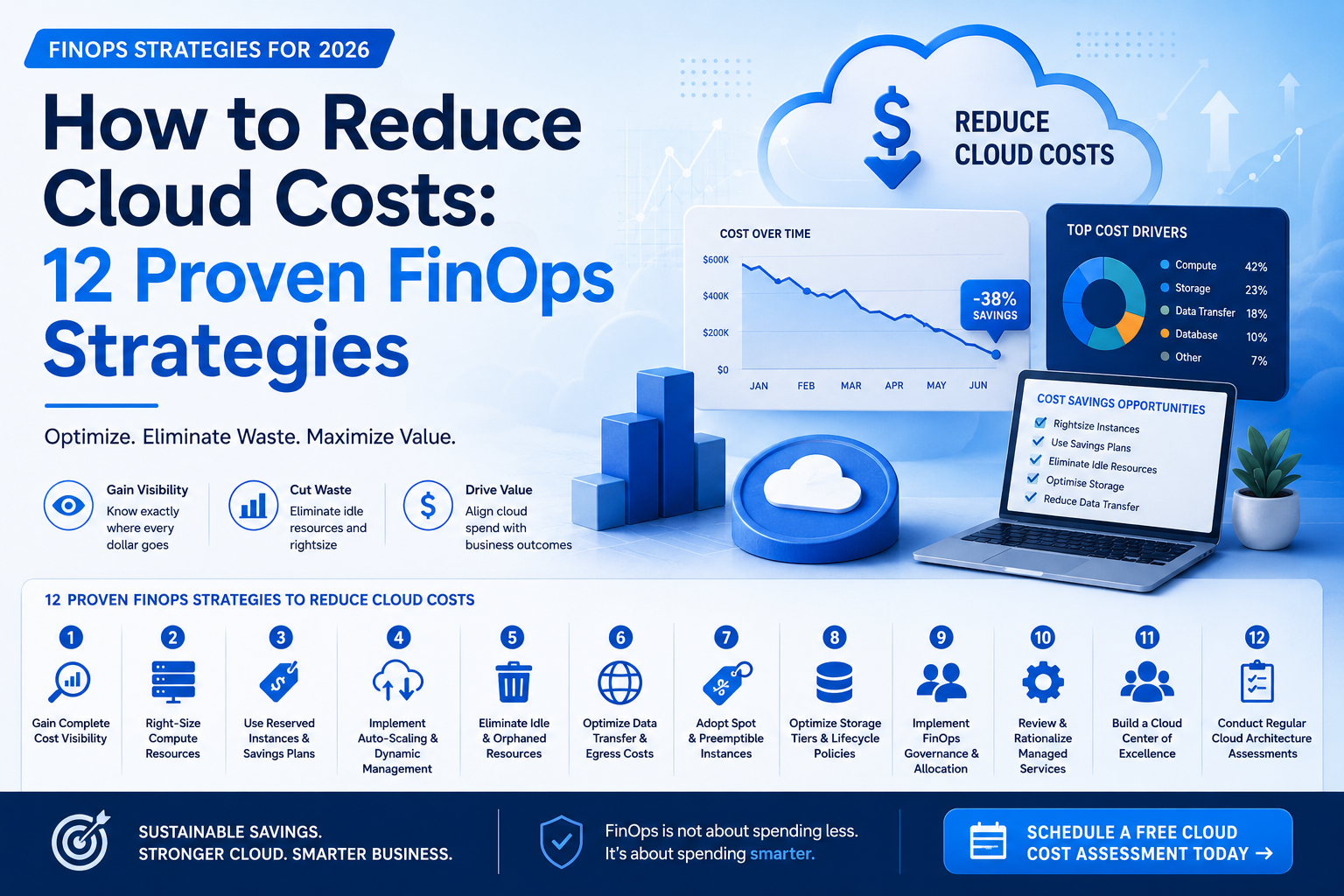
Cloud infrastructure is one of the fastest-growing line items in any technology budget. For many companies, cloud spend doubles every 18 to 24 months — often without a corresponding doubling of value. If your team is asking how to reduce cloud costs without compromising reliability or engineering velocity, you’re in the right place.
This guide walks through 12 battle-tested FinOps strategies that engineering leaders and finance teams can implement today. Whether you’re running a lean startup or managing cloud spend across a large enterprise, these techniques will help you identify waste, optimize usage, and build the financial discipline your cloud program needs.
Why Cloud Costs Spiral Out of Control
Before diving into how to reduce cloud costs, it helps to understand why they grow so fast in the first place. The answer is rarely malicious waste — it’s structural.
Cloud infrastructure is designed to be frictionless to provision. Spinning up a new database, compute cluster, or data pipeline takes minutes. But that same frictionless provisioning often means resources are created without clear ownership, sunset plans, or cost accountability.
Common culprits behind runaway cloud bills include:
- Over-provisioned compute instances sized for peak traffic that never arrives
- Idle or orphaned resources — snapshots, load balancers, and databases no one uses
- Data transfer and egress charges that accumulate invisibly
- Redundant tooling across teams without centralized visibility
- Missing reserved capacity agreements, defaulting to expensive on-demand pricing
The good news: each of these problems has a concrete solution. That’s exactly what FinOps consulting services are designed to address — and what the following strategies will help you execute. Explore the FinOps Foundation’s best practices
What Is FinOps? A Quick Primer
FinOps (Financial Operations) is a cloud financial management practice that brings together engineering, finance, and business teams to make data-driven decisions about cloud spending. It’s not just about cutting costs — it’s about ensuring every dollar of cloud spend delivers business value.
The FinOps Foundation defines three phases of FinOps maturity: Inform (understand your current spend), Optimize (reduce waste and right-size resources), and Operate (build continuous improvement into your engineering culture). Read the official FinOps framework
With that foundation in place, let’s get into the strategies.
12 Proven Strategies for How to Reduce Cloud Costs
1. Build Complete Cloud Cost Visibility First
You cannot manage what you cannot measure. The first step in any cloud cost optimization effort is establishing complete, real-time visibility into your cloud spend — broken down by team, service, environment, and application.
Use tagging policies to enforce cost attribution. Every cloud resource should carry tags for owner, environment (production/staging/dev), project, and cost center. Without tagging, cost data becomes an undifferentiated mass that makes optimization nearly impossible.
Tools like AWS Cost Explorer, Google Cloud’s Cost Management, Azure Cost Management, or third-party platforms like CloudHealth or Apptio Cloudability can help centralize this visibility. Compare cloud cost management tools
2. Right-Size Your Compute Resources
One of the highest-impact ways to reduce cloud costs is right-sizing — ensuring your virtual machines, container resources, and managed services are sized appropriately for actual workload requirements, not theoretical peak demand.
Most cloud providers offer native right-sizing recommendations based on utilization data. In practice, a significant share of cloud compute resources are chronically under-utilized — often running at 10–30% of their provisioned capacity.
Conduct a quarterly right-sizing review as part of your cloud cost optimization services program. Even moving from a general-purpose to a compute-optimized instance family can generate meaningful savings.
3. Use Reserved Instances and Savings Plans
On-demand pricing is the most expensive way to run cloud workloads. For any workload that runs continuously or predictably, committing to Reserved Instances (AWS), Committed Use Discounts (GCP), or Azure Reserved VM Instances can cut compute costs by 30–72% compared to on-demand rates.
The key is matching your commitment scope to your actual usage patterns. Work with your FinOps consulting services team to analyze 90 days of usage data before making reservations — over-committing to the wrong instance types can lock you into costs that don’t align with your workload trajectory.
4. Implement Auto-Scaling and Dynamic Resource Management
Static infrastructure is expensive infrastructure. If your servers are provisioned for peak load 24 hours a day but your traffic peaks for only 6 hours, you’re paying for idle capacity the other 18.
Implementing auto-scaling groups, Kubernetes Horizontal Pod Autoscalers, or serverless architectures ensures your infrastructure scales down when demand drops. Pair this with scheduled scaling — automatically powering down non-production environments nights and weekends — for immediate savings.
5. Eliminate Idle and Orphaned Resources
Every cloud account accumulates waste over time — development environments nobody uses, snapshots from decommissioned servers, load balancers attached to nothing, and IP addresses reserved but unassigned.
Run a quarterly idle resource audit. Tools like AWS Trusted Advisor, GCP Recommender, and third-party platforms like Spot.io or Densify can automate this detection. In many organizations, eliminating orphaned resources alone reduces monthly cloud bills by 15–25%.
This is one of the fastest wins in any cloud cost optimization services engagement — and it has zero performance impact.
6. Optimize Data Transfer and Egress Costs
Egress costs — the charges for moving data out of a cloud provider or between regions — are one of the most overlooked sources of cloud waste. They don’t show up prominently in cost dashboards and can grow invisibly as your application scales.
To reduce egress costs: architect services to minimize cross-region data transfer, use Content Delivery Networks (CDNs) to serve static assets at the edge, and evaluate whether your multi-cloud strategy is generating unnecessary transfer charges.
Understanding how to reduce cloud costs from egress often requires a detailed cloud architecture assessment to trace data flows and identify optimization opportunities.
7. Adopt Spot and Preemptible Instances for Fault-Tolerant Workloads
Spot Instances (AWS), Preemptible VMs (GCP), and Spot VMs (Azure) offer compute capacity at discounts of 60–90% compared to on-demand pricing. The trade-off: these instances can be reclaimed with short notice when demand for on-demand capacity increases.
This makes spot instances ideal for batch processing, CI/CD workloads, machine learning training jobs, and stateless microservices that can be designed to handle interruptions gracefully. If your engineering team hasn’t explored spot usage, this is one of the highest-leverage strategies for how to reduce cloud costs on compute-intensive workloads.
8. Optimize Storage Tiers and Data Lifecycle Policies
Not all data deserves expensive, high-performance storage. Cloud providers offer tiered storage options — from high-performance SSDs to archival tiers that cost a fraction of standard storage — designed for different access frequency patterns.
Implement lifecycle policies to automatically migrate aging data to cheaper storage tiers. For example, move S3 objects not accessed in 30 days to S3 Infrequent Access, and move objects older than 90 days to S3 Glacier. Similar policies exist across GCP and Azure.
For organizations with large data footprints, storage tiering can generate significant savings with minimal engineering effort. Read AWS S3 Intelligent-Tiering documentation
9. Implement FinOps Governance and Cloud Cost Allocation
Cost visibility is necessary but not sufficient. To sustainably reduce cloud costs, you need governance: clear ownership, budgets, and accountability at the team level.
Implement showback or chargeback models that attribute cloud costs to the teams generating them. When engineering teams see their cloud spend in context with their product metrics, cost consciousness becomes part of engineering culture rather than an afterthought.
This governance layer is a core component of mature FinOps consulting services engagements and is where the long-term ROI of cloud cost management is realized.
10. Review and Rationalize Managed Services
Managed services — databases, message queues, caching layers, analytics platforms — are convenient but often expensive. As your usage scales, it’s worth periodically asking whether the convenience premium of a managed service still makes economic sense compared to a self-managed or open-source alternative.
This isn’t a recommendation to abandon managed services — they deliver real value in reduced operational overhead. But a cloud architecture assessment of your managed service portfolio can reveal opportunities to consolidate, downsize, or replace services that no longer justify their cost.
11. Build a Cloud Center of Excellence (CCoE)
For organizations with significant cloud spend across multiple teams, establishing a Cloud Center of Excellence (CCoE) is a structural investment in how to reduce cloud costs over the long term. A CCoE is a cross-functional team (typically including engineering, finance, and security stakeholders) that sets cloud standards, monitors spend, and drives continuous optimization.
Managed cloud services providers often support CCoE functions — providing the tooling, reporting, and expert guidance that make cloud governance practical for engineering organizations that don’t want to build this capability entirely in-house.
12. Conduct Regular Cloud Architecture Assessments
Cloud technology evolves rapidly. An architecture designed 18 months ago may not take advantage of newer, more cost-effective services or pricing models available today. Regular cloud architecture assessments — ideally conducted annually with interim quarterly reviews — ensure your infrastructure design stays aligned with both your technical requirements and your cost optimization goals.
These assessments typically evaluate compute choices, data architecture, network topology, multi-cloud strategy, and alignment with FinOps best practices. They often uncover optimization opportunities that internal teams miss precisely because they’re too close to the existing architecture.
Building a FinOps Culture: The Missing Piece
Knowing how to reduce cloud costs is only half the battle. The other half is building the organizational culture and processes that make cost optimization sustainable.
The most successful cloud cost programs share a few common characteristics:
- Engineering teams have visibility into their own cloud spend — not just a finance dashboard no one reads
- Cost efficiency is a product metric, not a separate initiative — tracked alongside deployment frequency, availability, and customer satisfaction
- FinOps is iterative — monthly reviews, quarterly audits, and annual architecture assessments are built into the engineering calendar
- Cloud cost optimization is someone’s job — whether in-house or through FinOps consulting services, someone owns the process
When these elements are in place, cloud cost optimization shifts from a reactive fire drill to a proactive engineering discipline. Join the FinOps Foundation community
How Much Can You Save?
Results vary based on your starting point, but organizations that implement a comprehensive FinOps program typically see:
- 20–40% reduction in overall cloud spend in the first 90 days
- 15–30% additional savings from reserved capacity and architectural optimization over 6–12 months
- Ongoing 10–20% year-over-year improvement through continuous optimization
For a company spending $500,000 per month on cloud infrastructure, this represents potential savings of $100,000–$200,000 per month — or $1.2M–$2.4M annually. For most organizations, the ROI on cloud cost optimization services pays for itself many times over within the first quarter.
Frequently Asked Questions
How quickly can I see results from cloud cost optimization?
Many quick wins — eliminating idle resources, right-sizing obvious outliers, implementing auto-scaling — can reduce your cloud bill within the first 30 days. More structural changes like reserved capacity commitments and architecture optimization typically show full impact within 90–180 days.
What is FinOps and how is it different from just cutting cloud costs?
FinOps is a practice and cultural framework for cloud financial management. It goes beyond one-time cost cutting to establish ongoing visibility, accountability, and optimization as a continuous engineering discipline — ensuring cloud spend scales efficiently alongside your business.
Do I need a dedicated FinOps team?
Not necessarily. Small and mid-sized organizations often start with a fractional FinOps function — a combination of internal ownership and external FinOps consulting services — before building a dedicated internal team. The right model depends on your organization’s size, cloud spend, and engineering capacity.Which cloud provider is cheapest? There’s no universal answer — the “cheapest” provider depends heavily on your specific workloads, data volumes, geographic requirements, and existing technology commitments. A cloud architecture assessment can help you evaluate the true total cost of ownership across providers for your specific use case.