
Introduction
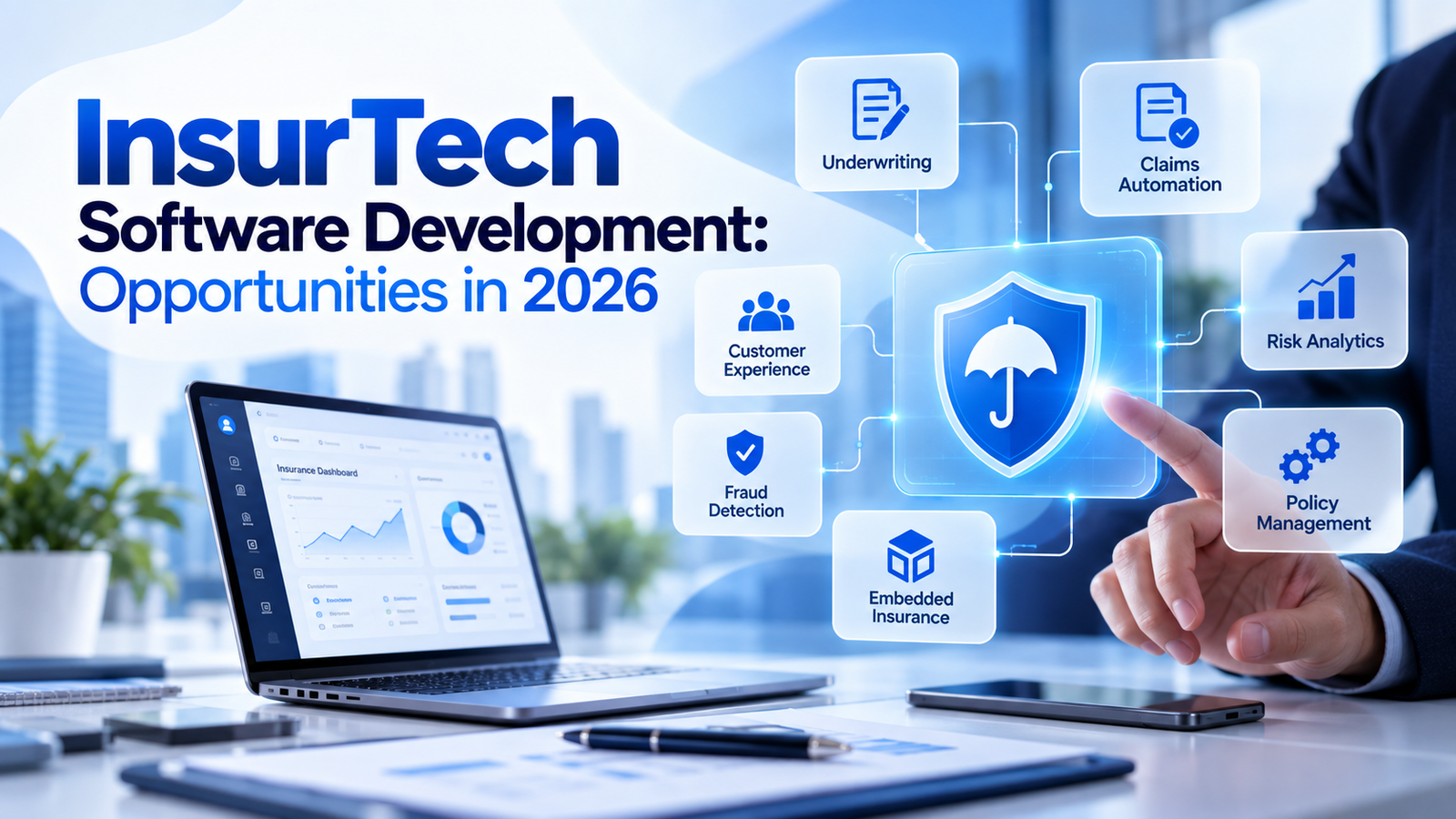
Insurance is one of the industries where software can change the economics of an entire operating model. Underwriting, claims, distribution, customer service, policy administration, fraud detection, compliance, and risk management all depend on large amounts of structured and unstructured information. As insurers modernize legacy systems and customers expect faster digital experiences, the demand for InsurTech software development is creating opportunities for carriers, brokers, MGAs, insurtech startups, and technology providers.
The opportunity in 2026 is not simply to put insurance forms online. The strongest products connect data, automation, analytics, artificial intelligence, and human decision-making into workflows that reduce friction without compromising accuracy or regulatory accountability. This guide explores where the most practical opportunities exist, what features modern insurance platforms need, how AI can be used responsibly, and what organizations should consider before starting an insurance software development project.
What Is InsurTech Software Development?
InsurTech software development refers to building digital products and systems that improve insurance processes through software, data, automation, artificial intelligence, APIs, cloud infrastructure, and digital customer experiences. Products can be designed for insurers, brokers, agents, MGAs, reinsurers, employers, or policyholders.
Because many insurance organizations have complex workflows and legacy dependencies, custom software development can be valuable when off-the-shelf systems cannot support a differentiated process or required integration.
Why 2026 Is an Important Year for InsurTech
Insurance organizations are under pressure from several directions at once: customers want faster service, operational teams want automation, regulators expect responsible use of technology, and data volumes continue to grow. AI is becoming more accessible, while APIs and cloud services make it easier to connect specialized systems. This creates room for products that solve specific parts of the insurance value chain instead of attempting to replace every core system at once.
The National Association of Insurance Commissioners notes that AI is already being used across underwriting, pricing, customer service, claims handling, marketing, and fraud detection. Its AI guidance and insurance technology resources also highlight governance, fairness, accountability, data, and model risk as important considerations.
1. AI-Powered Underwriting
Underwriting is one of the clearest areas for AI-enabled innovation. Modern platforms can collect information from applications, documents, databases, third-party sources, and historical records; normalize the data; identify missing information; and surface risk indicators for underwriters. The goal should not be to remove professional judgment automatically. Instead, software can reduce repetitive analysis and help underwriters focus on exceptions and complex cases.
- Automated application intake and document extraction.
- Risk scoring and prioritization.
- Data enrichment from approved external sources.
- Rules engines for straightforward eligibility decisions.
- Explainable recommendations and evidence trails.
- Human review queues for high-risk or ambiguous cases.
2. Claims Automation
Claims operations contain many repetitive steps that are suitable for workflow automation. A modern claims platform can capture first notice of loss, validate required information, classify documents, route cases, trigger tasks, and surface potential fraud indicators. Computer vision can support image-based assessment in some insurance lines, while language models can help summarize correspondence and documents for adjusters.
The strongest claims automation products are designed around human oversight. A model recommendation should be traceable, reviewable, and reversible when the evidence does not support an automated outcome.
3. Fraud Detection and Risk Analytics
Insurance fraud can involve unusual relationships, inconsistent documents, suspicious claims patterns, repeated identities, or coordinated activity across accounts. Analytics platforms can combine rules, anomaly detection, graph relationships, and machine learning to prioritize cases for investigation. This is an area where data quality and model governance are as important as algorithm selection.
4. Digital Customer and Policyholder Platforms
Customers increasingly expect insurance to work like other digital services. A policyholder portal or mobile application can support quotes, applications, policy documents, payments, claims updates, messaging, renewals, and self-service changes. A clean digital front end can also reduce call-center demand when it is connected properly to the underlying policy and claims systems.
5. Broker and Agent Platforms
Brokers and agents often work across multiple carriers, products, customer records, documents, renewals, and communications. A centralized workspace can reduce context switching by bringing customer information, policy comparisons, tasks, documents, and communication history into one interface.
6. Embedded Insurance
Embedded insurance places relevant coverage inside another customer journey, such as travel, payments, mobility, ecommerce, property, or financial services. API-first architecture is particularly important here because the insurance product has to fit into another company’s checkout or customer experience. Quote generation, eligibility, policy creation, payment, and claims status may all need to be exposed through secure APIs.
7. Insurance Data and Analytics Platforms
Insurance organizations can benefit from centralized analytics that combine policy, claims, customer, distribution, and risk data. A well-designed data platform can support operational dashboards, portfolio analysis, retention insights, pricing research, fraud investigation, and management reporting.
When building data-heavy systems, AI and machine learning solutions and scalable application architecture can be combined with appropriate governance to support analytics without creating a disconnected reporting environment.
Responsible AI Is a Product Requirement
Insurance is a high-impact domain, so AI cannot be treated as an ordinary recommendation engine. The NAIC Model Bulletin adopted in December 2023 reminds insurers that decisions or actions impacting consumers and supported by AI must comply with applicable insurance laws and regulations. It also sets expectations around governance and information regulators may request.
The NAIC Model Bulletin on AI by insurers is a useful reference when designing AI-enabled insurance workflows.
- Document the intended purpose and boundaries of each model.
- Maintain data lineage and understand the sources used for model inputs.
- Test for accuracy, robustness, bias, and inappropriate outcomes.
- Keep human review for decisions that require professional judgment or regulatory oversight.
- Monitor models after deployment rather than treating validation as a one-time activity.
- Maintain logs and evidence that can support internal reviews and regulatory inquiries.
Technical Architecture for Modern InsurTech
A modern insurance platform often combines a web or mobile application, API gateway, authentication service, business services, rules engine, data layer, document storage, workflow engine, analytics, notification services, and integrations with external systems. The architecture should be modular enough to replace individual components without rebuilding the entire platform.
Aventis Hub’s comparison of microservices and monolithic architecture can help teams evaluate whether distributed services are justified by scale and organizational needs.
For infrastructure planning, the serverless versus containers guide provides a practical framework for choosing between deployment models.
APIs and Integrations Matter More Than the UI
Insurance platforms rarely operate in isolation. Common integrations include payment providers, identity verification, credit or risk data, CRM systems, accounting platforms, document services, communication providers, fraud databases, policy administration systems, claims platforms, and regulatory reporting systems. An API-first strategy makes it easier to add or replace partners as the business evolves.
Security and Compliance Considerations
Insurance software handles personal, financial, and often sensitive information. Security architecture should therefore include strong identity management, least-privilege access, encryption, audit logging, secure APIs, secrets management, vulnerability management, backups, monitoring, incident response, and third-party risk controls. Depending on the markets and product, organizations may also need to account for privacy, financial regulation, data residency, and sector-specific requirements.
How Much Does InsurTech Software Development Cost?
InsurTech budgets vary widely because the complexity of a quote-and-bind experience is very different from the complexity of a core policy administration platform. A useful budget should separate the product into discovery, design, engineering, integrations, security, testing, deployment, and ongoing support.
- Simple customer portal or workflow application: lower complexity and faster validation.
- AI-assisted underwriting or claims MVP: higher data and model-development requirements.
- Broker or agent platform: significant integration and workflow complexity.
- Embedded insurance platform: API, partner, billing, and reliability requirements.
- Enterprise insurance platform: extensive integrations, migration, governance, security, testing, and operational requirements.
For a detailed budgeting framework, review How Much Does Custom Software Development Cost in 2026?.
A Practical InsurTech Development Roadmap
- Choose one measurable insurance workflow to improve.
- Map the existing process, data sources, users, decisions, and regulatory constraints.
- Define an MVP around the highest-value workflow rather than attempting to rebuild the entire insurance stack.
- Design the API and data model before connecting multiple third-party systems.
- Prototype AI features with representative data and measurable evaluation criteria.
- Build security, auditability, and governance into the architecture.
- Test with real operational users and edge cases.
- Launch in a controlled market or product line and measure outcomes.
- Expand into adjacent workflows only after the first system proves value.
What Insurance Companies Should Avoid
- Using AI simply because competitors are talking about AI.
- Automating high-impact decisions without appropriate review and governance.
- Ignoring data quality while focusing on model sophistication.
- Building a closed platform that cannot integrate with existing systems.
- Treating cybersecurity as an infrastructure-only concern.
- Trying to replace every legacy system in one project.
- Measuring success only by features shipped instead of loss ratio impact, processing time, conversion, retention, or operational efficiency.
Conclusion
InsurTech software development in 2026 is less about creating another generic insurance app and more about solving specific operational and customer problems with better technology. AI-enabled underwriting, claims automation, fraud analytics, digital policyholder experiences, broker platforms, embedded insurance, and data products all offer opportunities. The organizations most likely to succeed will combine automation with human oversight, API-first integration with strong security, and innovation with measurable business outcomes.
Aventis Hub works with organizations that need custom software development, AI-enabled applications, scalable web platforms, and cloud-ready systems. The right starting point is a focused workflow, a clear business metric, and an architecture that can grow with the product.
Frequently Asked Questions
What is InsurTech software development?
It is the development of digital products and platforms that improve insurance processes using software, APIs, automation, data analytics, cloud infrastructure, and AI.
How is AI used in insurance?
Common applications include underwriting, pricing support, claims processing, customer service, fraud detection, document analysis, and workflow automation. Use cases should include appropriate governance and human oversight.
What is embedded insurance?
Embedded insurance integrates a relevant insurance product into another company’s customer journey, often through APIs, so coverage can be offered during a purchase or service interaction.
Why are APIs important in InsurTech?
Insurance organizations rely on many internal and external systems. APIs provide controlled ways to exchange data and services without forcing every component into one application.
How should an insurer start an AI project?
Start with a narrow use case, define the business outcome, assess data quality, establish governance and evaluation criteria, test with representative data, and keep human oversight where decisions have significant consumer impact.