
Here’s a number that stops most founders cold: a senior developer in San Francisco can cost you four to five times what an equally skilled engineer costs in Krakow or Bangalore.
Same skill set. Same output. Wildly different invoice.
So naturally, the instinct is to chase the lowest number on the page. Then the fear kicks in — what if cheap means broken, late, and unmaintainable?
That fear isn’t irrational. But it’s also not the right question. Understanding software development cost by country isn’t really about finding the lowest hourly rate. It’s a math problem where the hourly rate is only half the equation, and the other half is everything that rate doesn’t tell you.
Let’s break down what actually drives the numbers, region by region, and how to use them without getting burned.
The Regional Math: Understanding Nearshore vs. Offshore Software Development
Think of global hiring like ordering dinner in two different cities. You can get a phenomenal five-star meal in Manhattan, or equally incredible street food in Bangkok. Both will feed you well. The overhead, the local economy, and what you’re actually paying for are completely different animals.
Nearshore software development is the Manhattan-adjacent option — maybe not quite as pricey, but close enough geographically that you’re eating dinner at the same hour. US-based companies tend to lean toward Latin America when they go the nearshore route. European companies nearshore to Eastern Europe or North Africa. The overlap in working hours means a Slack message at 2pm gets answered at 2:05, not tomorrow morning.
Offshore software development trades that overlap for raw savings and scale. You’re tapping into massive talent pools in South Asia or Southeast Asia, often at a fraction of nearshore rates. But you’re also managing a 10-to-12-hour time difference, and that changes how your whole workflow has to run — standups become recorded videos, code reviews become overnight handoffs, “quick question” stops being quick.
So which one’s better? Neither, honestly. It depends what you’re actually optimizing for. If your team can’t survive without same-day answers, nearshore wins every time. If you need forty engineers by Q3 and your budget has a hard ceiling, offshore is the only real option on the table. Pick based on your project, not because a competitor mentioned some agency on LinkedIn last week.
What Engineers Actually Cost Around the World Right Now
Rates shift constantly, so treat these as directional ranges rather than gospel. Still, the pattern holds steady year over year.
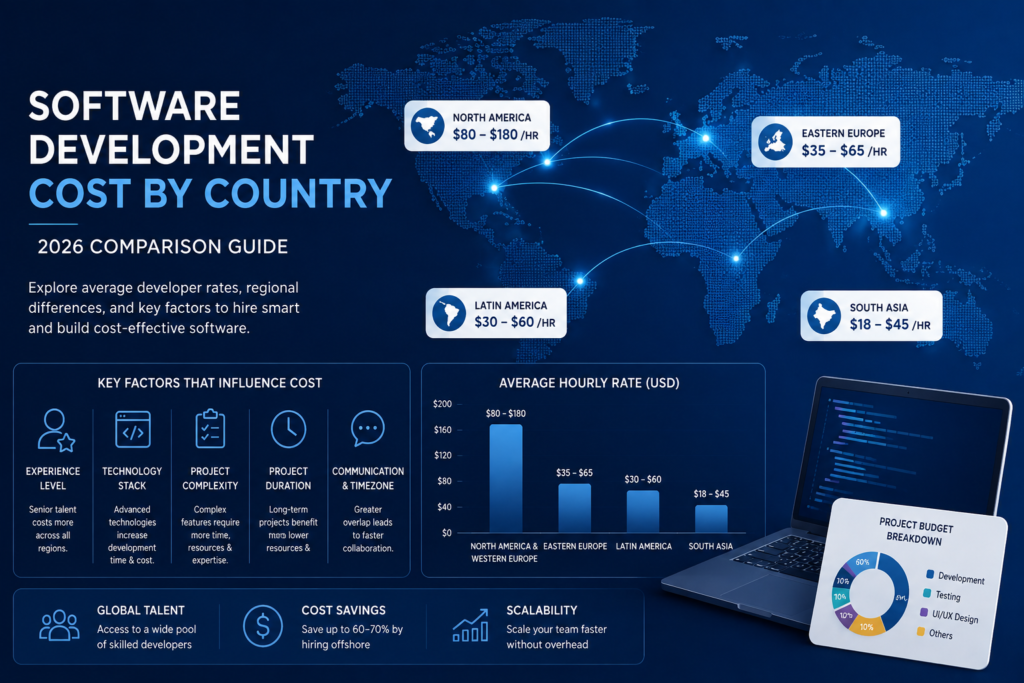
| Region | Avg. Hourly Rate (USD) | English Proficiency | US/EU Timezone Overlap | Typical Project Focus |
| North America & Western Europe | $80–$180 | Native/Excellent | Full overlap | Complex, high-stakes, regulated systems |
| Eastern Europe (Poland, Ukraine, Romania) | $35–$65 | Strong | High (EU); Moderate (US) | Enterprise software, fintech, deep engineering |
| Latin America (Brazil, Mexico, Argentina) | $30–$60 | Good to Strong | High (US) | Product development, startups, agile teams |
| South Asia (India, Pakistan) | $18–$45 | Good to Excellent | Low (requires async workflows) | Scalable teams, long-term builds, ODCs |
North America & Western Europe: Paying Top Dollar
You’re paying a premium here, and honestly, sometimes that premium is worth every cent. Highly regulated industries — healthcare, finance, defense — often need engineers who deeply understand local compliance frameworks without a translation layer in between.
But let’s be real. For a huge chunk of standard product work, this premium buys you convenience more than it buys you superior code.
Eastern Europe & Latin America (The Nearshore Sweet Spot)
This is the bracket where I’ve seen the most companies between fifty and five hundred employees actually settle, and once you look at why, it makes sense. You get strong engineering education systems, solid English, and — critically — working hours that actually align with yours.
Poland and Ukraine have produced serious enterprise-grade engineering talent for over a decade now. Brazil and Argentina have exploded as startup hubs, with product-minded developers who’ve grown up building for global markets, not just local ones.
The rates land somewhere in the middle, and honestly, that’s the whole appeal. You won’t find the rock-bottom prices you’d get in South Asia. You also won’t find yourself explaining to your board why the project went dark for three weeks.
South Asia: A Scalable Hub for Engineering Talent
Here’s something people misunderstand about choosing to outsource to India: the value was never really about rock-bottom pricing. It’s about scale.
India graduates more engineers annually than most countries have working professionals. That scale means you can build an entire dedicated team — architects, QA, DevOps, backend, frontend — without spending eighteen months on recruiting.
The trick is targeting Tier-1 tech hubs — Bangalore, Hyderabad, Pune — rather than defaulting to whichever agency has the cheapest quote in your inbox. Tier-1 cities carry a rate premium over smaller markets, sure. But you’re paying for depth of talent pool and infrastructure maturity, and that difference shows up in your delivery timeline fast.
4 Uncompromising Rules to Hire Software Developers Internationally
Rates on a spreadsheet look simple. Executing a global hiring strategy is not. I’ve watched teams with identical budgets end up in completely different places — one scaling smoothly past fifty engineers, the other quietly falling apart by month four. Here’s what separated the two, once I dug into it.
1. Calculate the “Time-Zone Tax”
Every hour of non-overlap isn’t free. It’s a hidden tax paid in delayed decisions and stalled blockers.
A question that would take five minutes to resolve in-person can eat an entire day when your teams are twelve hours apart. Multiply that across a six-month project, and suddenly your “cheap” offshore rate doesn’t look quite so cheap.
Budget for this explicitly. Build in async documentation habits and overlap windows, even short ones, before the project starts — not after the first missed deadline.
2. Filter for Deep Problem-Solving, Not Just Syntax
Most technical interviews test whether someone can reverse a linked list. Almost none test whether they can look at a messy, half-documented legacy system and figure out what’s actually broken.
When you hire software developers internationally, skip the syntax quiz, or at least don’t stop there. Hand candidates a real, slightly messy problem — something with missing requirements baked in on purpose — and just watch what they do. The ones worth hiring will stop and ask you three or four sharp questions before touching the keyboard. The ones who dive straight into code without asking anything? That’s usually a preview of how they’ll handle your actual codebase.
3. Factor in Legal, Compliance, and EOR Fees
That attractive hourly rate rarely includes the machinery required to legally employ someone in another country.
Employer of Record services, local tax compliance, benefits administration — none of it’s free, and none of it’s optional if you want to do this legally. Skip the homework here and you’ll find out the hard way, usually six months in, that your “$25/hour developer” was actually costing you closer to $34 the whole time.
4. Build a Hybrid Sourcing Strategy
The strongest setups we’ve seen rarely go all-in on one region. They pair a local or nearshore senior product manager — someone who owns vision and stakeholder communication — with a larger offshore engineering team handling execution.
It’s a strange-sounding setup on paper. In practice, it just works — you get someone making fast calls in your own time zone, backed by a much larger team executing at rates that would be impossible to find locally.
The “Total Cost of Ownership” Checklist
Everyone fixates on the hourly rate. It’s actually the smallest piece of what you’ll spend.
Management overhead. Somebody has to run the standups, coordinate across time zones, and translate “grow revenue 20%” into an actual sprint backlog. That person’s salary is part of your real cost, even though nobody ever puts it in the outsourcing pitch deck.
Communication friction. Strong English on paper doesn’t always mean zero friction in practice. Nuance gets lost. Sarcasm gets lost. Plan on extra review rounds early in the relationship, especially in the first couple of sprints.
Software licenses and tooling. Seat licenses for your PM tools, repo access, security scanning software — this stuff piles up fast, and it rarely makes it into anyone’s initial budget spreadsheet.
Onboarding time. No offshore team hits full speed in week one. Give it four to eight weeks before you start judging output.
Run these numbers before you compare regions side by side. A dirt-cheap rate buried under heavy overhead can quietly cost more than a pricier team that just runs itself.
The Real Takeaway: Chase Value, Not the Cheapest Invoice
Look, comparing software development cost by country was never meant to be a race to the bottom. What you’re really after is a region and setup that can actually deliver your project, on the timeline you’ve got, without pushing you past whatever level of risk feels sane for your situation.
A $20/hour developer who needs babysitting isn’t actually cheaper than a $45/hour developer who ships clean code on the first pass. Work out what things genuinely cost you, not just what the invoice says.
Pick your region on purpose. Build your team on purpose. The rate card was never the whole story — it was just the part that’s easiest to put in a spreadsheet.