
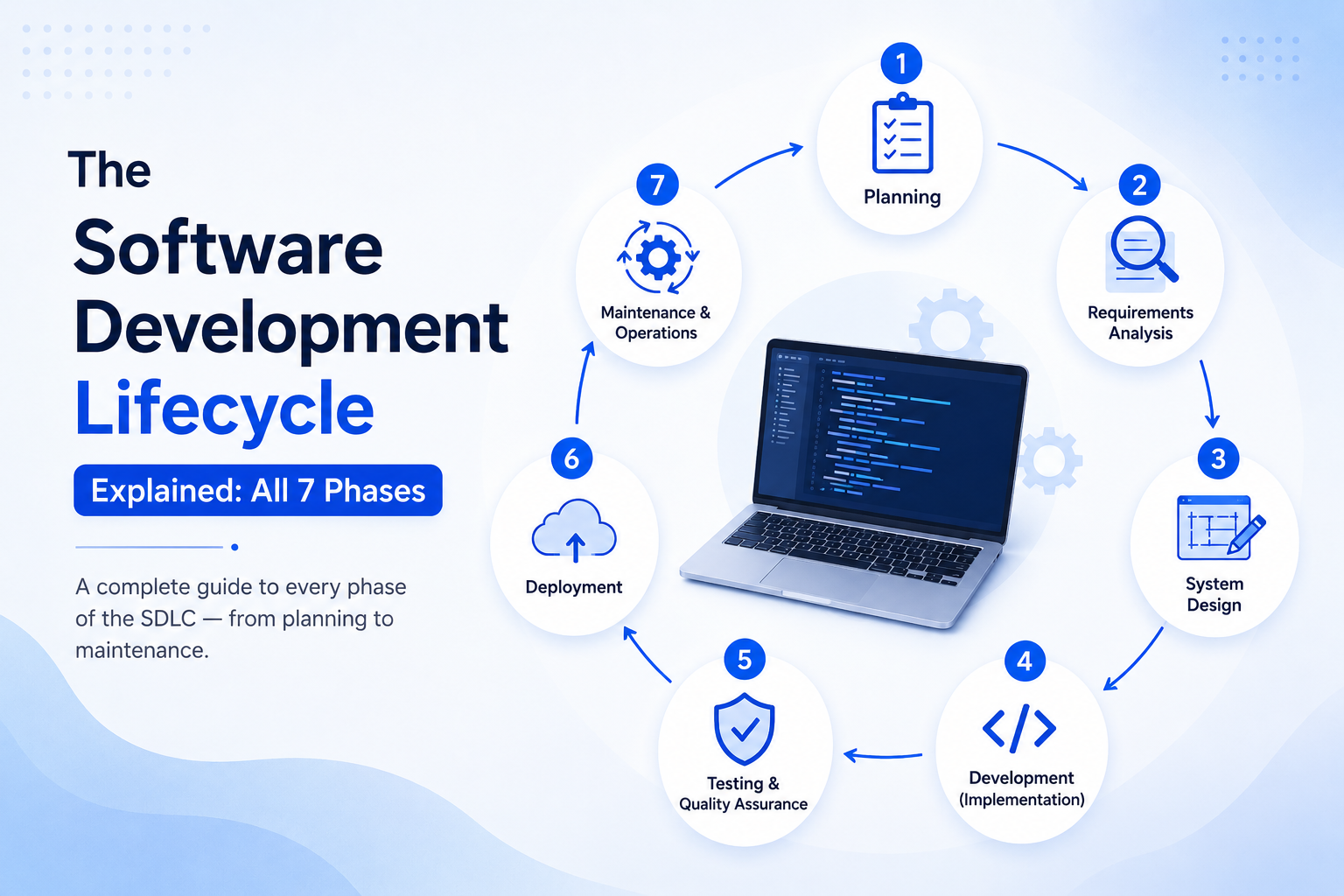
Every piece of software you interact with — the app on your phone, the platform your team uses to manage projects, the website your customers buy from — was built through some version of the same foundational process. That process is the software development lifecycle, and understanding it is one of the most valuable things a business leader, product manager, or aspiring developer can do. The software development lifecycle is not just a technical framework. It is the roadmap that determines whether a software project delivers on its promise or burns through budget and patience without producing anything usable.
This guide walks through all seven phases of the software development lifecycle in clear, practical terms — what happens at each stage, who is involved, what can go wrong, and how each phase connects to the next. Whether you are commissioning software for the first time, working with a development partner, or building an in-house team, this is the foundation you need.
| Quick definition: The software development lifecycle (SDLC) is a structured process that defines the stages of software creation from initial concept through deployment and ongoing maintenance. It provides a framework for planning, building, testing, and delivering software in a controlled, repeatable way. |
Why the Software Development Lifecycle Matters
Without a defined software development lifecycle, software projects default to chaos. Scope expands without control. Bugs are discovered in production rather than testing. Timelines drift indefinitely. According to the Standish Group CHAOS Report, only 29% of software projects are completed on time and on budget. Organizations that follow a structured software development lifecycle consistently outperform those that do not — across delivery speed, defect rates, and stakeholder satisfaction.
The software development lifecycle also provides a shared language between business stakeholders and technical teams. When everyone understands what phase a project is in, what decisions need to be made, and what comes next, communication improves dramatically and costly misunderstandings decrease.
Phase 1: Planning
The planning phase is where the software development lifecycle begins — and where the most consequential decisions are made before a single line of code is written. This phase establishes the feasibility of the project, defines its scope, identifies resources and timelines, and secures stakeholder alignment on objectives.
Key activities in the planning phase include defining the project vision and goals, conducting a feasibility study (technical, financial, and operational), identifying key stakeholders and their requirements at a high level, estimating resource requirements and budget, identifying risks and establishing a risk management plan, and producing a project plan or charter document.
The planning phase is where scope creep begins if boundaries are not established clearly. The most expensive software projects in history — government IT failures, enterprise ERP disasters — trace their problems back to inadequate planning. Engaging experienced agile software development services from the outset ensures the planning phase establishes realistic constraints rather than aspirational fiction.
Phase 2: Requirements Analysis
The requirements analysis phase translates the business goals identified in planning into specific, documented requirements that the development team can build against. This phase involves deep collaboration between business stakeholders and technical analysts to capture what the software must do (functional requirements) and how it must perform (non-functional requirements).
Functional requirements define specific behaviors and features: what happens when a user clicks a button, what data is captured in a form, what the system does when an order is placed. Non-functional requirements define qualities: the system must respond within 200 milliseconds, must support 10,000 concurrent users, must be available 99.9% of the time.
Common deliverables include a Software Requirements Specification (SRS) document, use case diagrams, user stories (in agile approaches), wireframes or prototypes, and a requirements traceability matrix. Poor requirements analysis is the single most common cause of software project failure. Investing time here — including structured reviews with actual end users — pays returns throughout every subsequent phase of the software development lifecycle.
Phase 3: System Design
The system design phase takes the requirements document and translates it into a technical blueprint for the software. This is where architects and senior engineers make decisions that will shape every aspect of how the software is built, how it performs, and how it can evolve.
System design operates at two levels. High-level design (HLD) covers the system architecture — the overall structure, technology stack, database design, integration points, and infrastructure choices. Low-level design (LLD) covers the detailed specification of individual components, modules, classes, and algorithms.
Critical design decisions made in this phase include the choice of architectural pattern (monolithic, microservices, serverless, or hybrid), the database design (relational vs. NoSQL, schema structure), API design and integration architecture, security architecture (authentication, authorization, encryption), and scalability strategy. Decisions made in the system design phase are expensive to reverse after development begins — which is why experienced software architects are so valuable in the SDLC.
Phase 4: Development (Implementation)
The development phase is where the software is actually built. Developers write code according to the specifications and architecture established in the previous phases, working within the chosen development methodology — whether that is agile sprints, waterfall iterations, or a hybrid approach.
In modern software development process approaches, development is rarely a single linear phase. Agile methodologies break development into short cycles (sprints) of two to four weeks, each producing working software that can be reviewed and tested. This iterative approach reduces the risk of building the wrong thing for months before anyone catches the error.
Key practices in the development phase include version control (Git), code review processes, coding standards and style guides, continuous integration (CI) to automatically build and test code as it is committed, documentation written alongside code, and regular communication with stakeholders through sprint reviews or progress updates.
The quality of code written in this phase directly determines the cost of every subsequent phase — particularly maintenance. Technical debt accumulated through shortcuts in development compounds over time, eventually consuming development capacity that should be building new features.
Phase 5: Testing and Quality Assurance
The testing phase systematically verifies that the software behaves as specified, performs at required levels, and is free from defects that would impact users. In a well-run software development lifecycle, testing is not purely a post-development activity — it begins in requirements analysis (reviewing requirements for testability) and continues throughout development through unit testing and CI pipelines.
| Testing Type | What It Verifies | Who Performs It |
| Unit Testing | Individual functions and components work correctly in isolation | Developers |
| Integration Testing | Components work correctly when combined | Developers / QA |
| System Testing | Complete system meets all specified requirements | QA team |
| User Acceptance Testing (UAT) | Software meets business requirements from user perspective | Business stakeholders |
| Performance Testing | System performs at required speed and scale | QA / performance engineers |
| Security Testing | System is free from known vulnerabilities | Security team / pen testers |
| Regression Testing | New changes have not broken existing functionality | QA / automated |
The cost of fixing a defect increases dramatically at each stage of the software development lifecycle. IBM Systems Sciences Institute research found that a defect caught in production costs 100 times more to fix than one caught during the design phase. Robust testing is not a cost center — it is a cost reduction strategy.
Phase 6: Deployment
The deployment phase moves the tested, approved software from the development environment into production where real users can access it. This phase requires careful planning to minimize disruption, ensure rollback capability if problems emerge, and validate that the production environment behaves as expected.
Modern deployment strategies have evolved significantly with the adoption of DevOps practices. Continuous deployment (CD) pipelines automate the release process, reducing the risk of manual errors and enabling organizations to deploy multiple times per day if needed. Common deployment strategies include blue-green deployments (switching traffic between two identical environments), canary releases (rolling out to a small percentage of users first), and feature flags (deploying code that is switched on or off without a new deployment).
The deployment phase also includes user training, documentation publication, and communication to affected stakeholders. A technically successful deployment that users are unprepared for is still a failed deployment from a business perspective.
Phase 7: Maintenance and Operations
The maintenance phase is the longest phase of the software development lifecycle — it begins the moment software enters production and continues for the entire operational life of the system. This phase encompasses corrective maintenance (fixing bugs reported by users), adaptive maintenance (updating software to accommodate environmental changes like OS upgrades or API deprecations), perfective maintenance (improving performance, usability, or functionality), and preventive maintenance (refactoring code and updating dependencies to prevent future problems).
Many businesses significantly underestimate the resource requirement of maintenance. Industry benchmarks suggest that maintenance typically consumes 60-80% of the total lifetime cost of a software system. Building maintainability into the earlier phases of the software development lifecycle — through clean code, comprehensive documentation, automated tests, and modular architecture — directly reduces this ongoing cost.
SDLC Models: Which One Is Right for Your Project?
The software development lifecycle is a framework, not a fixed script. Multiple SDLC models exist, each suited to different project types, risk profiles, and business contexts:
| SDLC Model | Best For | Key Characteristic |
| Waterfall | Fixed-scope projects with clear requirements | Sequential phases, no iteration |
| Agile (Scrum/Kanban) | Evolving requirements, fast delivery | Iterative sprints, continuous feedback |
| V-Model | Safety-critical systems (medical, aerospace) | Testing paired with each development phase |
| Spiral | High-risk, large projects | Iterative with risk analysis at each cycle |
| DevOps | Continuous delivery environments | Development and operations integrated |
| RAD (Rapid Application Development) | Prototype-driven projects | Fast iteration, heavy user involvement |
Frequently Asked Questions
What is the most important phase of the software development lifecycle?
Every phase matters, but requirements analysis is where most project failures are seeded. Research consistently shows that poorly defined requirements account for the majority of software project failures and cost overruns. Investing disproportionately in requirements quality — including structured reviews, prototypes, and user validation — pays the highest return of any SDLC investment.
How does agile change the traditional software development lifecycle?
Agile does not eliminate the SDLC phases — it distributes them across short, repeating cycles called sprints. Each sprint contains mini-versions of planning, requirements, design, development, testing, and review. This approach enables continuous delivery of working software, faster feedback, and better adaptation to changing requirements compared to traditional sequential SDLC models.
How long does the software development lifecycle take?
Duration varies enormously by project scope and methodology. A simple web application built with agile methods might complete its first release in 8-12 weeks. An enterprise platform might run through multiple SDLC cycles over two to three years before reaching full maturity. The software development lifecycle for maintenance and operations continues indefinitely for as long as the software is in use.
| Need a Development Partner Who Knows the SDLC Inside Out?Our software development team delivers structured, transparent development across every phase of the SDLC — from requirements definition and architecture to deployment and long-term maintenance. Whether you are building a new product or modernizing a legacy system, we bring the process discipline to make it succeed.Contact us today to get started -> |