
Introduction
Real estate has always been data-rich, but much of the industry has historically relied on fragmented systems, spreadsheets, disconnected listing tools, manual communication, and workflows that depend heavily on individual professionals. Real estate software development is changing that model. Property search, lead management, transactions, property management, valuation, marketing, building operations, and customer service can now be connected through APIs, cloud platforms, AI, automation, mobile applications, and IoT.
This transformation is commonly described as PropTech, but the opportunity is broader than a single category of applications. A brokerage may need a better CRM and transaction platform. A property manager may need automation and tenant communication. A developer may need analytics and smart-building capabilities. A real estate marketplace may need high-performance search and standardized property data. The technology strategy should begin with the business workflow and then select the right capabilities.
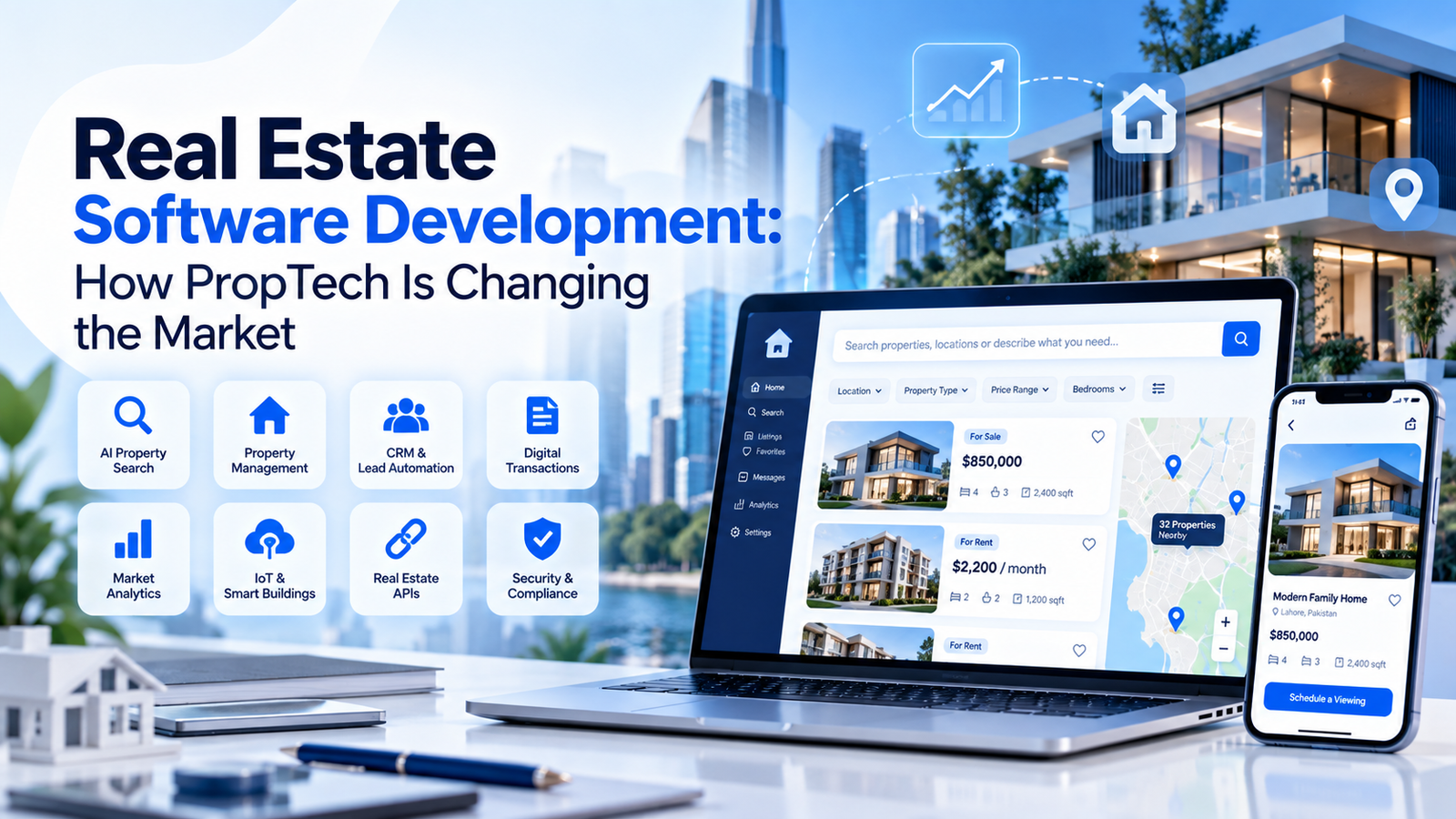
Real Estate Software Development: Core PropTech Features
Real estate software development involves building digital systems for property-related businesses and users. These systems can include listing marketplaces, property management platforms, CRM applications, transaction management tools, valuation systems, tenant portals, booking and viewing platforms, investment analytics, construction tools, smart-building platforms, and AI-powered search or recommendation engines.
A custom approach can be especially useful when a company’s workflow is a competitive differentiator. Aventis Hub explains the benefits of custom software for growing businesses and why unique processes may justify building rather than buying.
Why PropTech Is Accelerating
Technology adoption in real estate is becoming more practical. The National Association of REALTORS’ 2026 Technology Report found that agents primarily want technology to save time and improve the client experience. Recent NAR coverage also shows AI moving into workflows such as content creation, business analysis, listing experiences, and day-to-day productivity.
See the NAR 2026 technology findings for current industry context.
1. AI-Powered Property Search
Traditional property search relies heavily on filters such as price, location, bedrooms, and property type. AI can make search more conversational and contextual. Instead of selecting dozens of fields, a buyer could describe what they want in natural language, such as a quiet home near public transport with outdoor space and a short commute. The system can interpret the request, retrieve relevant properties, and explain why each result matches.
AI can also support listing summarization, question answering, lead qualification, personalized recommendations, and automated follow-up. The important design principle is that the system should ground its responses in current property data instead of generating unsupported claims.
2. Real Estate CRM and Lead Automation
Lead management is one of the most obvious areas for automation. A modern real estate CRM can capture leads from websites, portals, advertising campaigns, referrals, and social channels; assign them to agents; score or categorize them; schedule follow-ups; and provide visibility into the pipeline. AI can assist with message drafting, lead summarization, next-best-action suggestions, and prioritization.
Teams considering AI features can also review Aventis Hub’s step-by-step guide to building AI-powered applications for a broader development framework.
3. Digital Transaction Management
Property transactions involve documents, approvals, signatures, deadlines, inspections, communications, and multiple parties. Digital transaction platforms can centralize these activities and reduce the amount of manual coordination required. Useful capabilities include document generation, electronic signatures, workflow tracking, deadline reminders, secure file sharing, role-based access, and audit history.
4. Property Management Software
Property managers can benefit from centralized platforms for tenant onboarding, lease management, rent collection, maintenance requests, inspections, communications, vendor coordination, and reporting. Automation can route maintenance requests, send reminders, detect overdue tasks, and keep tenants informed without requiring staff to manually update every stakeholder.
5. IoT and Smart Buildings
IoT expands PropTech beyond software screens. Connected devices can provide data about temperature, occupancy, energy consumption, access, equipment status, water usage, and other building conditions. Property operators can use this data to identify anomalies, automate building processes, improve maintenance planning, and potentially reduce operating costs.
An IoT-enabled real estate platform should be designed with device identity, secure communication, data ingestion, storage, alerting, access controls, and lifecycle management in mind. Connecting devices without a plan for data governance can create a large operational burden rather than a useful platform.
6. Real Estate Analytics and Investment Platforms
Investors and operators increasingly need faster access to portfolio-level information. Analytics platforms can combine property data, financial information, occupancy, rent, market indicators, maintenance costs, and operational metrics. A well-designed dashboard can help users identify underperforming assets, compare properties, monitor portfolio trends, and test scenarios.
7. MLS and Property Data Integration
Property data integration is one of the technical foundations of modern real estate applications. The Real Estate Standards Organization, or RESO, provides standards for data structure and transport. Its Web API is designed to provide a modern, standardized way for real estate systems to exchange information.
The RESO Web API documentation explains how modern REST-based data exchange supports faster and more consistent technology integrations.
RESO also maintains a Data Dictionary that standardizes many property-related fields while allowing appropriate local extensions.
8. Virtual Tours and Digital Viewing Experiences
Virtual tours, interactive floor plans, video, 3D environments, and high-quality listing media can help buyers explore properties remotely. These experiences are particularly useful for relocation, international buyers, rental searches, and early-stage property discovery. The platform should optimize media delivery carefully because high-resolution assets can increase bandwidth and storage costs.
9. Predictive Analytics and Property Intelligence
Machine learning can support property valuation, lead scoring, demand forecasting, maintenance prediction, and market analysis. However, predictive models are only as useful as the data and assumptions behind them. Models should be evaluated continuously, and business users should understand what information influences important recommendations.
Security and Privacy in PropTech
A well-planned real estate software development strategy should connect this capability to the wider business workflow rather than treating it as an isolated feature.
Real estate systems can contain personal information, financial information, identification documents, payment details, property access information, and sensitive transaction records. Security therefore needs to be built into the platform rather than added after launch.
From an architecture perspective, real estate software development should make integrations, permissions, data quality, and future expansion part of the design from the beginning.
- Use role-based access so buyers, tenants, agents, brokers, property managers, owners, and administrators see only what they need.
- Encrypt sensitive data in transit and at rest.
- Protect APIs with strong authentication, authorization, rate limiting, and input validation.
- Maintain audit logs for important actions such as document access, permissions, approvals, and financial events.
- Secure file uploads and scan documents for malicious content.
- Use monitoring and alerting to identify suspicious activity.
- Maintain tested backups and recovery procedures.
- Assess the privacy and security obligations of every third-party integration.
For organizations comparing vendors, real estate software development should be evaluated against measurable outcomes such as efficiency, user adoption, reliability, security, and total operating cost.
How Much Does Real Estate Software Development Cost?
Successful real estate software development projects also require testing, monitoring, documentation, and a clear plan for post-launch improvement.
Real estate software costs depend on whether the product is a focused internal tool, a customer-facing marketplace, an enterprise property platform, or an IoT-enabled ecosystem. The biggest cost drivers are feature scope, integrations, mobile applications, data complexity, AI requirements, security, media processing, and scale.
The long-term value of real estate software development comes from creating a platform that can evolve as users, regulations, integrations, and business requirements change.
- Basic MVP: authentication, property records, search, profiles, leads, and an administrative dashboard.
- Marketplace platform: advanced search, listings, media, agent tools, messaging, payments, moderation, and high-performance infrastructure.
- Property management platform: tenants, leases, payments, maintenance, documents, vendors, and reporting.
- AI-powered PropTech: data pipelines, model evaluation, inference infrastructure, monitoring, and human review workflows.
- IoT platform: device connectivity, real-time ingestion, alerts, dashboards, security, and device lifecycle management.
For a broader 2026 software budget framework, see Aventis Hub’s custom software development cost guide.
A Practical Real Estate Software Development Roadmap
- Define the business problem. Choose one workflow where better software can produce a measurable outcome.
- Map users and data. Identify buyers, sellers, agents, managers, investors, administrators, external systems, and data ownership.
- Select the MVP. Avoid building every possible PropTech feature at once.
- Plan integrations. Identify MLS, payment, identity, CRM, accounting, mapping, communication, and other dependencies early.
- Design the data model. Property, listing, person, organization, transaction, document, and event relationships should be clear.
- Build secure workflows. Treat identity, permissions, audit logs, and document handling as core features.
- Validate with real users. Agents and property managers often know which manual steps consume the most time.
- Launch incrementally. Monitor adoption, search quality, lead conversion, transaction completion, support volume, and system performance.
- Expand intelligently. Add AI, IoT, advanced analytics, and automation when they solve validated problems.
Common PropTech Development Mistakes
- Building an attractive property marketplace without solving data freshness and integration problems.
- Adding AI without defining the decision or workflow the AI is supposed to improve.
- Ignoring the operational needs of agents and property managers.
- Underestimating media, search, mapping, and data infrastructure costs.
- Treating MLS or property data access as a simple plug-and-play integration.
- Giving broad access to documents or personal information.
- Trying to launch marketplace, CRM, property management, IoT, and AI features simultaneously.
- Failing to measure whether the software saves time or improves conversion.
Where PropTech Is Heading Next
The next phase of PropTech is likely to be more connected rather than simply more digital. AI assistants can help professionals handle repetitive research and communication. Property data can become more interoperable through standards and APIs. IoT can make buildings more observable. Transaction workflows can become increasingly digital. And customers can receive more personalized property experiences without requiring an agent to manually perform every step.
Recent NAR coverage shows AI moving toward more contextual, workflow-oriented assistance in real estate, while RESO standards continue to provide a foundation for structured property data exchange.
Conclusion
Real estate software development is becoming a strategic capability for organizations that want to improve customer experience, reduce operational work, and make better decisions from property data. The most valuable PropTech products will not necessarily be the ones with the most AI or the most features. They will be the products that connect accurate data, reliable workflows, intuitive interfaces, automation, and measurable business outcomes.
Whether you are building a property marketplace, management platform, CRM, analytics product, or AI-enabled PropTech solution, Aventis Hub can help translate the business workflow into scalable web applications, AI systems, cloud infrastructure, and custom software.
Frequently Asked Questions
What is PropTech software development?
PropTech software development means building technology products that improve real estate workflows such as property search, transactions, property management, investment analysis, customer engagement, and building operations.
How is AI used in real estate software?
AI can support natural-language property search, recommendations, lead scoring, listing content, document summarization, analytics, maintenance prediction, and workflow automation. High-impact recommendations should remain reviewable and grounded in reliable data.
What is the role of IoT in PropTech?
IoT connects physical building devices to software so operators can collect data, detect conditions, automate processes, and improve maintenance or building efficiency.
What is the RESO Web API?
It is a standardized, modern method for exchanging real estate data using widely adopted web technologies. RESO provides standards rather than the underlying MLS data itself.
How do I start a real estate software development project?
Start with one measurable business problem, map the users and data, define an MVP, identify integrations, design the core data model, and build security and analytics into the architecture from the beginning.