
‘How long will it take to build?’ is the question every founder asks and every development team finds difficult to answer honestly. Consequently, the gap between founder expectations and development reality is one of the most consistent sources of frustration in software product creation. Furthermore, that gap is almost never the result of developer incompetence — it is the result of optimistic planning that ignores the complexity inherent in every software project.
Therefore, this guide provides honest, realistic SaaS development timelines based on actual project experience. Moreover, it explains exactly what drives duration at each phase, what decisions you make as a founder that either compress or extend the timeline, and how to plan your product launch schedule with realistic buffer built in from the start.
| The most important thing to understand about SaaS development timelines: the phases founders underestimate most consistently are requirements definition, QA testing, and post-launch stabilisation. Consequently, adding 20-30% buffer to initial estimates is not pessimism — it is statistical accuracy based on how software projects actually behave. |
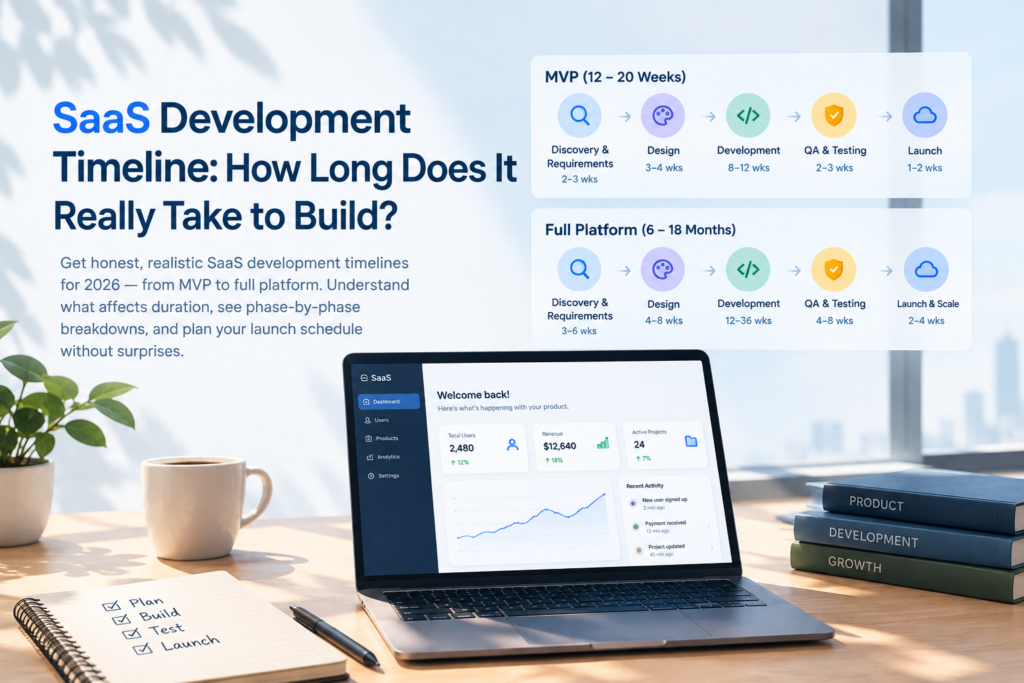
SaaS MVP Development Timeline: 12-20 Weeks for Most Products
What a SaaS MVP Includes
A SaaS MVP — the minimum version of the product that delivers real value to paying customers and enables market validation — typically includes core feature set (the single workflow that delivers the primary value proposition), user authentication and account management, basic team or organisation management, billing integration with at least one paid plan, and essential analytics. Furthermore, as Aventis Hub’s MVP development guide establishes, an MVP deliberately excludes advanced reporting, extensive integrations, mobile apps, enterprise SSO, and administrative tooling — all of which come after initial market validation.
Phase-by-Phase MVP Timeline Breakdown
| Phase | Duration | What Happens | Key Dependencies |
| Discovery and requirements | 2-3 weeks | User story mapping, technical scoping, architecture decisions | Founder availability for daily input |
| UX/UI design | 3-4 weeks | Wireframes, user flows, visual design system, prototype | Design feedback turnaround speed |
| Backend development | 4-6 weeks | API development, database, auth, billing integration | Design decisions finalised before dev starts |
| Frontend development | 4-6 weeks | UI implementation, state management, API integration | Backend API availability |
| QA and testing | 2-3 weeks | Functional testing, performance testing, UAT | Feature completeness |
| Deployment and launch prep | 1-2 weeks | CI/CD setup, cloud infrastructure, monitoring, launch | QA sign-off |
| Total MVP | 12-20 weeks | From kickoff to first paying customer | Scope discipline throughout |
Full-Featured SaaS Platform Timeline: 6-18 Months
What Distinguishes a Full Platform From an MVP
A full-featured SaaS platform extends the MVP with capabilities that enterprise customers require and that support growth at scale. Specifically, these include advanced role-based access control, enterprise SSO (SAML/OIDC), advanced reporting and analytics, public API and webhook infrastructure, multiple integration partners, mobile applications, white-labelling capability, and compliance certifications such as SOC 2. Furthermore, each of these capabilities adds weeks to months to the development timeline. Consequently, founders planning a full platform launch should expect 9-18 months from inception to general availability.
Why the Range Is So Wide
Moreover, the 6-18 month range reflects genuine variation in scope, team size, and decision-making speed — not uncertainty about how long individual tasks take. Specifically, a small team of four engineers building a focused vertical SaaS product with clean requirements and fast feedback cycles delivers an MVP in 14 weeks and a full platform in 9 months. In contrast, a larger team building a horizontal platform with multiple stakeholders, evolving requirements, and complex enterprise integrations takes 18 months for equivalent scope. Consequently, team structure and organisational decision-making speed drive timeline variation as much as technical complexity does.
The Five Factors That Extend SaaS Development Timelines
Factor 1: Scope Changes After Development Begins
Scope changes — adding features after development has started — are the single most common cause of SaaS development timeline overruns. Specifically, each unplanned feature addition competes for the same engineering capacity as planned work and lacks the design and architecture consideration that planned features receive. Furthermore, as Aventis Hub’s guide on why software projects fail establishes, scope creep accounts for the majority of budget and timeline overruns across the industry. Consequently, maintaining strict scope discipline — using a formal change control process even for seemingly small additions — is the highest-leverage timeline management technique available.
Factor 2: Delayed Feedback and Decision-Making
Furthermore, development teams need timely decisions from founders and stakeholders to maintain momentum. Specifically, design feedback that takes a week instead of a day creates a week of idle development capacity. Moreover, feature ambiguity that sits unresolved for three days while the team awaits clarification creates compounding delays as dependent work queues behind it. Consequently, founders who make themselves available for rapid decisions — ideally within 24 hours of being asked — consistently see faster delivery than those who treat development as something that happens independently of their involvement.
Factor 3: Third-Party Integration Complexity
Additionally, third-party integrations are consistently among the most difficult tasks to estimate accurately. Specifically, connecting to a well-documented API with an official SDK takes one to three days. In contrast, integrating with a legacy enterprise system through undocumented endpoints, inconsistent data formats, and limited sandbox access can take two to three weeks for what initially appeared to be a simple connection. Consequently, cataloguing and researching all required integrations before beginning development — and building generous time estimates for each — reduces integration-related timeline surprises significantly.
Factor 4: Inadequate QA Time
Moreover, QA testing is the phase most frequently compressed when projects run late — precisely the wrong response, because inadequate QA produces post-launch bug reports that consume more engineering time than thorough pre-launch testing would have required. Specifically, performance testing, cross-browser compatibility testing, and edge case scenario testing each require dedicated time that cannot be compressed below a minimum threshold without accepting post-launch quality risk. Therefore, protecting QA timeline allocation even when earlier phases run long is one of the most important timeline management decisions a founder makes.
Factor 5: Team Size and Ramp-Up
Furthermore, team size does not translate linearly into development speed. Specifically, Frederick Brooks’ observation in The Mythical Man-Month — that adding engineers to a late project makes it later — reflects a real dynamic. Moreover, new engineers require onboarding time, code review overhead increases with team size, and coordination costs grow non-linearly. Consequently, a four-engineer team with shared context typically outperforms a ten-engineer team assembled quickly for an unfamiliar codebase on a time-sensitive delivery.
Realistic SaaS Timeline by Product Type
| Product Type | MVP Timeline | Full Platform | Key Complexity Driver |
| B2B SaaS (single workflow) | 12-16 weeks | 9-12 months | Billing, RBAC, integrations |
| Marketplace (two-sided) | 16-24 weeks | 12-18 months | Two user types, payments, matching |
| AI-powered SaaS | 14-20 weeks | 10-16 months | ML pipeline, data quality, model iteration |
| Developer tool / API product | 10-16 weeks | 8-14 months | Documentation, SDKs, API design |
| Vertical SaaS (niche industry) | 12-18 weeks | 10-15 months | Domain complexity, compliance |
| Consumer SaaS | 10-16 weeks | 8-12 months | UX polish, onboarding, virality features |
How to Plan Your SaaS Launch Date Realistically
Work Backwards From the Launch Date
Specifically, start with your target launch date and subtract each phase duration, working backwards to determine when development must begin. Furthermore, add 20% buffer to each phase duration to account for the inevitable delays that empirical data shows are present in every project. Consequently, if the result means beginning development today to hit a launch date six months away, that is the correct conclusion — not a reason to compress the estimates.
Define Done Before You Start
Moreover, agreeing explicitly on what ‘launch-ready’ means before development begins prevents the common scenario where development appears complete but the product is not actually ready for paying customers. Specifically, launch-ready criteria should include: all MVP features passing QA, billing integration processing real payments, monitoring and alerting in place, customer support tooling operational, and at least three beta customers using the product without critical issues. Consequently, teams with explicit launch criteria hit their launch dates more reliably than those treating launch as an implicit shared understanding.
Plan for Post-Launch Stabilisation
Furthermore, every SaaS product experiences a post-launch stabilisation period — typically four to eight weeks — during which real user behaviour surfaces bugs, performance issues, and UX friction that testing did not catch. Consequently, scheduling engineering capacity for post-launch stabilisation before assuming the team moves entirely to new feature development is essential for launching without a crisis. For guidance on managing the development process more broadly, see Aventis Hub’s software development lifecycle guide and our piece on agile vs waterfall methodology.
Additionally, Aventis Hub provides SaaS development services with transparent timeline management — including milestone-based reporting, sprint reviews, and proactive communication when anything affects the delivery schedule. Furthermore, our custom software development cost guide covers the budget implications of timeline decisions in detail.
Frequently Asked Questions
Can a SaaS MVP really be built in 12 weeks?
Yes — with important conditions. Specifically, a 12-week MVP requires scope that has been rigorously defined and locked before development begins, a development team with prior SaaS experience working from day one, a founder available for daily feedback and decisions, and third-party integrations limited to well-documented services with official SDKs. Furthermore, teams that meet these conditions consistently deliver working MVPs in 12-14 weeks. Moreover, teams that allow scope to evolve during development or that experience slow stakeholder feedback loops typically take 18-24 weeks for equivalent scope.
Why do some agencies quote 6 months for an MVP that another quotes 3 months for?
Quote variation of this magnitude reflects genuine differences in team size, development approach, scope interpretation, and built-in contingency. Specifically, a larger team working in parallel phases delivers faster than a sequential small team. Furthermore, agencies that build in realistic contingency quote higher than those quoting optimistically to win the business. Consequently, the lowest quote is not the fastest delivery — it is often the least accurate estimate. Moreover, checking references for on-time delivery rates is more informative than comparing headline timelines across proposals.
How does a SaaS development timeline change when using AI features?
AI-powered SaaS features add complexity to development timelines in specific ways. Specifically, LLM integration requires prompt engineering, response evaluation, and handling of model errors and latency — each adding days to feature development. Furthermore, AI features require data pipelines that traditional SaaS products do not need. Additionally, AI model performance evaluation adds a testing dimension that standard QA processes do not cover. As Aventis Hub’s AI-powered application development guide explains, building AI features correctly takes longer than integrating a conventional API — but the resulting product differentiation justifies the additional investment.
| Want an Honest Timeline for Your SaaS Product?Aventis Hub provides detailed, milestone-based SaaS development timelines grounded in real project experience — not optimistic estimates designed to win the business. Book a free scoping call and get a realistic delivery plan for your specific product.Book a free consultation with Aventis Hub today -> |